Field Guide
Snowy Owl
In the winter of 2013, more Snowy Owls appeared in the lower 48 states than at any time in living memory. They turned up on rooftops in New York City, on airport runways in Chicago, on dunes along the New Jersey shore. Birders drove through the night to see them. The popular explanation - that a lemming crash had driven the owls south in desperation - turned out to be backwards. Project SNOWstorm, which began tagging birds during that event, found that most of the owls were young birds from a banner breeding year. The lemmings had been plentiful. Too plentiful. The tundra had produced so many owls that competition pushed the juveniles south. The Snowy Owl irruption of 2013 was not a disaster. It was an overflow. A white owl appearing far south of its range has long been read as an omen of change, though the truth behind it is colder arithmetic.
That inversion captures what makes Bubo scandiacus interesting. It is an owl built entirely around surplus and scarcity - an animal whose entire biology scales up and down with the fortunes of a small rodent it cannot manage, only follow.
What she looks like
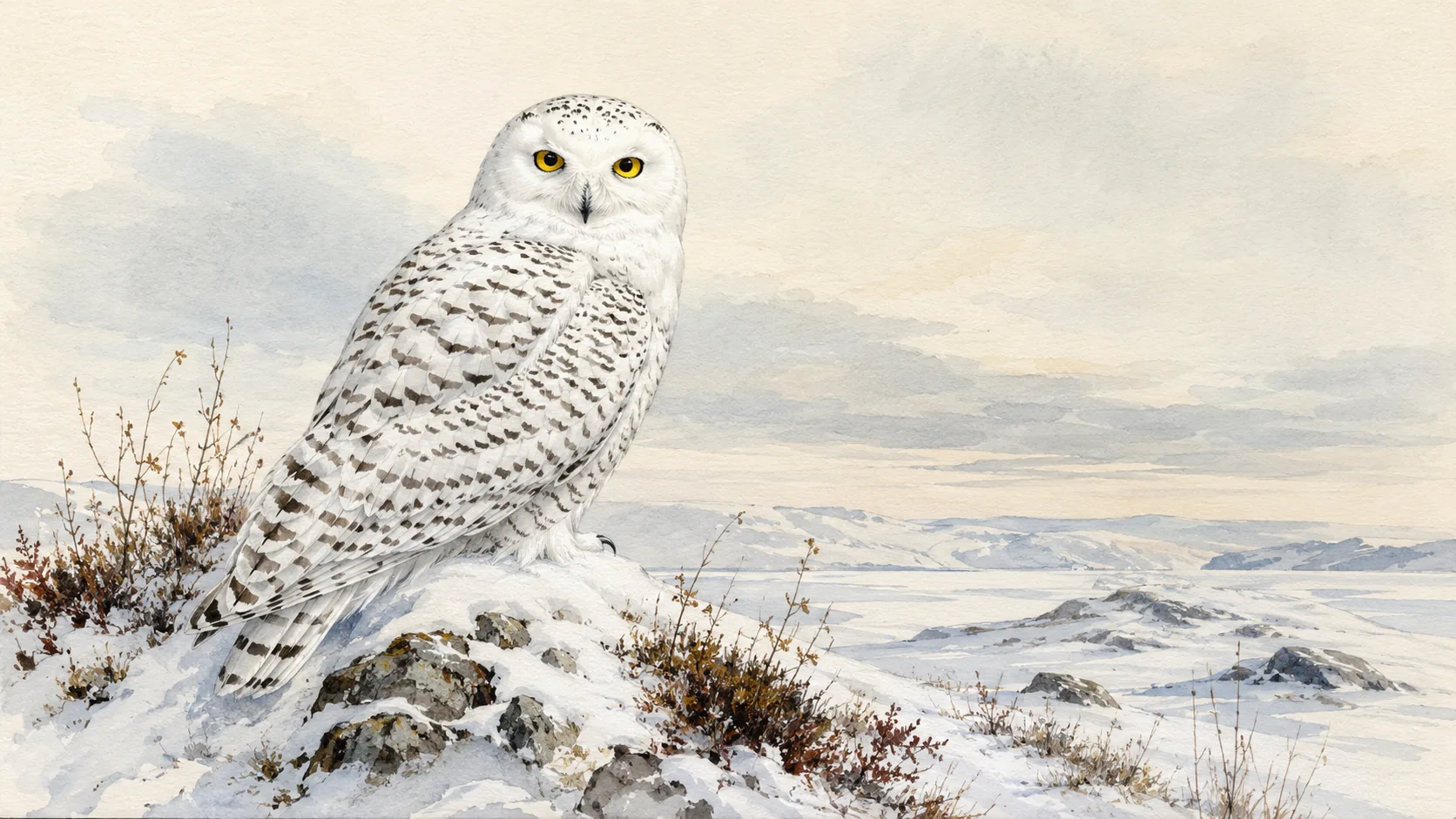
The Snowy Owl is the heaviest owl in North America. Females weigh up to 2,000 grams and measure up to 69 centimetres from bill to tail, with a wingspan reaching 164 centimetres. Males are lighter and smaller, and almost pure white. Females carry brown barring across their white plumage - heaviest on young birds, lightening but never fully disappearing with age. An old male can be nearly unblemished white; a young female is heavily streaked and may look more brown than white at a distance.
The face is round and flat, with no ear tufts. The eyes are a steady golden yellow. The bill is short, dark, almost hidden beneath white facial feathers. The feet are large, thickly feathered to the talons - an adaptation to sustained contact with frozen ground and snow-covered prey. Cornell Lab’s All About Birds notes the species weighs roughly four pounds, one pound heavier than a Great Horned Owl and twice the weight of a Great Gray Owl, despite the Great Gray’s longer body length.
In flight she is broad-winged and steady, with slow wingbeats that give little away about her speed until she closes on something.
Voice
On the breeding grounds the male calls with a deep, carrying series of hoots - a sound that travels far across open tundra. The female produces a hoarser, higher call. Away from the Arctic, at a southern winter roost, the birds are mostly silent. Cornell’s records describe croaks and shrill whistles in addition to the territorial hoot, but outside of breeding season the Snowy Owl is one of the quieter large raptors.
Range and the year’s movement
The breeding range is circumpolar - northern Alaska, northern Canada, Greenland, Scandinavia, and across Siberia. The species holds the most northerly breeding and wintering distribution of any owl. In lean years some individuals remain in the Arctic through winter darkness, hunting on open water and sea ice where seabirds and small mammals remain accessible. Most move south to the prairies and open agricultural land of southern Canada and the northern United States.
In irruption years - years following high lemming production when large cohorts of young owls are pushed off the breeding grounds by competition - the birds appear far south of their normal winter range: the Great Lakes, the Atlantic coast, occasionally the mid-Atlantic states. The Audubon Society’s field records show that irruption years have brought birds as far south as the central United States and, occasionally, to the Gulf Coast.
These irruptions are not predictable by calendar. They track the four-year lemming cycle, which is itself driven by vegetation growth, predator pressure, and Arctic weather systems. The owl follows the prey population, and the prey population follows the tundra.
Diet
Lemmings are the anchor of the diet. A Snowy Owl can consume more than 1,600 lemmings in a single year, according to Cornell Lab’s All About Birds. On the breeding grounds in high-lemming years, some nests are stocked with uneaten lemmings - a larder the female pulls from when the male cannot deliver fast enough. A paper published in Diversity (2025) examining 30 years of breeding data from Utqiagvik, Alaska, confirmed that Snowy Owls at that site are effectively obligate lemming predators during the breeding season: if lemmings are scarce, the owls do not nest.
Away from the breeding grounds the diet broadens. She takes rabbits and hares, waterfowl, shorebirds, and occasionally fish. She hunts by watching from a low perch - a fence post, a pressure ridge in the ice, a beach dune - then pursuing prey in direct low flight. Unlike most owls, she hunts in full daylight, a necessity in an Arctic summer that never gets dark and a practical advantage on winter prairie where dawn and dusk hunting would be too brief.
Breeding and nesting
The Snowy Owl nests on open tundra, on raised ridges, rocky outcrops, or any elevated ground with a clear sightline. There is no nest structure beyond a shallow scrape in the soil or snow. The female incubates eggs that are laid in May or June, beginning before the clutch is complete, so that eggs hatch asynchronously and chicks span a wide range of ages and sizes within one brood.
Clutch size scales almost directly with prey abundance. In a lean year the pair may not attempt breeding at all. In a good lemming year the clutch can run to 11 eggs and occasionally beyond that. Birds of the World at Cornell Lab records clutches of up to 14 to 16 eggs in exceptional seasons. The female stays with the young; the male hunts and delivers prey, which the female tears up and feeds to the chicks. Young birds fledge around seven weeks but depend on parental feeding for another two to three weeks.
The breeding season lasts roughly four and a half months, compressing everything - courtship, incubation, rearing, and fledging - into the brief Arctic window before freeze-up.
The lemming problem
Here is the position worth stating plainly: the Snowy Owl’s future is not in its own hands.
The IUCN lists Bubo scandiacus as Vulnerable, upgraded from Least Concern in 2017. The underlying data, assessed by BirdLife International and confirmed by the International Snowy Owl Working Group, show that breeding populations across the Arctic have declined by more than 30 per cent over three generations. A 2022 genetic study found the species is a single genetically continuous population across the circumpolar Arctic, which means population declines in one region are not compensated by immigration from another.
Climate change is altering the Arctic tundra - shrub cover is expanding, snowpack timing is shifting, and lemming cycle amplitude may be dampening in some regions. If the lemming cycles flatten, the owl’s boom years disappear with them. The species can handle scarcity - it evolved in a system built on scarcity. What it may not handle is a permanent reduction in the peaks.
The oldest known Snowy Owl on record was a female recaptured during banding operations in Massachusetts in 2015, at least 23 years and 10 months old - a bird born under one lemming cycle, surviving through many more, eventually landing on the human coast in a year the lemmings were too numerous to count.