Field Guide
Common Buzzard
A wet morning in mid-April on the Shropshire hills. A buzzard walks across a grazed field with the slow, deliberate tread of something that is in no particular hurry - head down, pausing, stepping, picking. It is collecting earthworms that have surfaced after overnight rain. For a bird with a 120-centimetre wingspan, the scene has an almost comic domesticity to it. It looks less like a bird of prey than a man in a library checking the floor.
This is Buteo buteo - the Common Buzzard - the bird that most people in Britain see first and most often when they think they’ve spotted an eagle, and the bird that ornithologists have watched quietly stage one of the most complete raptor recoveries in European history.
The thesis here is simple: the buzzard is a more interesting bird when you understand what it survived than when you study what it eats. It is a generalist, an opportunist, a bird that can walk a field for worms on Tuesday and soar 200 metres up on a thermal on Wednesday. That adaptability is what nearly killed it, and what saved it.
What it looks like
The Common Buzzard measures 40 to 58 centimetres from bill to tail, with a wingspan of 109 to 140 centimetres. Weight runs from 427 grams in a small male to 1,364 grams in a large female - females are consistently heavier. The BTO records an average weight for British birds of around 781 grams in males and 969 grams in females.
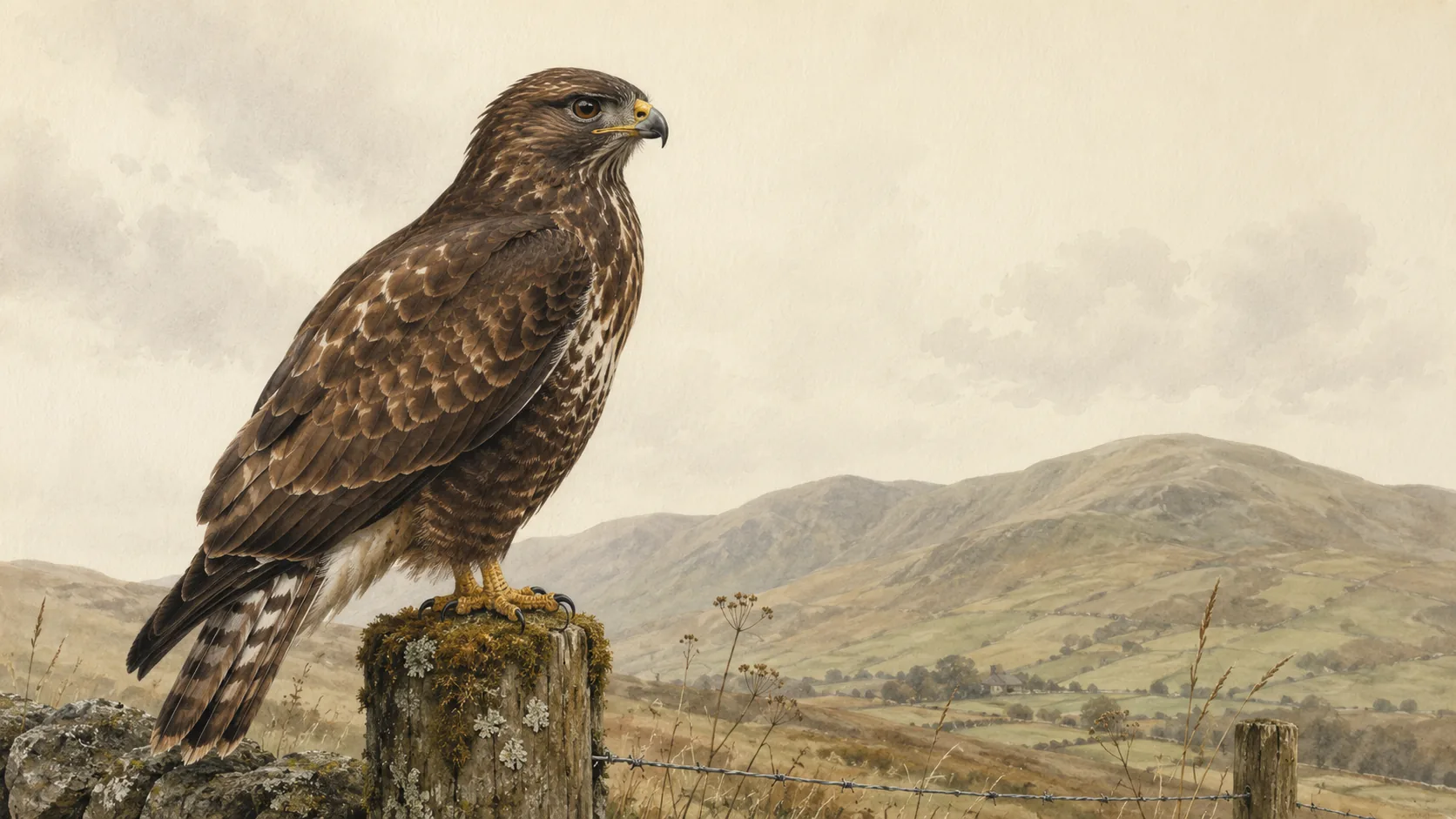
Plumage is famously variable - more so than almost any other European raptor. The typical bird is dark brown above, with a pale band across the breast contrasting against a streaked belly, and a banded, finely barred tail. The primaries darken to near-black at the wingtips. Some individuals are almost uniform chocolate brown. Others show extensive white on the underparts, with only dark carpal patches and trailing edges marking them out. A few are almost white. This variability has confused generations of beginners, and it is worth saying plainly: if you are in Britain and the soaring brown-ish raptor has broad rounded wings held in a shallow V and a short square tail, it is almost certainly a buzzard.
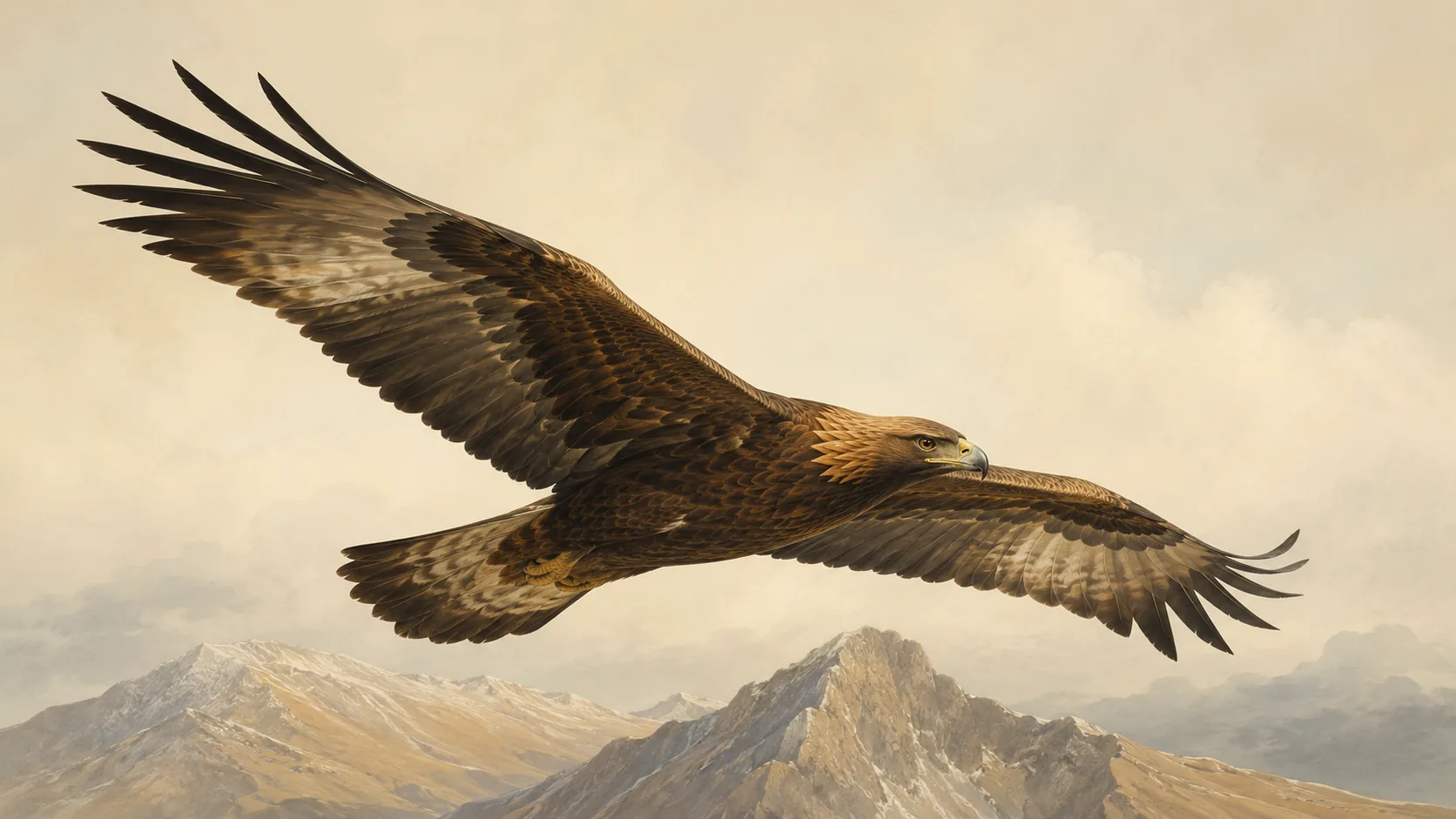
The face is small and pale, giving it a slightly surprised expression at close range. The cere and legs are yellow. The bill is grey, curving to a dark hook. In flight, the wings are typically held in a gentle V - not as pronounced as a Red Kite, but more lifted than a flat-winged Golden Eagle.
Voice
The call carries further than the bird is visible. A far-reaching, plaintive pee-yow - sometimes transcribed as a cat-like mewing - delivered while soaring in display or when alarmed near the nest. Pairs call to each other in flight during courtship. The RSPB notes that the call can be mistaken for a cat, which is an accurate description once you hear it and will never leave you.
Range and habitat across the year
The buzzard is a year-round resident in Britain and Ireland. The BTO records it as widespread across Britain, with breeding now confirmed in the eastern half of Ireland as well. Its British breeding range has expanded by 89 per cent since 1968 to 1972, a figure the BTO published in its breeding bird surveys - one of the largest documented range expansions of any UK bird of prey in the modern recording era.
Preferred habitat is a combination of woodland for nesting and open ground for hunting. The Woodland Trust describes the ideal territory as “woodland, farmland and moorland” - which in practice means most of the British countryside. Buzzards nest in woodland at around two-thirds of the way up a mature tree, near a clearing or woodland ride, and then hunt the surrounding farmland, moorland edge, and rough pasture. They can adapt to suburban areas where mature trees exist. On motorway verges across the Midlands, they are now a commonplace sight on fence posts or sitting on roadkill.
Diet
Small mammals dominate, particularly field voles - the BTO and research published in various ornithological journals suggests small mammals can account for 60 to 80 per cent of diet in productive areas. Rabbits matter significantly too, especially young rabbits in spring, and the expansion of rabbit populations since myxomatosis controls weakened is one of the factors credited with supporting the buzzard’s recovery in eastern England.
The earthworm habit is real and distinctive. After heavy rain, buzzards walk across fields in a slow foraging pattern, taking worms that have come to the surface. They also take beetles, large insects, and amphibians opportunistically. In winter, carrion and roadkill fill dietary gaps. The RSPB notes they are “often found feeding on carrion” through colder months when live prey is harder to locate.
This is not a specialist’s diet. It is a scavenger’s portfolio, assembled around whatever the season provides.
Breeding and nesting
Buzzards pair for life. Both the Woodland Trust and the BTO record mate fidelity across multiple seasons. Courtship in late winter and early spring involves aerial display - the male performs a “rollercoaster” flight, rising and falling on closed wings in repeated arcs above the territory. Pairs also soar together, calling.
Nests are large stick platforms built in a tree fork, typically at woodland edge. They are added to in successive years and can become substantial structures. Both sexes build. The clutch runs to two or three eggs, with incubation of around 34 to 35 days, led primarily by the female. The BTO records fledging at 44 to 52 days. One brood per year. Young are fed by both parents after fledging, remaining dependent for several weeks before dispersing.
Territories are defended throughout the year. In Snowdonia, research recorded a mean nearest-neighbour distance between nests of 1.95 kilometres. On prey-rich lowland farmland, pairs can nest closer.
The recovery and what it cost
By the mid-nineteenth century, systematic persecution by gamekeepers on shooting estates had pushed the buzzard to the western margins of Britain - Wales, western Scotland, the Lake District. The logic was straightforward and wrong: buzzards were presumed to take pheasant poults and were killed accordingly. Estate records from that period document the scale of it.
The First World War reduced persecution as gamekeepers enlisted. Numbers partially recovered. The Second World War reduced it again. The post-war years brought pesticides, which accumulated through the food chain and suppressed breeding success in the 1950s and 1960s. The legal protection that came with the Protection of Birds Act 1954 and the Wildlife and Countryside Act 1981 combined with the reduction of organochlorine pesticides to give the buzzard the space it needed.
Cornell’s Birds of the World and the BTO both note that the population expansion since the 1970s has been one of the more studied examples of raptor recovery in Europe. The IUCN lists the species as Least Concern with a stable and increasing population. Current estimates run to over 70,000 breeding pairs in Britain alone.
The irony is that the buzzard’s generalism - the quality that made gamekeepers nervous about it - was also what made the recovery possible. A bird that eats voles, rabbits, earthworms, beetles, and carrion does not need a single prey base to remain intact.
The behaviour worth watching
The earthworm walk. When a field has been soaked overnight, or freshly ploughed, or cut for silage, look for a buzzard moving across it on foot in a measured, deliberate stride. This is a large raptor doing something that looks nothing like predation: patient, slow, systematic. It picks up individual worms with a quick stab. It is collecting, not hunting.
The BTO notes this ground-foraging is a regular and documented behaviour, not an aberration. A buzzard that walks a field for worms in the morning will be on a fence post watching for voles by noon and soaring the thermals by early afternoon. It runs all its strategies simultaneously, shifting between them as conditions change.
That is the real story of the Common Buzzard. Not a specialist that excels at one thing, but a generalist that cannot be broken by the failure of any single strategy. The gamekeepers understood this as a threat. The ornithologists understand it as an ecological argument for flexibility over mastery. The buzzard has not formed a view on the debate. It is walking the field.