Field Guide
American Kestrel
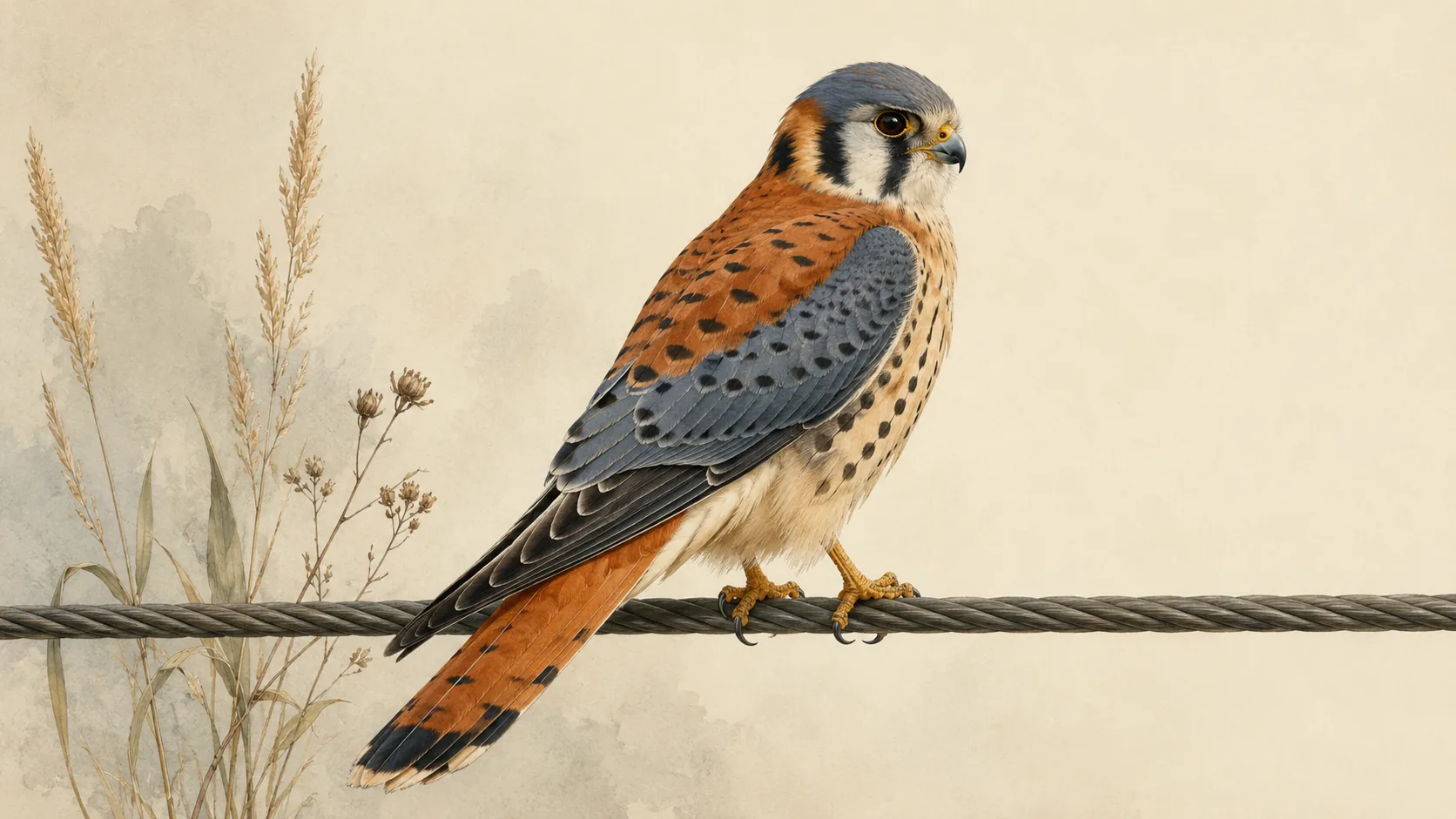
Drive almost any country road in summer, anywhere from the Yukon to Patagonia, and sooner or later you will pass a small falcon sitting bolt upright on a wire. Rufous back, a long tail, a head marked like a circus poster. It is watching the verge. When something moves in the grass below, it drops.
This is the American Kestrel, and it is the most widespread falcon in the Americas. It is also one of the smallest raptors most people will ever see, barely the bulk of a Mourning Dove, and it carries a piece of equipment that no human possesses. It can see ultraviolet light. Voles mark their runways with urine, and that urine fluoresces in the ultraviolet. To a hovering kestrel the meadow is not a uniform green blur. It is a network of glowing paths, each one leading to the animal that made it.
What he and she look like
The American Kestrel is one of the few raptors where a glance tells you the sex, because the two sexes are coloured differently from the day they fledge. Cornell’s Birds of the World records this sexual dimorphism as present even in juveniles, which is unusual among birds of prey.
The male carries slate-blue wings over a rufous back, with a rufous tail finished in a single broad black band near the tip. The breast is washed pale buff and flecked with black. The female is rufous on both back and wings, the whole upperside barred across its length with fine black bars rather than the male’s clean blue.
Both sexes wear the same striking head. A pale, almost white face is crossed by two vertical black marks, often called sideburns or moustache stripes, that frame the cheek. And on the nape, on the back of the head, sit two black spots ringed in pale feathering. They look uncannily like a second pair of eyes. The leading explanation, noted by Audubon, is that these false eyespots are not aimed at predators above but at the prey below, a small mammal glancing up to find it is apparently being watched from behind as well as in front.
In silhouette the kestrel is a slim falcon with long, pointed wings and a long tail. Females run slightly larger than males, a reversal of the usual songbird pattern but standard among raptors. Cornell Lab gives the species a length of 22 to 31 centimetres and a wingspan of 51 to 61 centimetres, with weights from around 80 grams in a small male to 165 grams in a large female.
What it sounds like
The voice does not match the elegance of the plumage. The common call is a shrill, rapid killy-killy-killy, sometimes written klee-klee-klee, delivered in a hard excited series when the bird is agitated, alarmed, or defending a nest. It is a sound you learn to recognise from a moving car: a sharp ringing chatter from a roadside pole before you have even located the bird.
Audubon and Cornell both describe a small set of additional calls, a whine and a chitter, used in courtship and close contact between mates. But the killy series is the signature, and it is loud out of all proportion to a bird this size.
Range and habitat
No other falcon in the Americas covers as much ground. The American Kestrel breeds from Alaska and across Canada south through the whole of the United States, Mexico and Central America, and on down through South America to Tierra del Fuego at the continent’s tip. Across that vast spread the pattern of movement splits by latitude. Northern populations are migratory, withdrawing south as prey becomes scarce in winter. Birds in the milder middle and south of the range are largely resident year-round.
The habitat is consistent even where the geography is not. The kestrel is a bird of open and semi-open country: grassland, farmland, desert, forest clearings, roadsides, and increasingly the mown edges of towns and cities. What it needs is open ground to hunt over and a raised perch to hunt from. A fence wire, a dead branch, a telephone pole, a tall weed. The bird supplies the patience.
Diet
The American Kestrel is built for small, abundant prey. In the warm months the diet leans heavily on large insects, and Audubon singles out grasshoppers as a favoured food, alongside beetles, dragonflies, cicadas and moths. It also takes small mammals, principally voles and mice, along with small birds and lizards, and these vertebrate meals matter most in winter when insects vanish.
The hunting is done two ways. The first is the still-hunt: the bird sits on a perch, watches the ground, and drops onto whatever it sees. The second is the one that makes the kestrel unmistakable. Where there is no perch, it will hover. It hangs in the air on fast, shallow wingbeats, tail fanned and head locked dead still against the wind, holding one patch of ground in perfect focus before folding and dropping. It is here that the ultraviolet vision earns its keep, the glowing vole-runs of the meadow resolving into a map of where the food is.
Breeding and nesting
For a falcon, the kestrel nests in a strange way. It is a cavity nester, and falcons as a family do not excavate. So the kestrel depends entirely on holes it did not make: old woodpecker holes, natural tree hollows, crevices in cliffs, and nooks and cavities in buildings and other structures. Cornell Lab notes that the species takes very readily to nest boxes, which is the single most useful fact a person can know about helping it.
The female lays four to five eggs and does most of the incubation, which Cornell Lab puts at roughly 26 to 32 days. The young leave the nest at about 28 to 31 days old. In good conditions a pair may raise more than one brood in a season, and Birds of the World records as many as four clutches taken from a single wild pair across a year. The oldest known wild American Kestrel, a male, was at least 14 years and 8 months old when found in Utah, banded in the same state in 1987.
The decline worth watching
There is a shadow over all of this. The American Kestrel is the continent’s most familiar falcon, and it is quietly disappearing. The North American Breeding Bird Survey, as reported by Cornell Lab, records a decline of about 1.41 per cent a year between 1966 and 2019, a cumulative loss of roughly 53 per cent. Partners in Flight estimates the global breeding population at around 9.2 million. The IUCN still lists the species as Least Concern, because the numbers remain large and the range remains immense, but the trend line bends the wrong way.
The causes are not fully understood, which is part of what unsettles researchers. The clearest pressures are habitat related: the felling of the standing dead trees the bird relies on for nest holes, and the tidying of farmland, the removal of hedgerows, brush and rough margins that once held both prey and cavities. Pesticides and the loss of large insect prey are also under scrutiny.
The American Kestrel is the falcon hiding in plain sight on the wire above the road, and it is slipping away while we watch the bigger birds.
This is where the nest box returns to the story. A bird that will accept a wooden box on a pole in open country is a bird people can directly help, and across North America kestrel nest-box trails have become one of the more hopeful responses to a decline that no one fully explains. The kestrel on the wire is not a rare bird. The work now is to make sure it stays that way.