Field Guide
Common Eider
A raft of a hundred Somateria mollissima rolls in a January swell off the coast of Maine, the drakes so boldly patterned - white backs, black bellies, pale green napes - that they look less like living birds than pieces cut from a heraldic crest. They dive, one after another, without ceremony. Sixty feet down, among the mussel beds, their gizzards are already at work.
That image - the plunging, crushing, surfacing, diving again - is the engine of a bird that has sustained whole Arctic economies. The Common Eider is the largest duck in the Northern Hemisphere. It is also, if you have ever slept under a good duvet in a cold room, the bird that kept you warm.
What it looks like
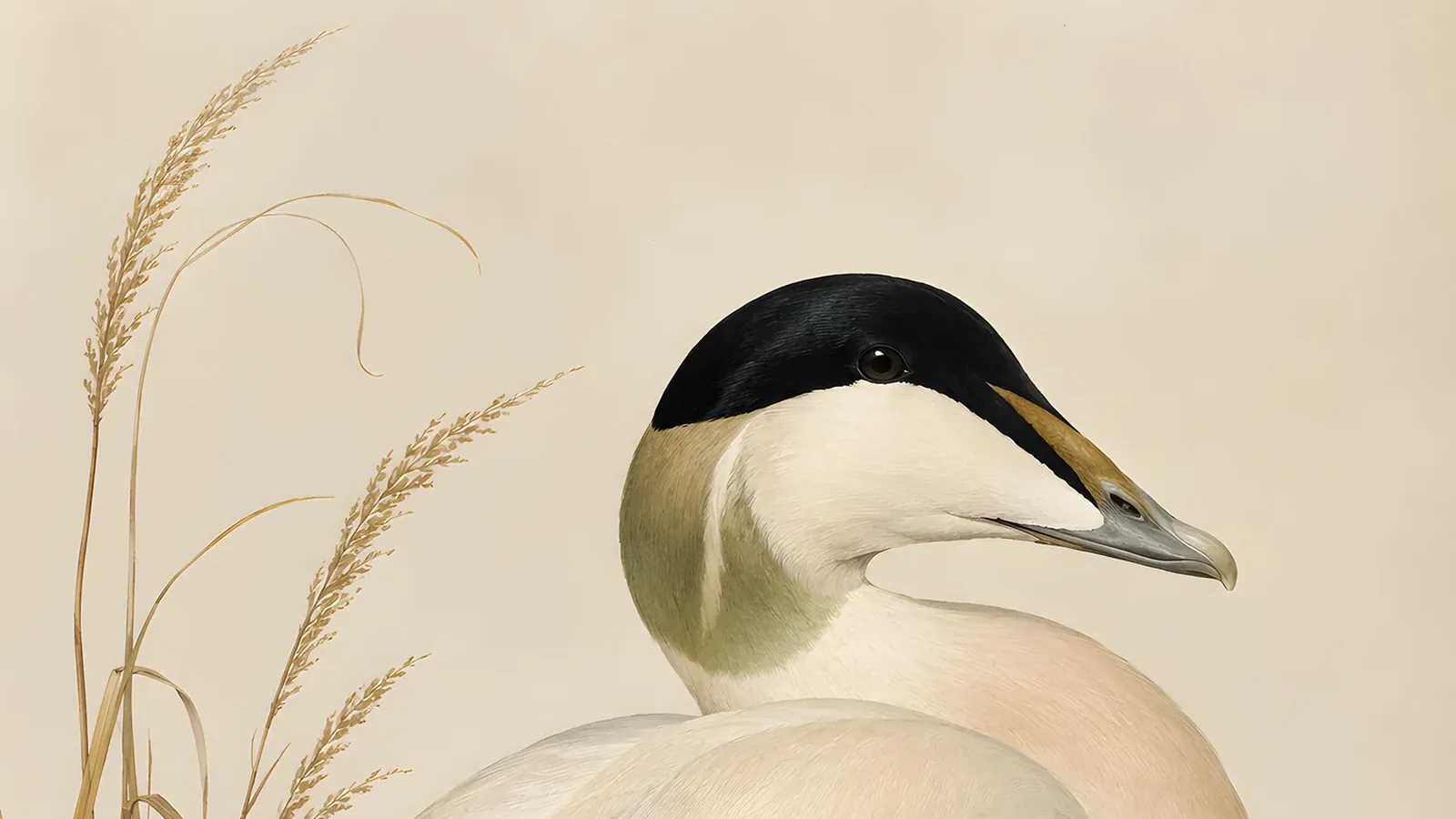
The adult male in breeding plumage is one of the more arresting combinations in North American waterfowl. His back and breast are white - a flat, paper-white that reads clean against grey winter water. His belly, flanks, and tail are deep black. His head is white above, with a cap of black that meets the bill like a mask. The back and sides of the neck carry a wash of pale sea-green, the one soft note in an otherwise graphic palette. The bill itself slopes back from the tip in a long, low wedge - a distinctive profile that distinguishes the eider in silhouette from any dabbling duck, even at distance.
The female is a different study entirely. She is warm brown throughout, closely barred with darker brown on the flanks and back. The patterning is precise and detailed - not the streaky browns of a mallard but a finely crosshatched surface, almost like tooled leather. She is large and heavy-bodied, 50 to 71 centimetres long and weighing between 810 and 3,025 grams (the wide range reflects seasonal variation and geographic subspecies). The wingspan runs 80 to 110 centimetres. Both sexes share that long, sloping bill and the heavy, forward-leaning posture of a duck designed for the sea rather than a pond.
| Measurement | Range |
|---|---|
| Length | 50-71 cm |
| Weight | 810-3,025 g |
| Wingspan | 80-110 cm |
| Wild lifespan | Up to 20 years |
| IUCN status | Near Threatened (NT) |
Young males pass through several intermediate stages before reaching adult plumage at around three years - piebald, dark-headed, white-chested arrangements that can puzzle observers used to the clean adult pattern.
The down
In early June on a rocky Icelandic island, a female Common Eider sits tight on four eggs in a hollow she has lined herself. What lines it is not plant material gathered from the surrounding vegetation. It is her own breast. Beginning when she lays her first egg, she plucks the soft inner down from her own chest - fine, grey, extraordinarily light fibers - and arranges them around and over the clutch. She loses condition steadily through the 25 days of incubation, eating almost nothing, giving up her warmth and her insulation simultaneously.
She does not eat. She does not leave willingly. She gives the eggs everything she has - and what she has, it turns out, is the warmest natural insulating material on earth.
The microstructure of eider down is what makes it exceptional. D’Alba and colleagues (2017, Journal of Avian Biology) compared plumules from Icelandic eider nests against greylag goose down and found that eider barbules are longer and create stronger cohesion between feathers, trapping more still air per gram than any other natural fiber tested. That cohesion - the way eider down clings to itself rather than shifting in clumps - is a structural property of the feather’s microscopic hooks. It cannot be replicated by domestic goose or duck down, and has not been successfully synthesized.
Icelandic farmers understood this long before it was measured. The eider has been protected by law in Iceland since 1847, and the practice of down collection predates that protection by roughly a millennium. Eider farmers build windbreaks, lay out nesting shelters, and guard colonies against foxes and ravens throughout the breeding season. In exchange, once the ducklings have left for the sea - typically in late July - the farmers collect the down-lined nests. Each nest yields perhaps 15 to 20 grams of usable down. It takes the material from roughly 60 nests to fill a single duvet. Worldwide, only around 4,000 kilograms of eiderdown is collected in a year, of which approximately 3,000 kilograms comes from Iceland. The birds are never touched or harmed. The down has already served its purpose for the ducklings.
The female’s self-sacrifice is not incidental to this. It is the point. The down is not incidentally warm - it evolved to maintain egg temperature in sub-zero coastal conditions. The fact that it also happens to be the finest insulating material available to human textiles is a coincidence of function and physics.
Diving for mussels
Outside the breeding season, the eider is almost entirely a creature of the sea. It favors shallow inshore waters - rocky coasts, tidal shoals, kelp beds - where it dives to depths generally between 10 and 20 metres to work the bottom. The primary prey is the blue mussel (Mytilus edulis), though the bird takes clams, scallops, crabs, sea urchins, and other invertebrates as available.
It swallows mussels whole. The crushing happens internally, in a gizzard that ranks among the most powerful of any duck. Guillemette (1998, Functional Ecology) showed that the eider manages the energetic cost of digestion carefully: smaller mussels, which require less crushing time, are selected preferentially when dive time is limited. The gizzard itself changes mass seasonally - a female’s gizzard can nearly quadruple in mass between the reproductive season and pre-breeding, when mussel consumption is at its highest. The shell fragments pass through. The soft tissue does not.
Feeding is communal. A raft of eiders will work a mussel bed together, diving in loose synchrony, the birds returning to the surface, resting briefly, diving again. On a calm morning the sound of them - a rolling, splashing churn punctuated by the occasional call - carries easily across the water.
What it sounds like
The male Common Eider produces one of the more evocative sounds in coastal birding: a deep, hollow cooing moan that rises slightly in pitch, something close to a slurred ah-ooo. It is often written as a sigh. On still winter days it carries long distances across flat water - an oddly warm sound from a duck sitting in cold grey chop. Males call most persistently during courtship display, when groups of them posture and call around a single female.
The female’s calls are lower and less carrying - a throaty, repetitive gog-gog-gog when she is feeding or tending young. Both sexes produce a harsher alarm note. The male’s cooing moan is distinctive enough that experienced observers can identify a raft of eiders by sound alone before they are close enough to see the plumage.
Range and habitat
Somateria mollissima has a circumpolar distribution, breeding along Arctic and subarctic coastlines across the Northern Hemisphere. In North America, breeding colonies extend from the Aleutian Islands and the coasts of Alaska east across northern Canada, Greenland, and Iceland, south to the coast of Maine - the only state in the lower 48 where they regularly nest. European birds breed from the British Isles north through Scandinavia to the White Sea and Siberia. Northern populations are migratory. Southern breeders, including those in Iceland and the British Isles, are largely resident year-round.
The American subspecies, S. m. dresseri, concentrates heavily in Maine in winter. The Pacific subspecies, S. m. v-nigrum, nests on the North Slope of Alaska and winters primarily in northeast Asia. The IUCN lists the species as Near Threatened globally, reflecting declines in certain regional populations - particularly in the Baltic, the Wadden Sea, and eastern North America - even as Arctic populations remain large. Overharvesting of mussels, oil spills, and climate-driven changes to prey availability are the principal threats identified in the most recent IUCN assessment.
Habitat is almost always coastal. The eider rarely uses fresh water outside the breeding season, and even at the nest it stays close to salt or brackish shoreline. Rocky islands without mammalian predators are preferred nesting sites. In winter, the birds aggregate in rafts that can number in the thousands on favored inshore grounds.
Breeding
Pair formation happens over winter and early spring. Males court females in groups, arching their necks, raising their heads back toward their shoulders, and delivering that cooing moan repeatedly. The female chooses her mate but the bond, as with most ducks, lasts only for the season. Goudie, Robertson, and Reed (2020, Birds of the World) note that some populations show longer-term pair bonds than others - the variation between colonies is real and not fully explained.
Females show strong nest-site fidelity, returning to the same location in successive years - in some cases to the same hollow. The nest itself is a shallow depression that she lines with plant material and then, progressively, with down as laying proceeds. Clutch size is typically three to five eggs, olive-green and unspotted. Incubation lasts 24 to 25 days, carried out entirely by the female, who does not leave the nest to feed. Males depart the breeding colony shortly after laying begins.
Once the ducklings hatch they are led to water quickly - often within hours. Females with ducklings frequently amalgamate into larger creches supervised by a few adults, a behavior that may reduce predation risk. The young are capable of diving from an early age but depend on food close to the surface initially, building toward the deep-diving that defines adult life.
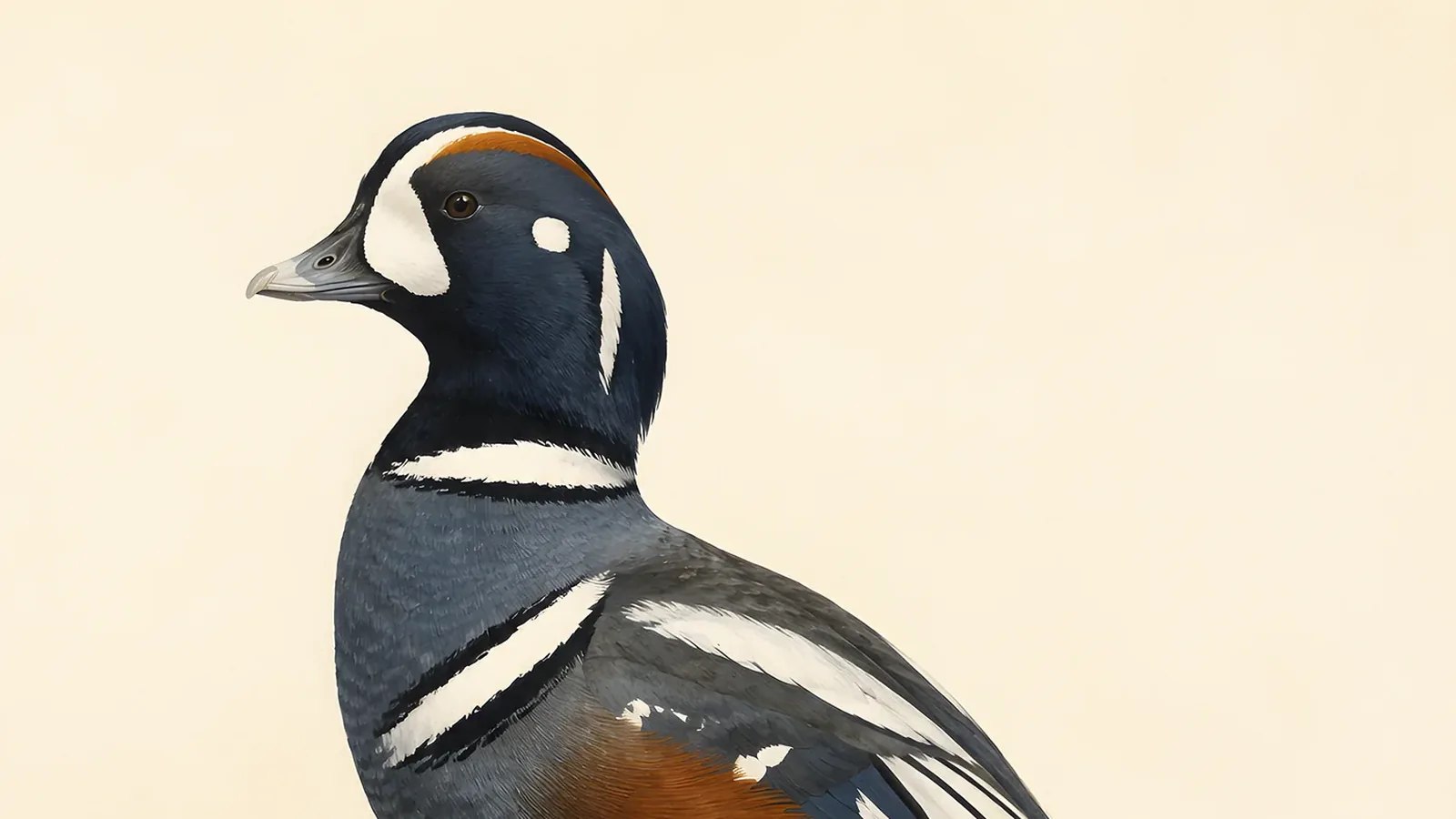
The harlequin duck shares the eider’s preference for cold, turbulent coastal water and comparably bold male plumage - though the harlequin trades black-and-white severity for a complex pattern of slate blue, chestnut, and white. Where the eider is a bird of open sea and mussel beds, the harlequin favors rushing rocky rivers in summer and exposed surf zones in winter. Both are among the most specifically marine-adapted ducks in the Northern Hemisphere.
Somateria mollissima is at its core a cold-water specialist so precisely tuned to its environment that its own body becomes part of the nesting architecture. The female does not merely build a nest. She builds it from herself. The down she plucks to warm her eggs will, in an Icelandic spring, be gently gathered by a farmer who has spent the season keeping foxes away from her colony. She will grow it back. She will return next year. The partnership is older than any institution either party could name.