Field Guide
Colima Warbler
You hear it before you see it. Somewhere in the oak canopy above Boot Canyon, a short trilled phrase drops then lifts at the end, nothing flashy, and you stop walking. The voice belongs to Leiothlypis crissalis, the Colima Warbler - a bird so plain and so particular in where it lives that it has become one of the more coveted sightings in all of North American birding. Not because of its colours. Because of its address.
What it looks like
The Colima Warbler rewards honest looking rather than a quick scan.
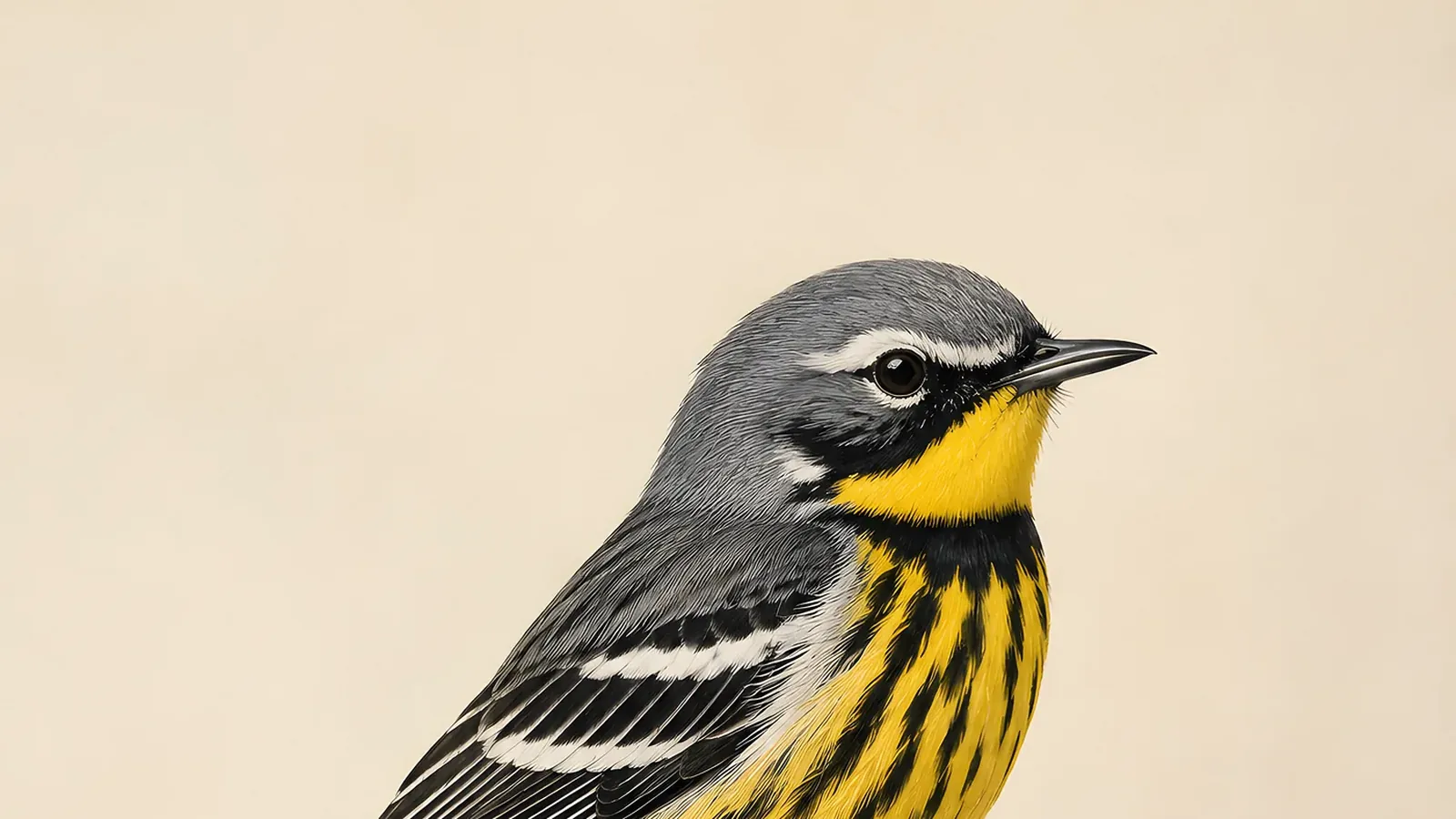
The body is grey-brown throughout - the back, the crown, the sides of the breast. There is a small chestnut cap on the head, easy to miss unless the bird turns toward you. A crisp white eye-ring sits cleanly against the grey face. The throat and belly are pale, almost off-white, with a buff wash along the flanks. None of this is showy.
Then the tail end: a yellow rump and undertail coverts that flash whenever the bird pumps its tail, which it does often. That mustard-to-ochre patch is the field mark that closes the identification. The scientific epithet crissalis takes its name from the crissum, the feathered region around the vent, and the Colima’s crissum is precisely what catches the light in a dark canyon.
| Feature | Detail |
|---|---|
| Length | 13 - 15 cm |
| Weight | 11 - 17 g |
| Wingspan | 18 - 20 cm |
| Crown | Chestnut patch |
| Eye | White eye-ring on grey face |
| Rump and undertail | Yellow to ochre |
| Underparts | Pale grey-white, buff flanks |
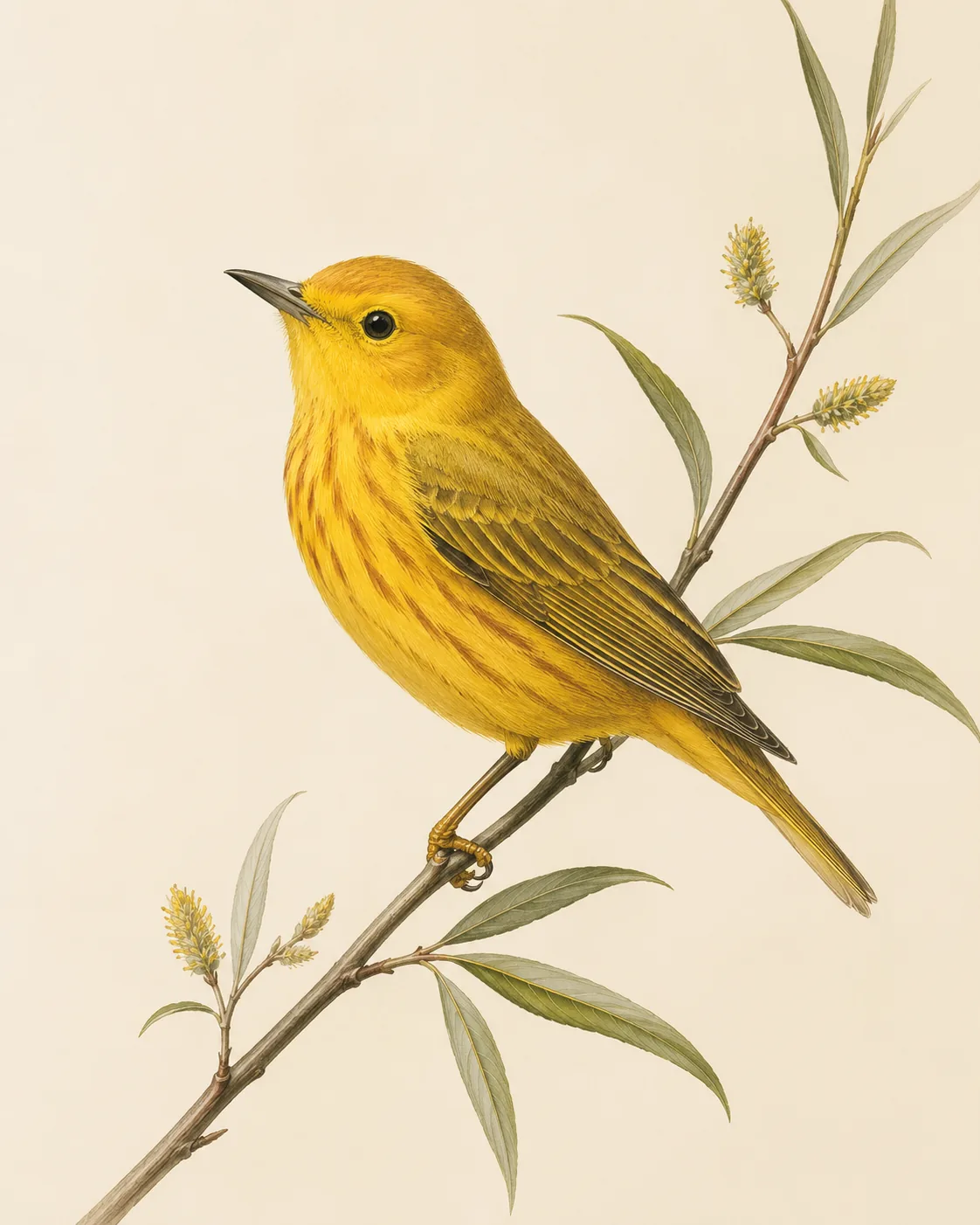
Compare it to the yellow warbler and you understand the difference immediately. The yellow warbler is all warm colour. The Colima looks as though it was made to disappear in the duff and shadow of a high-elevation canyon, which is more or less exactly what it does.
One mountain in Texas
The entire United States breeding range of the Colima Warbler is, for practical purposes, one place: the high Chisos Mountains inside Big Bend National Park in west Texas.
This is not quite an exaggeration. The species breeds through the Sierra Madre Oriental of northeastern Mexico, but on the American side it reaches no further than these mountains in the Chihuahuan Desert. The first U.S. specimen was collected on 20 July 1928 by Frederick M. Gaige in Boot Canyon in the Chisos Basin. Four years later, in 1932, the ornithologist Josselyn van Tyne of the University of Michigan led the expedition that found the first confirmed nest - a discovery he published in 1936 in the Miscellaneous Publications of the Museum of Zoology (University of Michigan). That nest, a ground cup tucked under leaf litter on a canyon slope, established that the United States had a breeding population of a warbler most American birders had never seen.
Censuses conducted between 1967 and 1996 counted between 42 and 83 pairs in the Chisos Mountains. A second small population of roughly 26 pairs was found in 1996 in a separate canyon area. The National Park Service has monitored territories in a five-year rotation since 1967, using as many as 35 citizen scientists to walk survey routes from Green Gulch to Boot Canyon.
Because the bird is accessible to anyone willing to hike - and because it is found nowhere else in the United States - it draws listers from across the continent. The typical approach is a loop of roughly 16 km ascending from the Chisos Basin Trailhead through Laguna Meadows, along the Colima Trail, through Boot Canyon, and back down via the Pinnacles Trail. The elevation gain carries the hiker from around 1,650 m at the basin to over 2,100 m at the canyon rim. That climb is the price of admission.
“Its U.S. presence is confined to only one National Park and that too to a handful of trails in the Chisos Mountains area.” - Digital Plume Hunter, 2014
The remoteness of the habitat has probably shielded the species from the pressures that have damaged lowland woodland birds across Texas. The Colima is listed as Least Concern by the IUCN, and the Chisos population has remained broadly stable across decades of monitoring.
What it sounds like
Males arrive in the Chisos Mountains in mid-March and begin singing by early to mid-April. The song is a short trill - roughly 1.5 seconds - that often ends with one or two downslurred notes. Some individuals deliver a monotonous single-note trill on a steady pitch. Others split their song into two parts, pairing a higher run with a lower closing phrase. The Audubon Field Guide renders it as a “musical seedle-seedle-seedle, sweet, sweet,” comparing it loosely to Virginia’s Warbler.
Singing males broadcast from the oak canopy before the leaves are fully out, which makes them easier to locate by voice than by sight. The call is a sharp, dry chip, similar to what many warblers use as a contact note. After the first leaf flush, the bird drops lower and quieter, and you need to slow down and work the understorey.
Range and habitat
Outside the Chisos Mountains, the Colima Warbler is a bird of the Sierra Madre Oriental - the long north-south mountain spine of northeastern Mexico. It winters along the Pacific slope of Mexico, from Sinaloa south to Oaxaca, returning to breeding grounds in April and departing mostly by August and September.
In the Chisos, breeding habitat occupies a band between roughly 1,500 and 2,300 m. The Texas Breeding Bird Atlas describes it as mixed oak, Mexican pinyon, juniper, and Arizona cypress - but the character of the preferred spots is more specific than a plant list suggests. Look for north-facing canyon slopes where the canopy is closed enough to hold moisture and the ground layer accumulates deep leaf litter. These are places that feel anomalous in the Chihuahuan Desert: cool, shaded, almost humid when the summer monsoon has been generous. The bird belongs to the high Mexican sierra, and the Chisos are a high Mexican sierra that happens to sit inside a Texas park.
Diet
Colima Warblers feed on insects and small arthropods, gleaned from leaves, twigs, and flowers by hopping through the canopy and understorey. When they first arrive in April and the oaks have not yet leafed out, they work a specific food source: wasp galls on oak branches, extracting eggs and larvae from within the gall tissue. This is practical foraging under early-season conditions when leaf-surface prey is not yet available.
Once the leaves open and nestlings appear, the diet shifts toward caterpillars and spiders. Observers have recorded crane flies and small moth larvae being carried to nest sites. The bird forages actively through leaf clusters, rarely staying in one spot for long, working upward through a tree before flying to the base of the next.
Breeding
Females begin nest construction shortly after pairs form. The nest is a neat cup placed in a shallow depression in the ground, usually at the base of a grass clump or tucked under leaf litter, a rock, or a root. The inner cup measures around 5 to 5.7 cm in diameter, woven from grass stems, moss, bark strips, and leaves, lined with fine grass or animal hair. It is well concealed and easily walked past.
A typical clutch is four creamy-white eggs with brown spotting concentrated at the larger end. The female incubates for approximately 12 days, the male attending the territory nearby. Both parents feed nestlings, which fledge roughly 11 days after hatching. Occasional second broods have been recorded. The NPS monitors active territories from late May through July, when nestlings are present through fledging.
Most birds have left the Chisos by early September, withdrawing south into Mexico before the desert nights drop sharply.
Here is the argument the Colima Warbler makes without knowing it makes one: plainness is not a problem. A grey-brown bird with a yellow rump has drawn thousands of people up a 16 km mountain trail through one of the most remote national parks in the lower 48 states. Not for spectacle. For the fact that it is there, in that one canyon, and almost nowhere else. Scarcity focuses attention. The Colima Warbler has taught more birders to look hard at a drab bird than any number of scarlets and golds.