Field Guide
Golden-winged Warbler
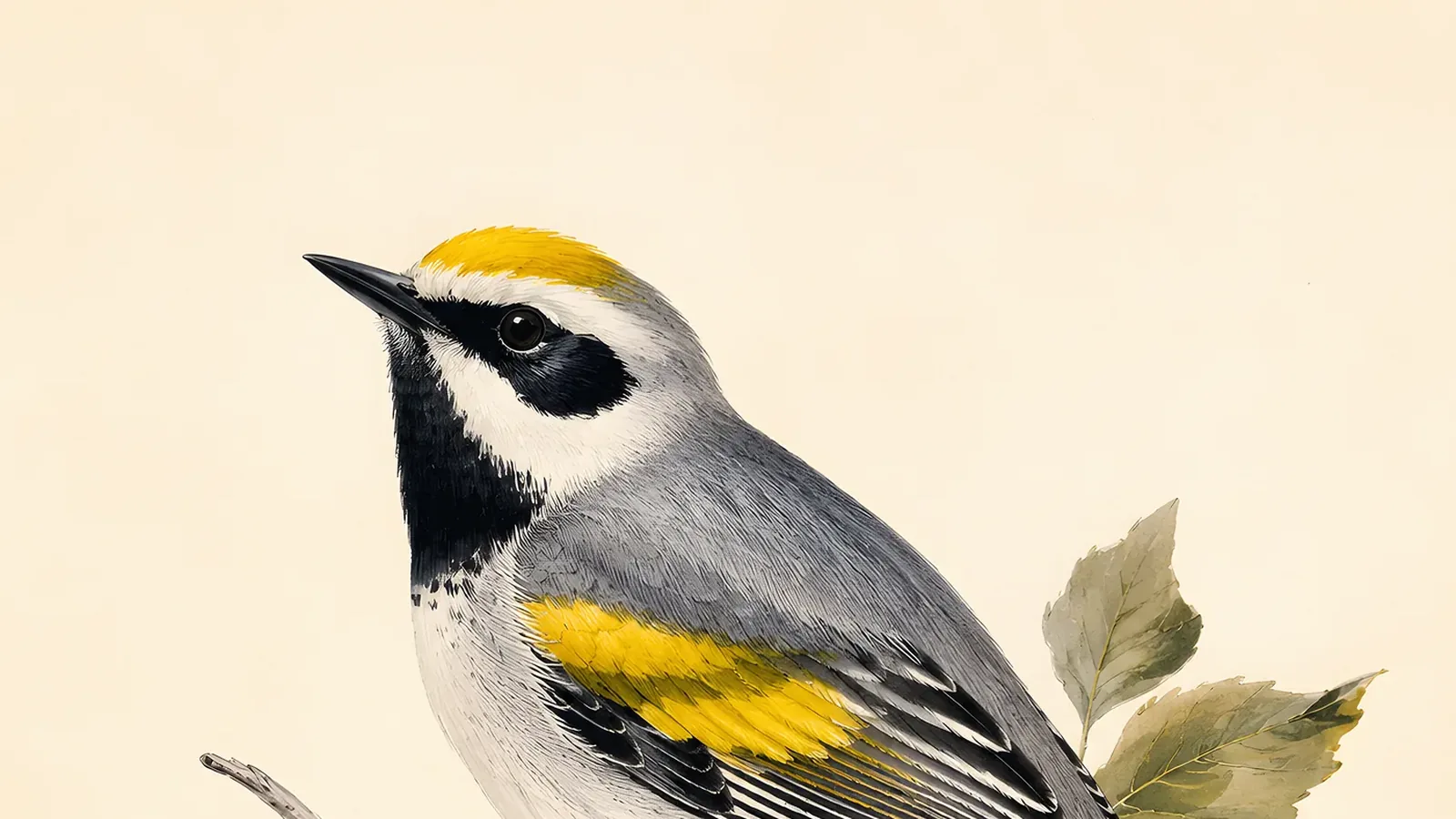
A clearing in northern Wisconsin. Alder thicket, wet ground, saplings chest-high. Before you see anything, you hear it: a high, thin bee note, then three lower buzzes that drop like stones. Bee - bzz - bzz - bzz. So insect-like that first-time listeners turn their ear away from the bird and toward the grass. Then the singer appears at the edge of a branch tip: silver-grey above, a blaze of yellow on the crown, a jet-black mask and throat, yellow blazing again from the folded wing. Vermivora chrysoptera. The Golden-winged Warbler. One of the most precisely beautiful small birds in North America. One of the fastest-disappearing.
What it looks like
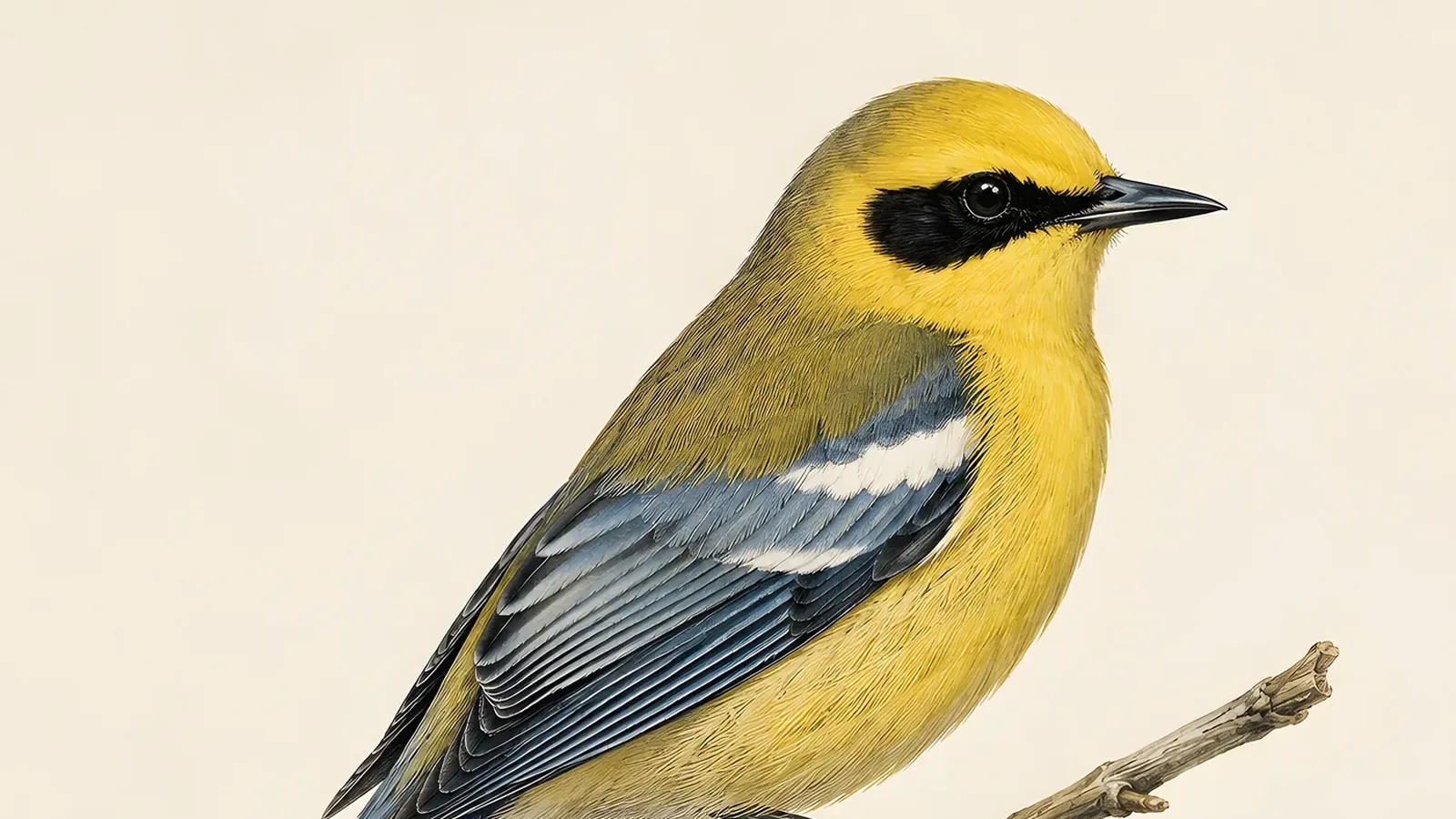
The male is a study in four colours used with a jeweller’s restraint.
The back and upperparts are clean silver-grey. The underparts are white. Against both, two patches of chrome yellow burn: one on the crown, one as a wide bar across the closed wing. The face carries a bold black mask that sweeps through the eye, and below it a black throat patch, solid and square. White supercilium and white moustache stripe flank the mask. The bill is slender and sharply pointed, an extraction tool for rolled leaves and curled bark.
The female uses the same template in muted register. Her mask and throat are grey, not black. Her yellow is the same intensity, which is why she is easy to overlook until the light catches her crown.
Size: 12 to 13 cm in length. Weight eight to ten grams. Wingspan 19 to 21 cm. By any measure a small bird, but the colouring punches far above the scale. There is nothing else in the wood at the same frequency.
| Measurement | Range |
|---|---|
| Length | 12 - 13 cm |
| Weight | 8 - 10 g |
| Wingspan | 19 - 21 cm |
| IUCN Status | Near Threatened (NT) |
The vanishing young forest
Vermivora chrysoptera is what ecologists call an early-successional specialist. It does not want old growth. It does not want farmland. It wants the brief window between the two: the shrubby, sun-lit tangle that colonises an abandoned field, a logged cutover, a beaver-flooded meadow, or a utility right-of-way. Alder scrub, young birch, dense goldenrod with scattered trees. The habitat that exists for perhaps 15 to 30 years before the canopy closes and shades it out.
That habitat is disappearing across eastern North America. Old-growth advocates saved mature forest. Agricultural abandonment shrank open field. Succession, left to run, converted shrubland to woodland in a generation. The Golden-winged Warbler required exactly the stage that nobody was actively managing for. Breeding Bird Survey data compiled by Buehler and colleagues (2007, The Auk) across 274 routes from 1966 to 2005 documented an average annual decline of 2.5% across the full range. In the northeast that rate reached 8.6% per year. In West Virginia it hit 10.2% annually, with one recent measurement period showing 27% per year - numbers associated with collapse, not fluctuation.
Rosenberg and colleagues (2016, Studies in Avian Biology) calculated that the total population has dropped more than 70% since 1966. Approximately 393,000 individuals remain rangewide, according to Partners in Flight. Population modelling projects roughly 37,000 by 2100 if current trends hold - a species reduced to a relic in Manitoba and Minnesota, extinct across the rest of its former ground.
The warbler did not fail to adapt. The habitat failed to stay.
The hybrid tide
If habitat loss is the slow blade, the blue-winged warbler is the fast one.
Vermivora cyanoptera - the blue-winged warbler - is the Golden-winged Warbler’s closest relative. They diverged perhaps one million years ago. Today their genomes are, by the measure of Toews and colleagues at Cornell, more than 99.97% identical. The two species are distinguished by plumage genes clustered around the ASIP locus, which controls throat-patch melanin, and a handful of other colour regulatory regions. Everything else - ecology, vocalizations, diet, foraging behaviour - runs nearly identical code.
When a blue-winged warbler arrives in a Golden-winged Warbler territory, the two birds interbreed freely. The resulting offspring are phenotypically distinct, carrying various combinations of the parent plumage genes. The pale-winged, largely white-throated form is called Brewster’s Warbler. The rarer, largely yellow form with a black throat patch is called Lawrence’s Warbler. Both names carry the legacy of nineteenth-century taxonomists who thought they were describing new species. Both are hybrids.
Baiz and colleagues (2020, The Auk, vol. 137, doi 10.1093/auk/ukaa027) showed that neither Brewster’s nor Lawrence’s Warblers are simple first-generation crosses. Lawrence’s Warblers in their study carried mostly blue-winged ancestry with a small patch of golden-winged genome upstream of ASIP - the minimum genetic footprint needed to switch on the black throat. They are multigenerational hybrids, not F1s. The swamping is already advanced.
The pattern wherever the two species meet is consistent and grim. The blue-winged warbler - a forest-edge generalist that tolerates second-growth - advances northward as climate shifts warm suitable habitat. Golden-winged Warblers persist on the leading edge for one or two decades. Then the genetic boundary dissolves. The golden-winged phenotype becomes increasingly rare, the pure genotype rarer still. In New England this replacement was largely complete by the 1990s. In Pennsylvania it is ongoing. The Appalachian population, 98% gone since the 1960s per Rosenberg et al. (2016), is losing the final fight on two fronts at once.
“The decline of the Golden-winged Warbler is the product of two forces operating simultaneously - the loss of breeding habitat and its genetic absorption into Blue-winged Warbler populations - and the two interact in ways that make management responses far more complex than habitat restoration alone can address.”
- Buehler et al., The Auk 124(4), 2007
What it sounds like
The primary song is the one most field guides describe and most birders find baffling on first hearing.
One high, sustained note - the “bee” - followed by three to four lower, buzzy pulses at roughly the same pitch. The whole thing lasts two seconds. The pattern is bee-bzz-bzz-bzz, a descending sequence that has far more in common acoustically with a grasshopper or a cicada than with the rich, warbling song most people associate with warblers. It is a ventriloquist’s song, too. The buzzy quality makes it hard to pin to a direction. You hear it, you scan, and the bird is already behind you on the next stem.
Males have a second song type, a rapid stutter of high thin notes followed by buzzy lower ones. This version is sung most in the hours before dawn. Both songs carry the same insect-like quality - thin, dry, without the tonal richness of a wood-thrush or even a common yellowthroat. This is not a bird that announces itself. It assumes a landscape thin enough to hear it. In a mature closed-canopy forest, which it avoids, the song would disappear into the leaf mass within twenty metres.
Range and the two populations
Vermivora chrysoptera breeds across a discontinuous arc from the upper Midwest through the Appalachians. The arc is now functionally two populations with different fates.
The Great Lakes stronghold - principally Minnesota, Wisconsin, and the Canadian province of Manitoba - holds more than 80% of all breeding Golden-winged Warblers alive today. Breeding Bird Survey trends here show a decline of roughly 1.4% per year - serious but survivable. The shrubby cutover and young aspen parkland of the upper Midwest still exist in quantity. The blue-winged warbler’s range has not yet caught up to this latitude in force.
The Appalachian population is a different story. From West Virginia north through New York, the birds that once filled shrubby hillsides and regenerating clearcuts have largely gone. Ninety-eight percent gone, by the Rosenberg et al. calculation. What remain are isolated pockets in young forest on steep ground, buffered from blue-winged contact by elevation. The buffer is temporary.
In winter, birds from both populations withdraw to mid-elevation forests from Guatemala to Colombia - a long migration, mostly nocturnal, across a landscape of its own shrinking mid-elevation habitat.
Breeding
Males arrive on breeding grounds in mid-May, sometimes while frost still patches the ground in Minnesota and north Carolina montane clearings. They sing immediately and persistently from exposed perches at the scrub edge, establishing territories of two to four acres.
The female builds the nest alone, on or very near the ground, anchored to the base of a goldenrod stem or tucked into a clump of sedge. Construction uses dead leaves, strips of grapevine bark, long grasses, and fine plant fibre for the lining. The nest is deliberately hidden. A male will stand nearby and sing, which is perhaps the least helpful thing he could do for concealment, but the female positions the cup below his sightline in vegetation that conceals her completely when she sits.
Clutch size runs four to five eggs, pale cream with brown and lilac speckling. The female incubates alone for ten to eleven days. Fledglings leave the nest at eight to nine days - barely feathered, fluttering into the grass where the parents divide them between territories and feed them for another month.
One brood per season. No second chance if the nest fails to a cowbird or a raccoon. The arithmetic of a species already short on habitat does not allow for much failure.
The argument for saving this bird is not that it is the most numerous, the most endangered, or the most genetically distinct warbler in the east. It is that its loss would be comprehensible and preventable - a species undone not by some remote oceanic catastrophe but by the way successional forest on the land beside us has aged out, unmanaged, one county at a time. Young shrubby forest is not wilderness. It does not attract conservation donors or front-page photographs. It looks, to most people, like an unmowed mess. The Golden-winged Warbler has paid the price of that perception. What happens to it in the next thirty years depends on whether anybody is willing to manage for the mess.