Field Guide
Barn Owl
The skull of a Barn Owl is built wrong by design.
The left ear canal sits measurably higher on the skull than the right. This is not a defect. It is the most precise direction-finding instrument in the bird world, and it is the reason Tyto furcata can drop onto a vole hidden under a foot of snow, in a field with no moon, without ever having seen it.
That fact - the asymmetric skull, the absolute darkness, the vole - is the thesis of this bird. The Barn Owl is not, as folklore has it, a creature of mystery or ill omen. It is a precision instrument that evolution spent millions of years calibrating. Everything about its appearance, its sound, and its habits traces back to that singular pressure: hunt without light.
Identification
The American Barn Owl is 33 to 41 centimetres long, weighs 425 to 710 grams, and spans 100 to 130 centimetres across the wings. Females are noticeably larger than males. In all other respects, the sexes look alike.
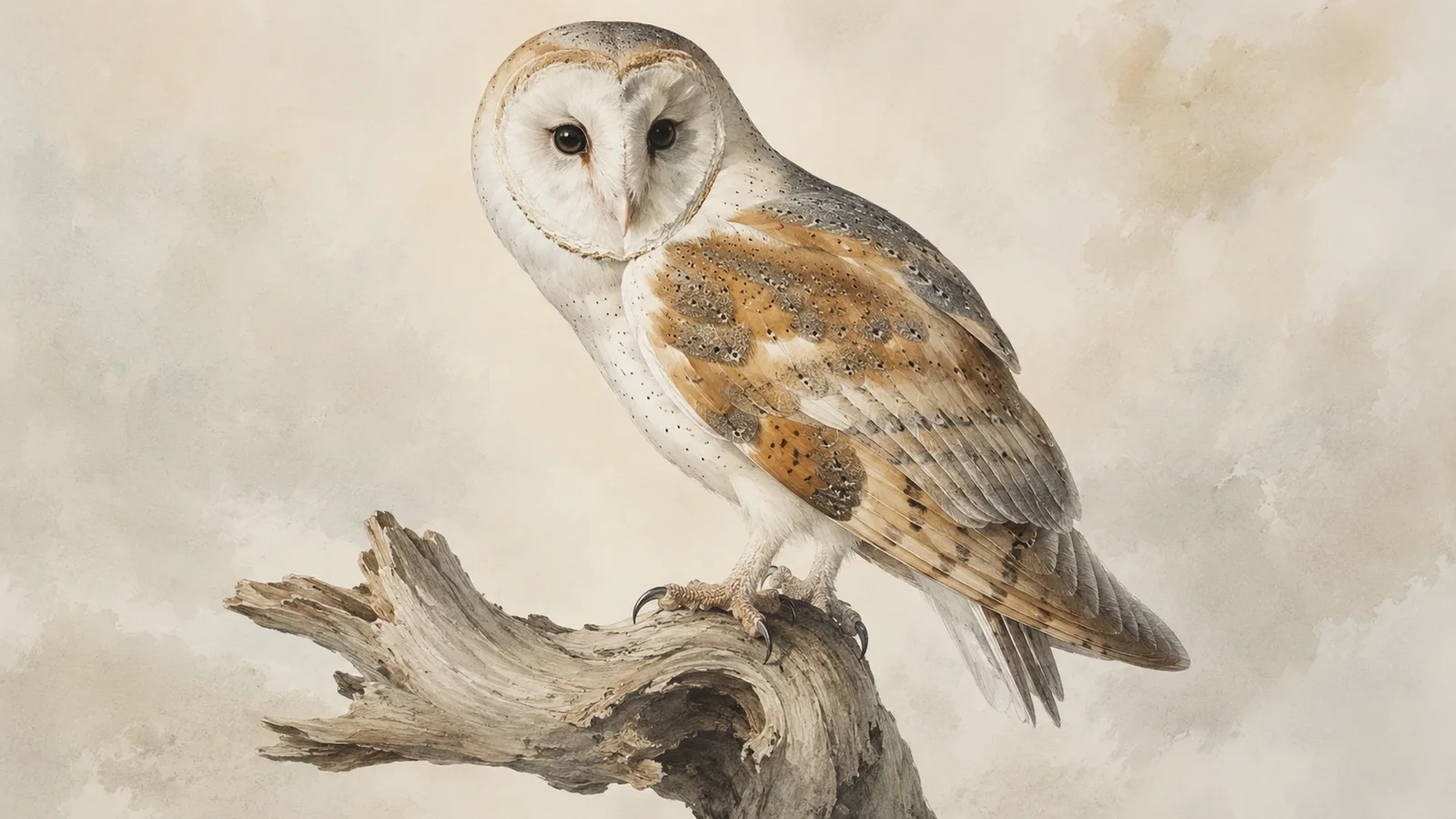
The face is the field mark. It is white, wide, and heart-shaped - a forward-facing satellite dish of stiff feathers arranged in a parabolic disc. Dark eyes sit at the centre. The facial ruff around the edge is pale buff shading to brown. No other North American owl has this face. At any distance, in any light, the heart-shaped disc identifies this bird.
The rest of the plumage is pale and subtly patterned. The back is golden buff washed with grey and finely speckled with dark brown and white. The underparts are white to pale buff, sometimes with faint dark spotting, varying by individual and region. In flight the bird looks almost white below, with long legs trailing behind the tail. The wings are broad and rounded at the tips, pale tawny above, white below.
In North American daylight, the bird most likely to be confused with a Barn Owl in flight is a large white moth - they share that soft, buoyant, almost weightless wing-beat. At closer range, no confusion is possible.
Voice
The Barn Owl does not hoot. Its primary call is a long, rasping shriek, three to four seconds of sustained noise that carries far across open fields. It is one of the more unsettling sounds in the North American night, which accounts for a good portion of its historical reputation. There are also hissing notes, bill-snapping, and a soft twittering between paired birds. The young in the nest produce a persistent food-begging rasp that continues well into the fledgling period and can be heard from outside a barn or church steeple at close range.
The Cornell Lab’s Birds of the World notes that the species has no song in the strict passerine sense. The calls function as territorial advertisement and pair communication. They are not musical. They are effective.
Range and habitat
The American Barn Owl is one of the most widely distributed land birds on Earth. In North America, Audubon’s field guide places it across the continental United States from California to the Mid-Atlantic, through the Great Plains, Southwest, and Southeast, and into southern Canada. It is resident year-round across most of its range.
The habitat requirement is consistent and simple: open or semi-open country with prey, and a cavity large enough to nest in. This means farmland, grassland, marsh edges, scrub, desert scrub, riparian corridors, and the edges of woodlands where they meet open ground. The name comes from the habit of using farm buildings, and that association holds wherever working barns survive. But the bird is equally at home in a hollow sycamore, a coastal sea cave, a church tower, or a wooden nest box installed on a fence post.
It is almost entirely absent from dense forest and from the northern tier of states where deep, persistent snow covers prey for months at a time. The Midwest and Northeast have seen the sharpest declines, Audubon notes, largely because of habitat loss and the reduction of rough-grassland hunting ground.
Diet
Voles and mice are the core of the diet. Cornell’s Birds of the World records that small mammals make up the overwhelming majority of prey by biomass, with voles of the genus Microtus - meadow voles, prairie voles, California voles - forming the largest single component across most of the North American range. Pocket mice, deer mice, shrews, and occasionally rats round out the list. The bird takes insects and small birds rarely.
The hunting method is direct. The owl courses low over open ground on a heading determined by sound, drops at the moment the acoustic geometry triangulates to a single point, and seizes the prey with its talons. Experiments with captive birds have confirmed that individuals can strike prey accurately in laboratory conditions with zero visible light, using sound alone. Remove the facial disc feathers and the bird can still locate sound in the horizontal plane but loses accuracy in the vertical - confirming that the disc itself resolves elevation.
The indigestible parts - bone, fur - are compacted into a pellet and regurgitated. Barn Owl pellets are large, dark, and intact, and they accumulate in numbers below a roost site. Pellet analysis has been the primary tool for studying Barn Owl diet for decades precisely because the pellets preserve prey remains so cleanly.
Breeding and nesting
Pair bonds are strong and pairs often return to the same nest site across multiple years. Nest selection runs to cavities - a hollow tree, a barn loft, a cliff crevice, a nest box. No nest material is added beyond the accumulated debris of regurgitated pellets, which forms a soft substrate over time.
Clutch size ranges from three to eight eggs, laid at two-to-three day intervals. The female incubates alone for 29 to 34 days. The male hunts continuously through incubation, delivering food to the nest. After hatching, the young remain in the nest for approximately 55 to 65 days before first flight, and they are often fed by both parents for several weeks beyond that.
The Cornell Lab’s Birds of the World records that pairs may attempt two broods in a year in favourable conditions, occasionally three. Productivity in Barn Owls is tightly coupled to prey availability. In a vole boom year, a pair may raise ten or more young. In a poor year, many nests fail entirely.
The acoustic argument
The asymmetric skull is worth dwelling on because it is not a minor variation. It is a full structural reorganisation of the skull bones around a single functional priority.
In most birds, the two ears are at the same height. In Tyto furcata, the left ear canal is positioned higher than the right, behind the facial disc. A sound arriving from directly below reaches the right ear a fraction of a millisecond before the left. A sound arriving from above reaches the left ear first. The brain resolves the time-of-arrival difference into an elevation angle. Combined with the standard horizontal timing difference common to animals with two ears, the result is a three-dimensional sound map precise enough to aim a strike in the dark.
This system is, by the standard of vertebrate sensory biology, unusual. Facial disc plus asymmetric skull plus the soft, fringed feather edges that suppress wind noise during the approach - the whole bird is an acoustic weapon. The pale plumage, which once seemed to be a puzzle given that pale animals are conspicuous, turns out not to matter much for a predator that closes on prey before the prey can see it coming.
The Barn Owl does not need the moon. It has something better: a skull built to the tolerances of a precision instrument, calibrated to the sound of a vole moving through dry grass forty metres away.
The oldest banded American Barn Owl on record, recovered in Ohio, was at least 15 years and five months old at death - Cornell’s longevity data holds this figure. Most wild birds live far shorter lives. Mortality in the first year of life is high, and the species recovers its numbers not through individual longevity but through consistent productivity: many young, over many years, from the same pair returning to the same barn.
That continuity - the pair, the site, the accumulated pellet mat on the barn floor, the seasons of mice and voles caught in the dark - is what the species actually is. Not an omen. A mechanism. A beautifully specific one.