Field Guide
Blue-winged Warbler
On a June morning in an abandoned Connecticut pasture - the kind of place where old apple trees compete with sumac and wild grape - a sound rises from the chest-high tangle that is unlike any other warbler you know. Two notes only. The first is an indrawn wheeze, reedy and thin, as if the bird is drawing breath across a reed. The second answers it, lower and buzzier, a brief rattle of wings. Together they make something like beee-bzzz: a miniature, insectile exhalation that gives you no drama but does give you one of the northeast’s most consequential small birds.
Vermivora cyanoptera, the Blue-winged Warbler, sits in its scrubby field singing that two-part buzz, and it does not know - or does not care - that it is slowly swallowing its own cousin whole.
What it looks like
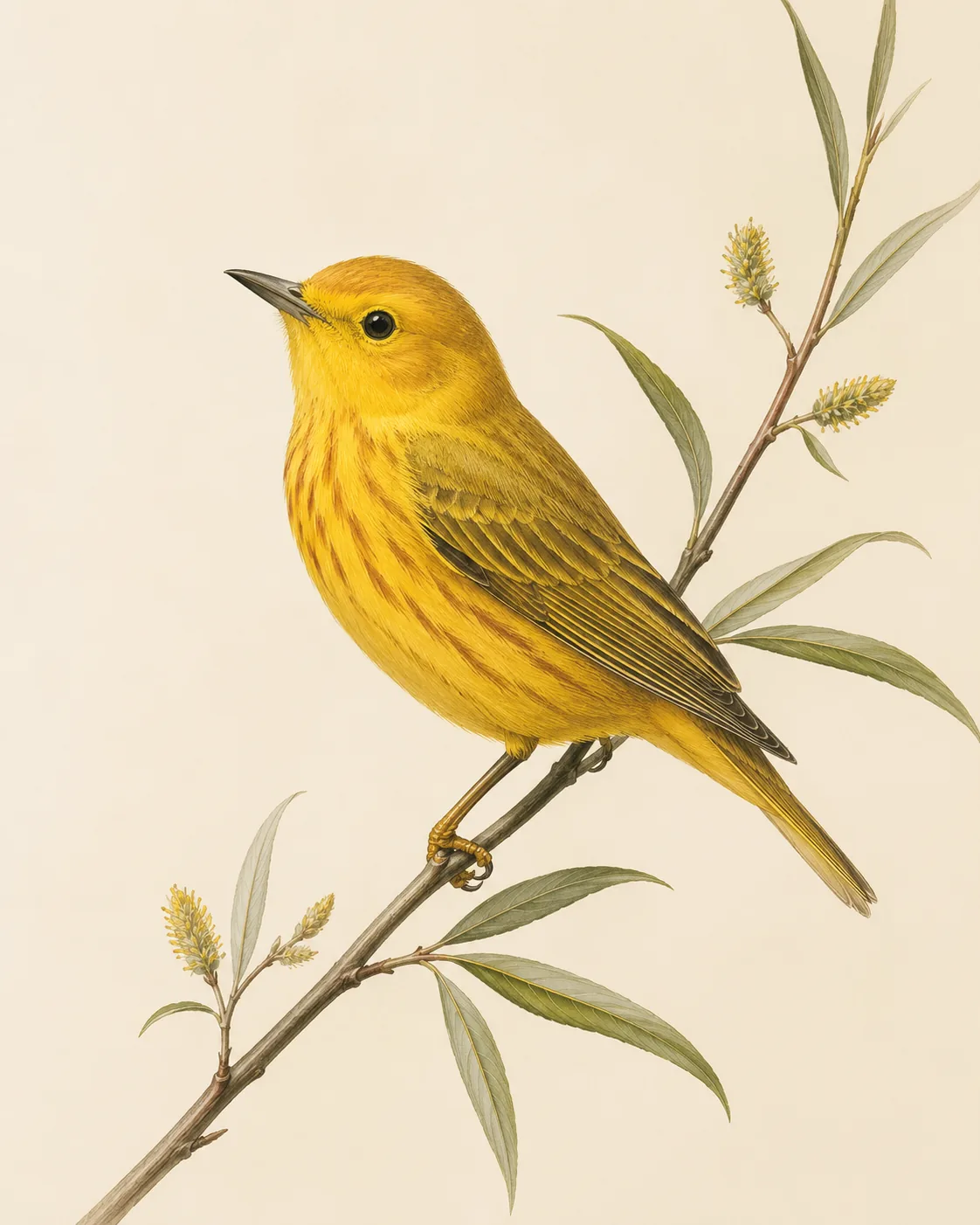
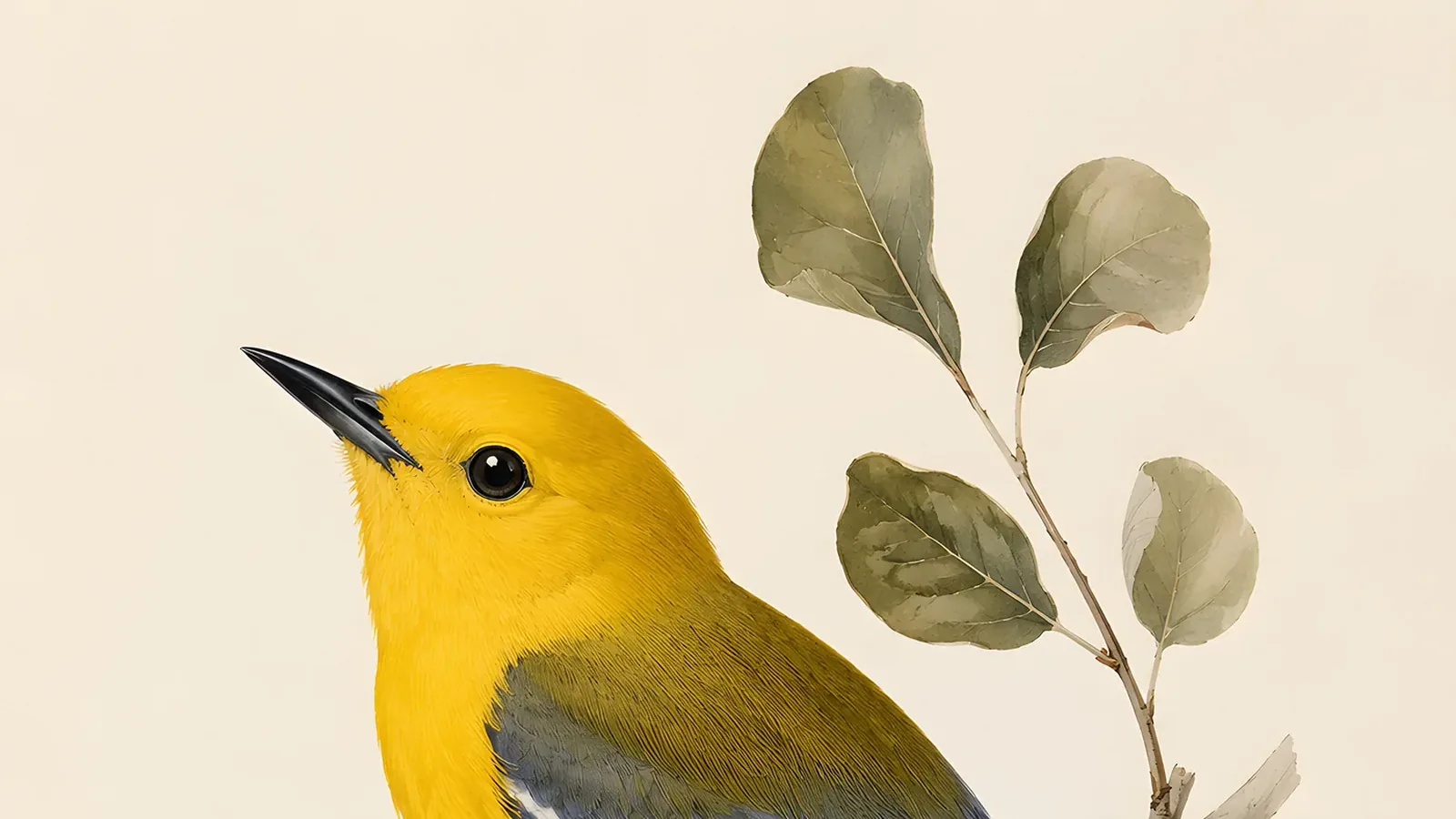
Start with the yellow. This is a bird lit from the inside.
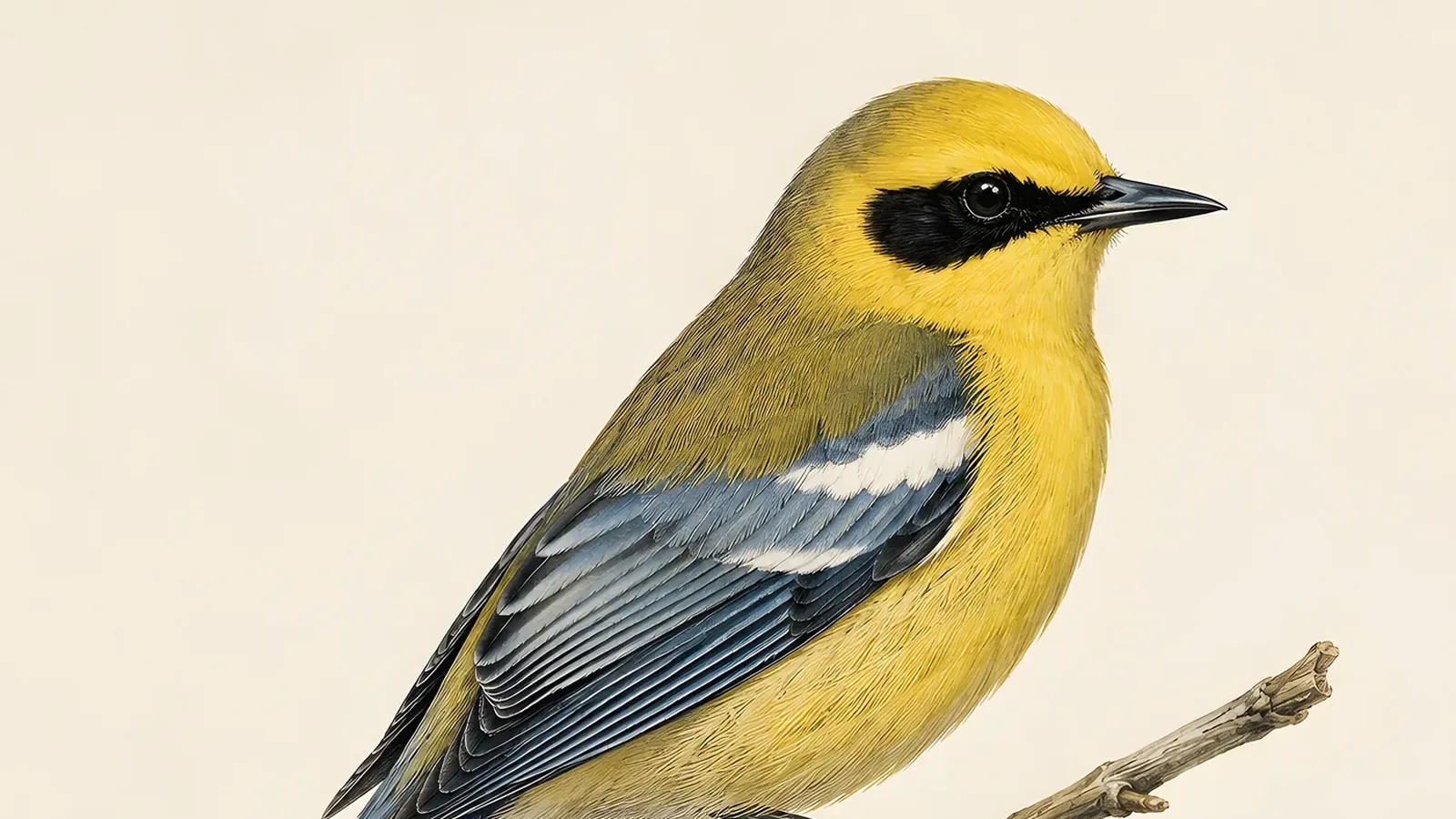
The male in breeding plumage is a uniform bright yellow from his crown to his belly, pure and unmodulated, without the chestnut streaking of the yellow warbler or the orange wash of the Prothonotary. The wings break the rule. They are blue-grey, cool against the warm body colour, crossed by two crisp white wing bars that stand out clearly in the field. Running back from the bill through each eye is a thin black line - narrow as a pencil stroke, clean-edged, and the one dark note in an otherwise golden bird. The tail shows white spots on the outer feathers, useful when the bird pivots and fans.
The female carries the same pattern but turned down in saturation. Her yellow is softer, more olive-washed, the black eye-line present but thinner. Both sexes share the thin, slightly decurved bill of the Vermivora genus, a tool for probing curled leaves and prying into plant galls rather than simply gleaning surfaces. That bill is slimmer than anything in the closely related Setophaga warblers, and it tells you something about how these birds work.
Cornell Lab of Ornithology measures the species at 11 to 13 centimetres in length, weighing eight to 12 grams, with a wingspan of 17 to 20 centimetres. The oldest bird on record was a male at least nine years and eleven months old when recaptured during banding operations in Ontario.
| Measurement | Range |
|---|---|
| Length | 11-13 cm |
| Weight | 8-12 g |
| Wingspan | 17-20 cm |
| Max. recorded lifespan | 9 years, 11 months |
The bee-buzz song
The song is the most useful field character and also one of the most distinctive in the family.
Audubon described wood-warbler voices in terms of motion and colour. This one is better described as texture. The two-syllable phrase - a rising wheeze followed by a lower, buzzing trill - sounds less like a bird than like a large insect laboring in the heat. The first note is often written beee, the second bzzz, and the impression is of a bee both inhaling and exhaling. It carries across open scrub but does not cut through closed forest the way a clear-whistled song does. If you hear it, you are probably already near the right habitat.
A second song type exists, more complex, sometimes described as a “chip-sputter” combination, and is delivered more quietly. Older field guides sometimes refer to the two variants as the “Type I” and “Type II” songs, the second given less frequently in the context of territory establishment.
The hybrid problem
Blue-winged Warblers cause Golden-winged Warbler disappearance within fifty years and sometimes within twenty years, with rapid and virtually complete elimination of the Golden-wing phenotype across regions where the species coexist.
- Confer, J.L., The Auk, 123(4), 2006
This sentence is the central fact of the species and the reason ornithologists have studied it with such intensity for more than a century.
The Blue-winged Warbler and the Golden-winged Warbler (Vermivora chrysoptera) are sister species that share breeding habitat across a wide contact zone running through Pennsylvania, New York, and southern New England. Where they meet, they interbreed freely, producing two named hybrid types. The Brewster’s Warbler is the more common of the two - white below with yellow highlights, showing some Golden-winged facial pattern elements on a bird with the blue-grey wing markings of the Blue-wing. The Lawrence’s Warbler is rarer, carrying the dark throat and face mask of the Golden-winged combined with the yellow underparts of the Blue-winged, and it results from a particular backcross combination. Both hybrids are fertile. That is the problem.
Working from specimens and site records across southern Connecticut, Frank B. Gill documented in 1980 (The Auk, 97:1) that a general pattern of replacement of Golden-wings by Blue-wings within fifty years of initial interaction had occurred repeatedly across the northeast. The Blue-winged Warbler expanded northward into New England beginning in the 1880s as farm abandonment created the scrubby second-growth habitat it favors. Wherever it arrived, it introduced itself to the resident Golden-wings, and within a few decades, the Golden-wing phenotype had largely disappeared from those sites.
The mechanism is partly about plumage and partly about who chooses whom. Confer et al. (2020, Ecology and Evolution, 10:10633-10644), analyzing data from 2,679 territorial warblers across nine studies spanning 47 years, found that male Golden-winged Warblers backcross with hybrid females at a rate of 4.9%, while male Blue-winged Warblers do so at only 1.7%. That asymmetry - Golden-winged males pairing more readily with Brewster’s females than Blue-winged males do - creates a directional flow of Blue-winged genetic material into the Golden-winged population. The genes move one way faster than they move the other. Over generations, this differential backcrossing tips the genetic balance steadily toward Blue-wing ancestry, even when the birds in the field still look like Golden-wings.
The result is what geneticists call genetic swamping: the absorption of one species into the genome of another through sustained hybridization. The Golden-winged Warbler is now listed as Near Threatened on the IUCN Red List, its populations in decline across much of the Appalachian range where Blue-wing contact is heaviest. The Blue-winged Warbler, meanwhile, holds Least Concern status with a stable or increasing population. This is a textbook case of a numerically dominant, ecologically expanding species absorbing a rarer relative not through direct competition but through the quiet mechanism of interbreeding.
The irony is not small. Conservation ordinarily means protecting species from hunting, poisoning, or habitat loss. Here the problem is love.
Range and habitat
The Blue-winged Warbler breeds across the eastern United States, centered in the mid-Atlantic states and the Midwest, north through the Great Lakes and southern New England, and it continues to push its range northward. It is a bird of early-successional shrubland: the old pasture going back to scrub, the power-line right-of-way, the clearcut in its second decade, the wetland margin thick with willow and alder. It needs low, dense, tangled vegetation for nesting - the messier the better - with some taller shrubs or short trees for song perches.
It does not stay in this habitat year-round. The breeding season runs May through August in the northeast, and by late summer the birds begin moving south through the eastern states in a migration that proceeds largely at night. They winter in Central America, in the lowland forests and forest edges of Guatemala, Belize, Honduras, and surrounding countries, where they join mixed-species flocks and forage in the mid-canopy.
Spring arrival in the northeast typically comes before the Golden-winged Warbler, a detail that may give the Blue-wing a territorial advantage in establishing itself in shared scrubland.
Diet
The Blue-winged Warbler is almost entirely insectivorous through the breeding season. Audubon’s field guide records a diet that includes beetles, ants, caterpillars, and grasshoppers, along with spiders. The thin, probing bill is well adapted to reaching into curled dead leaves and plant galls, and the species is notably fond of foraging in exactly this way - hanging at the tip of a branch, probing a rolled leaf, working systematically through low shrubs in a manner more deliberate than the surface-gleaning of many of its relatives.
On migration it will take soft fruit opportunistically, but insects remain the core of its diet throughout the year.
Breeding
The nest is placed on or very near the ground, tucked into the base of a clump of grasses or weeds or among the roots of a shrub. It is a neat, deep cup built largely by the female, constructed of dry leaves, grasses, and bark strips, often with the whole structure wrapped in dead leaves to provide concealment from above. Nest placement is typically well hidden enough that they are found mostly by flushing the incubating female by accident.
The female lays four to six eggs, most commonly five, white with fine reddish-brown speckling. She alone incubates for ten to eleven days. The young are altricial, hatching naked and helpless, and they leave the nest eight to eleven days after hatching - notably early, which reduces the window during which nest predators or Brown-headed Cowbirds can cause damage. The species raises a single brood per season.
The Blue-winged Warbler is a frequent host of Brown-headed Cowbird parasitism. Unlike the yellow warbler, which detects foreign eggs and buries them under a new nest floor, the Blue-wing typically accepts and raises the cowbird chick. In fragmented landscapes where cowbirds move freely, this acceptance imposes a real cost.
What does not impose a cost, apparently, is finding a mate. Where Blue-winged and Golden-winged Warblers share territory, the Blue-wing’s willingness to pair across species lines, combined with the asymmetry in how backcross matings fall, keeps the genetic current flowing in one direction. The Golden-winged Warbler is not being outcompeted for food or territory in any simple sense. It is being incorporated.
A bright yellow bird with blue-grey wings and a thin black eye-line sings its two-part buzz from a sumac thicket in June, and the sound is easy enough to miss. The story behind it is one of the stranger ones in North American ornithology: a species doing nothing more than finding mates and raising young, and in doing so, slowly erasing the bird it most closely resembles.