Field Guide
Black-capped Vireo
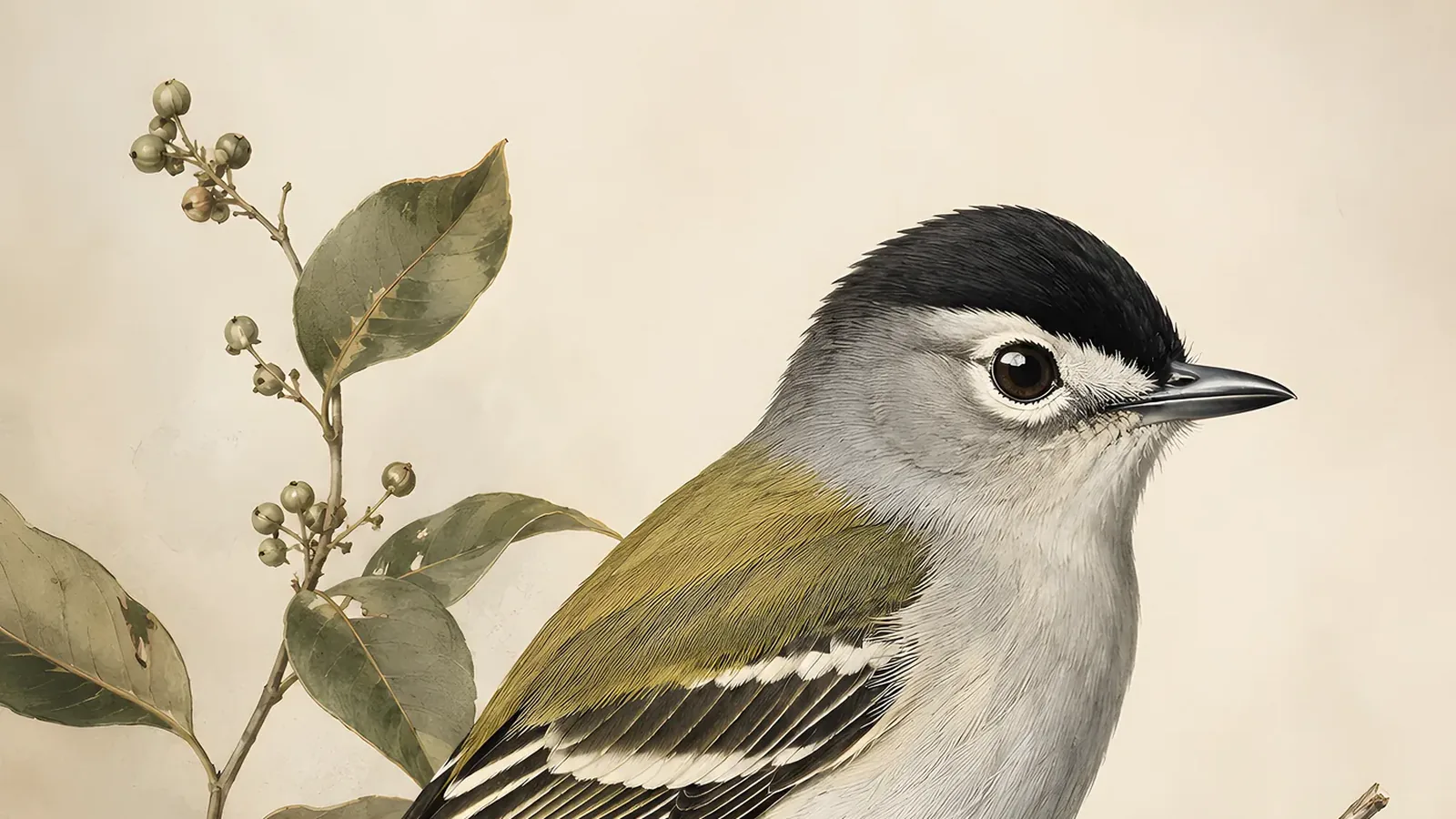
The male has been singing since before the sun cleared the cedar ridge. He moves in short bursts through the shin oak - two feet up, three feet sideways, never more than head height above the dry Texas limestone - and from every perch he fires off another phrase. Not sweet, not lilting. Harsh and hurried, almost angry, the song of a bird that has no time for pleasantries in a breeding season that lasts barely four months. The spectacles are the thing that stop you: two arcs of clean white on a jet-black head, the loral stripe broken so each eye sits in its own bright crescent, making the face look permanently alert and slightly indignant. This is Vireo atricapilla - the Black-capped Vireo - and it is singing from precisely the kind of country that almost no one would think to call a haven.
Low shrubs. Open grass. Limestone outcrops. Scrub oak and sumac in clumps with gaps between them, the whole landscape barely knee-height.
It is exactly what this bird demands, and it nearly disappeared along with it.
What it looks like
Vireo atricapilla is one of the smallest members of Vireonidae. At 11 to 12 centimetres and 9 to 10 grams it sits closer to a large warbler than to most of its vireo relatives, which tend toward chunkier proportions. The wingspan runs 16 to 17 centimetres. In the hand it is almost unbelievably light.
The male is unmistakable. The cap is glossy black, extending down across the lores to produce what ornithologists describe as a partial ring around each eye - the “spectacles” that distinguish this species from every other North American bird. John Tveten noted in 1987 that V. atricapilla is “the only North American bird to have white spectacles on a jet-black head.” The throat is white. The back and wings are olive-green, with two yellowish wing bars. The flanks wash yellow, fading to white on the belly. The eyes are deep red - a shared vireo trait, but vivid against the black mask.
Females and first-year birds are considerably subtler. The cap becomes slate-gray, the spectacles are still present but less contrasting, and the overall impression is of a small, plain, olive bird with a slightly distinctive face pattern. Young males show a patchy transition between slate and black on the crown through their first autumn.
| Feature | Measurement |
|---|---|
| Length | 11 - 12 cm |
| Weight | 9 - 10 g |
| Wingspan | 16 - 17 cm |
| Lifespan (wild) | 5 - 6 years |
| Clutch size | 3 - 4 eggs |
| Incubation period | 14 - 17 days |
The young-scrub specialist
Breeding habitat for V. atricapilla is not simply “Texas scrubland.” It is a specific structural condition - and one that most landscapes drift away from without active intervention.
The bird requires low, dense, deciduous shrubs arranged in clumps with open grassy areas between them. In Texas, this means primarily shin oak (Quercus sinuata var. breviloba), sumac, and associated understory species growing on limestone outcrops of the Edwards Plateau and Trans-Pecos region. The Texas Breeding Bird Atlas documented nesting in 27 counties since 1990, with highest concentrations in Bandera, Bell, Burnet, Coryell, Edwards, and Kerr counties. In Oklahoma, the population is far smaller, confined to three known nesting areas, principally at Fort Sill and the Wichita Mountains.
The habitat is not mature brush. It is early-successional brush - exactly the stage that follows disturbance by fire or grazing, when shrubs are young, multi-stemmed, and still short enough that a vireo can nest two to four feet above the ground and keep visual contact with the surrounding landscape. As oak scrub matures and grows dense, it becomes unsuitable. As grassland succeeds into closed woodland, it becomes unsuitable. The window of usability is narrow in time and depends entirely on whether something - fire, grazing, mechanical treatment - periodically resets the vegetation to that early stage.
That is why the cattle ranchers who historically grazed the Edwards Plateau, and the fires that historically swept through on roughly ten-year cycles, were unwittingly maintaining the conditions V. atricapilla needed. And that is why a century of fire suppression and overgrazing, both of which drive succession toward either bare ground or closed scrub rather than open-structured brush, drove the species to the edge.
The cowbird problem
The habitat collapse was bad enough. The cowbird made it worse.
The Brown-headed Cowbird (Molothrus ater) is an obligate brood parasite - it lays its eggs in other birds’ nests and relies on the host to incubate and raise the young. As agricultural development cleared forest and created open feeding habitat across the continent, cowbird populations exploded. On vireo territories in the Edwards Plateau before active management began, biologists at Fort Hood documented cowbird eggs in over 90 percent of V. atricapilla nests in the late 1980s.
The problem is compounding. Cowbird eggs incubate in roughly 11 days. Vireo eggs take 14 to 17 days. When a cowbird chick hatches first, it grows rapidly and demands more food than the attendant vireos can produce. Vireo eggs that have not yet hatched frequently fail. The female vireo often abandons parasitized nests entirely and renests - losing two to three weeks of the breeding season and rarely raising any vireo young at all.
Wilsey, Lawler, Cimprich, and Schumaker, writing in Conservation Biology in 2014 (vol. 28, pp. 561-571), modeled the Fort Hood vireo population and found that sustained parasitism above 45 to 85 percent - depending on population growth assumptions - would likely drive the Fort Hood birds below minimum recovery targets within 25 years even if habitat was otherwise adequate. They concluded that V. atricapilla is conservation-reliant: even a recovered population requires ongoing cowbird management to stay recovered.
This is the same dynamic that shaped the near-collapse of the Kirtland’s Warbler in Michigan, where cowbird trapping became a prerequisite for any nest success at all. Two very different birds. One very effective parasite. And in both cases, the trap proved more decisive than almost anyone expected.
Fort Hood biologists began cowbird trapping in 1989. By 1997, parasitism rates on the installation had dropped below 10 percent. Vireo numbers at Fort Hood climbed from fewer than 200 birds in 1988 to more than 8,500 in 2021 surveys.
What it sounds like
The song of V. atricapilla is the most immediately recognizable thing about it, and the hardest to translate into words. Scott, writing in 1987, described it as “restless, almost angry in quality” - a string of hurried, varied two-note to four-note phrases delivered rapidly and without obvious pattern. Unlike many vireos, which have repetitive song structures with a predictable sequence, the Black-capped Vireo draws from an unusually large syllable repertoire. Cornell Lab researchers have documented a syllable inventory an order of magnitude greater than in most vireo species, meaning the male can produce long bouts of song with few repeated phrases.
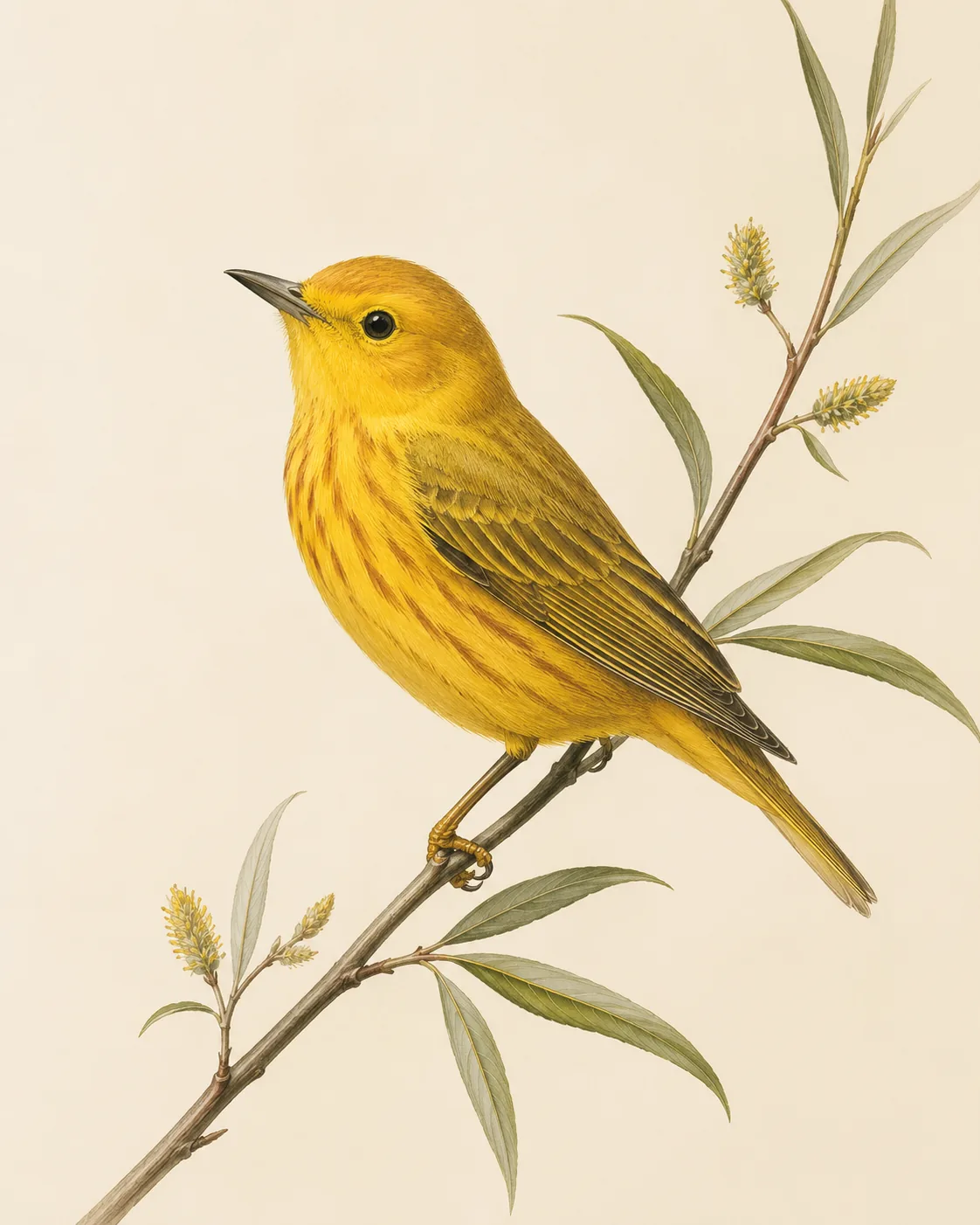
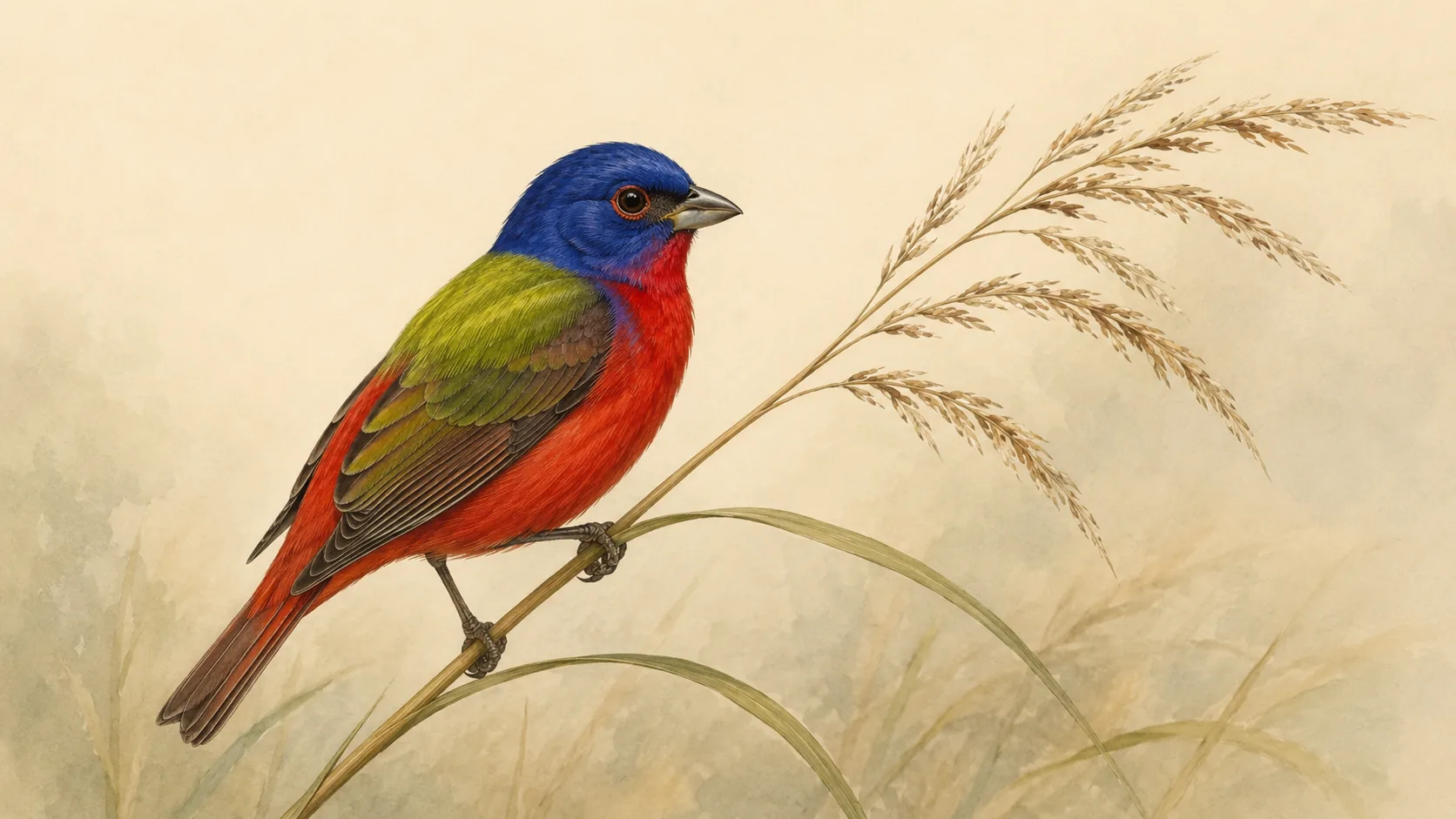
The practical effect in the field is a song that sounds busy and slightly irritated - harsh where a Yellow Warbler would be sweet, packed where a Painted Bunting would be melodious. Males sing persistently throughout the breeding season to defend territories of two to four acres and to maintain pair bonds. Females do not sing but produce short alarm calls when the nest is approached.
“The song is harsher than other vireos’, its hurried waspish phrases restless, almost angry in quality.” - Scott, Black-capped Vireo species account, 1987
Range and recovery
The breeding range of V. atricapilla was never enormous, but it was larger than it is today. Historical records from the late 19th century document breeding in Kansas. The last confirmed Kansas nesting occurred in 1953 (Oberholser 1974). By the time the U.S. Fish and Wildlife Service listed the species as Endangered in October 1987, the estimated total population was approximately 350 birds, scattered across degraded habitat fragments in central Texas and a remnant population in Oklahoma.
The number is almost unbelievably low for a species with a range spanning two states.
Recovery required parallel tracks: cowbird control at breeding sites, and habitat management - prescribed burning and rotational grazing - to keep the scrub at the early-successional stage the vireo needs. Fort Hood and Fort Sill became the two largest single sites, accounting for a substantial fraction of the total population. Texas state parks and private landowners in the Edwards Plateau contributed additional managed habitat.
By 2018, surveys estimated approximately 14,000 individuals range-wide. The USFWS formally removed V. atricapilla from the Endangered Species List on May 16, 2018. Post-delisting monitoring reported more than 22,000 birds in subsequent years. The IUCN currently lists the species as Near Threatened (NT) globally - a status that reflects the genuine recovery without pretending the vulnerabilities have gone away.
The vulnerabilities are real. Cowbird populations have not declined. Oak scrub continues to succeed toward closed woodland without active management. The birds that winter on Mexico’s Pacific coast slope face habitat pressure there as well. The USFWS post-delisting monitoring plan, published as a December 2024 interim report, tracks whether recovery gains are holding - they are, so far.
Breeding
Males arrive on breeding territories in late March to mid-April. Song begins immediately and is intense through May and into June. The nest is a hanging cup, 2 to 4 feet above the ground, suspended in a fork of a shrub branch and constructed from dried leaves, bark strips, grasses, and spider silk. Both sexes build the nest and both incubate the three to four white eggs for 14 to 17 days. Fledglings leave the nest 10 to 12 days after hatching and continue to receive food from both parents for several weeks.
Diet is almost entirely insects: caterpillars, beetles, grasshoppers, and crickets gleaned from foliage by the characteristic vireo technique of hanging upside-down to inspect the undersides of leaves. Spiders supplement the arthropod diet, particularly for nestlings. Berries are taken sparingly.
Territories are defended vigorously through song and, when necessary, direct chase. Males are philopatric, returning to the same territories in successive years. Females also show site fidelity. A banded bird returns to the same few acres of shin oak, and if the management that kept that oak at the right height and structure continues, it will likely find the habitat it left.
That fidelity is ultimately the reason recovery worked. The bird did not need to colonize new ground. It needed the ground it remembered to still be there.
The scrub is there now. The traps are still running. Whether those two conditions hold for the next generation of birds - returning in late March to a limestone hillside they mapped as fledglings - is the open question that every post-delisting survey is trying to answer.