Field Guide
Carolina Parakeet
On the morning of February 21, 1918, a keeper at the Cincinnati Zoological Garden found a male Carolina Parakeet dead in its cage. His name was Incas. His mate of 32 years, Lady Jane, had died the previous summer. The cage they shared was the same one in which Martha, the last Passenger Pigeon, had died four years earlier. Two extinctions in the same aviary. One institution, twice.
Conuropsis carolinensis was the only parrot native to the eastern United States, the only member of its genus, and for the first three centuries of European settlement it was one of the most conspicuous birds on the continent. John James Audubon painted it alive. He wrote about it from field notes, not memory. By the end of his own life he was already recording its absence from places it had been common. He did not know he was keeping an elegy.
What it looked like
The Carolina Parakeet measured 30 to 34 centimetres from bill to tail-tip and weighed around 280 grams. The wingspan ran 53 to 58 centimetres. It was a long-tailed, swift-flying bird built for moving through tree canopy in company.
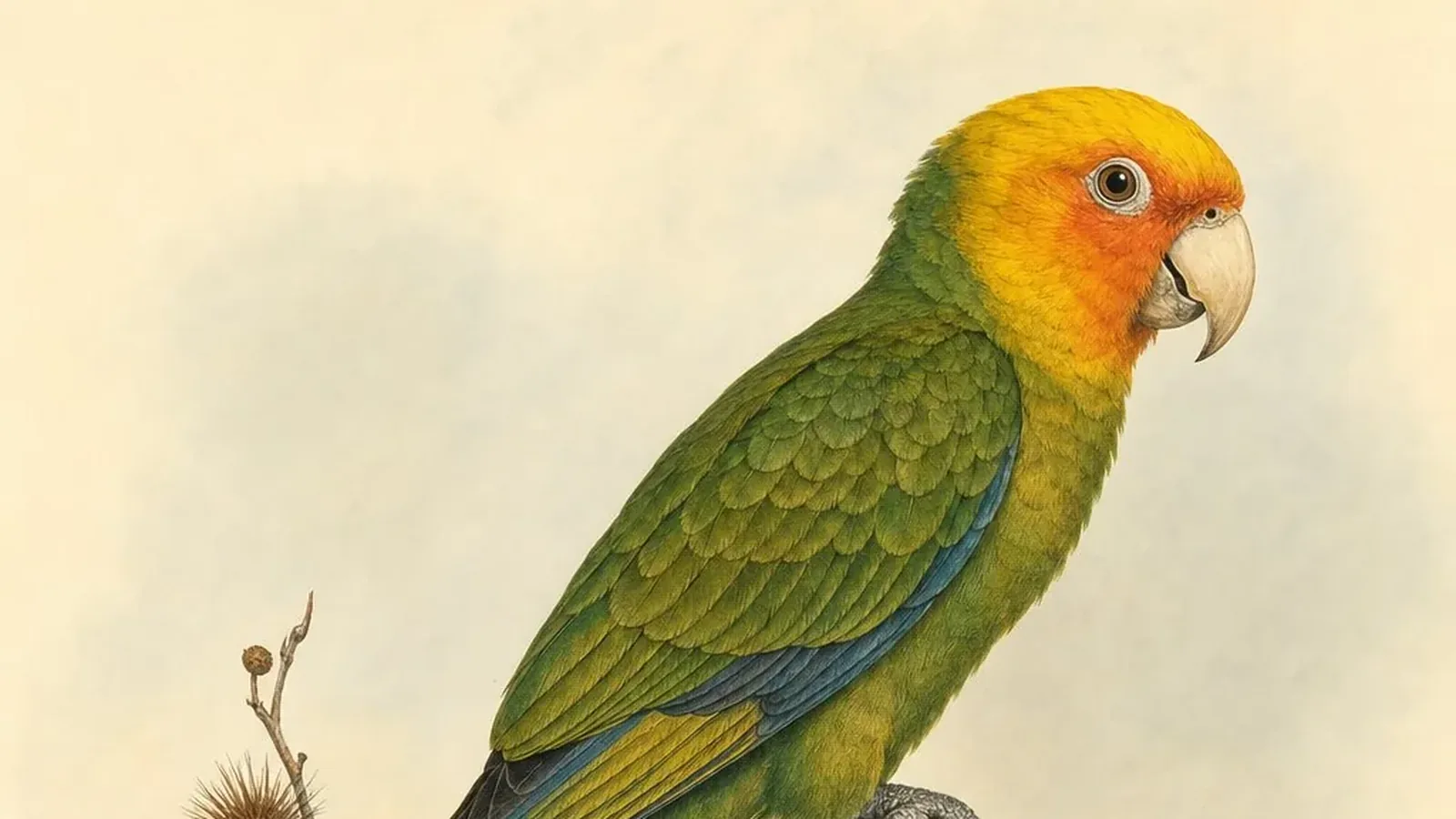
The colouring was impossible to mistake. The body was bright green, paler and yellower on the underparts. The head was vivid yellow from the throat upward, and the forehead, lores, and the skin around the eyes were deep orange, an orange that extended behind the eye as a distinct patch. The bend of the wing and the thighs were also yellow. The bill was pale horn, the feet and legs pinkish brown.
Audubon, writing in The Birds of America (1827-1838), described flocks settling on the ground so densely that they presented “the same effect as if a brilliantly covered carpet had been thrown over them.” That description is ornithological record as much as literary performance. He was writing down what he saw.
| Measurement | Value |
|---|---|
| Length | 30-34 cm |
| Weight | approximately 280 g |
| Wingspan | 53-58 cm |
| Captive lifespan (Incas) | approx. 33 years |
Juveniles lacked the orange face entirely. Their heads were dull green shading toward brownish-orange at the forehead, a plumage they held until their first moult. Male and female adults were alike in colour, with males marginally larger.
The only parrot of the eastern woods
No other parrot ranged this far north or this far into the continent’s interior. The Carolina Parakeet occupied the forests of the eastern United States from the Gulf coast north to New York and west to eastern Nebraska and Colorado. It was most abundant in the bottomland river forests and cypress swamps of the Southeast, the dense, wet, tall-timbered country along the Ohio, the Missouri, and the Mississippi. It was a bird of the flood-plain.
The river swamps of Florida once held flocks year-round, and the Florida population - the eastern subspecies C. c. carolinensis - appears to have been largely resident. The western subspecies C. c. ludovicianus, which spread through the Mississippi drainage and into the Missouri River basin, was likely a seasonal migrant, moving south and east in winter. Burgio, Carlson, and Tingley, writing in Ecology and Evolution in 2017, used machine-learning analysis of 450 years of historical records to reconstruct the species’ range and found it was considerably more restricted than 20th-century estimates had assumed - and more tightly tied to low-elevation bald cypress and sycamore systems than earlier accounts had suggested.
Bald cypress was the axis around which the bird’s life turned. It roosted in cypress cavities, nested there, and fed on the seeds of the trees around them. The fully feathered ceres - the fleshy covering at the base of the bill, unusual in parrots for being covered in feathers rather than bare skin - may have provided insulation against the cold winters of the northern part of its range.
It was a gregarious bird in every sense. It moved in flocks of 100 to 300 birds and sometimes more, flying with quick, direct wingbeats and calling constantly in flight. Audubon described the calls as loud enough to be heard from far off. On the ground and in the trees, the flock maintained a low, continuous chatter. It was never a quiet bird.
Why the flocks died
The Carolina Parakeet was not secretive, not scarce, not confined to inaccessible terrain. It was a bright, noisy, abundant bird that arrived in large flocks on apple orchards, peach trees, and grain fields and ate with destructive efficiency. The Puerto Rican Parrot is now down to a remnant population partly because its habitat has been stripped away. The Carolina Parakeet’s destruction was more direct: it was killed by the people whose crops it raided, and then killed again for its feathers.
The birds were not difficult to kill. This is the hard fact at the centre of the species’ story. When a flock member was shot and fell, the others in the flock did not scatter. They wheeled, they returned, they gathered around the fallen bird, calling. A farmer with a shotgun could stand in an orchard and work his way through an entire flock, bird by bird, because each volley brought the survivors back within range. Noel Snyder, whose 2004 book The Carolina Parakeet: Glimpses of a Vanished Bird (Princeton University Press) remains the most thorough treatment of the species, described this flock coherence as one of the decisive factors in the birds’ vulnerability to shooting. The same bond that made them effective foragers - the tendency to maintain contact with distressed flock-mates - made them catastrophically easy to destroy.
Then there was the millinery trade. Through the late 19th century, the fashion industry in Europe and North America consumed wild bird feathers on a scale that is difficult to comprehend now. The iridescent green and yellow plumage of the Carolina Parakeet was among the feathers taken for decorating women’s hats. Dough and Powell, writing for NCpedia (2006), documented both the shooting-as-pest-control and the trade in feathers as concurrent pressures. The birds had no respite from either.
Snyder also advanced a disease hypothesis: that the Carolina Parakeet’s attraction to cocklebur seeds, which brought it into contact with farms, livestock, and the pathogens settlers carried, may have exposed the species to diseases to which it had no immunity. This remains unproven but not implausible. What is certain is that the combined pressures - habitat loss as bottomland forests were cleared, persecution as a crop pest, shooting for the feather trade, and possible introduced disease - collapsed a population that had once been one of the most numerous birds in the eastern woodlands. The decline was not gradual in the final decades. It went fast.
The last confirmed wild sightings came from Florida in the early 1900s, with unconfirmed reports from the Okeechobee swamp into the late 1920s and from the lower Santee River in South Carolina into the late 1930s, according to Snyder’s compilation of historical accounts.
The last bird
“I have looked upon him almost daily for the past four years. He is the last of his race. The sorrow and pity of it - I cannot express it.”
- Cincinnati Zoo keeper, quoted in contemporary accounts of Incas’s final months
Incas arrived at the Cincinnati Zoo in 1885. He was purchased with 15 other birds for $40, the zoo hoping to establish a captive breeding population. Over 32 years, he and Lady Jane laid eggs repeatedly. They rolled them from the nest every time. When Lady Jane died in the summer of 1917, zoo keepers noted that Incas became withdrawn, noticeably changed in behaviour. He died seven months later, on February 21, 1918. In the 48 hours before his death, Cincinnati had experienced unseasonably severe cold, with temperatures dropping to 7 degrees Fahrenheit.
The species was formally declared extinct by the American Ornithological Society in 1939, though the practical extinction dated to 1918. Incas’s body was promised to the Smithsonian Institution but never arrived. Its final resting place is unknown.
The same cage had held Martha. The last Passenger Pigeon had died there on September 1, 1914. Incas outlived her by less than four years. The Cincinnati Zoo, within the span of a single decade, bore witness to two of the most consequential extinctions in North American natural history.
What it ate
The Carolina Parakeet was primarily a seed-eater, with a strong preference for cocklebur (Xanthium species), thistle, and the seeds of native trees including maple, elm, pine, and sycamore. As forests were cleared and farmland expanded, the birds shifted toward orchard fruit - not the flesh but the seeds inside, which they extracted by ripping unripe fruit open and discarding the pulp. This made them serious pests to fruit-growers, and it sealed their fate on farm after farm. They also took beechnuts, chinquapins, and birch buds in autumn and spring respectively.
Cocklebur seeds contain a glycoside, carboxyatractyloside, that is toxic to many animals. The Carolina Parakeet consumed them regularly and without apparent harm. Audubon noted that cats died after eating parakeets, which has since been taken as circumstantial evidence that the birds may have sequestered some toxicity from the cocklebur in their own flesh. Snyder examined this hypothesis in detail but could not confirm it from the available evidence. The birds were certainly resistant to the cocklebur’s toxin. Whether that resistance made them distasteful to predators is still open.
What we lost
There is a kind of specificity to this extinction that is worth holding. The Carolina Parakeet was not a peripheral or specialist species clinging to a narrow habitat. It was a central, conspicuous, abundant element of the eastern forest ecosystem. It nested in the same cavities that other species depended on. It ate the seeds of cocklebur, a weedy plant that thrives where forests are disturbed - meaning the bird was most numerous precisely at the forest edges that human settlement was creating. It should have been, on paper, adaptable. It was not.
What the losses at Cincinnati tell us is something about the nature of sociality as a survival strategy. The flock coherence that made Conuropsis carolinensis an effective forager - the willingness to return to distressed flock-mates, to call and gather rather than scatter - was the same quality that allowed an entire flock to be shot out of a tree. What works in a world without systematic persecution fails catastrophically when the threat is human and persistent. The Passenger Pigeon’s extinction worked the same way. The same cage. Two birds. The same lesson, not learned in time.
Audubon painted Conuropsis carolinensis from living specimens. He wrote down its calls, its habits, its food, its sociability. He noted, toward the end of his field work in the 1820s and 1830s, that it was already retreating, already quieter in places where it had once been noisy. He was among the last naturalists to know it as a common bird, and he knew what he was seeing. That his paintings and accounts are now the most detailed evidence we have of how it moved and what it looked like is the measure of what we lost - not an abstraction, but a specific green-and-gold bird that once filled the river forests of the eastern woods with noise, and does not anymore.