Field Guide
Kirtland's Warbler
It is mid-May in the jack-pine plain north of Mio, Michigan. The trees here are ten years old, shoulder-high, their branches still low enough to brush the sand. A male Setophaga kirtlandii - Kirtland’s Warbler - mounts the tip of a pine and opens his throat. The song is loud, low-pitched, bubbling, rising at the end: a three-part phrase that carries two hundred metres across the open ground. He bobs his tail steadily while he sings. The soil under his pine is Grayling sand - dry, nutrient-poor, almost white. Fifty miles in any direction there is no habitat that will do. He has flown from the Bahamas to be precisely here.
What it looks like
Setophaga kirtlandii is a large warbler by the standards of the family - in fact the largest of the 35-plus species now placed in the genus Setophaga. It measures 14 to 15 centimetres in length, weighs 12 to 16 grams, and spans roughly 20 to 22 centimetres across the wing, perceptibly bigger than the yellow warbler that shares its family.
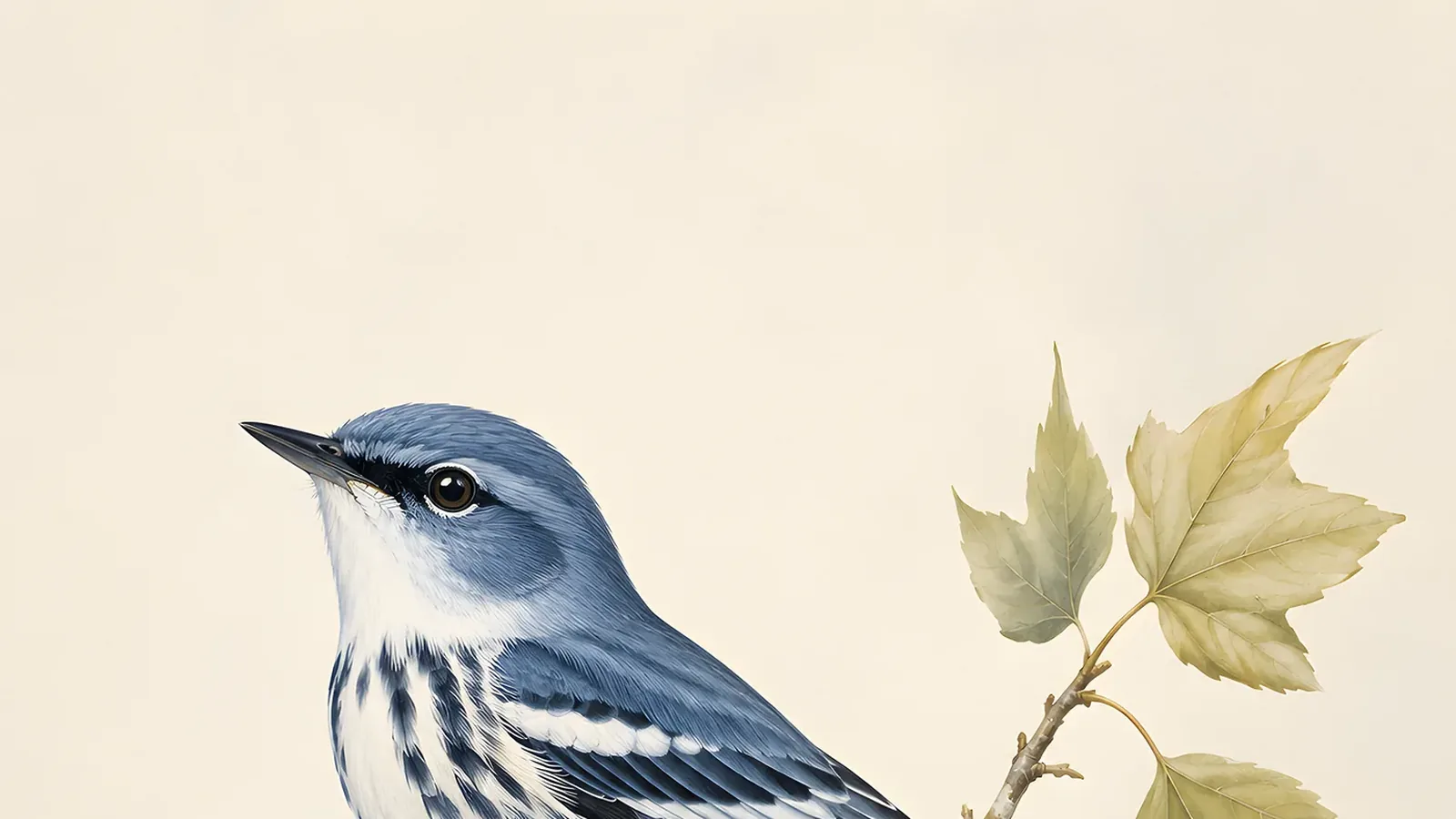
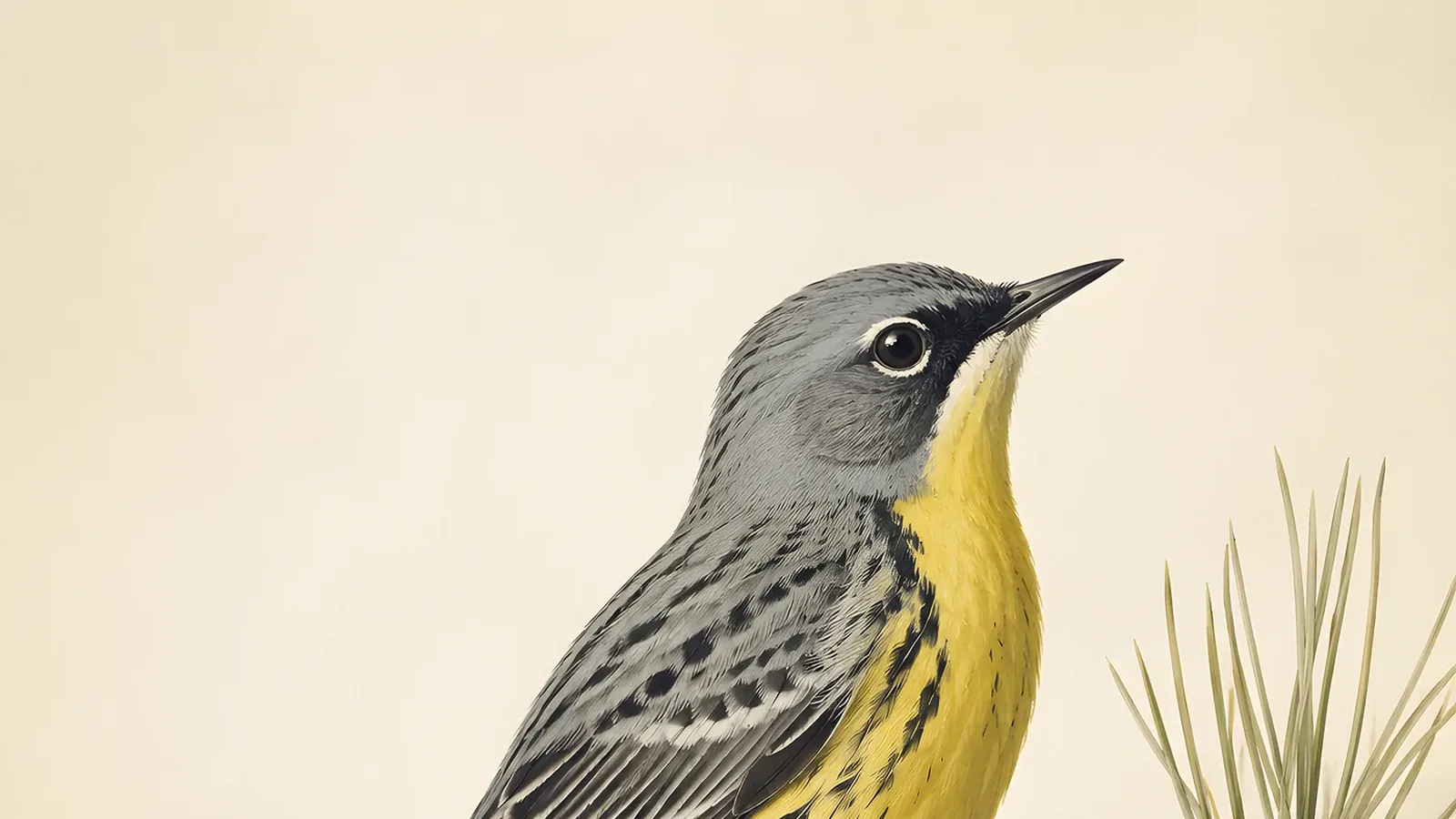
The male’s head and back are blue-grey, streaked darker on the mantle. The underparts are yellow from throat to belly, broken by dark streaking along the flanks and sides. The lores are black, giving the face a masked look. Thin white crescents arc above and below the eye - not a full ring, but two separate arcs that catch the light. No other Michigan-breeding warbler carries that combination of grey above, yellow below, and black lores. The female is browner and less boldly marked, but shares the same structural cues: the yellow belly, the white eye-arcs, the faint flank streaks.
One behaviour marks this bird at any distance. It bobs its tail continuously while perched - a steady, rhythmic pump uncommon in northern wood-warblers and useful for immediate identification when the plumage is in shadow.
| Feature | Measurement |
|---|---|
| Length | 14 - 15 cm |
| Weight | 12 - 16 g |
| Wingspan | 20 - 22 cm |
| Lifespan (wild) | up to 9 years |
| Clutch size | 3 - 6 eggs |
| Incubation | 13 - 15 days |
The jack pine and the fire
Few breeding habitats in North American ornithology are as narrow as this one.
Kirtland’s Warbler nests on the ground, always under the living branches of young jack pine (Pinus banksiana), always on Grayling sand - a well-drained, coarse-grained soil type found in a corridor of northern Michigan counties that amounts to roughly 70 by 90 miles. The trees must be the right age. Warblers abandon stands younger than about five years (branches not yet low enough to conceal a nest) and avoid stands older than about 20 years (lower branches dying off, ground cover thickening). The window of usable habitat is roughly 15 years per stand. Then the forest moves on, and the warbler must follow.
This dependence is not accidental. It is the product of a long co-evolution with fire. Jack pine cones are serotinous - sealed with resin that melts only at the temperature of wildfire, releasing seeds in the hours after a burn passes through. The sandy, open ground that follows is exactly what the young pines colonise fastest. For millennia, lightning fires moved across these plains every few decades, resetting the forest clock and generating the rolling mosaic of age-classes that kept Kirtland’s Warbler supplied with habitat. The relationship between this bird, this tree, and this soil is as tight as any in North American ecology.
Fire suppression changed everything. From 1946 onward, federal and state agencies controlled burns across Michigan’s national forests. The jack pines matured beyond the warbler’s threshold. Young stands stopped regenerating. By the early 1970s, suitable habitat had contracted to a fraction of its former range.
167 males
In 1971, the annual census counted 201 singing males across the entire breeding range. Three years later, in 1974, that number fell to 167 - the lowest ever recorded. The same low was touched again in 1987.
To hold that number in mind for a moment: every Kirtland’s Warbler breeding male on earth could have been counted in a single northern Michigan county on a single June morning.
Two forces drove the collapse together. Fire suppression had removed the process that built new habitat. Brown-headed Cowbirds, expanding into northern Michigan with agriculture, were parasitising warbler nests at rates exceeding 70 percent in some areas - laying their eggs in warbler cups, letting the larger cowbird chick outcompete the smaller nestlings. Wilson, Marra, and Fleischer (2012, BMC Ecology, vol. 12) estimated through genetic analysis that the effective population size at this bottleneck was approximately 161 individuals - smaller even than the singing-male count suggested. Allelic richness was being lost with every generation that could not replace itself.
The cowbird war
The U.S. Fish and Wildlife Service began trapping Brown-headed Cowbirds on the breeding grounds in 1972. Cage traps were set across the jack-pine plains each spring. Research published in the Journal of Wildlife Management documented that cowbird parasitism dropped below one percent once trapping was fully operational. That difference - from above 70 percent to below one - is the difference between a population that replaces itself and one that does not.
By the mid-1990s, cowbird control had been running for over two decades and the tree-planting programmes were building the habitat bank that suppressed fires had destroyed. The U.S. Forest Service, the Michigan Department of Natural Resources, and the USFWS were working in rotation - cutting mature jack pine, replanting seedlings, burning where burning was safe - to maintain more than 150,000 acres of managed forest specifically for this bird.
The population responded. One hundred and sixty-seven singing males in 1974. Over 1,000 pairs by 2001 - the recovery plan target surpassed for the first time. Over 1,700 singing males by 2010. More than 2,300 pairs by 2019.
Range and the Bahamas winter
The breeding range, even now, is compact. The great majority of nests occur in a cluster of counties in the northern Lower Peninsula of Michigan, centred on Oscoda, Crawford, and Roscommon counties. Small breeding populations have established in Wisconsin and Ontario as the overall population has grown, but Michigan remains the core. The entire species breeds in an area that could be covered by a medium-sized county.
Migration is seldom witnessed. Most observers who have spent decades in the field have never seen one in transit.
The Bahamas receive them in October. Sykes and Clench (1998, The Wilson Bulletin, vol. 110, no. 2) documented the winter range across 13 islands of the Bahamian archipelago, with the densest use in central Eleuthera and secondary populations on Grand Turk, North Caicos, and Crooked Island. On the wintering grounds the bird retreats into low scrub - natural shrub and secondary growth under six metres in height, dense enough for concealment, open enough to forage through. The entire known world population of Kirtland’s Warbler spends the winter within the range of a single tropical storm system. That geographical concentration remains the species’ most serious long-term vulnerability.
Brown, Donner, Ribic, and Bocetti (2019, Ecology and Evolution, vol. 9, no. 18) modelled the long-term viability of the population under various climate and management scenarios. Under projected reductions in March precipitation at the Bahamas wintering grounds, 95 percent of their simulations fell below the critical threshold of 200 breeding males. The jack-pine plains of Michigan were secured. The Caribbean scrub was not.
Delisted
On November 8, 2019, the U.S. Fish and Wildlife Service officially removed Kirtland’s Warbler from the Federal List of Endangered and Threatened Wildlife. The species had been listed since 1967. Its recovery took 47 years and three overlapping programmes - annual cowbird trapping, managed jack-pine rotation across hundreds of thousands of acres, and continuous population monitoring. It was the first warbler ever delisted in the United States due to successful recovery.
“The Kirtland’s warbler persists only through continual management activities designed to mitigate recurrent threats to the species.” - USFWS Federal Register, 2019
The IUCN lists the species as Near Threatened (NT) - an assessment that reflects the genuine recovery while acknowledging that the population remains conservation-reliant. As a condition of delisting, the USFWS, U.S. Forest Service, and Michigan DNR signed a memorandum of understanding committing to continued habitat management at levels sufficient to sustain the population. The cowbird traps still run each spring. The planting crews still go out each autumn. The managed burns continue.
The cerulean warbler is disappearing from its Appalachian breeding forest with no recovery programme of equivalent scale and no clear end point in sight. Kirtland’s is the proof that a songbird can come back from 167 individuals. It is also the proof of what that takes: not a single intervention but a permanent commitment, measured not in project cycles but in generations of sustained institutional effort. The jack pines that a singing male needs in 2026 were planted by someone in 2006. The ones he will need in 2041 are being planted now, by agencies that have agreed - on paper, in a signed memorandum - to keep planting them.
The argument the Kirtland’s Warbler makes, silently, from the top of a ten-year-old pine, is this: species do not recover on their own. They recover because specific humans made specific choices and kept making them, decade after decade, in a wet May morning on sandy ground in northern Michigan, when no one was watching.