Field Guide
Cassia Crossbill
A male Loxia sinesciuris braces against a cone. The lodgepole pine has not let go of its seed willingly - the distal scales, thick as a boot sole, clamp shut against the August heat. The bird wedges its lower mandible beneath the scale, twists, and levers. The scale lifts. The seed drops. This is not incidental behaviour. It is the entire reason this bird is a species.
The Cassia Crossbill is the smallest bird range in North America. Six thousand individuals. Two mountain ranges. One county in Idaho. And an argument with a pine tree that has been running for thousands of years.
What it looks like
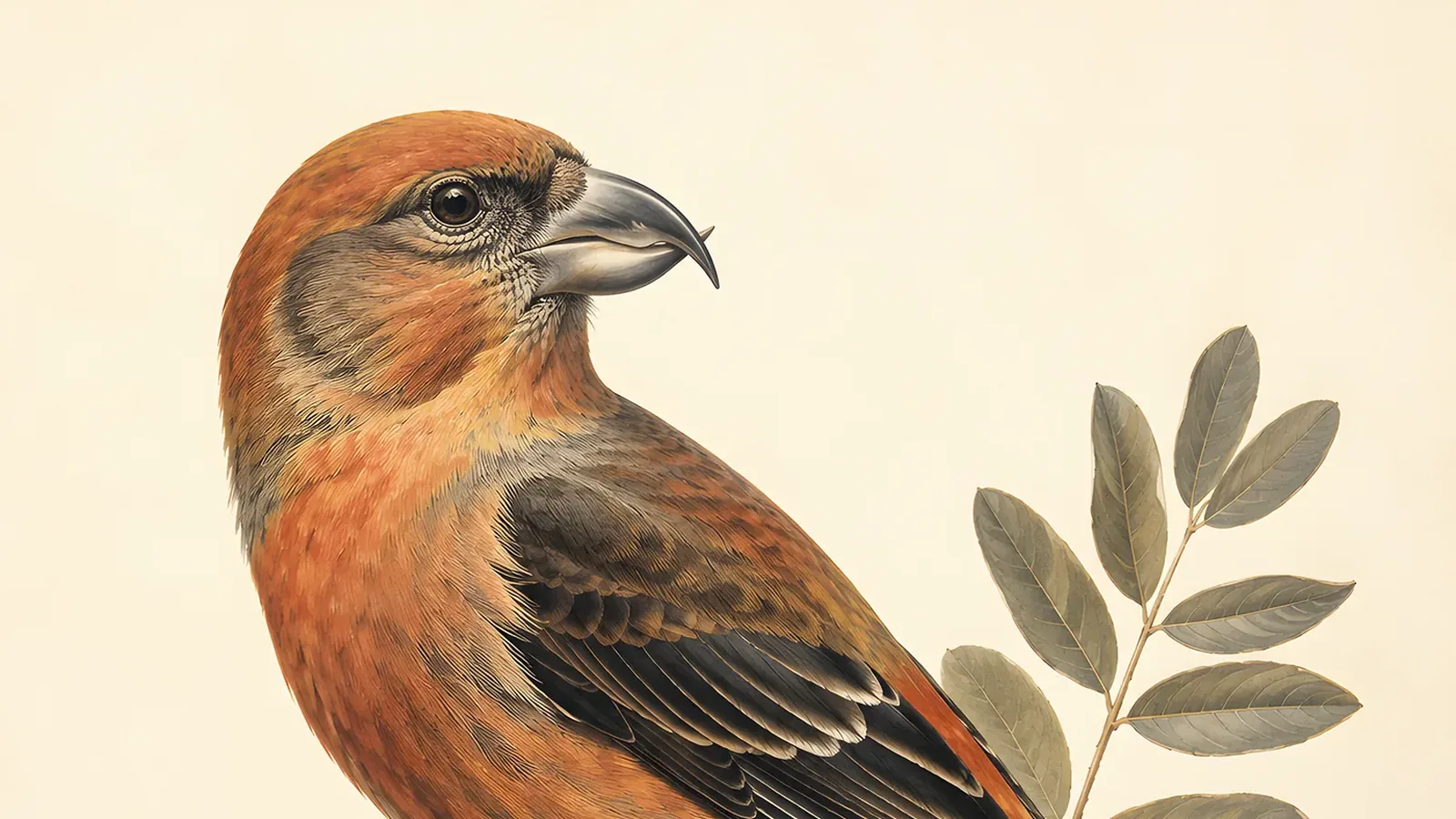
The male is brick-red - the red of old tile, not traffic lights. The crown, breast, and belly carry this warm flush, while the flight feathers and tail hold a deep brown that darkens to near-black at the wingtips. The female is olive-green to yellow-olive, with a yellower rump and faint streaks across the breast. Both sexes have the same hallmark of every crossbill: the bill tips scissored past each other, upper mandible curving one way and lower the other.
The Cassia Crossbill is almost indistinguishable from its nearest relative the Red Crossbill by eye. What sets it apart is scale: the bill runs measurably deeper, averaging 8.9 to 10.6 mm in depth compared to the shorter, flatter bill of the Red Crossbill types sharing adjacent ranges. The body runs heavier too, 29 to 44 grams, and the wings measure 85 to 100 mm.
| Measurement | Value |
|---|---|
| Length | 16 cm |
| Weight | 29 - 44 g |
| Wing length | 85 - 100 mm |
| Bill depth | 8.9 - 10.6 mm |
| IUCN status | Least Concern (LC) |
You will not find this bird by plumage. You find it by location - if you are in the South Hills or the Albion Mountains, you are in the right place. If you are anywhere else, you are not.
The arms race
The science behind this bird is among the cleaner demonstrations of coevolution in ornithology, and it belongs almost entirely to Craig W. Benkman, who has studied the South Hills population since the 1980s.
The argument runs as follows. In most of the Rocky Mountain West, lodgepole pines have two primary seed predators: red squirrels (Tamiasciurus hudsonicus) and crossbills. Squirrels harvest cones wholesale - they cut them from the tree in autumn and cache them in middens, where the cones stay closed and the seeds preserved. That harvesting behaviour selects for a particular cone type: short, armed with thick basal scales that squirrels find harder to process, and quick to open and shed seed when the squirrel pressure is absent. Crossbills, meanwhile, select for something different entirely. They want cones that stay on the tree through winter, sealed tight, holding seed as a standing resource. Those competing pressures cancel each other out across most of the range.
The South Hills and Albion Mountains have no red squirrels. They never did.
With squirrels gone, crossbills became the only agent of selection on the pine. The pines responded. Over generations, the trees in these two ranges evolved cones with heavier, thicker distal scales - the ones crossbills pry at first, because that is where the majority of seeds sit. Benkman, Parchman, Favis, and Siepielski documented this directly in 2003, demonstrating that South Hills cones carry heavier scales than cones from ranges where squirrels are present, and that crossbills were the selective force driving that divergence. (Benkman et al., The American Naturalist, 162: 182-194, 2003.)
The crossbills had to answer back. A deeper bill can generate more torque against a thicker scale. The South Hills population evolved deeper bills than any other Red Crossbill type in the region. The pines got harder. The birds got stronger. Then the pines got harder again. Parchman et al. confirmed in 2016 that the population is now genomically distinct, with more than 18,000 SNP markers separating South Hills birds from all other crossbill types, with principal component analysis placing them in a monophyletic cluster of their own (Molecular Ecology, 2016). The American Ornithological Society recognised the Cassia Crossbill as a full species the following year, in 2017.
“Preferential foraging by crossbills on lodgepole pine cones in the South Hills, where Tamiasciurus are absent, has led to the evolution of larger, thicker-scaled cones than in nearby ranges where red squirrels are present.” - Benkman et al., The American Naturalist, 2003
Two mountain ranges
This is a bird that lives inside a fence post. The South Hills rise above 2,400 metres south of Twin Falls, Idaho. The Albion Mountains sit 30 kilometres to the east. Together they hold roughly 67 square kilometres of lodgepole pine forest. That is it. That is the world.
Behl and Benkman estimated the total population at approximately 5,800 individuals (95% CI: 3,100 to 11,000) in a survey conducted in fall 2016, making the Cassia Crossbill one of the rarest endemic birds in the continental United States by absolute number. (The Condor: Ornithological Applications, 120: 2018.) They found crossbills concentrated on north-facing slopes, where the canopy moderates temperature and serotinous cones - cones that require heat to open - stay sealed longer into the summer, preserving the seed bank the birds depend on.
Unlike every other crossbill in North America, the Cassia Crossbill does not irrupt. Other crossbill species are nomads, following cone crops across continents, appearing in thousands one winter and vanishing the next. The Cassia Crossbill cannot do that. Its bill is tuned too precisely to a single cone type to forage efficiently elsewhere, and the lodgepole cone bank in the South Hills is, in most years, reliable enough to sustain a year-round resident population. The species mates assortatively at extremely high rates - birds match with others of the same call type - which keeps it reproductively isolated from the nomadic Red Crossbills that pass through.
This residency is both the proof of its isolation and the source of its vulnerability.
The crossed bill
The crossed bill is one of the stranger tools in all of vertebrate anatomy. It looks like a mistake.
The mandibles are not aligned but offset - in roughly half the population, the lower crosses to the right, and in the other half, to the left. The bird wedges the lower mandible beneath a cone scale, closes the jaw, and the crossed tips act as a lever. As the bill closes and the crossing angle increases, the torque against the scale increases. The seed pops free.
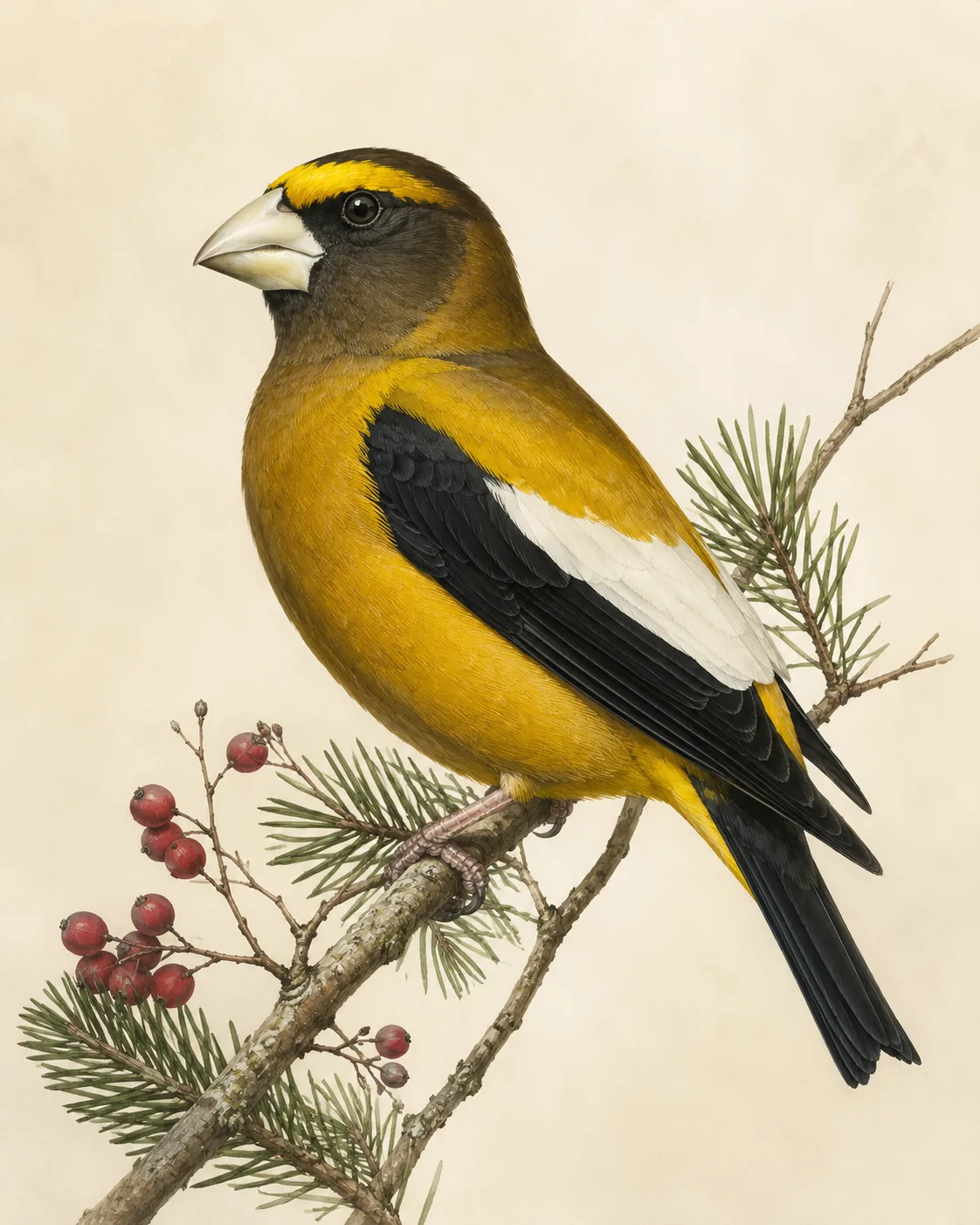
The evening grosbeak cracks a seed by crushing it directly between two massive, symmetric mandibles. The crossbill does something stranger: it pries. The crossed tips work like a lever, and the deeper the bill, the more force it can apply. In a cone with scales as thick as those South Hills pines now produce, a shallow-billed crossbill loses. A deeper bill wins. Generation by generation, that differential survival is what has driven the Cassia Crossbill’s bill beyond anything the broader Red Crossbill complex has produced.
What it sounds like
Flight calls are the primary field character and they are reliably different from the Red Crossbill types that share the region. The call is lower-pitched, dry, and hard - closer to chup-chup or dip-dip-dip than the higher, more liquid kyip-kyip of the commonest regional crossbills. Benkman’s original work on crossbill types identified call type as the primary mechanism of assortative mating: birds of a given type preferentially flock and breed with birds giving the same call, which is the behavioural gate keeping the Cassia lineage separate despite geographic proximity to other crossbills.
The song runs more buzzy than whistled, with a repetitive, slightly grinding quality. You are unlikely to hear it unless you are in the South Hills in late winter, when breeding has already begun.
Breeding and the threat
The Cassia Crossbill begins building its open cup nest in late March or early April, considerably earlier than most mountain passerines in Idaho. The female incubates two to four eggs for approximately 14 days. Young fledge at 18 to 22 days. The breeding season runs through late July, tied not to temperature or photoperiod in the usual way but to the availability of seeds in the cone bank - the bird breeds when the resource is present.
This is its most dangerous trait.
Serotinous lodgepole pine cones are normally sealed shut by resin. They require heat to open. In a normal year the seeds disperse slowly, and the birds can exploit the standing crop through winter and spring. But in a hot summer - above 32 degrees Celsius is the critical threshold - cones open early and shed seed before the birds can use it. Behl and Benkman’s survey found an estimated 80 per cent population decline between 2003 and 2011, a period that included several anomalously hot summers. Models project that lodgepole pine could be extirpated from south-central Idaho by 2080 as temperatures continue to climb.
The bird is also acutely exposed to wildfire. The South Hills and Albion Mountains are not large. A fire on the scale of those now burning across the American West could eliminate a meaningful fraction of the total habitat in a single season. There is no refuge elsewhere. The coevolutionary tightness that made this bird is the same tightness that leaves it nowhere to go.
The IUCN currently lists the Cassia Crossbill as Least Concern, which technically means what it says: the population is not currently in rapid decline. It does not mean the bird is safe. It means we are still in the interval between the recognition of a species and the formal documentation of its collapse.
The South Hills crossbill exists because the lodgepole pine found a way to make its seeds harder to reach, and a bird found a way to reach them anyway. That negotiation has been running since before these mountain ranges existed in their current form - the forest patch that holds this entire species was probably absent as recently as 6,000 years ago. The bird evolved, speciated, and became irreplaceable faster than a civilisation rises. Whether the next 6,000 years include it depends almost entirely on whether those north-facing slopes stay cool enough, wet enough, and forested enough for the cones to stay closed until the bird is ready.
The pine is still evolving. Whether it evolves fast enough is the question neither the bird nor the tree can answer.