Field Guide
Common Raven
On a January morning in the White Mountains, a raven circles a wolf kill at 400 metres, watching. Two more land. Then one flies off in a direction that does not go toward the carcass. It goes toward where two other ravens are roosting in a stand of spruce. Within 20 minutes the whole group returns together and the wolves, outnumbered at their own kill, give ground.
This is not a fairy tale. It is field observation documented by biologist Bernd Heinrich across decades of work in Maine and Vermont. Corvus corax does not merely find food. It recruits. It communicates. It reads a situation and responds to it in ways that behavioural ecologists still struggle to classify cleanly.
The thesis here is not that the raven is “smart” in some loose popular sense. It is something more precise: the raven has demonstrably broken through the ceiling that limits most bird cognition, and understanding how it lives - where, on what, with whom - only makes sense once you accept that premise.
What it looks like
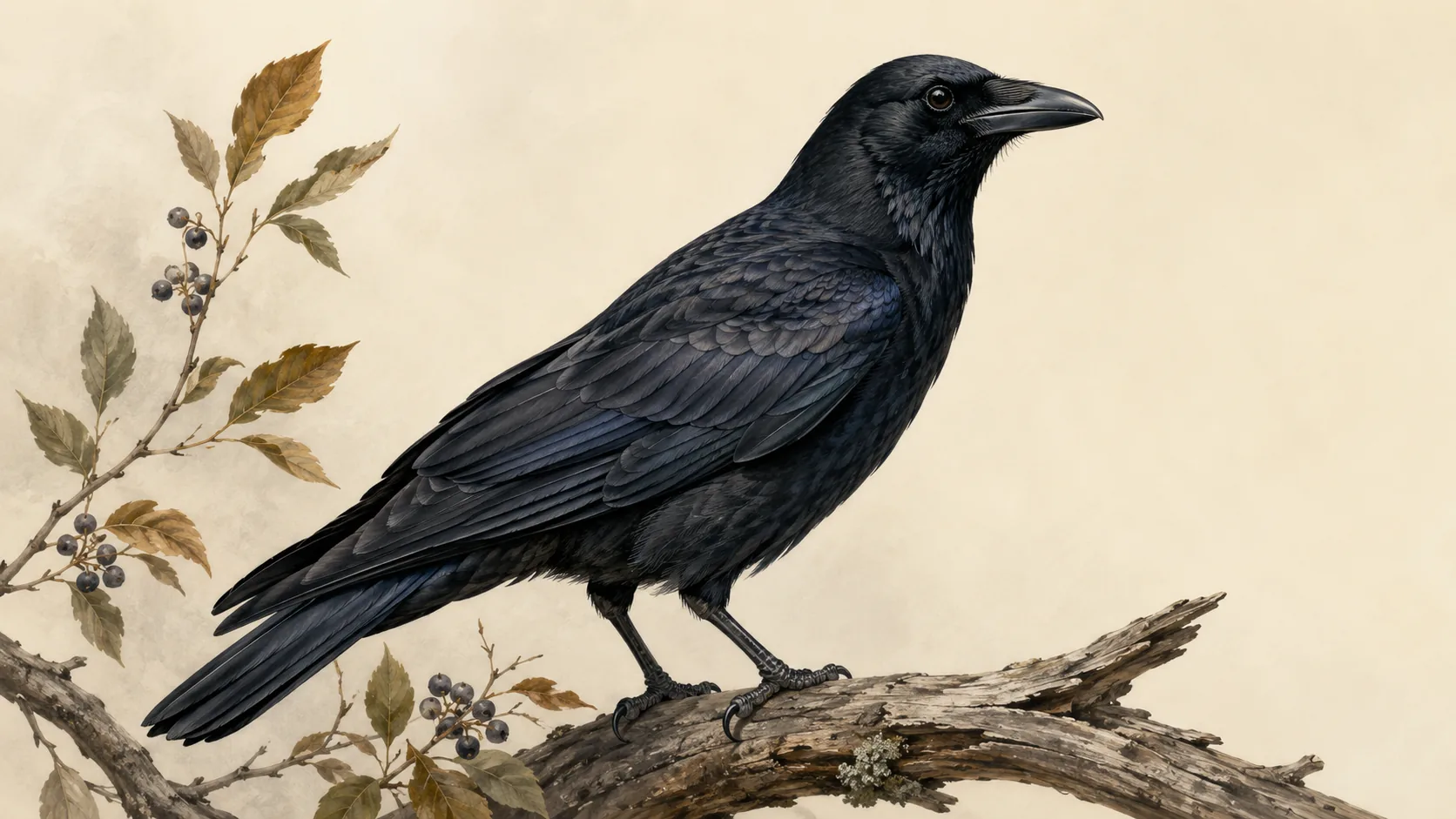
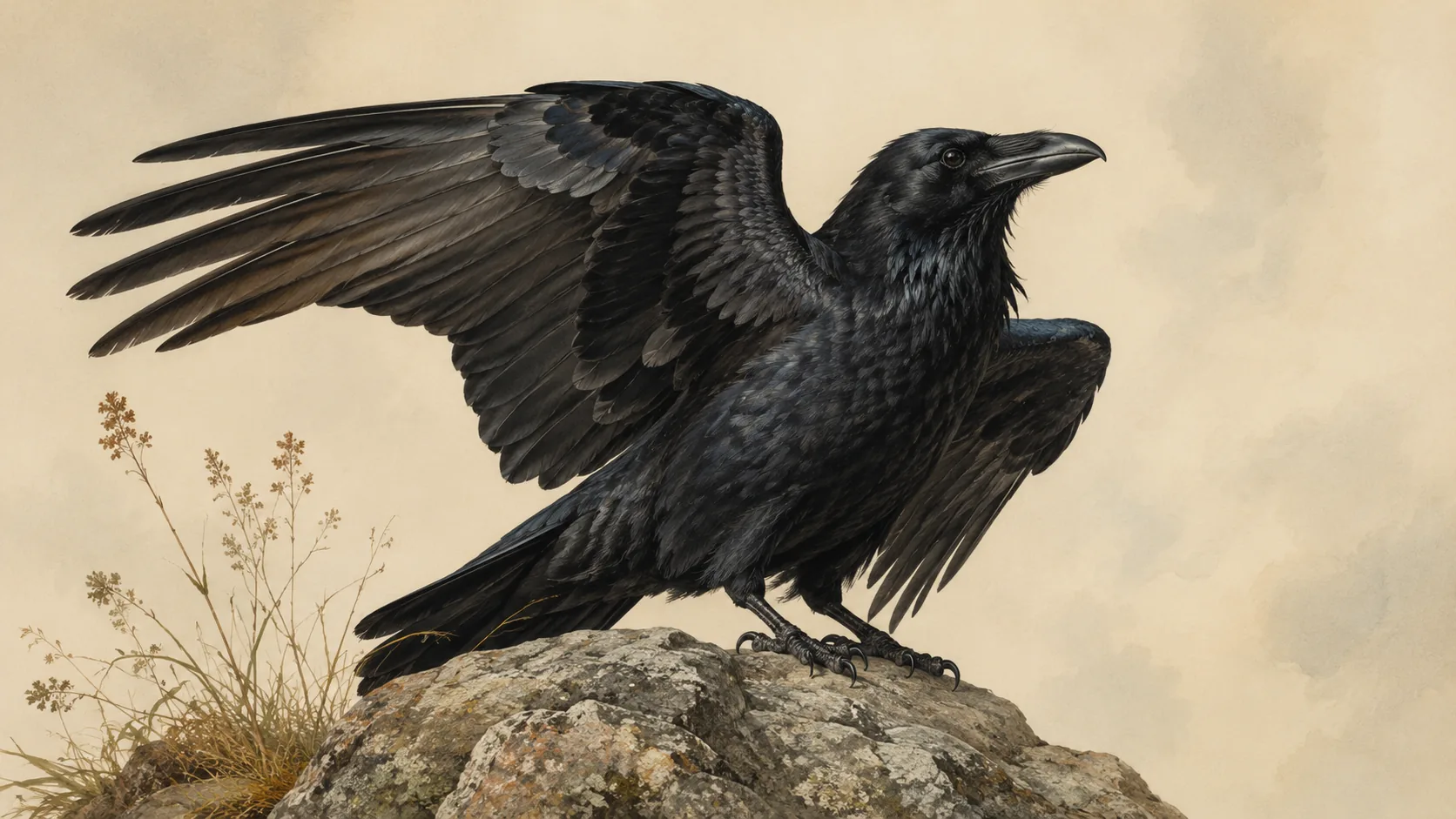
The Common Raven is the largest passerine on earth. At 56 to 69 centimetres from bill tip to tail, it approaches the size of a Red-tailed Hawk. It weighs between 689 grams and 1.6 kilograms - heavier than most birders expect when they first encounter one up close. The wingspan runs 116 to 118 centimetres.
Everything about it is black. Not the flat matte black of a starling, but an iridescent black that shifts through violet, blue-green, and deep purple as the angle of light changes. The bill is heavy and slightly arched, built for tearing. The throat carries long, shaggy hackle feathers that flare when the bird calls or displays - a feature that separates it immediately from the American Crow, which has a smooth throat. In flight, the tail is wedge-shaped rather than the American Crow’s rounded fan: the single most reliable field mark at distance.
The voice is the other give-away. Where a crow produces a clipped, nasal caw, a raven delivers a deep, rolling cronk that carries across a kilometre of still air. Heinrich and others have catalogued a repertoire of at least 33 distinct call types in wild populations - bell-like knocking notes, guttural gurgles, and close imitation of other species.
Range and habitat
The Audubon field guide records the raven across Alaska, northern and western Canada, the western and northeastern United States, and down into the Appalachians and the desert Southwest. In Europe and Asia the range extends from Scandinavia to the Pacific coast, and south through North Africa. Cornell’s Birds of the World notes it as “the largest-bodied of all passerines” and one of the most geographically widespread of any land bird.
It favours terrain that offers both open foraging ground and cliff or large-tree nest sites: boreal forest, mountain slopes, coastline, arctic tundra, and the canyon country of the American West. It has expanded into the Mojave and Sonoran deserts over the past century, partly following human settlement and its attendant landfills, partly following the decline of large predators that once held it in check. The Audubon guide documents it equally in “boreal and mountain forests, coastal cliffs, tundra, and desert.”
It is resident year-round across most of its range. Some high-altitude individuals move to lower elevations in winter, but this is altitudinal drift rather than true long-distance migration.
Diet
The raven is an omnivore with an emphasis on opportunism. Audubon records “insects, including beetles and caterpillars, small vertebrates such as rodents, lizards, and frogs, eggs and young of other birds.” It scavenges carrion regularly - Wolf country in North America is raven country precisely because wolf kills provide reliable large-carcass access through winter. A raven can consume roughly 900 grams of food in one sitting and cache the surplus, returning to buried caches over subsequent days.
The wolf-raven relationship documented by Heinrich is not incidental. Ravens locate carcasses, ravens call to recruit other ravens, and in doing so they also signal wolves to the location - or follow wolves to locate carcasses they could not otherwise detect. The relationship runs in both directions and has been maintained across thousands of years of shared range.
Breeding and nesting
Pairs form early. Courtship flights over breeding territory in February and March involve aerial rolls, tumbles, and prolonged soaring in contact, with mutual preening on prominent perches. The pair bond is long-term, often persisting across multiple breeding seasons.
The nest is a large basket of sticks and branches lined with moss, bark strips, and animal hair, typically placed on a cliff ledge or in the canopy of a tall conifer. The Audubon guide gives clutch size as four to six eggs, with incubation lasting roughly 18 to 21 days. Young fledge at approximately five to six weeks. The nest site is reused year after year, rebuilt with fresh material each season.
Ravens do not tolerate other ravens in their breeding territory. A bonded pair will chase intruders persistently and at length. Non-breeding juveniles and young adults form loose roaming flocks - the groups observed at wolf kills and landfills are these floaters, not established breeders.
The problem-solving question
In his 1999 book Mind of the Raven, Heinrich describes an experiment that became a landmark in corvid cognition research. A piece of meat was suspended on a long string hanging from a branch. A perching raven could not simply grab it - the string was too long to pull up in one motion. The solution required a sequence: pull up a loop of string with the bill, stand on the loop, pull up another loop, stand on that, repeat until the food was within reach. Ravens achieved this without prior training, and on first encounter.
The relevance is not that ravens are good at tricks. It is that the solution requires holding a goal in working memory across multiple physical steps, each of which temporarily obscures the food from view. This is the same category of cognition that developmental psychologists call “means-end reasoning” in human children, typically appearing around 18 to 24 months of age.
Cornell’s Birds of the World records the raven’s documented association with wolves, human settlements, and garbage dumps, noting it as “increasingly colonizing urban environments” - an expansion driven precisely by this cognitive flexibility. A species that can reason its way around novel physical problems can also reason its way around novel human landscapes.
Lifespan
Wild individuals typically live 10 to 15 years, with the oldest ringed wild bird on record reaching at least 22 years and seven months. In captivity the species is reported to exceed 40 years. The IUCN lists Corvus corax as Least Concern, with a global population estimated above 16 million individuals and a documented 166 percent increase in North America over the past 40 years.
A note on the colour
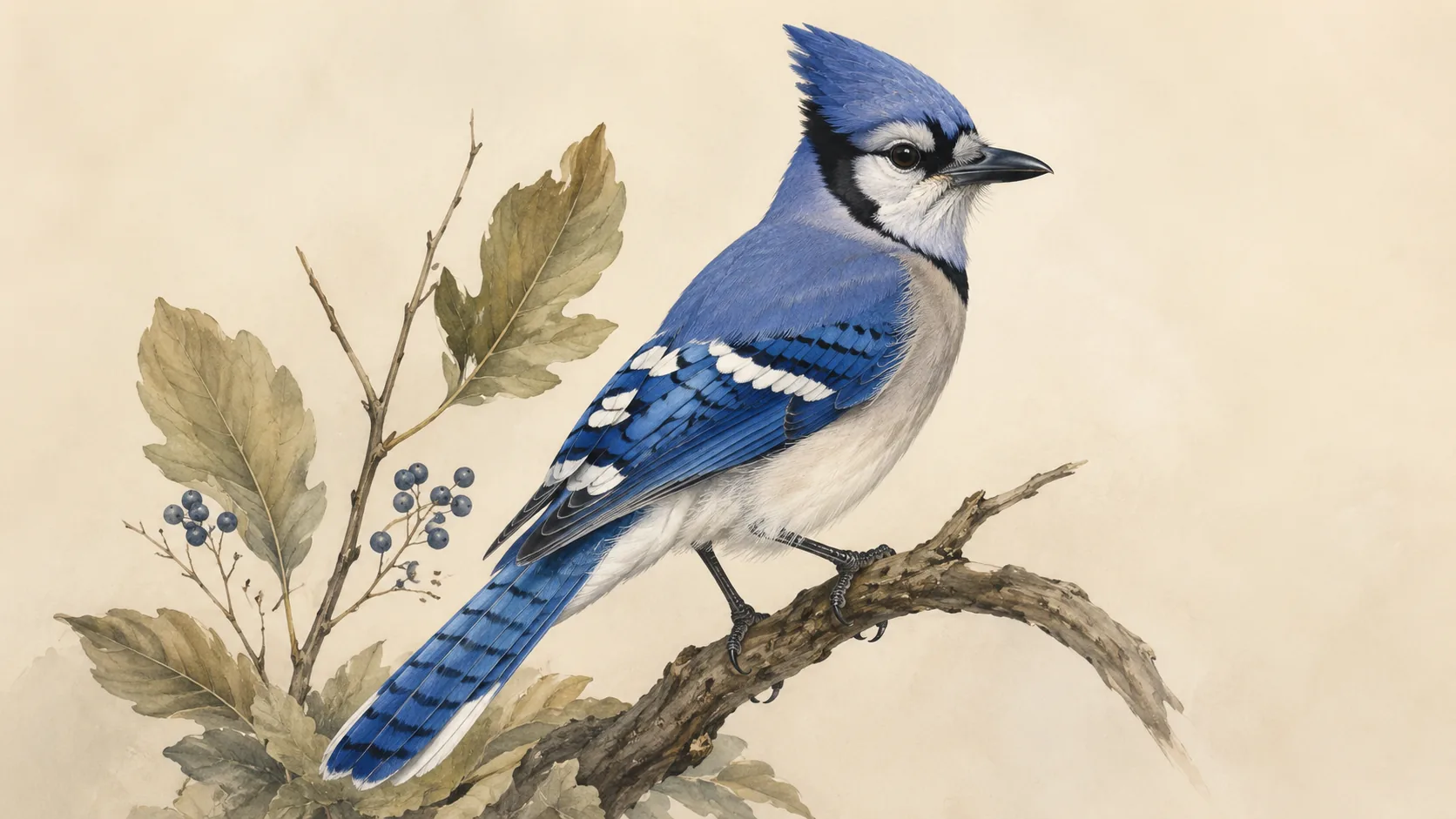
Every feather the raven carries is black. This is not camouflage - a bird this size, this loud, and this behaviourally conspicuous is not hiding from anything. The black is structural iridescence: the same physics as Blue Jay blue, producing a shifting spectrum of colour that is only visible at the right angle and in direct light. In flat overcast, a raven is simply black. In morning light on a granite ledge, it is something close to purple.
The Common Raven is not the bird of death that northern folklore made it. It is the bird that found the body first, reported it to the wolves, and came back for its share. That is not foreboding. That is intelligence applied to scarcity, which is the same thing every successful organism has ever done.