Field Guide
Steller's Jay
Stand at a campsite in the Sierra Nevada in October and you will hear the Steller’s Jay before you see him. Then you will hear something else: the descending kee-eeee-arr of a Red-tailed Hawk, which will make you look up, scan the pines, and find nothing. Look back at the picnic table. The jay is already there.
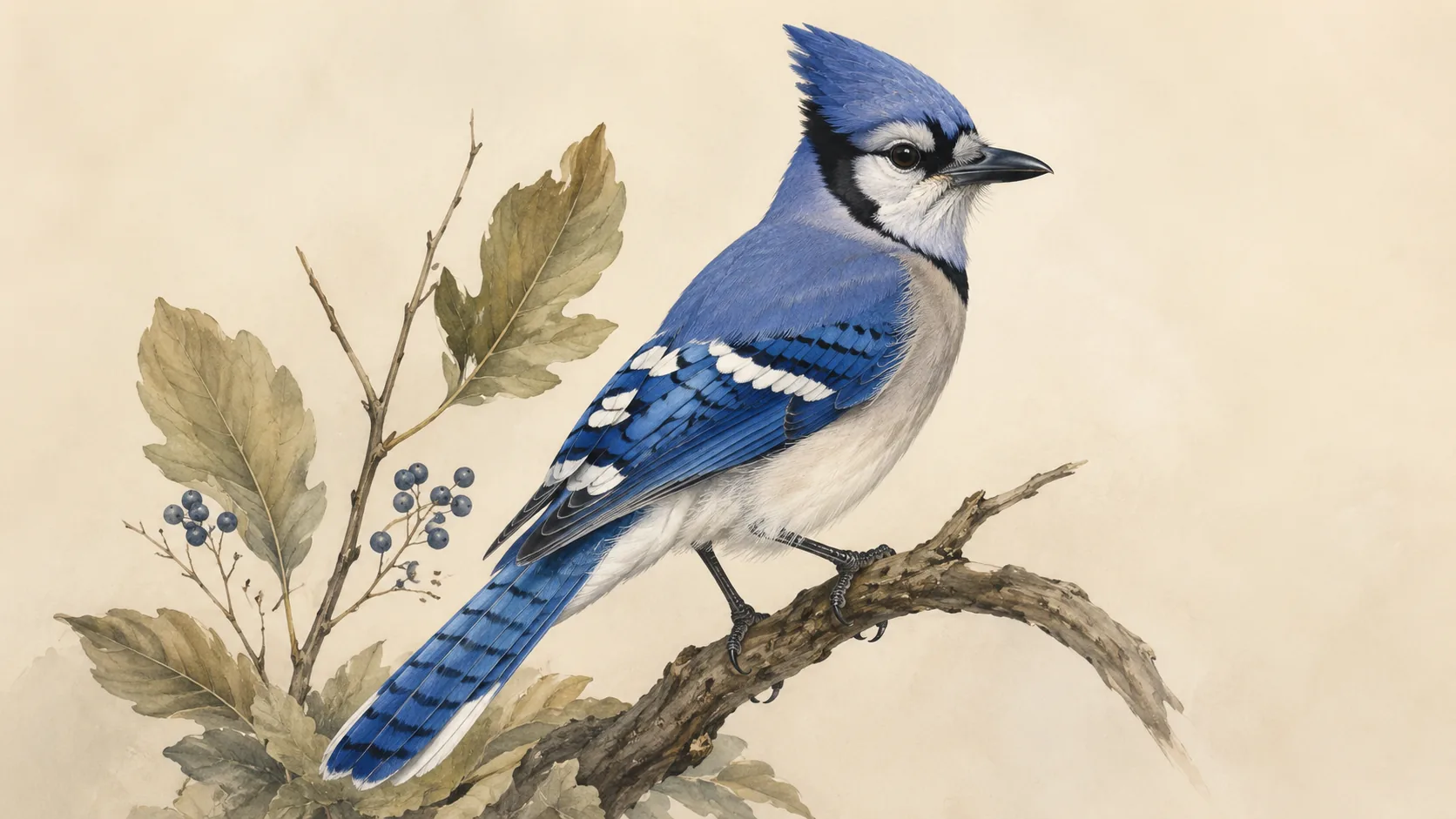
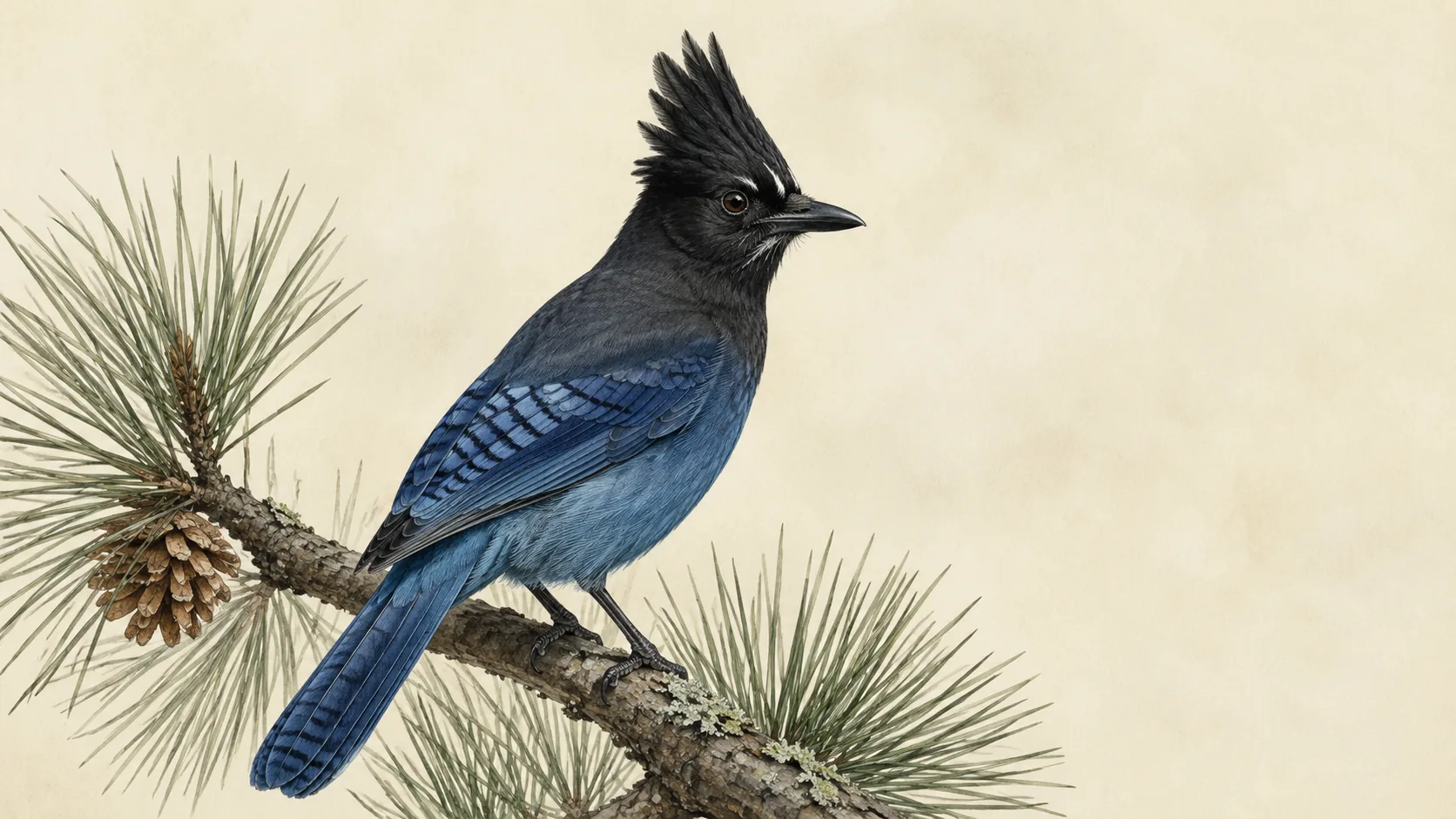
Cyanocitta stelleri is the western corvid that the eastern Blue Jay is not. Where the Blue Jay carries white and powder-blue like a college pennant, the Steller’s Jay is almost entirely dark - black head and crest, dark navy-blue back and wings, deep cobalt-blue belly and tail. He is the more severe bird, and in the mountains of the American West, the more dominant one. Cornell’s Birds of the World notes that pairs form apparently monogamous, long-term bonds and establish site-centered dominance near nesting areas, which in practical terms means that once a pair of Steller’s Jays has decided your campsite or your mountain cabin is their territory, they will hold it with conviction.
The thesis of this bird is simple: he is smarter than you expect, louder than is polite, and more important to the conifer forests of western North America than most field guides bother to say.
What he looks like
The field mark is the crest, which is long, sharply pointed, and black - always black, even in populations where the rest of the plumage shifts toward bluer hues. Northern and coastal populations wear black from the crown down through the back and breast, with the dark transitioning to deep blue on the wings, belly, and tail. Inland Rocky Mountain birds tend toward slightly bluer backs. Central American populations, far to the south, can have blue crests and gray-blue backs, reflecting the geographic variation that Gmelin documented when he formally described the species in 1788.
He is a large jay. Body length runs 30 to 34 centimetres, weight 100 to 140 grams, wingspan 45 to 48 centimetres. That makes him noticeably larger than the Blue Jay and closer in heft to a small crow. Small white spots mark the forehead and near the eye, more prominent in coastal birds; that detail alone can separate the race when you are in the field. The bill is stout and black. The legs are dark. At rest on a pine branch with the crest raised, he has the look of a bird who has decided something and is about to act on it.
Juvenile birds resemble adults but carry softer, greyer tones that fade to the adult pattern through the first winter.
What he sounds like
The usual calls are a series of harsh, repeated notes - a shack-shack-shack or a rolling wek-wek-wek - carried at a volume that travels through dense conifer canopy without effort. He also produces softer whistles and gurgles between paired birds, sounds that seem improbable from an animal this loud in other contexts.
The mimicry is the part worth paying attention to. A 2024 study published in Birds (Harvey, Gabriel, and Black) documented hawk mimicry in a colour-marked population of 49 Steller’s Jays: 14 individuals, or 28.6 percent of the study population, reproduced the calls of Red-shouldered Hawks with identifiable fidelity. The behaviour occurred most often during the early breeding season, on territory, and in the presence of the mate. Younger, larger, and bolder birds were the most likely performers. The researchers note that mimicry was less common during aggressive encounters - suggesting the call is not purely a dominance display, and that its function remains genuinely uncertain.
Cornell’s All About Birds describes the mimicry as resembling the scream of a Red-tailed Hawk. Both accounts are accurate: the jay appears to have more than one hawk in his repertoire, and what he does with those calls depends on context the observer cannot always read.
Range and habitat through the year
The Steller’s Jay is a bird of the western conifer forest. His range runs from the coast of southern Alaska south through British Columbia and the Pacific states, through the Rocky Mountain chain, down into Mexico and the highlands of Central America as far as north-central Nicaragua. He is a year-round resident across almost all of that range. Most populations are non-migratory, though birds at high elevations - 1,000 to 3,500 metres in the mountains - move to lower forest zones in winter when snow covers the ground.
He lives in coniferous and mixed coniferous-deciduous forest. Ponderosa pine and mixed-conifer zones are the core habitat. He does not range into the open shrubland or grassland that separates the western mountains from the eastern woodlands where the Blue Jay lives, and that gap explains why the two species barely overlap. He is also one of the corvids most habituated to humans: campgrounds, ski resort edges, mountain cabin feeders, and trailhead parking lots are reliable places to find him.
Diet and food caching
Audubon’s field guide records that roughly two-thirds of the Steller’s Jay’s diet is plant matter and one-third animal matter. Pine seeds and acorns form the core of the plant side; insects, spiders, bird eggs, and occasionally small vertebrates make up the rest.
Like the Blue Jay in the East, he caches food. He can carry several acorns or pine seeds at once in his expandable throat, then bury them one by one, returning through winter as he needs them. Research on caching corvids documents his ability to hold cache locations in spatial memory for weeks, adjusting strategy when he notices competitors watching. He does not retrieve everything he stores. The unclaimed caches - pine seeds pressed into forest soil in autumn - germinate the following spring. In a conifer forest with a resident jay pair, some fraction of the seedlings at the edge of a clearing is there because of last autumn’s forgotten stores.
Breeding and nesting
Nesting begins in spring. Pairs are monogamous and appear to maintain long-term bonds, consistent with the site-centered territory they defend year-round. The nest is a bulky cup of twigs, weeds, moss, and dry leaves, built 3 to 12 metres above ground in a coniferous tree, often plastered with mud at the base. Clutch size runs two to six eggs, with four being typical. Incubation lasts approximately 16 days. Fledging follows around three weeks after hatching.
Outside the breeding season, Steller’s Jays are social. Flocks form through winter and move through the forest together, foraging in the canopy and on the ground, communicating constantly with the call repertoire that any hiker in western mountain terrain quickly learns to recognize.
What the crest says
The crest is not decorative. Steller’s Jays raise it when alert, when aggressive, when asserting position at a feeding site. They flatten it when subordinate, when alarmed by something genuinely threatening, when approaching a dominant bird sideways. Combined with wing-spreading and specific postures, the crest gives the species a visual communication system that the bare-headed corvids - the crows, the ravens - do not have.
That crest is also what George Wilhelm Steller noticed when he spotted the bird on Kayak Island, Alaska, in 1741, during Vitus Bering’s second Pacific expedition. Steller had never seen a Blue Jay. He knew that a North American bird with that crest had to be related to the Blue Jay, which he knew only from Mark Catesby’s illustrations. He was right: the two species are the only members of the genus Cyanocitta, the only crested blue jays in the world, separated by the Rocky Mountain rain shadow and several million years of divergence. The crest was the field mark that connected them across an ocean, before anyone on that expedition had set foot on the continent.
That is worth more than a glance when the bird is screaming at you from a pine branch in the Cascades. He is, in some sense, the bird who proved North America was North America.