Field Guide
Eurasian Magpie
In the autumn of any year, on any hedgerow in lowland England, you can watch a Pica pica spend several minutes studying a dead crow. She will walk around it slowly, tilt her head at each angle, and then leave. Whether she is assessing risk, gathering information, or doing something we have no name for yet, no one is entirely sure. What is sure is that she is doing something, and she is doing it deliberately. The Eurasian Magpie is not the bird of bad luck that British folklore made her. She is, by the best available measure, one of the most cognitively sophisticated animals on the planet.
That is a position worth defending. It rests on a single experiment conducted in Germany in 2008.
The mirror test and what it means
Helmut Prior, Ariane Schwarz, and Onur Güntürkün published their results in PLOS Biology in August 2008. They placed five magpies in front of mirrors and, using anaesthetic, marked each bird with a coloured spot on the throat - a spot visible only in a mirror, not by direct sight. Two of the five birds, Gerti and Goldie, repeatedly touched and scratched at the marked spot while facing the mirror. When the mirror was removed, the behaviour stopped. When the coloured mark was replaced with a black mark invisible against the feathers, the behaviour stopped. The inference was clear: the birds recognised the reflection as themselves, noticed something wrong on their own body, and tried to remove it.
Before 2008, the mirror test had been passed by chimpanzees, orangutans, dolphins, elephants, and children over the age of about 18 months. No bird had passed it. The magpie’s success was the first evidence that self-recognition - once thought a mammalian signature - had evolved independently in a lineage that split from ours roughly 300 million years ago. The brain she used for this is roughly the size of a walnut.
This is the fact the field guide needs to open on, because it changes how you look at the bird at the bus stop.
What she looks like
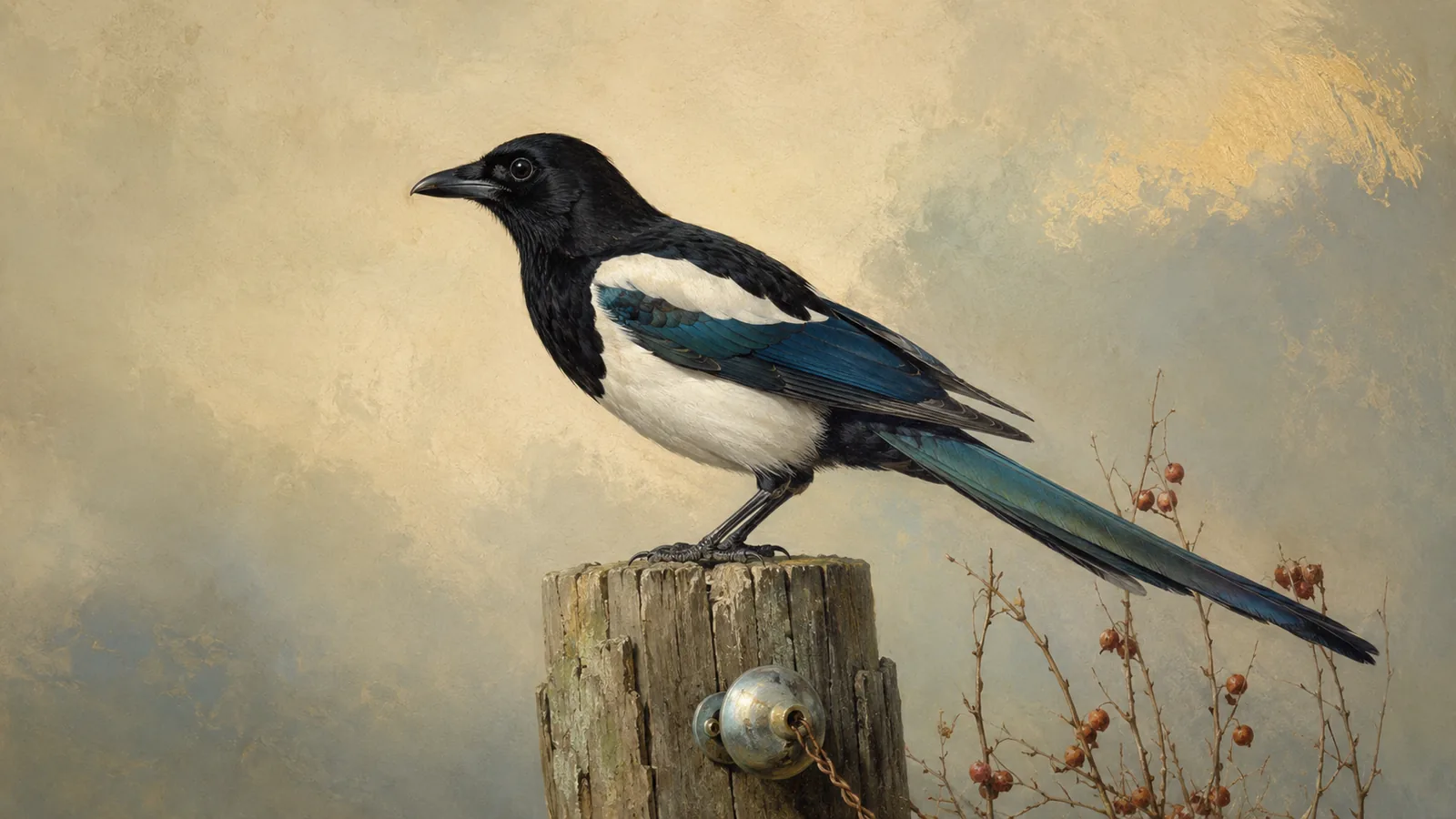
She is 44 to 46 centimetres long, over half of which is the long, graduated tail. She weighs between 182 and 272 grams depending on sex - males run heavier - and spans 52 to 62 centimetres across the wings. The overall impression from a distance is severe: a black-and-white bird with a long stiff tail and a direct, assessing gaze. Up close, the black is not black. The wing feathers carry a purplish-blue iridescent sheen; the tail runs to a deep metallic green that shifts colour as she moves. The belly and flanks are clean white. The scapular patches are white. Everything else - head, neck, breast, vent - is glossy black.
There is nothing else in the UK that looks like her. The size, the tail, the two-tone pattern, and the iridescence are unique among resident British birds.
Voice and territory
Her primary call is a loud, rapid chac-chac-chac-chac that carries across gardens and field margins with no ambiguity. She uses it as an alarm, as a territorial marker, and, in non-breeding season, as a social signal to gather loose flocks. BTO monitoring records describe it as “repetitive” in a way that undersells its usefulness: in a garden with magpies, you know about every cat, every fox, and every sparrowhawk before you see it. The crow family has always been the woodland’s early warning system, and the magpie is the loudest sub-station in that network.
Captive birds show mimicry abilities, though wild birds rely predominantly on their own alarm vocabulary.
Range and habitat across the year
The magpie is a resident across most of Britain and Ireland, year-round. The RSPB lists her as absent from northern Scotland and its islands, where the terrain and weather thin the population. Highest densities run through southeast England and the urban corridor from the Midlands to Lancashire and west Yorkshire. She is not a migratory bird. She stays, and she knows her territory well enough to recognise individual humans who have threatened her.
Beyond Britain, Pica pica ranges from western Europe east to the Sea of Okhotsk in far-northeastern Russia, with six recognised subspecies occupying different portions of that arc, as recorded by Cornell’s Birds of the World. She is, globally, one of the most widespread corvids.
Her habitat requirements are generous. She prefers open country with scattered trees and woodland edge - farmland, parkland, scrubby hedgerows, suburban gardens with mature planting. She has followed human settlement successfully for centuries. BTO’s Breeding Bird Survey shows her UK population increased by 106% between 1967 and 2023, a figure that reflects both recovery from twentieth-century persecution and genuine adaptation to the suburban landscape.
Diet
She is an omnivore without strong preferences, which is precisely the strategy that made her so successful. The diet runs to insects, earthworms, small mammals, carrion, grain, fruit, acorns, and, in the nesting season of other birds, eggs and nestlings. The RSPB describes her as a “scavenger, predator and pest-destroyer” in a single phrase, and the phrase is accurate. She caches food across seasons - burying excess in soil or under leaf litter and returning for it later. This food-caching behaviour requires both spatial memory and planning across time, two cognitive capacities that researchers once assumed were uniquely human.
Her predation of other birds’ nests during spring is the source of most human complaint. The evidence that this predation causes population-level declines in songbirds is, in the view of most ornithologists, weak. BTO analyses of long-term songbird population trends find no correlation between magpie density and songbird abundance at a landscape scale. The reputation exceeds the effect.
Breeding and nesting
She pairs monogamously and maintains the bond across breeding seasons. The nest is one of the more conspicuous structures in British woodland: a large domed construction of sticks with a mud cup inside, typically high in a deciduous tree, occasionally on electricity pylons in treeless landscapes. Both birds build together, and the dome - covering the mud cup from above - is an active defence against corvid and raptor interference from neighbouring territories.
The female lays five or six eggs. Incubation runs to around 20 days. Fledging takes 26 to 31 days, as recorded by the BTO, after which the young remain with the parents for several weeks before dispersing. One brood per year is typical.
Non-breeding birds, particularly younger birds excluded from territories, congregate in loose flocks through the autumn and winter. These gatherings are locally called “parliaments” - a name that predates the research by centuries but turns out to be more apt than the people who coined it probably intended.
What she is actually for
The magpie has attracted sustained human suspicion in the UK. The counting rhyme - “one for sorrow, two for joy” - dates at least to the eighteenth century and encodes an anxiety about solitary birds that is purely folkloric. In reality, a single magpie means only that you are in magpie territory in daylight hours, which covers most of lowland Britain.
What she is, underneath the folklore, is a corvid at the top of the avian cognitive range: a bird that caches food, recognises herself in mirrors, tracks individual humans, communicates complex social information across flocks, and builds structures that reflect an understanding of her own nest’s vulnerability. The IUCN lists her as Least Concern globally, with a stable population somewhere between 64 million and 104 million mature individuals.
She is not the bird of bad luck. She is the bird that looked in the mirror and recognised what was looking back. That is a harder thing to do than it sounds.
The magpie passed the self-recognition test with a brain the size of a walnut. The test had previously been passed only by mammals and children. She is not a simple bird.