Field Guide
Cassin's Finch
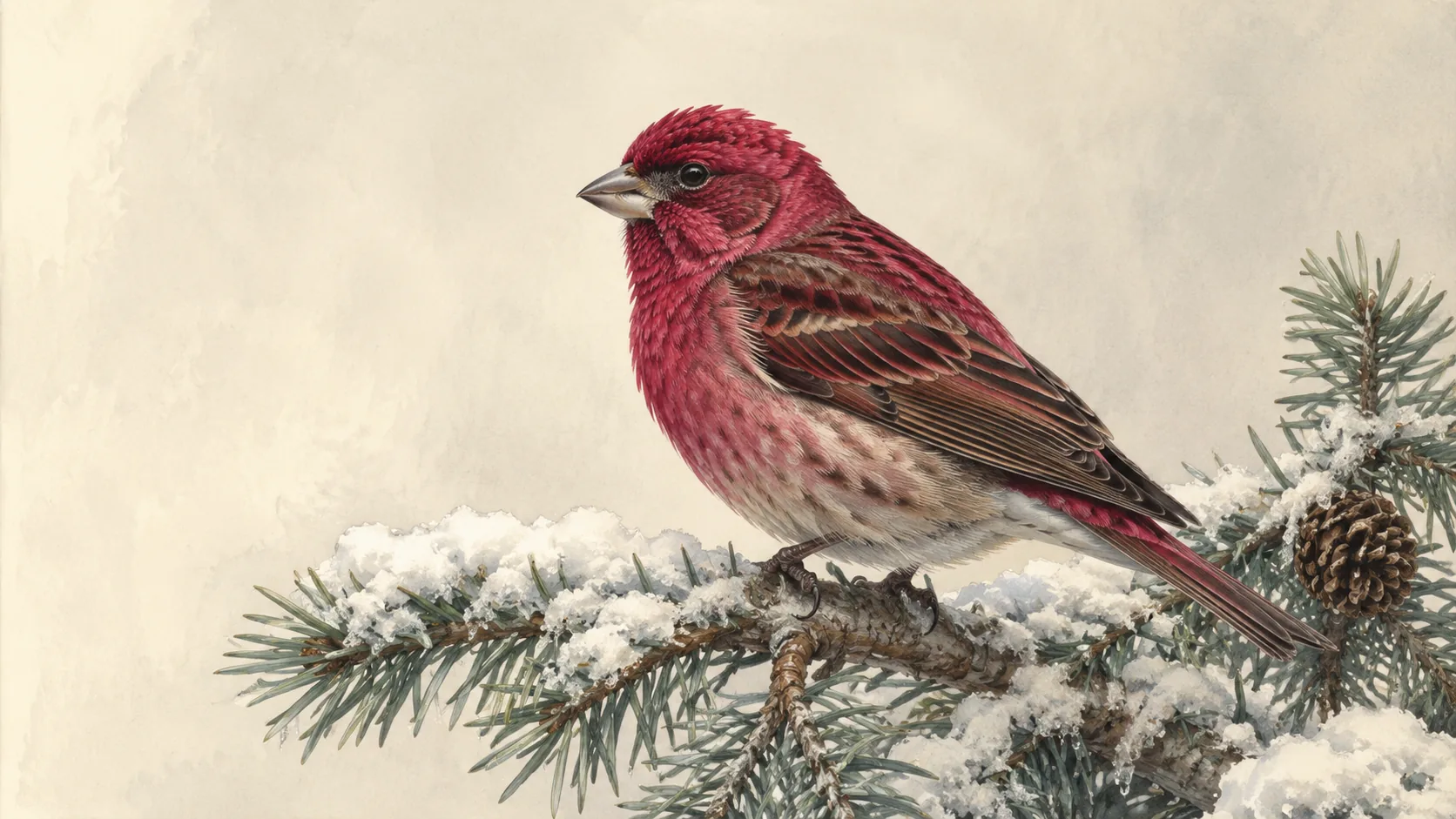
A male Cassin’s Finch sits at the very top of a Douglas fir in a Rocky Mountain spring, ten thousand feet up, and pours out a fast, rolling warble. It carries across the slope. Then, inside the song, a stranger’s voice appears: the call of a junco, the note of a crossbill, a phrase lifted from a bird two valleys over. The Cassin’s Finch is a mimic, and his song is partly stolen goods.
He is the high-country member of the three red rosefinches of North America, the bird you have to climb for. Where the House Finch lives in car parks and the Purple Finch keeps to the eastern woods, the Cassin’s Finch belongs to the conifer forests of the mountain West, and to the cool air near the treeline. The bright crown is the field mark birders learn first. The borrowed song is the thing they remember.
What he looks like
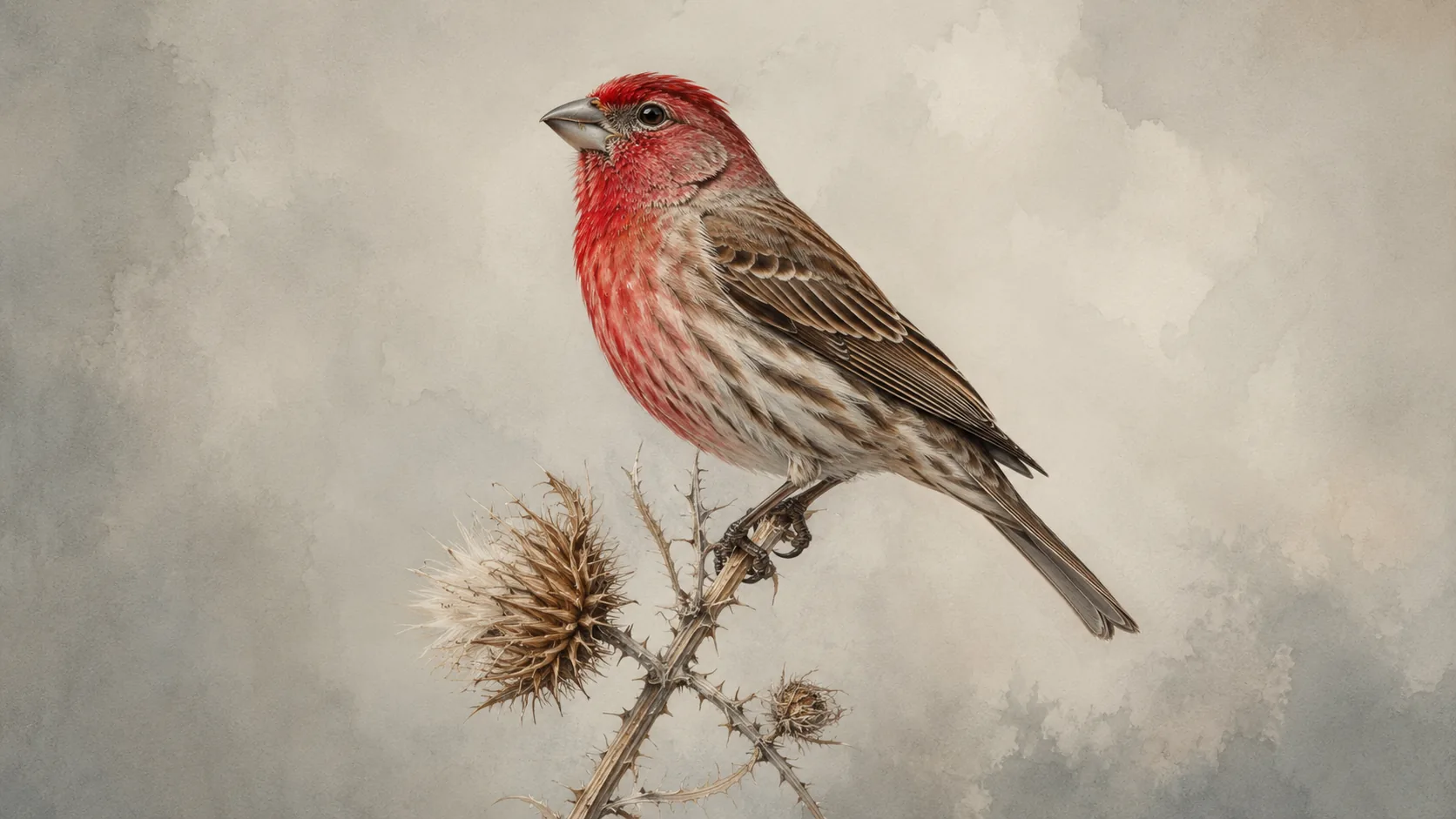
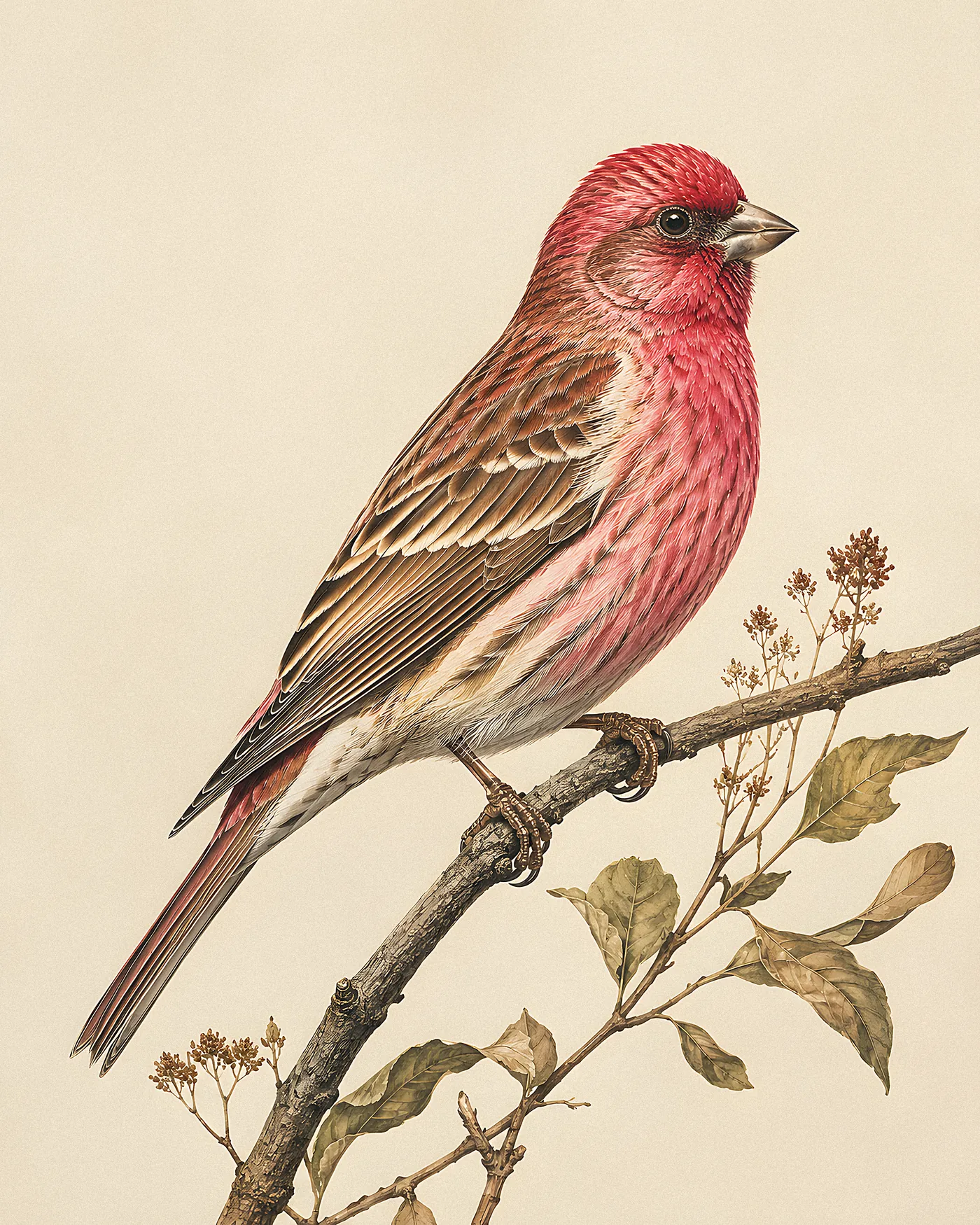
The breeding male is a rosefinch washed in raspberry. The colour is brightest on a sharply peaked crown, which burns a clean crimson and sits above a paler, pinker face and breast. That contrast is the key. Cornell Lab notes the bright red cap stands out as the most saturated part of the bird, where the House Finch wears an evenly rounded, all-red head and the Purple Finch carries a more uniform wine-red over the whole crown. The underparts are nearly unstreaked white, washed pink at the breast, and the back is brown with fine dark streaking. The bill is longer and more sharply pointed than either relative’s, and the wingtips are long, the tail short.
The female is a brown-and-white bird, and a cleaner one than her cousins. She is crisply streaked above and below, the streaks dark and well defined rather than blurred, with a muddled pale face and a thin pale eyebrow. Cornell Lab uses exactly that crispness to separate her from the female House Finch, whose underpart streaks are softer and more smeared. Young males look like females for their first year, then moult into the rose, so a streaky brown bird singing from a fir top in spring is very likely a first-year male still wearing the wrong coat.
What he sounds like
The song is a high, varied, rollicking warble, similar in shape to the Purple Finch’s but flutier and more broken into phrases. What sets it apart is the mimicry. Cornell Lab records that males weave the calls of other species into their song, so a Cassin’s Finch may quote a Red Crossbill or a junco mid-phrase. The result is a song that changes from bird to bird and slope to slope.
The call is the surest mark of all. It is a dry, musical pwee-de-lip or kee-up, given in flight and from the perch, and birders treat it as diagnostic - the one sound that names the species without a sight of the bird.
Range and habitat
Haemorhous cassinii is a bird of the mountain conifer forests of western North America. It breeds through the Rockies, the Sierra Nevada, the Cascades and the Great Basin ranges, from southern British Columbia and the inland Northwest down through the western United States into the highlands of northern Mexico. It favours open coniferous forest at middle to high elevation, often near the upper edge of the trees, in fir, pine and spruce.
It is a wandering, partly nomadic bird rather than a strict migrant. Some birds drop to lower elevations or shift south in winter, and numbers in any one place swing with the conifer seed crop, so a forest thick with finches one year may hold few the next. The IUCN lists the species as Least Concern, but it notes a long-term population decline; the species was previously assessed as Near Threatened and downlisted in 2019 as the decline appeared to slow. The trend is still downward, which makes the bright bird in the fir top a little less common than it once was.
Diet
The Cassin’s Finch is built around conifer seeds. Cornell Lab lists the seeds of pine, fir and other evergreens as the staple, taken straight from the cone, along with the buds and the seeds of quaking aspen, the berries of mountain shrubs, and the seeds of many weeds and grasses. In summer it adds insects.
A particular habit gives the bird away. Cassin’s Finches are drawn to mineral salts, and small parties gather at natural salt deposits and at the edges of mountain roads where salt has been spread, dropping to the ground to take it directly. At feeders in the foothills they favour sunflower, but the species is a creature of the high forest first and a feeder bird second.
Breeding and nesting
Breeding is a high-elevation affair, timed to the short mountain summer. The female builds an open cup of fine twigs, rootlets, weed stems and lichen, placed high in a conifer and set well out on a horizontal branch, often near the top of the tree. Cornell Lab gives a typical clutch of four to five blue-green eggs marked with fine dark spots.
The female alone incubates, for about twelve to fourteen days, and the male feeds her through it, slipping up to the nest with food while she sits. Both adults then feed the young. The pairs are loosely social, and several may nest within sight of one another in the same stand, so a single tall fir can hold more than one singing male in a good seed year.
The brightest red on the mountain is also the most borrowed voice on it, a finch whose song carries the quoted calls of the birds around him.
When the snow finally clears the high passes and the firs warm in the morning sun, the male climbs to the top of the tallest tree he can find and sings. Listen long enough and you will hear the seams in it - a junco here, a crossbill there, stitched into a warble that is unmistakably his own. The peaked crimson cap names the bird. The patchwork song is the better introduction.