Field Guide
Cave Swallow
On a highway bridge north of San Antonio, at dusk in late April, the birds emerge in a flood. Hundreds of them - maybe thousands - pour out from the shadow of the girders, banking low over the Guadalupe River floodplain, then wheeling back. The sound is a continuous soft twitter. The light catches the buffy throat on each bird as it turns. This is Petrochelidon fulva, the Cave Swallow, and the bridge beneath your feet has become, for the species, a perfect limestone cave.
The Cave Swallow is not the most colorful member of its family. It does not migrate across oceans. Its song is a twitter, pleasant but unremarkable. What makes it worth sitting with - what makes it one of the more instructive birds in North America - is what it did over the last sixty years. It took a structure that did not exist a century ago, found in it the essential properties of the nesting habitats it had used for millennia, and built a continent-wide expansion on that recognition. By 2006, Kosciuch, Ormston, and Arnold, writing in The Southwestern Naturalist, documented that the species’ breeding range in Texas had grown by approximately 898 percent between 1957 and 1999, with an average rate of 10.8 percent per year. Cave swallows were found in more than 90 percent of the highway culverts surveyed in western Texas. The numbers are unusual even among birds known to use artificial structures.
What it looks like
Petrochelidon fulva measures 12 to 15 centimetres in length, weighs 11 to 17 grams, and spans 28 to 33 centimetres from wingtip to wingtip. Cornell Lab of Ornithology (All About Birds) records these ranges for North American birds. The oldest individual documented by the Bird Banding Laboratory, a banding station in New Mexico, lived to at least 12 years and two months.
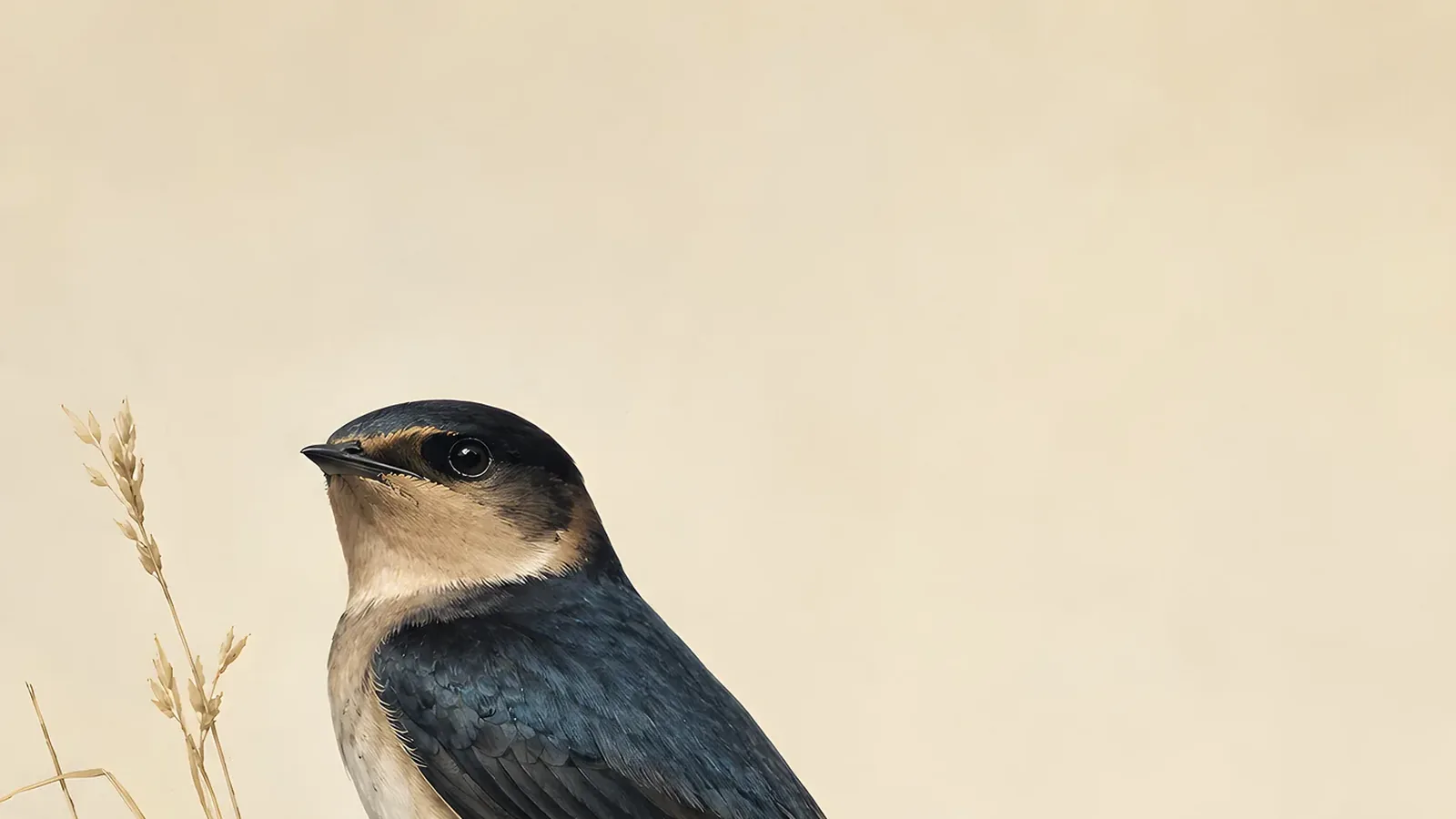
The cap is dark - blue-black in good light - contrasting against a pale buffy-orange forehead patch. The throat is the diagnostic field mark: a clean, washed buff or tawny buff, paler than anything on a Cliff Swallow. The nape shows a chestnut collar. The back and wings are dark glossy blue. The rump is orange-buff, shared with Cliff Swallow but a shade paler. The underparts are white to off-white. The tail is short and square - not forked as in the barn swallow - a shape that gives the bird a stockier, front-heavy look in flight. Sexes are similar. Juveniles are duller on the head and throat, but the square tail and pale throat still set them apart.
| Measurement | Range |
|---|---|
| Length | 12-15 cm |
| Weight | 11-17 g |
| Wingspan | 28-33 cm |
| Typical lifespan | 8-12 years |
| Clutch size | 2-5 eggs (usually 3-4) |
| Incubation | 15 days |
| Fledging | 20-26 days |
In flight the Cave Swallow moves with quick, shallow wingbeats interspersed with glides, tracking low over open ground or water. At a distance, the square tail is the first thing to confirm. At closer range the buffy throat glows warm even in flat light - quite unlike the dusky-chestnut throat of the Cliff Swallow.
From caves to sinkholes to bridges
Before European settlement, Petrochelidon fulva in the United States was a bird of two very specific habitats: limestone caves and sinkholes on the Edwards Plateau of central Texas, and a handful of natural limestone caves in the Guadalupe Mountains. Selander and Baker (1957) documented the species confined to five counties on the southern Edwards Plateau. Its range in the continental United States was, by any measure, restricted.
The Texas Breeding Bird Atlas records the first nesting outside the Edwards Plateau as 1972, in a cave at Big Bend National Park. By 1973, birds were documented nesting in highway culverts west of Fort Stockton. The pattern that followed is, in ecological terms, a textbook case of a generalist exploiting a novel resource class. A concrete highway culvert is, to a cave swallow, a limestone sinkhole: dark, enclosed, with a vertical or angled surface to receive a mud-cup nest and an open end facing an insect-rich floodplain or pasture. The birds did not need to learn a new behavior. They needed only to recognize the structural match.
By the late 1980s, colonies had reached southeastern Texas and the south Texas brush country. The expansion was not random but tracked the road network - a pattern that makes sense if the birds were following culverts and underpasses as stepping stones across open terrain. Kosciuch et al. (2006) note that the USDA Breeding Bird Survey detected a 10.8 percent annual population increase through this period. The species’ IUCN Red List category is Least Concern (LC), with a population trend described as increasing.
The Florida population represents a separate subspecies with Caribbean affinities, present year-round in the southern part of the state. New Mexico holds small breeding populations in natural caves as well as culverts. Late autumn brings vagrant Cave Swallows as far north as the Great Lakes and New England, a phenomenon that has grown more frequent as the core Texas population has expanded.
Telling it from the Cliff Swallow
The two are close relatives and sometimes nest in the same culvert, which should be a recipe for confusion but is actually one of the simpler field problems in swallow identification once you know what to look for.
The Cliff Swallow has a dark chestnut or rusty throat that runs up to a pale cream-buff forehead patch. The Cave Swallow reverses this: a pale buffy throat and a dark cap that extends forward to the bill, with only a small pale forehead mark. The Audubon Field Guide summarizes the distinction neatly: Cave Swallow shows “pale buff throat, dark forehead,” Cliff Swallow the opposite.
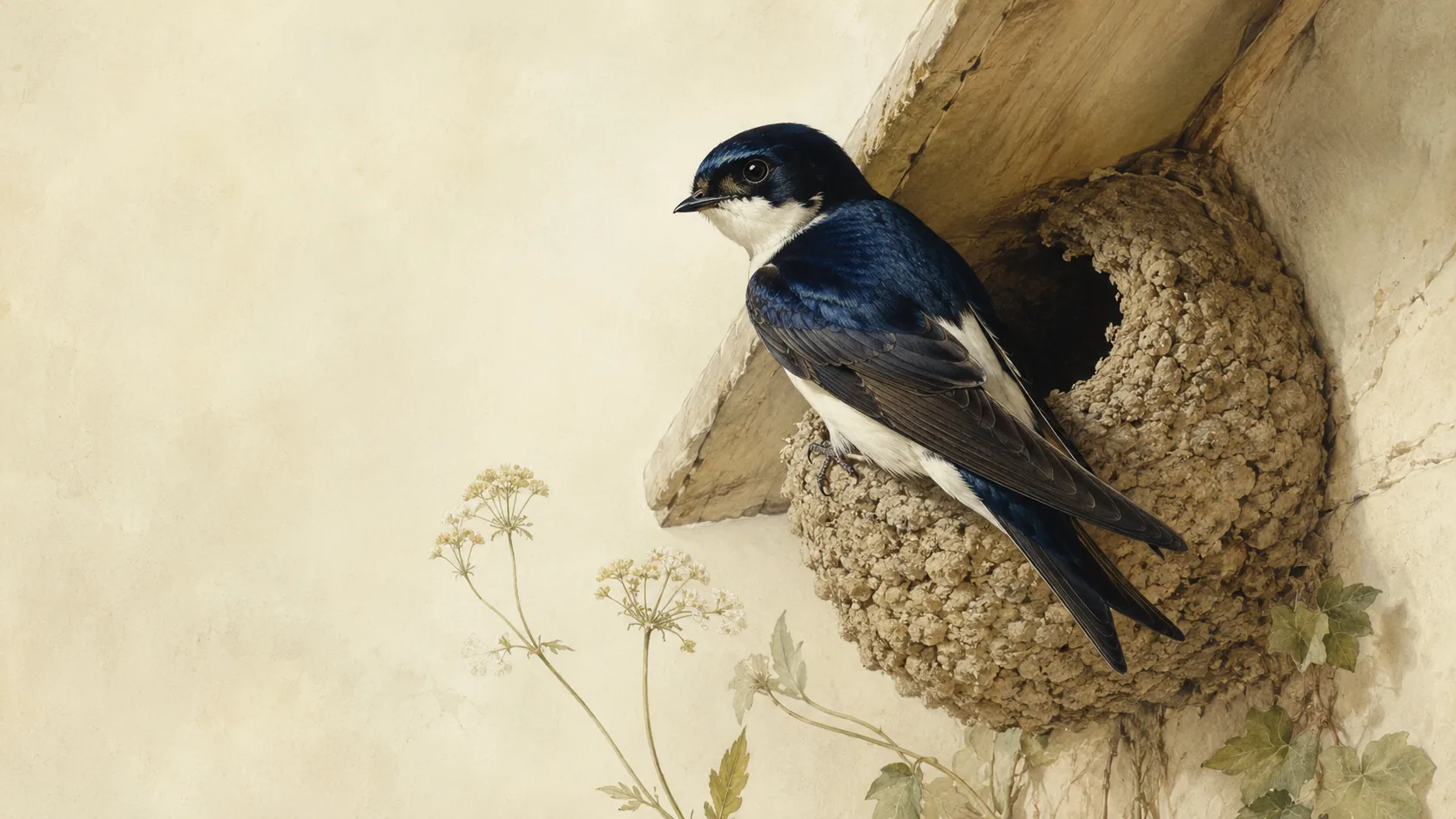
The nests make the identification definitive at the colony level. Cliff Swallows construct enclosed, gourd-shaped mud structures with a narrow entrance tunnel - the jug-like profile that clusters so recognizably under bridge decks. Cave Swallows build an open cup: a mud half-bowl plastered against the substrate, open at the top, resembling a truncated Cliff Swallow nest or a mud-dauber installation. Where both species use the same culvert, you can read the colony’s composition from the nest shapes without seeing a bird.
Voice provides a secondary check. Cliff Swallow has a low, nasal churr and a distinctive squeak-then-chatter sequence. Cave Swallow produces a softer, more continuous twitter - the song is described by Cornell as a series of squeaks, twitters, and warbles, ending in double-toned notes. The “che” note, high and nasal, is the most frequently given call in flight near the colony.
What it sounds like
The song of Petrochelidon fulva carries little distance. It is not a bird you hear from far off. At the colony entrance, the sound is a constant soft chattering, each bird adding a few notes to the ambient hiss, the combined effect like a creek heard through willows.
The alarm call is different in character - higher, sharper, repeated with increasing urgency when a predator (a Peregrine Falcon, a rat snake working its way up a culvert wall) triggers the colony. The sound tightens as the threat persists. Other swallows in the mixed colony respond to it.
Range and the expansion
The current North American breeding range covers much of Texas, particularly the Edwards Plateau, the Trans-Pecos region, south Texas, and the eastern lowlands as far as the Gulf Coast. New Mexico holds smaller colonies. Florida supports a year-round population at the southern tip of the state, with the birds moving into the Keys during winter. Caribbean subspecies occur in Cuba, Puerto Rico, Hispaniola, and Jamaica, where the original cave habitats remain.
In autumn, the Texas population disperses rather than making a long-distance migration. Since the late 1990s, regular occurrences in the Mid-Atlantic and Great Lakes in October and November have established Cave Swallow as an expected vagrant in the Northeast. The birds appear to drift with frontal systems moving out of the Gulf.
Breeding
Colonies form early. In south Texas, nest construction begins by late February. The pair builds the open mud cup together, pressing wet material from nearby streambeds against the concrete or rock surface in small beak-loads, working upward from a base smear. Dried grass and feathers line the interior.
The female lays two to five eggs - most commonly three or four - white and speckled with brown and purple toward the larger end. Incubation lasts approximately 15 days, shared by both adults. Chicks fledge in 20 to 26 days. Most Texas pairs raise two broods, the second clutch beginning while first-brood fledglings are still near the colony. The season runs through early September.
Colony sizes range from a handful of pairs in a small roadside culvert to hundreds of pairs under a major highway overpass, each girder bay holding a dense cluster of open mud cups.
A highway bridge is only a cave without the limestone. The Cave Swallow has understood this for six decades. It expanded its range by 898 percent not by adapting to a new environment but by recognizing an old one in a new material. That is a different kind of intelligence, and it has worked.
Twelve years ago, Cave Swallows were unknown in coastal Virginia in October. Now they appear annually. The infrastructure they depend on is not shrinking. If the pattern of the last sixty years holds, the cave that humans keep building - one concrete culvert at a time, from the Rio Grande to the Platte River - will keep filling with birds.