Field Guide
Acadian Flycatcher
Somewhere above a creek in Ohio, where the sycamores close overhead and the light barely reaches the water, a small olive bird throws itself into the air and screams. Two syllables, a hard upward pitch: peet-SAH. Birders in the know hear “pizza.” It is an absurd description for one of the continent’s least absurd birds. Put the binoculars down. You are not going to see much. You are going to listen.
Empidonax virescens - the Acadian Flycatcher - is the bird you identify with your ears, not your eyes. It lives where the canopy is thick and the interior dim. Its plumage is a study in the inconspicuous. Its song, once lodged in the ear, is unmistakable for anything else in eastern North America.
What it looks like
The Acadian Flycatcher measures 14 to 15 centimetres in length and weighs 11 to 14 grams - roughly the size and weight of a large chickadee, though it carries itself more furtively. Wingspan runs 22 to 24 centimetres. Banding records document individuals living nearly 11 years, with most wild birds surviving six to nine years (McDonald 2012, Animal Diversity Web).
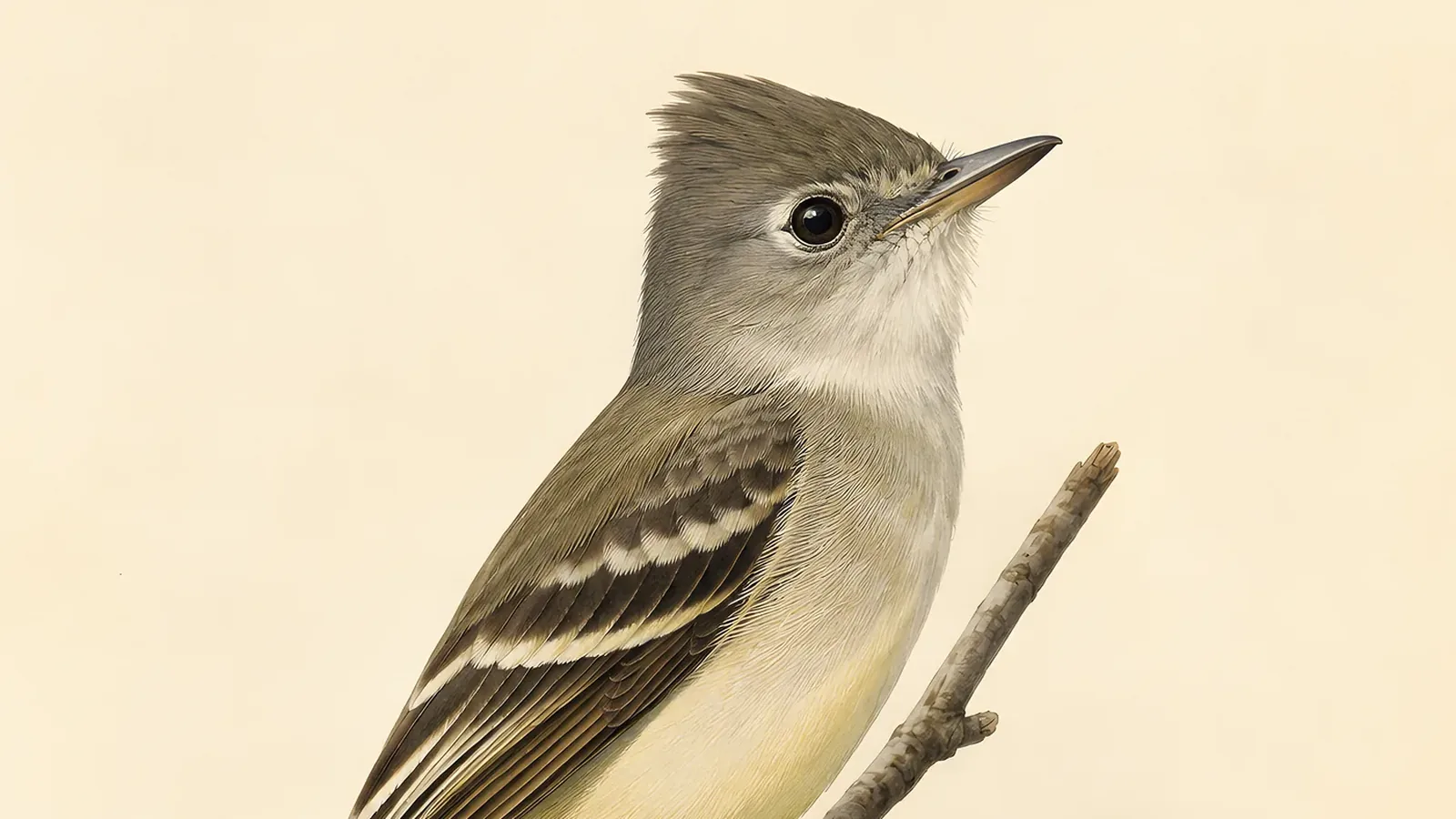
The plumage is olive-green above, clean white below, with a pale yellow wash on the belly that is more visible in fresh autumn birds. A thin white eye-ring circles the eye. Two white wing bars cross the dark flight feathers. The bill is broad and flat - a flycatcher’s bill, built for snatching - orange-yellow below, dark above, noticeably stout compared to the similar Yellow-bellied Flycatcher.
Here is the problem. The eastern Empidonax flycatchers - Acadian, Least, Yellow-bellied, Willow, Alder - are so visually similar that even expert birders with a bird in the hand are reluctant to make confident calls on plumage alone. This is not an exaggeration. They are among the most confusing groups in North American ornithology. The Acadian’s broader bill and longer primary projection separate it on close study, and breeding habitat eliminates most alternatives (McDonald 2012). But the reliable identification tool is the song.
| Measurement | Range |
|---|---|
| Length | 14 - 15 cm |
| Weight | 11 - 14 g |
| Wingspan | 22 - 24 cm |
| Wild lifespan | up to 11 years |
| Clutch size | 2 - 4 eggs |
| Incubation | 13 - 15 days |
The song that names it
The song is described in the ornithological literature as explosive - and that word is earned. Two syllables delivered sharply upward, with the accent crashing onto the second: peet-SAH. The second note lands harder and higher, and the whole phrase cuts through the closed canopy in a way that the bird’s quieter calls do not. Males sing from perches 2 to 20 metres above the ground at rates of roughly two to six songs per minute during the breeding season (Cornell Lab of Ornithology, Birds of the World).
The male Acadian Flycatcher, sitting quietly in deep shade, does not look like a bird that could fill a forest hollow. The song says otherwise.
The “pizza” transcription dates at least to the mid twentieth century and has been in field-guide use ever since. It does not quite capture the metallic quality of the real sound, but once you have heard the bird and then heard the mnemonic, the connection is immediate and permanent.
The dawn song - a longer series of calls produced before first light - is a slower, more varied affair. Territorial males will also produce a sharp single-note call, written as peet or chip, when alarmed near the nest. Females are largely quiet, especially once incubation begins.
The voice is the single most important identification character in the field. No other Empidonax breeding in the shaded interior of eastern deciduous forest produces this sound. Learn it once and the rest follows.
What it eats
The Acadian Flycatcher is an insectivore with a specific foraging style. It sits still on a low to mid-level branch and watches. When it spots prey, it sallies out in a short flight - often to the underside of a leaf, occasionally into the air, rarely to the ground - and returns to its perch. This gleaning and sally-hovering style is characteristic of the genus and well documented (Cornell Lab of Ornithology, Birds of the World).
The diet runs to flies, wasps, bees, ants, beetles, caterpillars, moths, and spiders. Small fruits and berries are taken occasionally, particularly in late summer. Nestlings are fed almost entirely on insects (McDonald 2012). The bird’s preference for the undersides of leaves - where caterpillars and small flies congregate in shade - ties it physically to the forest interior. Open habitats do not offer the structural complexity it needs to hunt efficiently.
Range and the deep woods
The Acadian Flycatcher breeds across the eastern United States, from the Great Lakes and the southern edge of New England south to Florida and east Texas. It reaches its highest densities in the bottomland hardwood forests of the Mississippi and Ohio valley drainages, in the Appalachian ravines, and in the broad coastal plain forests of the Carolinas, Tennessee, and Virginia. A small Canadian breeding population exists in southern Ontario, where the species is assessed as Endangered by COSEWIC.
Winter range lies entirely in the Neotropics - northwestern Colombia, Ecuador, Venezuela, Central America south to Panama. Migration crosses the Gulf of Mexico, often at night, with northward movement in April and May and southward withdrawal from August through October.
In range-wide terms the population is estimated at roughly 5.2 million mature individuals and the IUCN lists the species as Least Concern (LC), population trend stable (BirdLife International, IUCN Red List). The apparent security in the global numbers obscures a more complicated local picture: this is an area-sensitive species that requires large, unfragmented forest blocks to breed successfully.
Studies in Ohio and elsewhere have shown that Acadian Flycatchers select deciduous forests larger than about 40 hectares, though they will use smaller blocks near continuous forest. The reason is predation and parasitism pressure. Hoover (2006, Journal of Field Ornithology) documented that nests within fragmented or edge-affected forest in the midwest experienced substantially lower success than nests in forest interiors - a pattern driven by both nest predation and increased brood parasitism by Brown-headed Cowbirds. Forest-interior conditions are not a preference. They are a requirement.
The scissor-tailed flycatcher - that streamlined, pale tyrant of open Oklahoma grasslands - represents the opposite end of the flycatcher ecological spectrum from the Acadian. One needs the open sky. The other needs the canopy closed over its head.
Breeding and the nest
She builds. He sings and guards.
The female Acadian Flycatcher constructs a nest unlike anything produced by comparable small forest birds. It is a shallow, loose hammock slung in the fork of a horizontal branch, typically three to nine metres above the ground. The structure is made from fine grasses, plant fibers, weed stems, and caterpillar silk, held to the supporting fork with spider silk - and here is the distinctive detail: long strands of the same materials trail below the nest cup, forming what ornithologists call a nest tail. These dangling strands can extend several centimetres below the body of the nest and are composed largely of catkins, seed fibers, and silk. The effect is of something between a hammock and a small hanging basket. Sometimes the nest is so loosely woven that the eggs are visible from below (Cornell Lab of Ornithology, Birds of the World).
Clutch size is two to four eggs, most commonly three. The eggs are creamy white with fine brown speckling concentrated at the larger end. Incubation lasts 13 to 15 days and is carried entirely by the female. Both parents feed the nestlings, and the young fledge at roughly 13 to 15 days. Second broods occur with reasonable frequency, particularly in Virginia and Pennsylvania (Cornell Lab of Ornithology, Birds of the World).
Wilson and Cooper (1998, The Wilson Bulletin) monitored 601 nests across a large bottomland hardwood forest at the White River National Wildlife Refuge in Arkansas over three seasons. Annual breeding success ranged from 10 to 25 percent across years. Nest predation - primarily by snakes and corvids - accounted for 75 percent of all failures. Brown-headed Cowbird parasitism was relatively modest at that site (21 percent of nests), and caused only seven percent of total failures. The study demonstrated what other work has since confirmed: even in ideal habitat, the Acadian Flycatcher is not an easy breeder. The nest design is flimsy by necessity - fast to build between predation events - and the season is short.
The bird is loyal to bottomland forest, to shaded ravines, to the margins of slow creeks where the canopy remains unbroken. It does not adapt to the suburban edge, to regenerating clearcuts, or to park fragments isolated in the urban matrix. Its ecological requirements are stable and narrow.
That narrowness is worth holding onto. Most small songbirds are flexible enough to persist in degraded or simplified landscapes. The Acadian Flycatcher is not. It is the eastern forest interior in bird form - requiring closed canopy, permanent moisture, large blocks, and the specific structural complexity that only old and undisturbed woods provide. As eastern bottomland forests continue to shrink and fragment, the bird’s global stability will require attention in ways the current IUCN assessment does not fully capture.
The song still carries through the sycamores. It may be the clearest possible signal of what a fully functioning bottomland forest sounds like from the inside.