Field Guide
Red Kite
By 1989, every breeding Red Kite in Britain lived in Wales. A relic population, perhaps thirteen pairs, clinging to mid-Wales oak valleys while the rest of the country had spent four centuries poisoning, trapping, and shooting the species out of existence. The Welsh birds were not especially resilient. They were simply the last ones left.
Today, Milvus milvus soars above the Chilterns, the Yorkshire Dales, the Galloway Hills, and the suburbs north of London. The RSPB records a 2,464 per cent increase in UK numbers between 1995 and 2023. Britain now holds approximately 17 per cent of the entire global population. The Red Kite’s recovery is not a gentle ecological comeback story. It is a controlled experiment in what happens when you stop killing something and give it back its range.
The experiment’s first result is the bird itself, which repays attention.
Identification and appearance
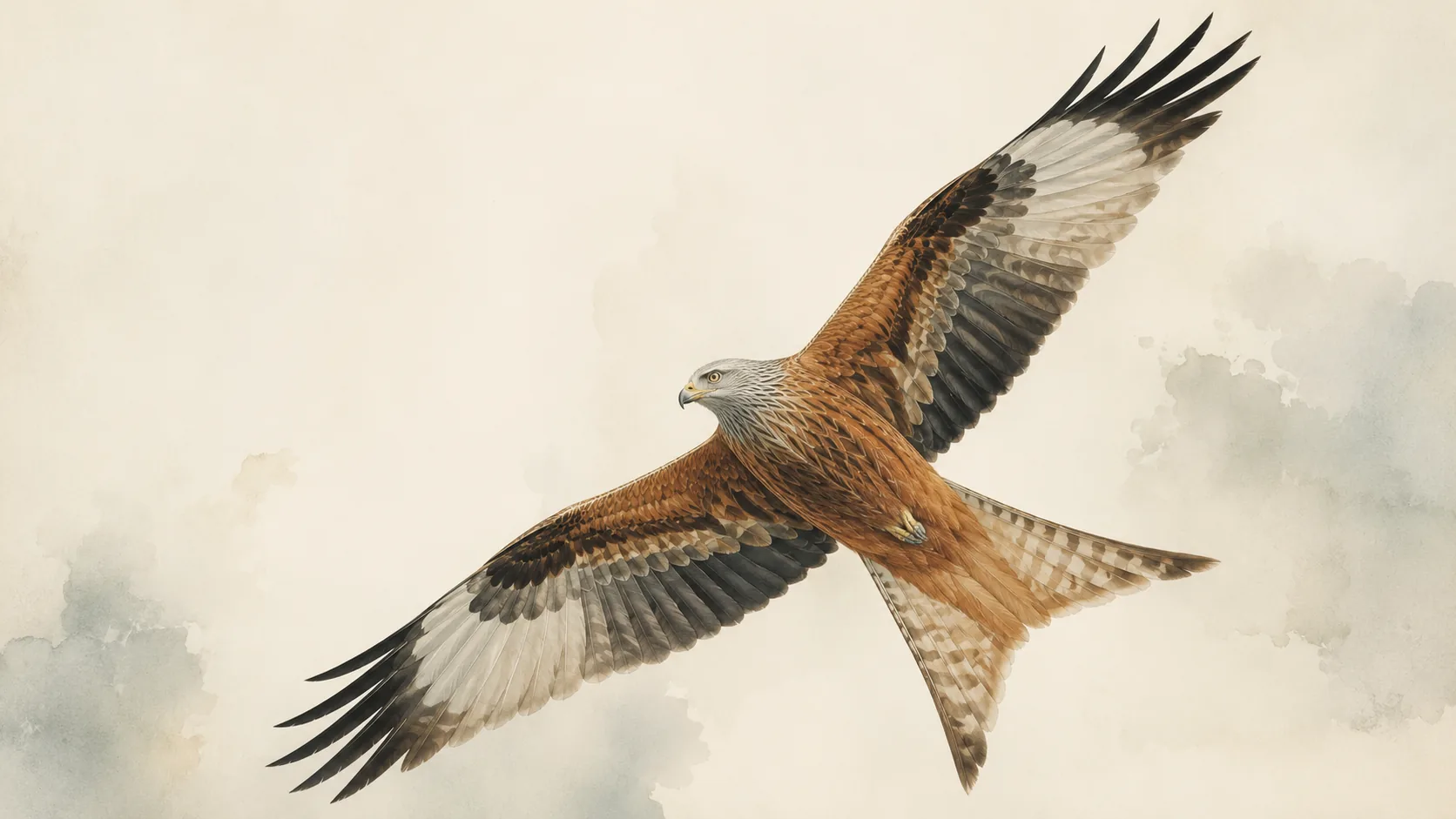
The Red Kite is a large raptor - 60 to 66 centimetres from bill to tail tip, with a wingspan of 175 to 195 centimetres - and once seen in flight, it is difficult to mistake for anything else. The tail is the starting point. Long, deeply forked, and coppery-russet in colour, it works constantly as a rudder, twisting and tilting as the bird adjusts course on the thermals. No other raptor in Britain carries that tail shape.
The body is richly rufous across the back and underparts, streaked dark brown. The head is pale grey-white, streaked darker, and smaller-looking than you expect for a bird this size. From below, the wings show a strong white patch at the base of the primary feathers - the ‘windows’ - framed by dark wingtips and a pale buff body. The effect in flight is graphic and angular: a big, buoyant bird with a forking tail and a pale head, banking on flat wings held slightly kinked at the carpal joint.
Males and females share the same plumage. Juveniles are similar to adults but carry slightly softer tones and a less pronounced fork to the tail.
The call, often heard before the bird is spotted, is a wavering whistle - thin and mewing - that carries across open country with surprising clarity.
Voice
The Red Kite’s call is not the commanding scream of a Buzzard or the bark of a Peregrine. It is a thin, keening whistle, sometimes rendered as weee-ooo-ooo, that sounds more plaintive than predatory. Pairs call between themselves at the nest and during courtship display. The sound carries a long distance across open hillside and tends to draw the gaze upward before the bird is visible.
Range and habitat across the year
The species is endemic to the western Palearctic - Europe and northwest Africa. The core breeding populations sit in Germany, Spain, and Wales, with major numbers across central Europe. Birds in the northern parts of the range, particularly Sweden and parts of Germany, are migratory, moving south to France and Iberia for winter. British birds are largely resident year-round.
The BTO records that Red Kites now occupy 24 per cent of breeding survey squares in the UK and 33 per cent in winter, figures that would have seemed implausible in 1990. The winter rise reflects the fact that birds from continental Europe join residents, particularly in southern England, where kites from Sweden and Germany are now regular visitors.
Habitat preferences run to open farmland, pasture, and woodland edge - places where carrion is available and the bird can soar efficiently. The Chilterns, the first reintroduction site in England, now support one of the highest densities of Red Kites anywhere in the world.
Diet
The Red Kite has comparatively weak talons for a raptor of its size. This is the biological key to its ecology: it cannot take the prey that a Buzzard or a Peregrine can kill reliably. Instead, it has evolved as a specialist in carrion and opportunistic scavenging. The RSPB notes that kites frequently quarter roads, watching for roadkill - a modern adaptation to a modern food supply that has worked greatly in the species’ favour.
The diet also includes earthworms, which the birds take in large numbers from open fields, particularly after rain. Small mammals, young rabbits, and some invertebrates fill the rest. Birds of the World (Cornell) describes a diet ranging from small mammals and birds to fish and invertebrates, with carrion as the dominant component in most populations.
This dietary flexibility - carrion when available, earthworms when not, live prey when possible - is likely part of why the species recovered so quickly once persecution eased. It does not need a specialist habitat or a single prey type.
Breeding and nesting
Red Kites nest in woodland, typically in the fork of a tall deciduous tree, building a platform of sticks lined with grass, moss, and wool. The lining is where the species becomes ecologically peculiar. Red Kites are, by the evidence of the nests that have been examined, systematic collectors of human detritus. Nests have been recorded containing gloves, socks, plastic bags, sweet wrappers, tea towels, and considerably stranger things. The RSPB and multiple field observers have documented this behaviour consistently. The function is debated; one hypothesis holds that the collected material signals nest occupancy to rivals.
Clutch size runs to two or three eggs, laid from late March through April. Incubation runs 31 to 32 days; fledging takes around 50 to 60 days. The pair typically raises one brood per year. Young birds reach sexual maturity at around three years.
The BTO’s maximum recorded lifespan for a ringed British bird is 25 years and eight months - a figure that suggests a long-lived species for which early survival is the main limiting factor.
A behaviour worth understanding
The reintroduction programme that rebuilt British Red Kite numbers began in 1989, using birds sourced from Sweden and Spain. The programme, run by the RSPB and the Nature Conservancy Council, released the first birds in Scotland and the Chilterns while the Welsh population - which had survived naturally - continued to recover under protection. The 1989 cohort succeeded for reasons that include careful source stock selection, well-chosen release sites, and a wider shift in public attitude toward raptors.
What the programme revealed is something about the bird’s social ecology: Red Kites concentrate. They are not territorial in the sense that many raptors are. They form loose, semi-colonial groupings, share information about food sources, and roost communally in winter. Once a population passed a critical density in the Chilterns, recruitment accelerated. The birds that spread west into Wales and north into Yorkshire were not pioneers in an empty landscape; they were overflow from a population that had run out of room. Cornell’s Birds of the World notes the species’ tolerance of conspecifics as a factor in the success of reintroductions generally.
The lesson is that Red Kites require not just absence of persecution but a community large enough to sustain itself.