Field Guide
Red-faced Warbler
A grey warbler moves through the understory of a mountain pine and the eye slides past it. Then it turns its head, and the face is an explosion of red, a deep scarlet that extends from the forehead across the cheek and around the throat, so sudden and concentrated that it reads almost as violent. The Red-faced Warbler stops you mid-thought. Then it drops into the leaf litter and disappears.
This is an Arizona sky island bird, a species that belongs to the cool pine and pine-oak forests that crown the isolated mountain ranges rising from the desert of the Southwest. The Chiricahuas. The Huachucas. The Santa Ritas and Pinaleños. Sky islands - literal islands of high-country habitat separated by valleys of desert - and the Red-faced Warbler is one of their signature species.
What it looks like
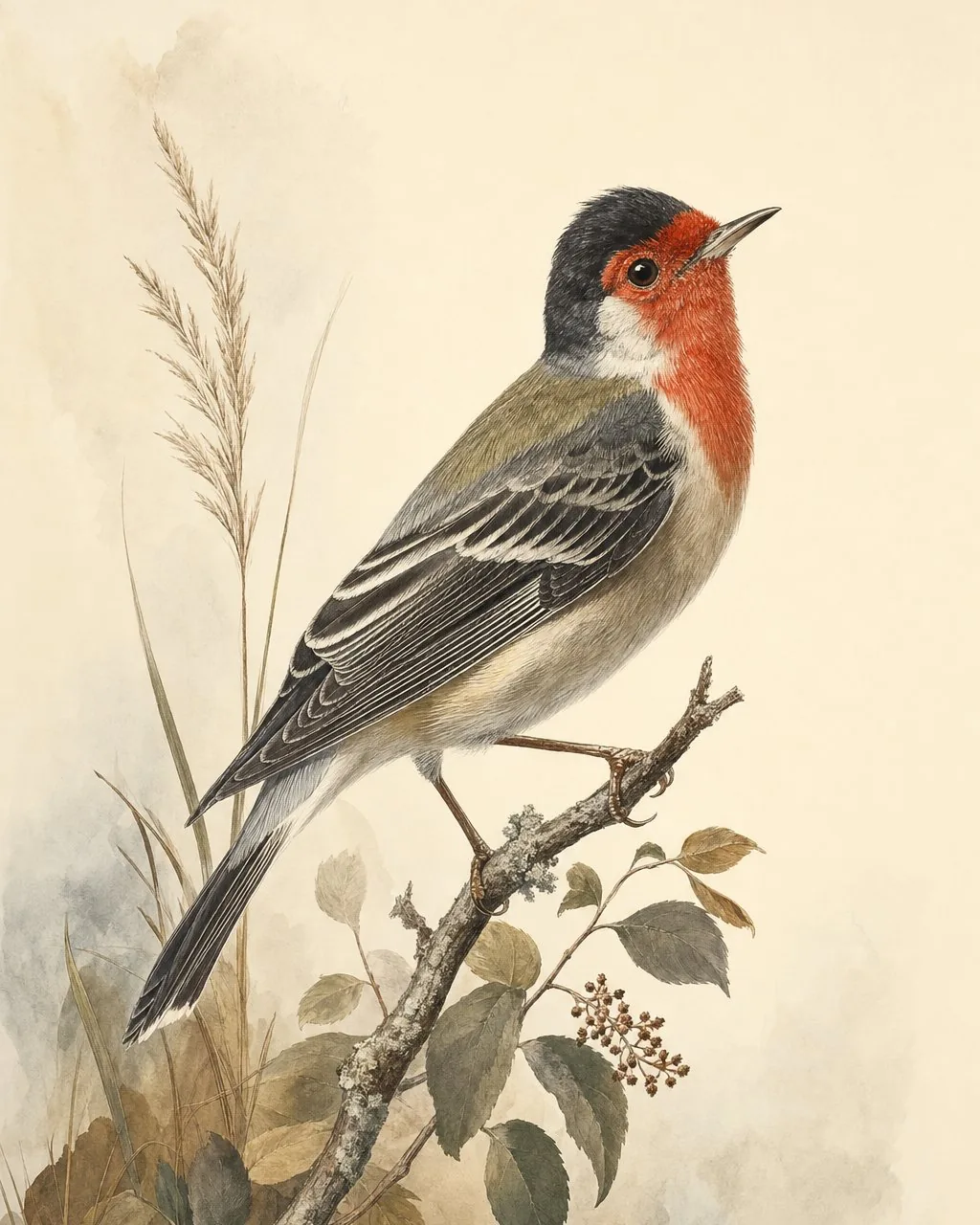
Gray above, with a white belly and white wing bars. The rump is white and often flashed as the bird moves, visible as a pale patch above the tail in a bird that is otherwise grey. The tail is dark.
The face is the whole story. A deep, crimson red covers the forehead, sides of the face, chin and upper throat, framed by a black cap that covers the crown and ear coverts. The black and red meet in a hard line. The white rump echoes the white belly beneath the red face, giving the bird a clean, high-contrast palette: grey, white, red, black. No intermediate tones.
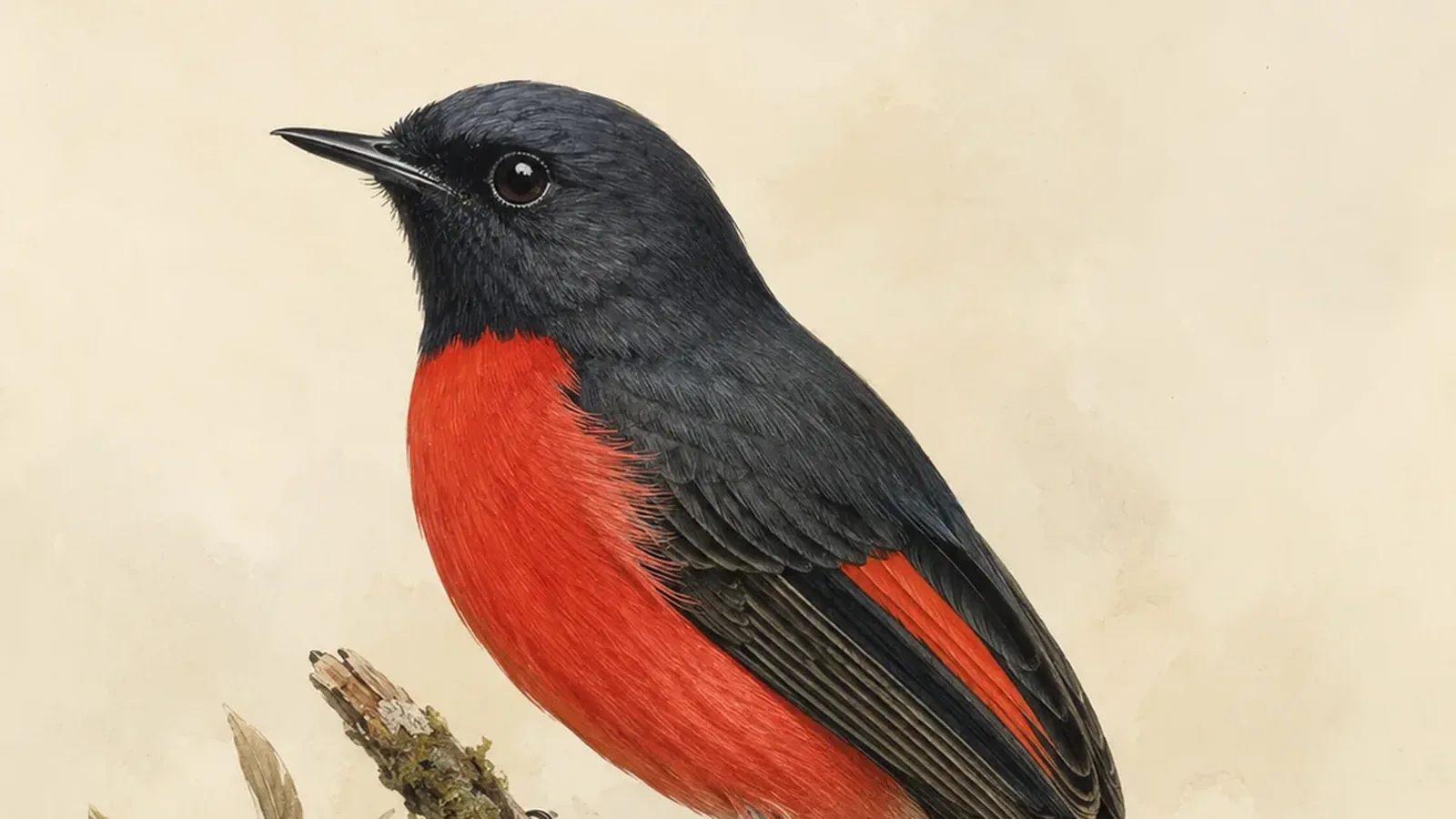
The Painted Redstart shares the sky island habitat and also shows strong contrasting colors, but its pattern is entirely different - black with red breast and white wing patches. The two species can occur in the same canyon and are not confusable.
Sexes are similar in the Red-faced Warbler - males and females both show the red face, though the female’s red may be slightly less saturated. Young birds have a washed-out version of the adult pattern.
| Measurement | Range |
|---|---|
| Length | 13-14 cm |
| Weight | 7-10 g |
| Wingspan | 20-21 cm |
| Lifespan | 3-8 years |
Voice
A high, variable, musical song - a series of sweet notes, sometimes loosely descending, delivered from a mid-canopy perch. The song quality is bright and airy, not as complex as some warblers, but carrying well in the mountain pine forest. The call is a sharp chip, similar to other Cardellina warblers.
“He sang from a ponderosa snag at the canyon rim, ten metres up, the red face visible against the bark even at that distance. Three song variants in succession, each slightly different - as if testing arrangements.” - field notes, Chiricahua Mountains, June
Range and habitat
In the United States, the Red-faced Warbler is confined to the sky island mountains of southeastern Arizona and the Bootheel of southwestern New Mexico. It arrives in late April or May and departs by September. It does not winter in the United States.
The winter range is in the mountains of Mexico and into Guatemala - pine and pine-oak forest at elevation, similar in structure to the breeding habitat. The migration routes are not well documented for this species.
Within the sky islands, the bird is found in cool, moist conifer and pine-oak forest, typically above 1,800 metres. It shows a preference for forests with significant ponderosa pine or mixed conifer cover and a well-developed understory. In the heart of its Arizona range - the Chiricahua Mountains, accessible from the town of Portal - it is reliably found and a primary draw for birders visiting the region.
Diet
Insects gleaned from foliage and caught in brief aerial sallies. The Red-faced Warbler forages actively through the mid-canopy and understory, often hanging beneath leaves and probing from below, a habit shared with several other warblers. It also forages in the leaf litter on the ground, particularly when feeding young. The full diet composition is not well studied.
Breeding
Ground-nesting distinguishes the Red-faced Warbler from most other North American warblers. The nest is a deep cup of grass, pine needles, and plant fibres, set into a depression in the ground at the base of a plant or rock, typically on a slope and always in the shade. The concealment is careful - nests are difficult to spot even when you know they are there.
Four eggs, white with fine brown spots. Both parents incubate, which is not universal among warblers. Incubation takes about two weeks. Both parents feed the young, which fledge in roughly twelve days.
The ground nest makes the species vulnerable to cowbird parasitism, but the prevalence of brood parasitism in the sky island populations appears to be lower than in some other warbler species in the region.
Sky islands and what they hold
The sky island mountain ranges of southeastern Arizona are among the most biologically diverse places in North America. They sit at the meeting point of four biogeographic regions - the Rockies, the Sierra Madre, the Chihuahuan Desert, and the Sonoran Desert - and the high-elevation forests share species with both the United States and Mexico. Elegant Trogons, Sulphur-bellied Flycatchers, Buff-breasted Flycatchers, and five species of hummingbird breed in the canyons alongside birds that would be entirely familiar from forests further north.
The Red-faced Warbler is one of the Mexican-origin birds that pushes north into this zone - a Mexican mountain species at the edge of its range in the Arizona highlands. It represents one strand of the complex biogeographic weaving of the sky islands, where bird communities from very different traditions meet and overlap.
Because the sky island ranges are isolated by desert, populations on different ranges do not interbreed freely. Over long time scales, this isolation can drive divergence. The Red-faced Warbler is currently considered one species across its range, but the mountain-island structure of its habitat creates the conditions for eventual differentiation.
Closing
The Chiricahua Mountains are six hours from most of the US population. The Red-faced Warbler is one of the reasons birders make the drive. It is not subtle. A small grey warbler with a face like a coal. You will see it moving through the pine understory in June and it will stop you, even when you know it is coming. The face does not become ordinary with familiarity. It remains, each time, the same small shock of red in the green of the mountain forest.