Field Guide
Red-headed Woodpecker
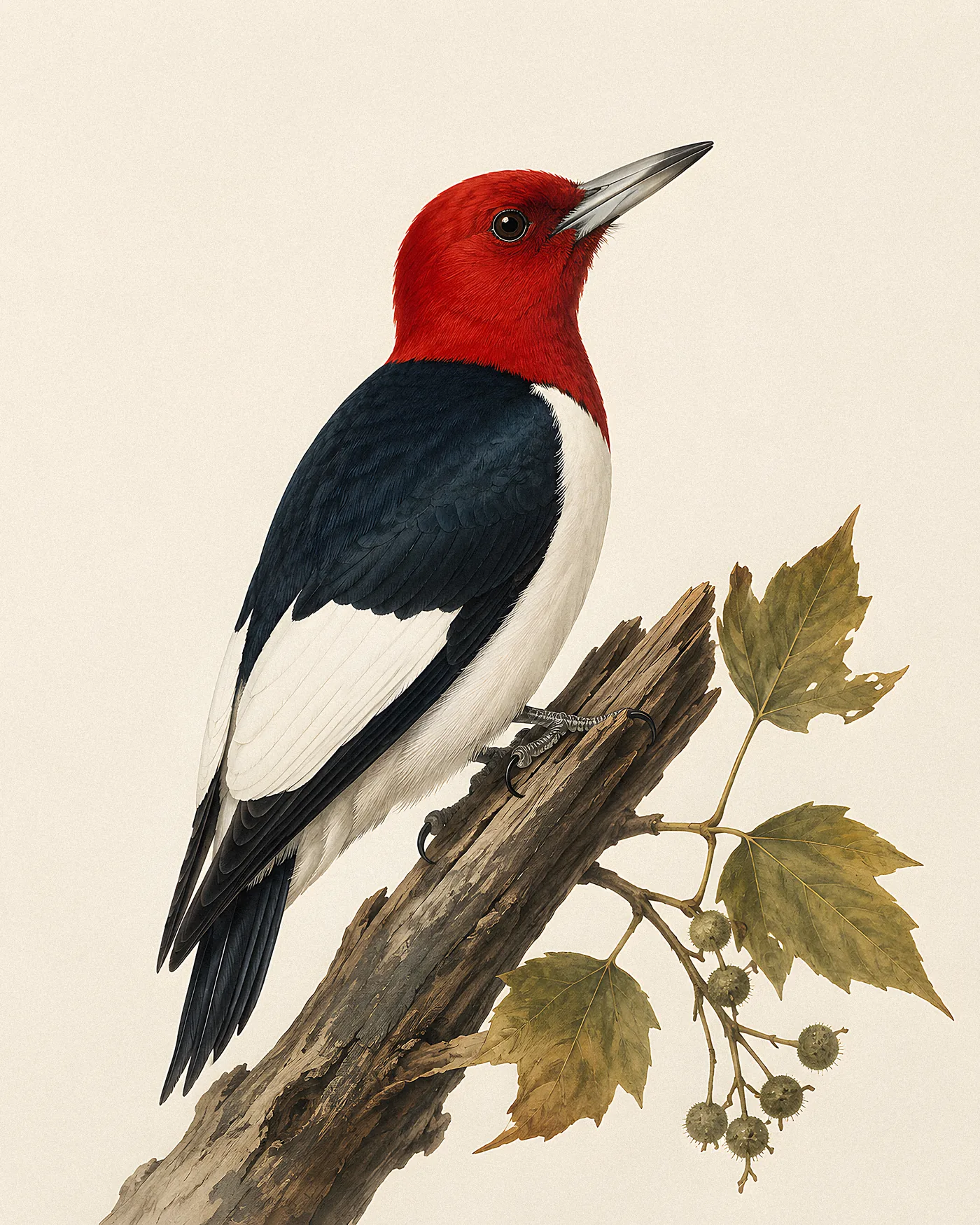
An open oak savanna in the upper Midwest, autumn, and a bird drops off a dead snag in a slow, flashing arc of black and white and crimson. It is not creeping up a trunk the way woodpeckers are supposed to. It sallies out from a perch like a flycatcher, snaps an insect from the air, and swings back. Then it turns to an acorn, carries it to a crack in the bark, and hammers it home for the winter. The whole head is solid red, the back is black, and two great white patches blaze on the wings.
The Red-headed Woodpecker breaks several of the rules its family is supposed to follow. It hawks insects on the wing, it stores food, and it wears the cleanest, boldest three-colour pattern of any woodpecker on the continent.
What it looks like
There is no field-mark puzzle with an adult. Cornell Lab describes the entire head and neck as deep crimson, set against a clean black back and tail, with the underparts and rump bright white. On the folded wing and especially in flight, large white patches on the inner wing flash against the black, so a flying bird shows three blocks of solid colour - red, black, white - with almost no pattern in between. Few North American birds are this graphically simple.
Unusually for a woodpecker, the sexes look alike: male and female both wear the full red hood, with no difference in the field. Cornell Lab puts the bird at 19 to 23 centimetres long, 56 to 91 grams, with a wingspan around 42 to 43 centimetres, larger than a Downy and roughly Red-bellied in bulk.
Young birds are the source of most confusion. Juveniles have a grey-brown head rather than red, and the white wing patches are crossed by dark bars. They moult into the red hood gradually through their first winter, so autumn often shows birds with a half-finished red head.
What it sounds like
The common call is a loud, harsh tchur or queer, higher and sharper than the rolling churr of the Red-bellied Woodpecker, often repeated as the bird moves between perches. Cornell Lab notes a range of rattles, chatters and harsh notes used around the nest and in disputes, and this is a vocal, conspicuous bird through the breeding season.
Drumming is part of the repertoire too, a short, soft roll on resonant dead wood used to claim territory, though the Red-headed Woodpecker leans more on its voice and its bold flight displays than many of its relatives.
Range and habitat
Melanerpes erythrocephalus is a bird of open country with big scattered trees: oak and beech savanna, open deciduous woodland, forest edges, river bottoms with standing dead timber, parks, golf courses, and old orchards. The constant is dead wood for nesting and an open structure for its flycatching and its long, flashing flights. It does not want closed, shady forest.
The range covers the eastern and central United States and the southern edge of Canada, with northern birds migrating south and the species shifting around in winter to follow the acorn and beechnut crop. Cornell Lab and the IUCN both now list it as Least Concern - the IUCN moved it back from Near Threatened to Least Concern in 2018 - but Cornell is careful to add that the species has declined sharply over the past half-century. The losses trace to the removal of dead trees, the clearing of open savanna, competition for nest holes with European Starlings, and the long collapse of the American chestnut and other mast trees it once relied on.
Diet
This is the most omnivorous of the eastern woodpeckers, and the most acrobatic feeder. Cornell Lab records it catching insects in mid-air with real skill, sallying out from a perch and returning, as well as gleaning beetles, grasshoppers and other prey from bark and ground. Plant food matters just as much: acorns, beechnuts, berries and fruit, and it will take seeds and corn at the edges of fields.
What sets it apart is hoarding. The Red-headed Woodpecker is one of only a handful of North American woodpeckers that stores food for later, wedging acorns and nuts into crevices, under bark and into fence posts. Cornell Lab notes it sometimes packs the cache so tightly, or covers it with bark and wood, that the store is effectively sealed in - and that it will even wedge live grasshoppers into tight cracks so firmly that they cannot escape.
Breeding and nesting
The nest is a cavity in dead or dying wood - a standing snag, a dead limb, a utility pole. Cornell Lab records that both sexes build but the male does most of the excavation, often working from an existing crack and digging out a gourd-shaped chamber over roughly 12 to 17 days. The same tree, and sometimes the same hole, may be reused in following years.
The clutch is typically four to five white eggs, occasionally more. Both parents incubate for about 12 to 14 days, the male taking the night shift, and both feed the young, which leave the nest at around 24 to 31 days old. In the warmer south a pair may raise two broods in a season.
Few birds on the continent are as graphically simple as an adult Red-headed Woodpecker: three solid blocks of red, black and white, and almost nothing in between.
What to watch for
The thing that marks this bird out in the field is not the colour, striking as it is, but the behaviour. Watch a Red-headed Woodpecker for a few minutes in autumn and you will see it act like three different birds: a flycatcher snapping insects out of the air, a woodpecker hammering bark, and a hoarder ferrying acorns to its private stores. No other eastern woodpecker does all three with such ease.
It is also a bird worth seeking out while it is still common enough to find easily. The long decline is real, and the open, dead-wood savanna it depends on is exactly the habitat people are quickest to tidy away. A pair working an old oak grove, flashing black and white and crimson between the snags, is one of the finest sights in eastern birding, and one the tradition of Audubon set down again and again.