State Guide
Orange Birds in Washington State
Some mornings in late May, a male Western Tanager drops into the conifers above a Cascades trailhead and seems lit from inside. The head is orange-red, the body clean lemon yellow, the wings black with two sharp bars. He looks subtropical. He is not. He has just climbed out of Mexico along the Pacific slope and arrived, right on schedule, in the Douglas-fir forests he will breed in for the next three months.
Washington is one of the richer states in the country for orange-plumaged birds, and the Cascade Range is the reason. It splits the state into two distinct worlds - a damp, conifer-dense west and a dry, cottonwood-threaded east - and each side holds a different cast. The same mountain barrier that gives Seattle its rain and Spokane its drought determines which orange birds you find.
The Varied Thrush: western and year-round
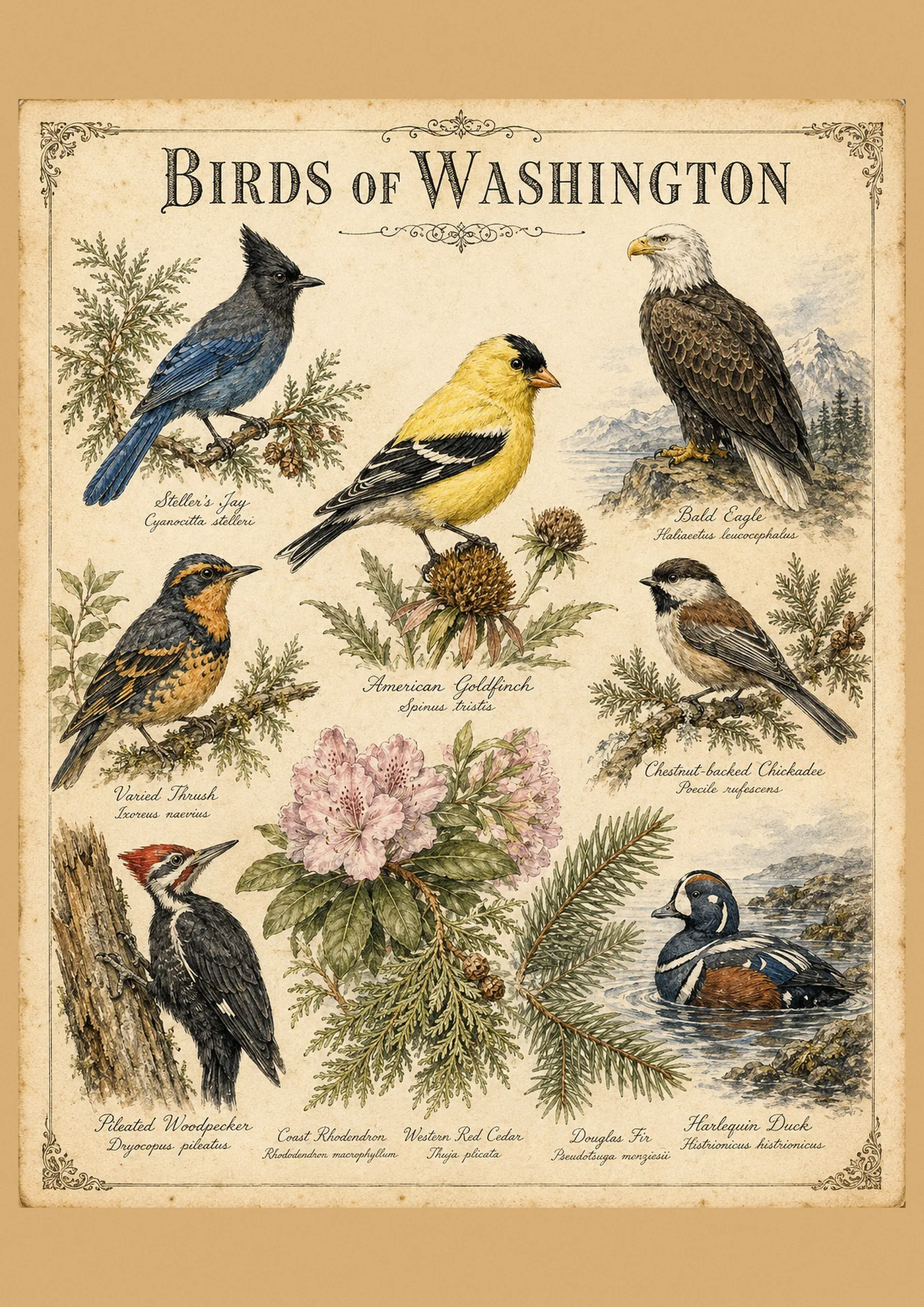
The wet side has its signature species and it is not the tanager. Ixoreus naevius is a year-round resident in western Washington’s dense coniferous forest, an altitudinal migrant that breeds at middle and high elevations and descends to the lowlands each autumn. BirdWeb (Washington Ornithological Society) lists it as common in all western forest zones throughout the year.
The male carries a burnt-orange belly and throat, a black breastband, and an orange stripe above the eye - like an American Robin with more considered markings. The female is the same pattern in lighter gray-brown. The plumage is not what makes the Varied Thrush worth knowing. The call is. Cornell’s All About Birds describes the song as a “flutelike, sometimes burry tone on a single pitch” - each phrase lasting about two seconds, then silence, then a different pitch. Most often heard at dawn, dusk, and just after rain. In the old-growth hemlock and cedar of the Olympics, that sound carries through the canopy like a tuning fork.
The Varied Thrush is not the loudest bird in Washington’s rainforest, but it is the one whose single sustained note you are still hearing in your head when you reach the trailhead parking lot.
The Western Tanager: the late arrival
BirdWeb describes Piranga ludoviciana as “relatively late-spring and early-fall migrants” - present in Washington from May through September. That late spring arrival is not coincidence: Cornell’s All About Birds notes that Western Tanagers breed farther north than any other North American tanager, and they time their ascent to match the flush of insects that follows snowmelt. They are widespread in eastern Washington’s ponderosa pine and Douglas-fir zones, and common through the North Cascades from May to August. During fall migration they turn up in almost any habitat, including grassland and desert, before slipping south again by late September.
Females are quieter yellow-green with the same black-and-white wing bars. They are less conspicuous, just as present.
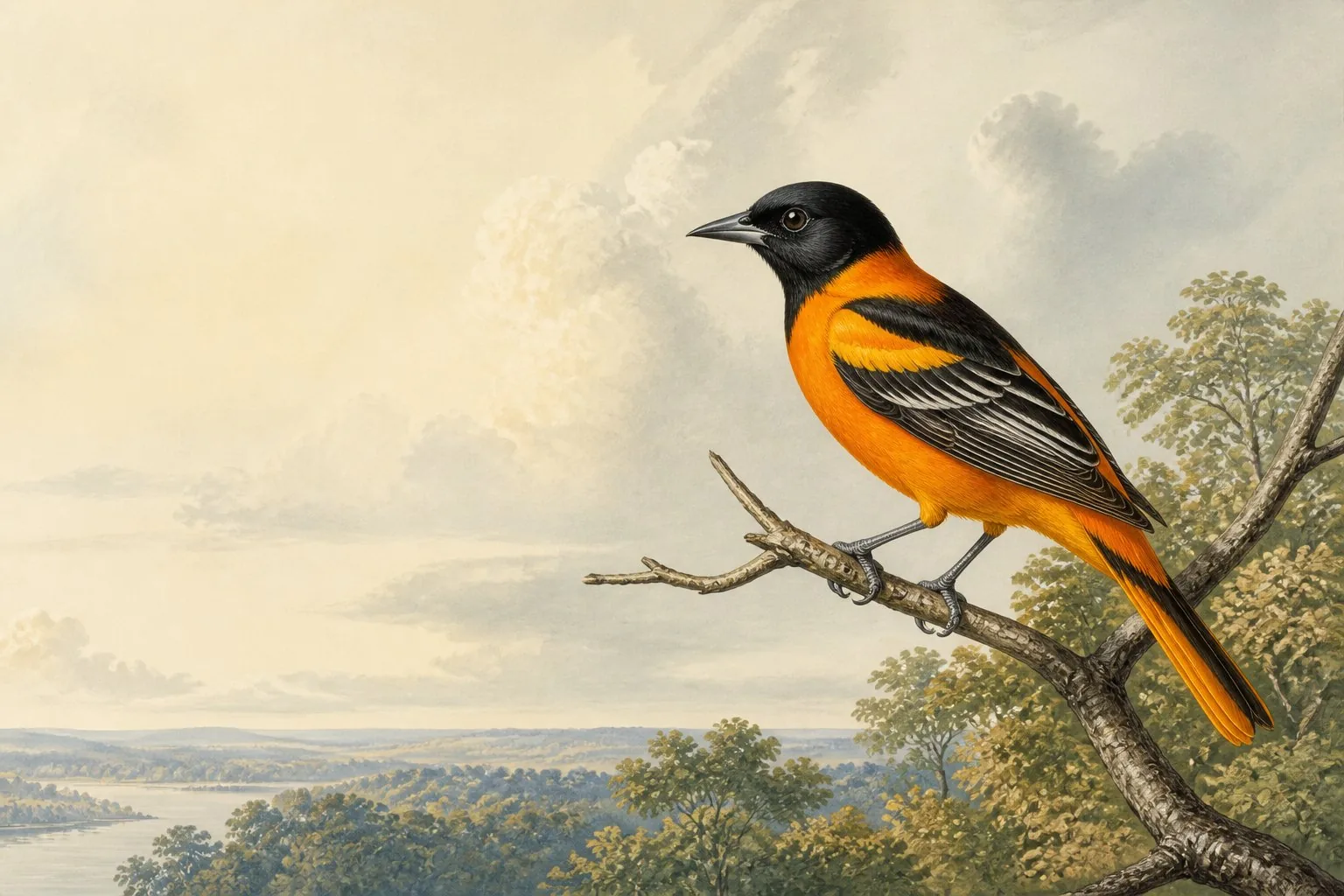
For an article on orange birds in Illinois, the equivalent showpiece migrant is the Baltimore Oriole - a species with roughly the same relationship to the breeding season but a very different habitat. In Washington, the tanager owns the conifer zone. Nothing in the eastern United States quite matches it.
Bullock’s Oriole: the eastern species
Cross Snoqualmie or Stevens Pass in late May and the vegetation changes within ten miles. Cottonwoods replace hemlock. BirdWeb gives Bullock’s Orioles 14 weeks in the state - arriving early May, departing by early August - concentrated in the riparian corridors that thread the Columbia Plateau and the Okanogan valley.
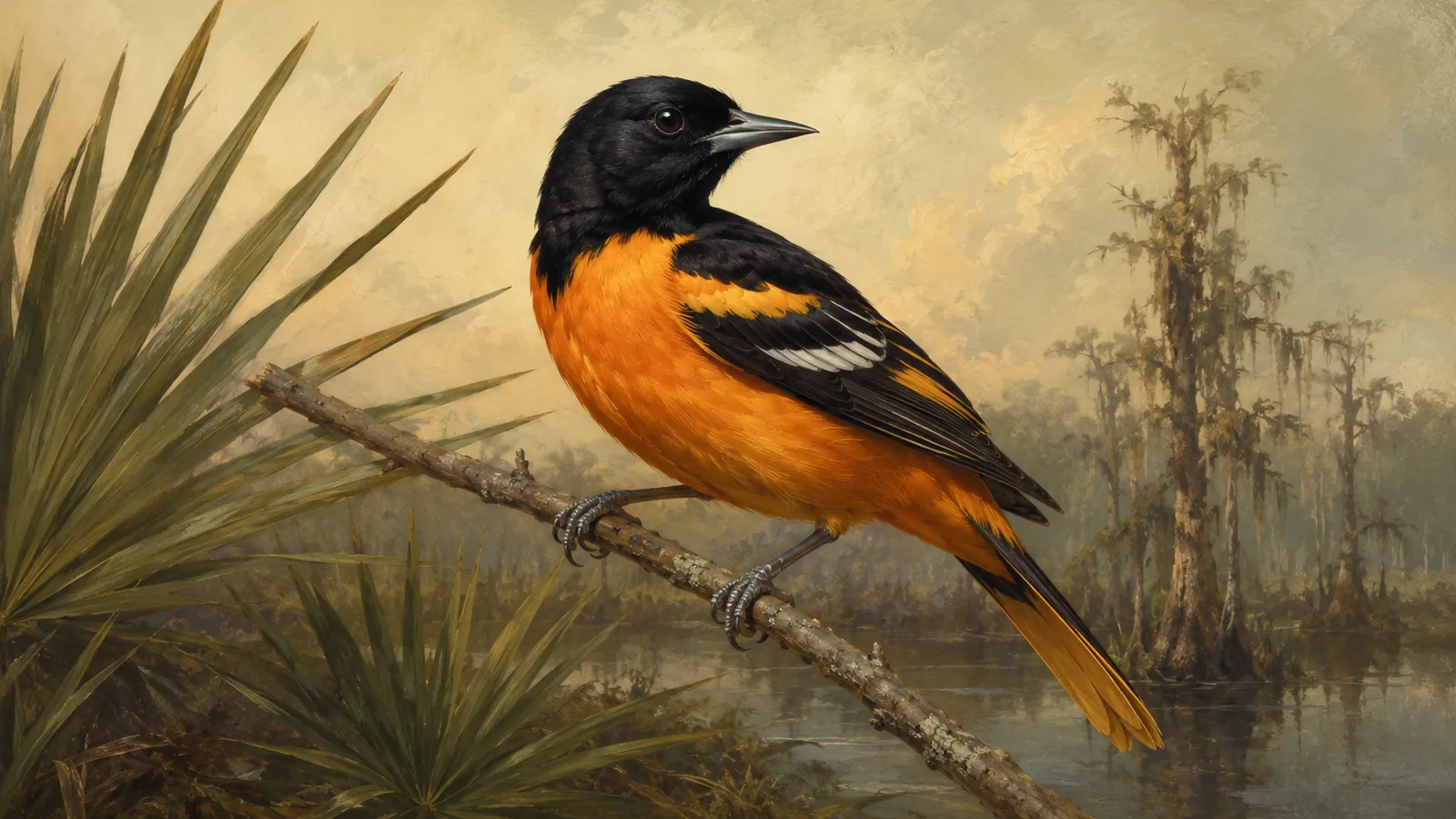
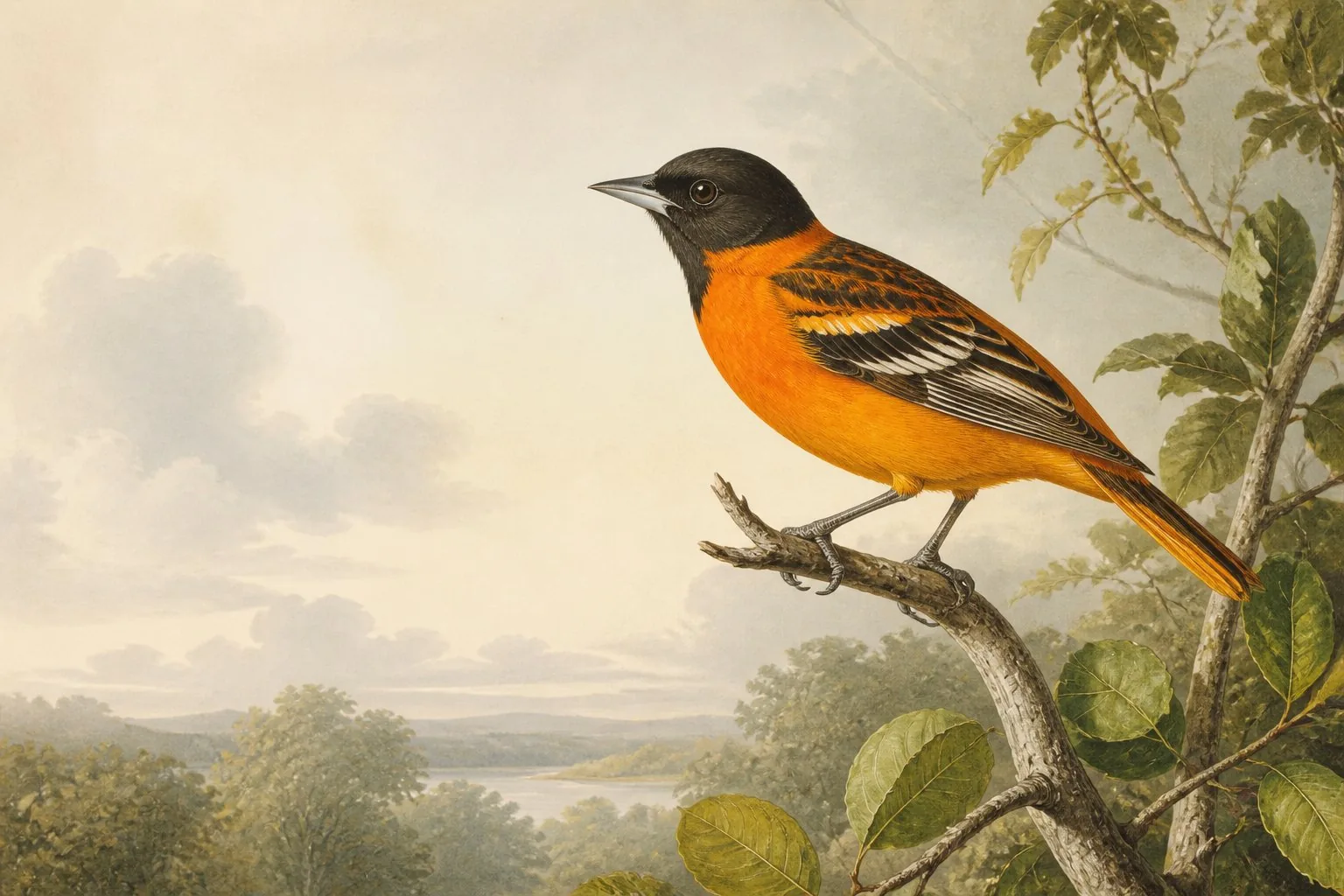
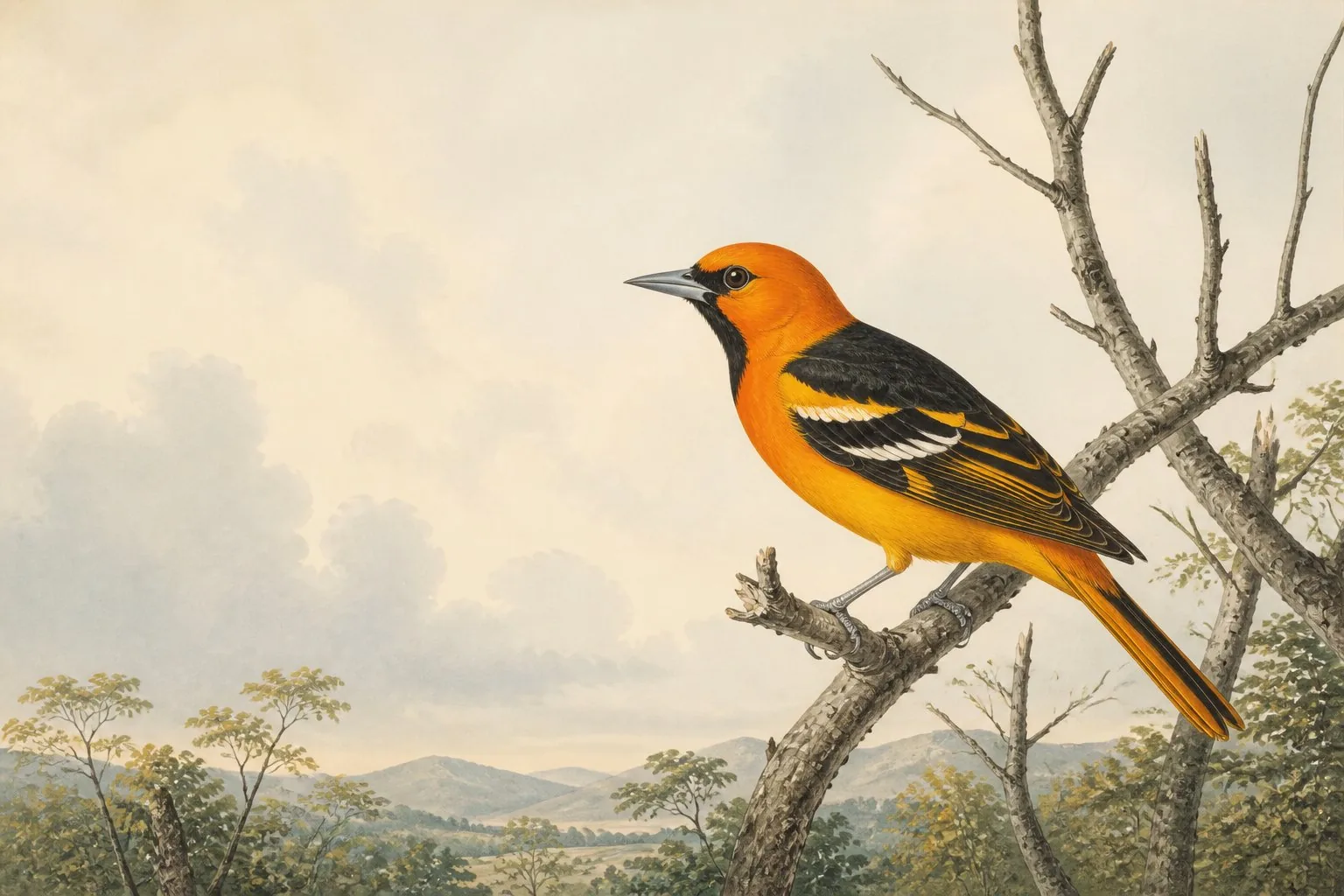
Cornell’s All About Birds describes Icterus bullockii males as having more white in the wings than their Baltimore Oriole cousins, with a distinctive tail pattern. The face and underparts are a clean orange, contrasting a black crown and eye-line. Females are grayer, with a whitish belly and a darker eyeline, and are genuinely difficult to separate from some other orioles. The female builds the nest: a hanging pouch woven from plant fibers and bark strips, suspended from a cottonwood branch 10 to 25 feet up, holding four to five eggs that she incubates for about 11 days.
They are common in eastern Washington’s open country and only fairly common in the Puget Trough. West of the Cascades they are a May migrant in small numbers. For a comparable riparian oriole situation in a midwestern state, see orange birds in Michigan.
The Rufous Hummingbird: earliest orange
Selasphorus rufus males are rufous nearly everywhere except a white chest and short green wing patches - Cornell’s All About Birds identifies them as the only rufous-backed hummingbird in North America. BirdWeb Washington records them arriving in western Washington from late February to early March, their timing tied to the bloom of red flowering currant and salmonberry. They migrate north up the Pacific coast and are the northernmost breeding hummingbird on the continent.
In eastern Washington they are restricted to higher elevations in the northeast corner of the state and the Blue Mountains. Males depart the breeding grounds in June and July. Females and juveniles follow through August and September. They travel light and leave early.
Other orange birds statewide
Four species ignore the Cascade divide. The Red-shafted form of the Northern Flicker - the subspecies standard in Washington - flashes salmon-red under the wings on every undulating flight, year-round, statewide. American Robins carry their orange-red breasts on lawns and in parks at every elevation. Spotted Towhees show rufous-orange flanks in the dense brush of foothills across both sides of the state. Red-breasted Nuthatches work conifer trunks with rusty underparts throughout the year, calling with a nasal yank that carries farther than the bird appears capable of.
| Species | Orange feature | Season | Side |
|---|---|---|---|
| Varied Thrush | Orange belly, eyebrow stripe | Year-round | West |
| Western Tanager | Orange-red head, yellow body (male) | May - Sep | Both |
| Bullock’s Oriole | Orange face and underparts (male) | May - Aug | East |
| Rufous Hummingbird | Rufous body (male) | Feb - Sep | Both |
| Northern Flicker | Red-orange under wings | Year-round | Both |
Where to look
For the Varied Thrush: any old-growth or mature second-growth forest in the Olympics or western Cascades will produce them from autumn through spring. The Hoh Rainforest trail in November, when birds descend from the upper canopy to work the forest floor, is a reliable location.
For the Western Tanager: the eastern Cascades around Winthrop and Leavenworth are more productive than the wet west side during summer. North Cascades National Park holds good numbers from May through August.
For Bullock’s Orioles: drive east. The Spokane River corridor, the Methow Valley, and the cottonwood groves along the Okanogan River reliably hold them through June. For a different take on orioles in a more varied landscape, the orange birds in Arizona guide covers the Hooded Oriole alongside Bullock’s.
The Northern Cardinal does not reach Washington - it is a bird of the eastern half of the continent, as the cardinal field guide explains. Washington’s answer to the bright-red feeder bird is the Western Tanager, and unlike the cardinal it arrives for only a season, on a schedule the conifers have kept for longer than the state has had a name.