Backyard
How to Attract Owls to Your Garden
A Barn Owl ghosting over a field at midnight covers the ground equivalent of a dozen mouse traps. The farmer who puts out rat poison loses both the mice and the owl.
That tension sits at the heart of every owl garden. You do not attract owls by putting out food. You attract them by building a hunting ground - and then getting out of the way.
Why owls visit some gardens and not others
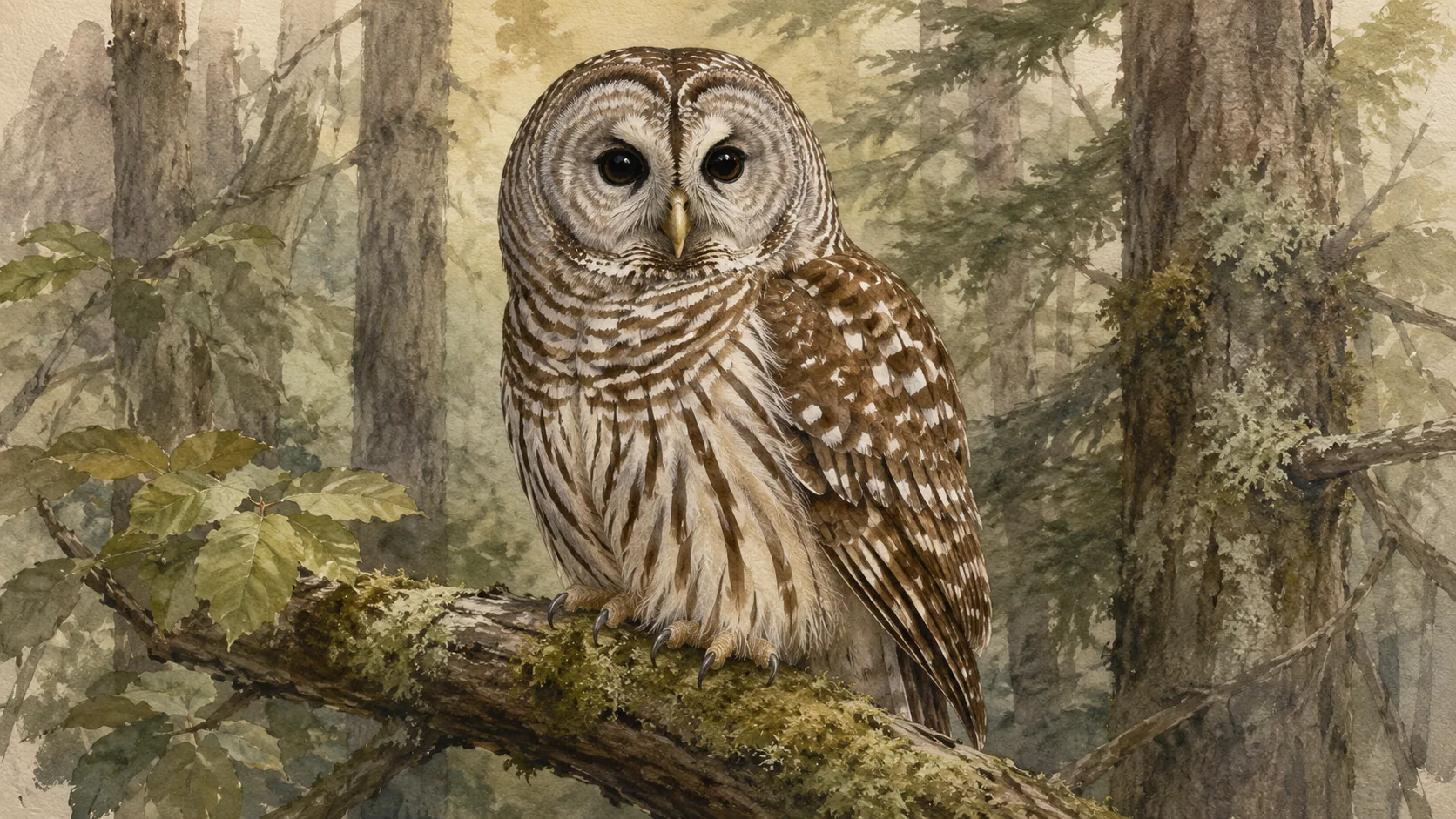
Owls are territorial and low-density. A single Great Horned Owl pair may defend a territory of several hundred acres. A Barred Owl pair will hold the same woodland hollow for decades. These are not birds that flock to a feeder.
What moves an owl to investigate your patch is simple: a reliable prey population and somewhere safe to watch from. Mice, voles, shrews, and the occasional small rabbit. A big old tree to perch in. A quiet approach from the dark. Take that seriously and the rest follows.
Expect months, not days. Screech-owls exploring a new box sometimes spend an entire winter scouting before committing. Patience is part of the deal.
Stop using rodenticides - this is the one non-negotiable
Before you buy a single nest box, walk your property and remove every rodenticide bait station.
Second-generation anticoagulant rodenticides - SGARs, the most common residential rat and mouse poisons - work by preventing blood from clotting. A rodent that has eaten SGAR bait does not die immediately. It becomes slow, disoriented, and easy to catch. An owl takes it. The poison moves up the food chain intact, and the National Audubon Society reports that these compounds can persist in a raptor’s body for months. Internal bleeding follows, usually fatally.
The scale of this is not theoretical. A 2020 Tufts Wildlife Clinic study found that every Red-tailed Hawk admitted to the clinic tested positive for rodenticides, and the same compounds are a documented major source of indirect poisoning in Great Horned Owls. When Flaco, the Eurasian Eagle-Owl who spent years charming New Yorkers after escaping Central Park Zoo, was examined after his death, toxicology found multiple rodenticides in his system.
Snap traps catch rodents. Owls deal with rodents. Pick the tool that does not poison the bird you are trying to attract.
Build the hunting ground first
A garden mown to the edges has nothing to offer an owl. A garden with rough edges has everything.
The Owl Research Institute is direct on this: without a steady prey population, owls will not stay. That prey population depends on habitat - long grass along fence lines, leaf-litter banks, brush piles of sticks and garden trimmings positioned away from the house. These patches shelter mice and voles through winter. The owl follows the food chain, not the birdwatcher.
A few specific changes that matter:
- Leave a strip of grass uncut along one garden edge, at least a metre wide
- Stack a brush pile - sticks, leaves, bark - in a corner the family does not use daily
- Tolerate some leaf litter under hedges; shrews hunt in it and owls hunt shrews
- Resist the tidy impulse along field or woodland edges that adjoin your property
None of this requires a large garden. A suburban plot with one rough corner is measurably more attractive to a hunting Eastern Screech-Owl than a uniform lawn.
Dead wood and tall perches
Standing dead trees - snags - are some of the most valuable real estate in any garden for owls. The Owl Research Institute lists retaining snags as one of the highest-impact habitat actions available. They provide roost cavities, hunting perches, and the insects that feed the small mammals owls hunt.
Where a dead tree is genuinely dangerous, over a path or over a roof, it has to come down. Where it is not, leave it. Even the top section of a dead trunk, with the lower limbs removed, works as a hunting perch.
Tall, open-canopied mature trees matter too. A Barn Owl needs clear approach lanes over open ground. A Barred Owl needs interior woodland with an elevated perch to drop from. Think about sightlines when you place a nest box later.
Nest box specifications by species
Three species accept nest boxes in North America. One famously does not.
The Great Horned Owl does not use a cavity and will not use a box. Great Horned Owls reuse the open platform nests built by Red-tailed Hawks, Common Ravens, and other large birds. They do not excavate or adopt enclosed spaces. The same applies to Great Gray Owls and Long-eared Owls. If you see advice online about a “Great Horned Owl box,” it is wrong.
For the species that do use boxes, install before the breeding season, December through early February for most regions.
| Species | Floor | Depth | Entrance hole | Height | Notes |
|---|---|---|---|---|---|
| Eastern Screech-Owl | 9 5/8” x 11 1/4” | 17 3/8” | 3” diameter | 10-30 ft | Space boxes 100 ft apart; add 2-3” wood shavings |
| Barn Owl | 12 3/8” x 22 3/4” | 16” | 4 1/2” diameter | 8-25 ft | Open habitat essential; do NOT disturb April-May |
| Barred Owl | 13” x 13” | 23” | 7” diameter | 12-15 ft | Place within 200 ft of water if possible |
Specifications are from NestWatch, the nest box monitoring programme run by the Cornell Lab of Ornithology.
Screech-owl boxes do best mounted on a live tree at least as wide as the box, set under a limb at the woodland edge with fields or wetland within easy hunting distance. A predator guard on the trunk is worth the effort; raccoons are persistent.
Barn Owls are extremely sensitive to disturbance during early nesting. If an occupied box is approached in April or May, the adults may abandon eggs or young entirely. Install early, clean out old nesting material each December when the birds are least active, and leave the box alone from March through July.
Barred Owl boxes work best at the lower end of the height range, within 200 feet of water, in mature deciduous or mixed woodland. Aim for at least half a mile between boxes if you put up more than one.
Keep it dark, keep it quiet, keep the cats inside
Three small changes remove three large deterrents.
Outdoor lights at night are an active obstacle to owls whose ambush hunting depends on darkness. Turning off exterior lights, or switching to motion-sensor fittings that stay off unless triggered, removes the deterrent immediately, according to the Owl Research Institute.
Cats left outdoors at night compete for the same rodents owls hunt. They also put smaller cats at genuine risk. The Great Horned Owl will attack animals as large as skunks, and a small domestic cat is not outside that range. Keep cats in after dark for the owl’s benefit and the cat’s.
Noise and disturbance near a roosting or nesting owl causes repeated flushing. The bird burns energy and eventually moves on. Give any owl you notice a wide berth, especially from January through June.
You attract owls by building a hunting ground, not a feeding station - stop the poison, rough up the edges, and then leave the garden alone enough for a nocturnal predator to trust it.