Backyard
Where to See Ducks in Wooded Wetlands
You hear it before you see anything. A loud, rising squeal - oo-eek, oo-eek - and then a flash of wings punching up through the canopy. The bird is already gone. That is a Wood Duck, and it just told you that you are in exactly the right place.
Wooded wetlands are their own category of habitat, and the ducks that live inside them behave nothing like the birds you watch from a lake shore or a marina dock. Getting it right means understanding the terrain first.
What Wooded Wetlands Actually Look Like
Forget open water. The habitat you are looking for has trees over the water, or immediately at its edge. Flooded bottomland timber after spring rains. Beaver ponds ringed with alder and willow. Wooded swamp margins where the ground is soft and the tree roots go dark below the surface. Slow, tree-lined creeks where the canopy nearly meets overhead.
Cornell Lab of Ornithology notes that Wood Ducks fare best when open water alternates with roughly 50 to 75 percent vegetative cover - downed logs, shrubs like buttonbush, alder, and willow, emergent plants like arrowhead and smartweed. That ratio is your field diagnostic. If you are standing at the edge of a wide-open reservoir with a clear sight line across the water, you are in mallard and teal territory. Step into the tree line and follow the water into the shade. That is where this article begins.
The Two Birds You Are Looking For
Wood Ducks are one of the very few duck species with sharp claws that allow them to perch in trees and fly through a forested canopy with real agility. Their broad tail and short, wide wings make them maneuverable in conditions that would strand other waterfowl on the water. They are not wading the open shallows. They are sitting on branches above your head, or moving through gaps in the trees you have not found yet.
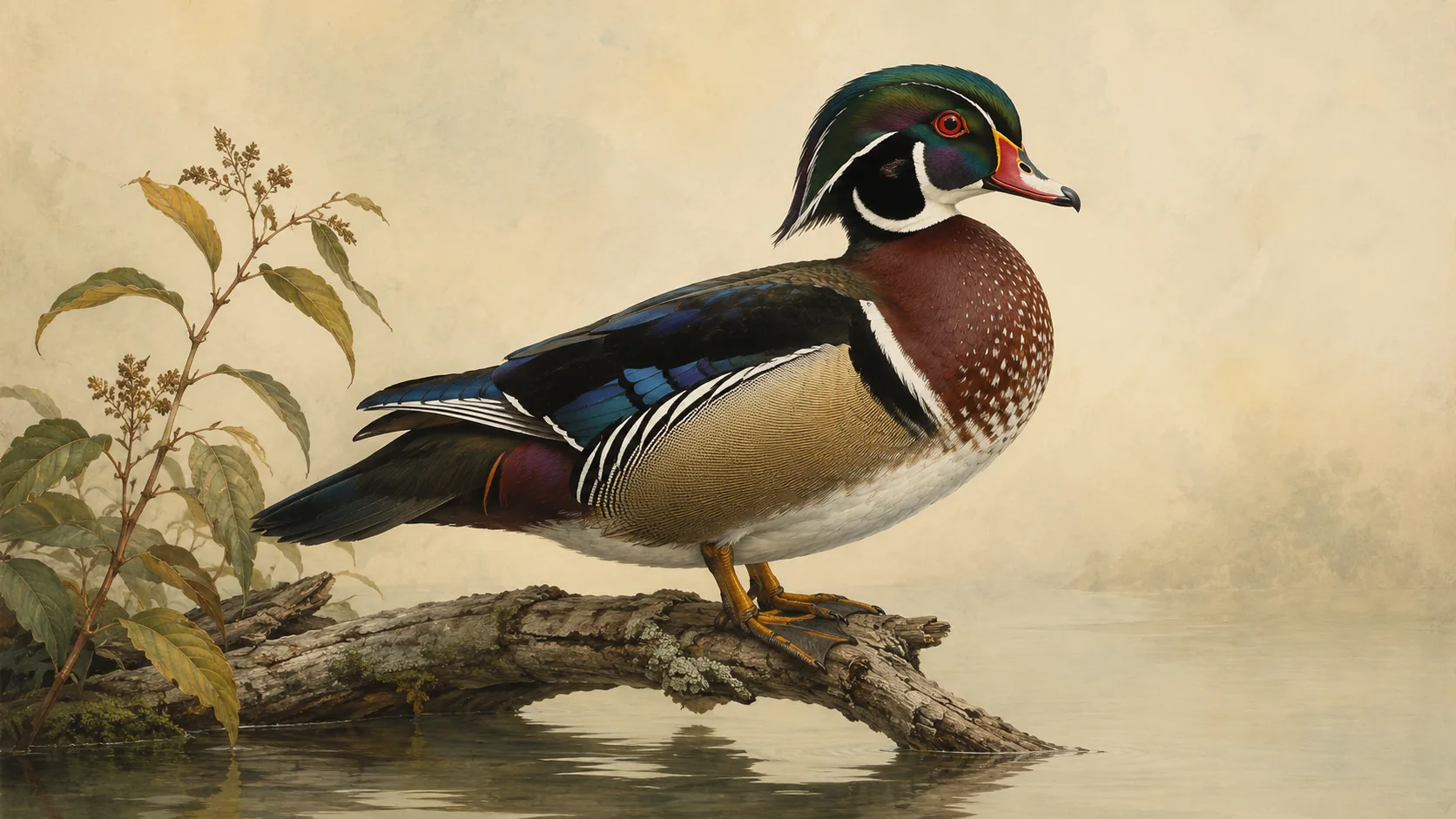
The male in breeding plumage is almost implausible - iridescent green and purple crown, chestnut breast, white facial stripes, red eye. The female is grey-brown with a distinctive white teardrop eye ring. Both will be tight to the wooded edge.
Hooded Mergansers share this habitat. At 16 to 19 inches, they are the smallest of North America’s three native merganser species, and they belong to a completely different foraging guild from Wood Ducks. Where Wood Ducks dabble and pick food from the surface, Hooded Mergansers dive in clear, shallow forest ponds and streams, propelling themselves with their feet, using serrated bills and eyes adapted for underwater vision to catch small fish, crayfish, aquatic insects, and amphibians.
The male in display is extraordinary. He raises his great fan-like crest, throws his head back, and gives a low, froglike croak. The female is a quieter rusty-brown with a smaller, reddish-orange crest.
Neither of these birds is a marsh duck or an open-lake duck. The habitat they share is trees over, or touching, water.
When to Go
Spring is the best season. The National Audubon Society confirms that Wood Duck pairs form in January, and most birds arrive at northern breeding grounds already paired. First clutches are laid from late February through April in many regions. The birds are active, vocal, and present in good numbers before leaf-out thickens the cover.
Early autumn is the second window, before Wood Ducks begin their southward migration, when family groups are still in the area and the juveniles have not yet dispersed.
Within any day, dawn is the time. Wood Ducks are most active at first light, leaving roosting sites to head for feeding areas. By mid-morning in dense wooded habitat, your chances drop sharply. Midday in a flooded swamp in summer is quiet and hot. Get there as the sky goes grey and be patient for the first hour of light.
Moving Along the Wood-Water Edge
The technique is slow movement along the transition line where trees meet water, not through the interior of the woods, not along an open bank. You want to stay where you can see the surface but keep the tree trunks close on one side.
Listen first. The female Wood Duck’s alarm call, that loud, rising oo-eek, is your primary detection tool in heavy cover. It comes before the bird is visible, typically as she flushes from somewhere you could not have spotted her anyway. When you hear it, stop. There will be other birds in the same area that have not yet flushed.
When Wood Ducks do flush, they go up, not along the water. Watch for movement in the canopy, not along the surface. The wings make a distinctive sound cutting through branches.
Use gaps in the tree line as sight lines across to the far bank. Scan slowly. A Hooded Merganser pair will often be in the middle of a quiet pool, diving and surfacing. A Wood Duck will be in the shallower margin, under the canopy edge, often motionless on a log.
| Sign | What it means |
|---|---|
| Rising squeal from cover | Female Wood Duck flushed or alarmed - other birds nearby |
| Wings audible through canopy | Wood Duck departing upward, not along surface |
| Small diving bird, forested pool | Hooded Merganser - look for the crest |
| Log over water, shaded margin | Prime Wood Duck loafing spot - scan slowly |
| High cavity in large dead tree | Potential natural nest site - watch at dawn |
The Recovery Story and What You Can Do
Wood Ducks were nearly extinct by the early 1900s, driven down by market hunting and the destruction of old-growth trees with the large cavities they require. They cannot excavate their own holes. They depend entirely on existing tree cavities, typically in trees two feet or more in diameter, anywhere from two to sixty feet above the ground, or on nest boxes.
The Migratory Bird Treaty Act of 1918 ended the hunting pressure. The nest box programs run through the US Fish and Wildlife Service and taken up by conservation groups did the rest. The Wood Duck population is now approximately 4.6 million birds, according to Audubon. The Hooded Merganser, at around 1.1 million birds, has increased alongside them, because both species use the same nest box design.
That detail matters. Audubon’s nest box specifications call for a 10-by-10-inch floor, 24-inch interior height, and an elliptical entrance hole 4 inches high by 3 inches wide - the elliptical shape discourages European Starlings. Mount it 6 feet high on land, or 3 feet above the historic high water mark over water, with 4 inches of wood chips inside. If you install a Wood Duck box near a wooded pond, a Hooded Merganser pair may well be the ones who use it first.
You can read more about putting one up in how-to-build-a-wood-duck-nest-box.
What You Will Actually See
Be honest with yourself about what wooded wetland birding delivers. The encounters are brief, close, and explosive. A male Wood Duck flushing from three feet away, that moment of iridescent green catching the first light before he threads the trees and is gone, is the sighting. Not a long, comfortable look.
What you accumulate over multiple visits is pattern. You learn where the birds are roosting from the direction of the dawn flight. You learn which pool holds Hooded Mergansers through the winter. You find the log where Wood Ducks loaf at midday. In late spring, a female leads ducklings in a line across a dark pool, and that is the payoff for every quiet morning you put in.
The wooded wetland rewards a different kind of attention than open-water birding - not scanning, but listening, moving slowly along the tree-water edge, and letting the rising squeal of a flushing Wood Duck tell you where to stand still.