Field Guide
Wood Duck
There is a beaver pond in a Carolina bottomland in late April where, just after dawn, a female Wood Duck calls up to a hole in a dead tupelo. The hole is 12 metres above the ground. Inside it are her ducklings, hatched the day before, dry now and ready. She gives a low clucking call from the water below, and one by one they climb to the entrance on claws built for bark, look down at a drop many times their own height, and jump.
They cannot fly. They will not fly for two months. They fall the whole way, tumbling through the air like windblown leaves, and they hit the ground or the water and they bounce, and they are fine. Then they paddle to their mother and the brood moves off into the swamp. It is one of the most extraordinary first mornings of any animal in North America, and the bird that performs it is also the most improbably beautiful duck on the continent. Both facts are true of the same creature. The Wood Duck does not choose between drama and beauty. It carries both.
What he looks like
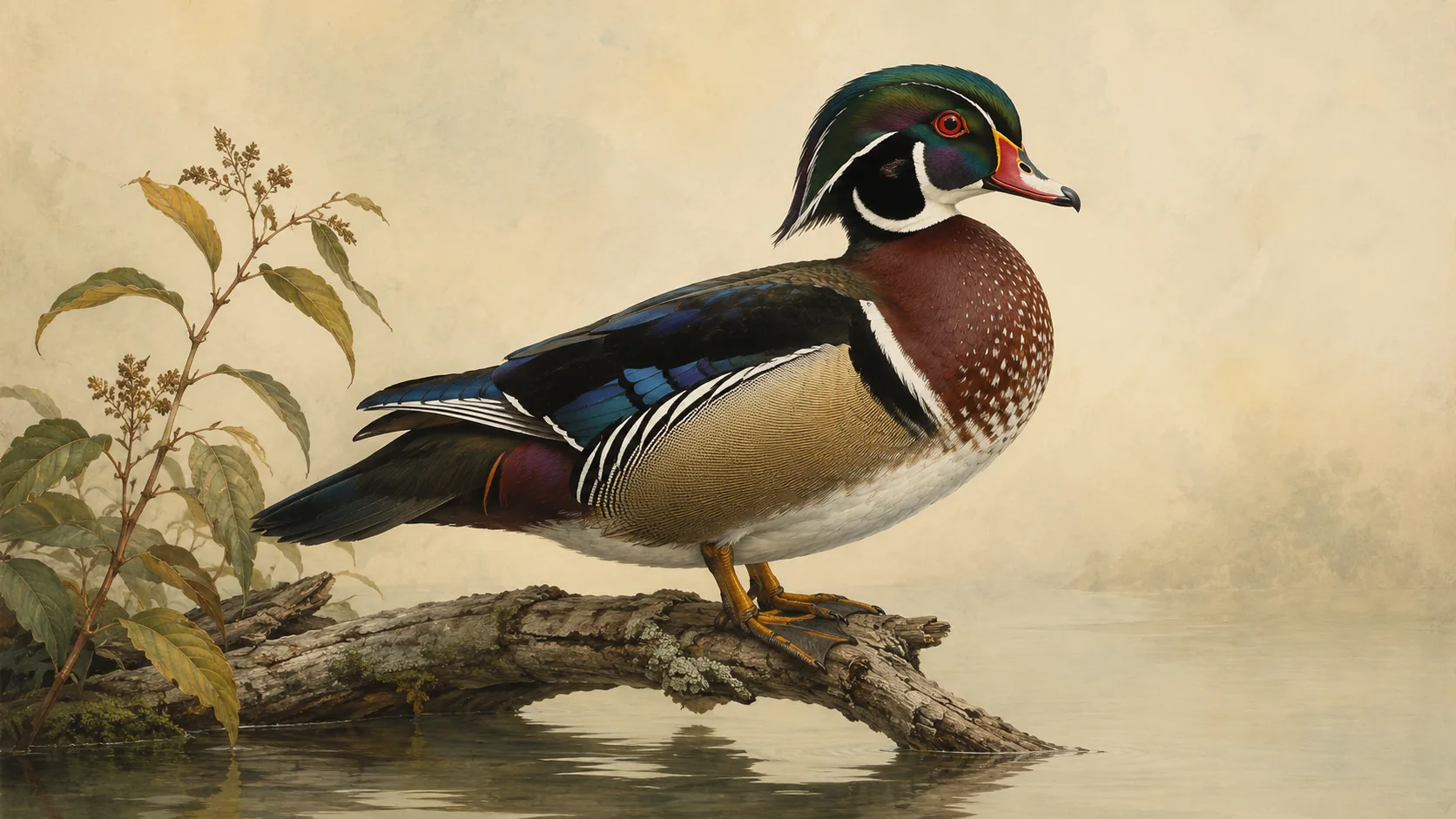
The drake Wood Duck does not look real the first time you see one. The head is iridescent green and purple, swept back into a long drooping crest and cut by two clean white lines, one from the bill over the eye, one curving up behind it. The eye and the eye-ring are bright red. The throat is white, sending fingers up onto the cheek. The breast is a deep burgundy chestnut speckled with white, divided from the warm buff flanks by a vertical bar of black and white. The back runs to an oil-slick of bronze and green. Audubon’s field guide describes the male as carrying ornate pattern on nearly every feather, and that is close to literal.
The female is built on the same elegant frame but painted with restraint. She is soft grey-brown with a back of darker bronze, finely spotted underparts, and the field mark that names her in every guide: a white teardrop, a clean ellipse of white around and trailing back from the dark eye. The crest is present but shorter, a suggestion rather than the drake’s full sweep.
In silhouette both sexes show the same things: a boxy crested head held high, a short neck, a long broad squared tail that the bird flies with cocked, and a stance that lets it perch on a branch like no other dabbling duck. Cornell Lab notes the species measures roughly 47 to 54 centimetres long with a wingspan near 66 to 73 centimetres, smaller and trimmer than a Mallard. In flight the Wood Duck looks long-tailed and short-necked, and it threads through standing timber at speed where other ducks would not attempt the turn.
What she sounds like
The Wood Duck is, by duck standards, not a quacker. Its name in the old swamp counties was Squealer, and the female earns it. Her flight and alarm call is a loud rising oo-eek, oo-eek, a squeal that lifts at the end, given as she flushes off the water and bursts up through the trees. It is the sound most birders learn first, because it usually arrives a half-second before the bird is seen.
The drake is quieter and stranger. Cornell Lab describes his call as a thin rising and falling whistle, a jeeb or zeet that climbs and drops like a slide whistle, soft and almost toy-like. He gives it in courtship and in contact with the female through the flooded timber. Ducklings, even on their first day, peep constantly, and the female answers them with the low clucking notes she uses to call them down from the nest hole and to hold the brood together as it moves.
Range and habitat
The Wood Duck is a bird of trees and water together, and its range follows that combination. Two broad populations hold the continent: a large eastern one from the Gulf Coast and Florida north through the Mississippi and Atlantic drainages into southern Canada and the Great Lakes, and a western one down the Pacific coast from British Columbia through Washington, Oregon, and into California. Northern birds migrate south for the winter. In the warm south, many females are permanent residents and never leave the swamp they were hatched in.
The habitat is specific: wooded swamps, bottomland hardwood forest, beaver ponds, slow tree-lined rivers, and the shallow wooded margins of inland lakes. The species wants standing or slow water with overhanging cover and, critically, big old trees nearby with cavities large enough to nest in. Bottomland hardwood and beaver-created wetland are the classic Wood Duck country, which is why the bird’s fortunes have risen and fallen with the fortunes of swamp forest and the beaver itself.
Diet
The Wood Duck forages on the surface and by tipping head and neck under, dabbling rather than diving, and it will also feed on land. The diet shifts hard with the season. Through autumn and winter the staple is mast, above all acorns, along with the fallen seeds of swamp trees, and Cornell Lab and Audubon both note that the bird will walk out into oak woods well back from water to gather them. In the growing season it takes the seeds, stems, and fruits of aquatic and wetland plants: duckweed, smartweed, wild rice, sedges, and pondweeds. It will also take waste grain from flooded fields.
The ducklings tell a different story. In their first weeks they eat almost entirely animal protein, the invertebrate life of the swamp surface: insects, their larvae, spiders, and small crustaceans. The high-protein start builds the body fast. Only as they grow do they shift toward the seed-and-plant diet of the adults.
Breeding and nesting
The Wood Duck is one of the very few North American ducks that nests in tree cavities, and the only one to manage the full strangeness that follows. The nest is a natural hollow, often an old Pileated Woodpecker hole or a rotted-out limb scar, set anywhere from near the ground to, Audubon records, as high as 20 metres up, sometimes well back from the water. Since the 1930s, purpose-built nest boxes on poles around lake and pond margins have become a second great supply of cavities, and the species has taken to them readily.
The female lays a large clutch, which Cornell Lab puts at typically 9 to 14 dull white to pale buff eggs, sometimes more. She incubates alone for 25 to 35 days. The eggs hatch together, and the morning after hatching comes the jump: the ducklings climb to the cavity entrance on their clawed feet and leap to the ground or water below at the female’s call, cushioned by down, light bones, and leaf litter. They follow her to water within a day. They fledge at around eight to nine weeks.
Two further things make the species unusual among waterfowl. Cornell Lab and Audubon both note that the Wood Duck is the only North American duck that regularly raises two broods in a single year, a southern habit. And its nesting is marked by heavy egg dumping, where females lay eggs in each other’s cavities, a behaviour that intensifies when nest sites are crowded close together. A dumped nest box can end up holding dozens of eggs from several hens, more than any one female could ever hatch.
The recovery worth knowing
By the start of the twentieth century the Wood Duck was nearly gone. Unregulated hunting, the draining of bottomland swamp, and the felling of the old cavity-bearing trees had pushed the species so low that ornithologists genuinely feared its extinction. It is one of the closest calls in North American bird history.
What saved it is the part worth holding onto. The Migratory Bird Treaty Act of 1918 ended the year-round market shooting. Hunting seasons were closed and then carefully reopened. And ordinary people, conservation groups and landowners and clubs, began nailing wooden nest boxes to poles in the very wetlands where the big hollow trees had been cut. The bird that needed a tree cavity was handed a substitute by the thousand. It worked. Audubon now puts the North American population near 4.6 million, and the IUCN lists the species as Least Concern with a stable trend.
The most ornate duck on the continent was nearly shot and logged into oblivion, and it came back on the strength of a hunting law and a wooden box nailed to a pole. Beauty did not save it. People did.
The Wood Duck you see on a quiet pond today is not a relic that survived by luck. It is a deliberate rescue, one of the first great proofs that a vanishing North American bird could be brought back on purpose. The drake’s impossible colours are the easy thing to love. The harder, better thing to know is that those colours are still here because someone decided they should be.