Symbolism
What Woodpeckers Actually Meant Before They Became Good Luck Tokens
The god Mars was originally a woodpecker.
This is not a metaphor or a loose association. In early Roman religious tradition, before Mars was primarily a war god, he was a deity of woodlands and agriculture, and his sacred animal was a bird called Picus. The name Picus is Latin for woodpecker, specifically the Green Woodpecker (Picus viridis), and the genus name Picus is still the scientific name for the true woodpeckers today. The word for the bird became the name of the god who was the bird, and the god became the father of Romulus, the founder of Rome, by some genealogical accounts. The woodpecker that hammers at the edge of your yard has been an ancestor of civilization for longer than most symbols that get called ancient.
Most of what circulates online about woodpecker symbolism is not this. It is persistence, determination, protection of the home, the power of communication. These readings are not exactly wrong. But they arrived in the last two or three decades, via new-age and spirit-animal sites that did not consult Roman mythology, and they replaced a tradition that was considerably stranger.
Picus: The King Who Became a Bird
The story of Picus is in Ovid’s Metamorphoses, Book 14, lines 320 to 434, written around the year 8 CE.
Picus was a woodland deity, a prophet, a king of Latium - the region in central Italy that would become Rome’s heartland. He was young and beautiful and desired by the sorceress Circe, who encountered him while he was hunting in the forest. He refused her. He was devoted to his wife, the nymph Canens, whose name means “singing.” Circe, unable to persuade him, transformed him into a woodpecker.
The Latin text at that moment has Circe say, in the Melville translation: “You shall be a bird.” Picus the prophet-king vanishes. His wife Canens searched for him, wasting away in grief until she dissolved entirely into air and sound. The word “canens” - singing - is all that remained of her. In some tellings she became the echo that birdsong leaves in a forest.
Picus as a prophetic king who becomes a woodpecker is coherent within Roman augury. Woodpeckers were birds of Mars, and Mars was the god of war and of important decisions. In Roman augury - the formal practice of reading divine will through bird behavior - the woodpecker was a bird that mattered. Plutarch, writing in the first century CE, documents the double sacred status: both the wolf and the woodpecker were sacred to Mars, the wolf because of the Romulus myth, the woodpecker because of Picus. The association of Mars with warfare and the woodpecker with Mars meant that a woodpecker appearing before a military decision had weight.
This is documented. This is what the bird meant in the culture that named its genus.
The Red-Headed Bird of the Plains
The Red-headed Woodpecker (Melanerpes erythrocephalus) is the species most often referenced in Plains tribal traditions. Its head is entirely scarlet - not streaked or capped, but solid crimson - and it is among the most visually dramatic of North American woodpeckers.
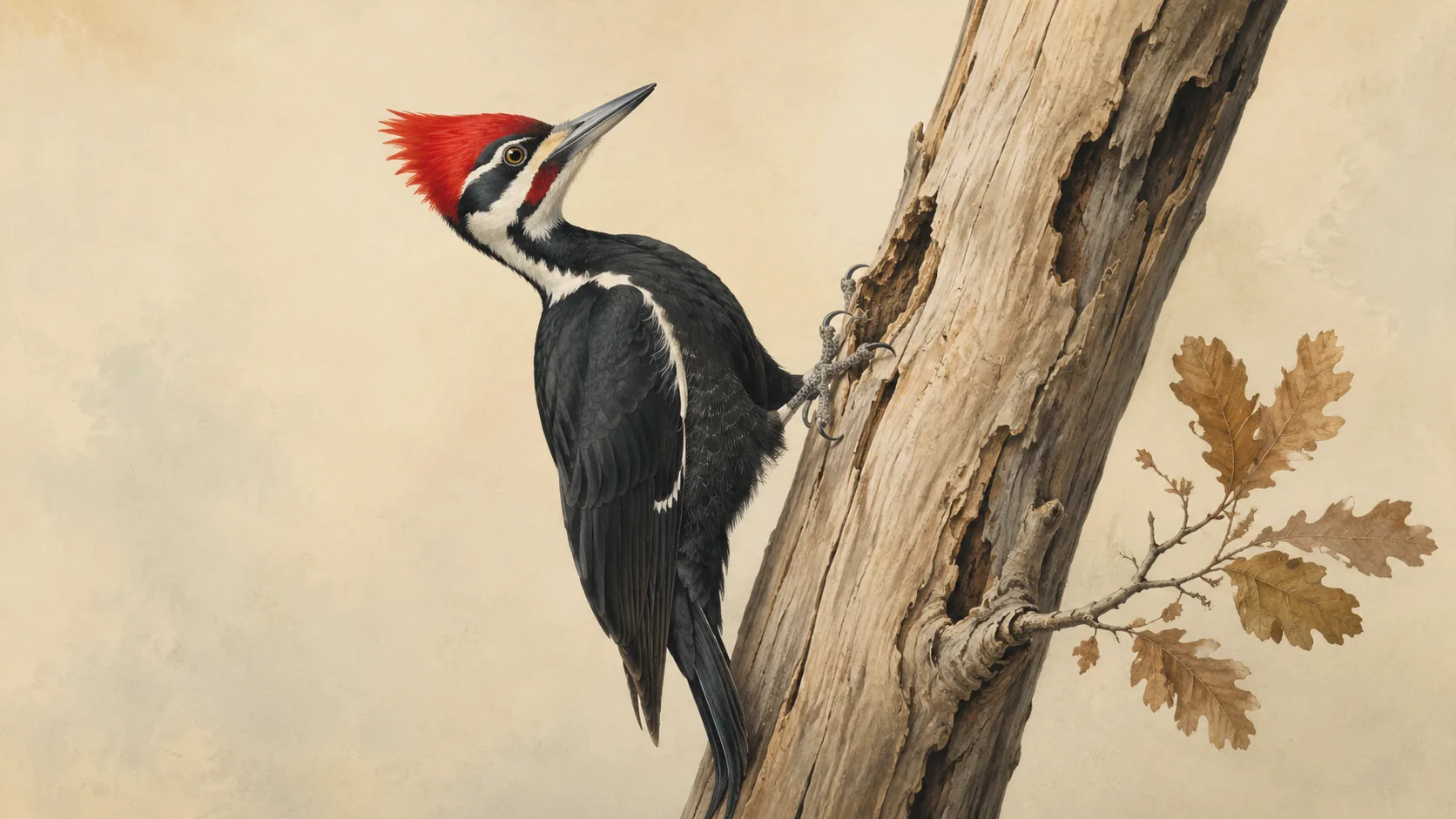
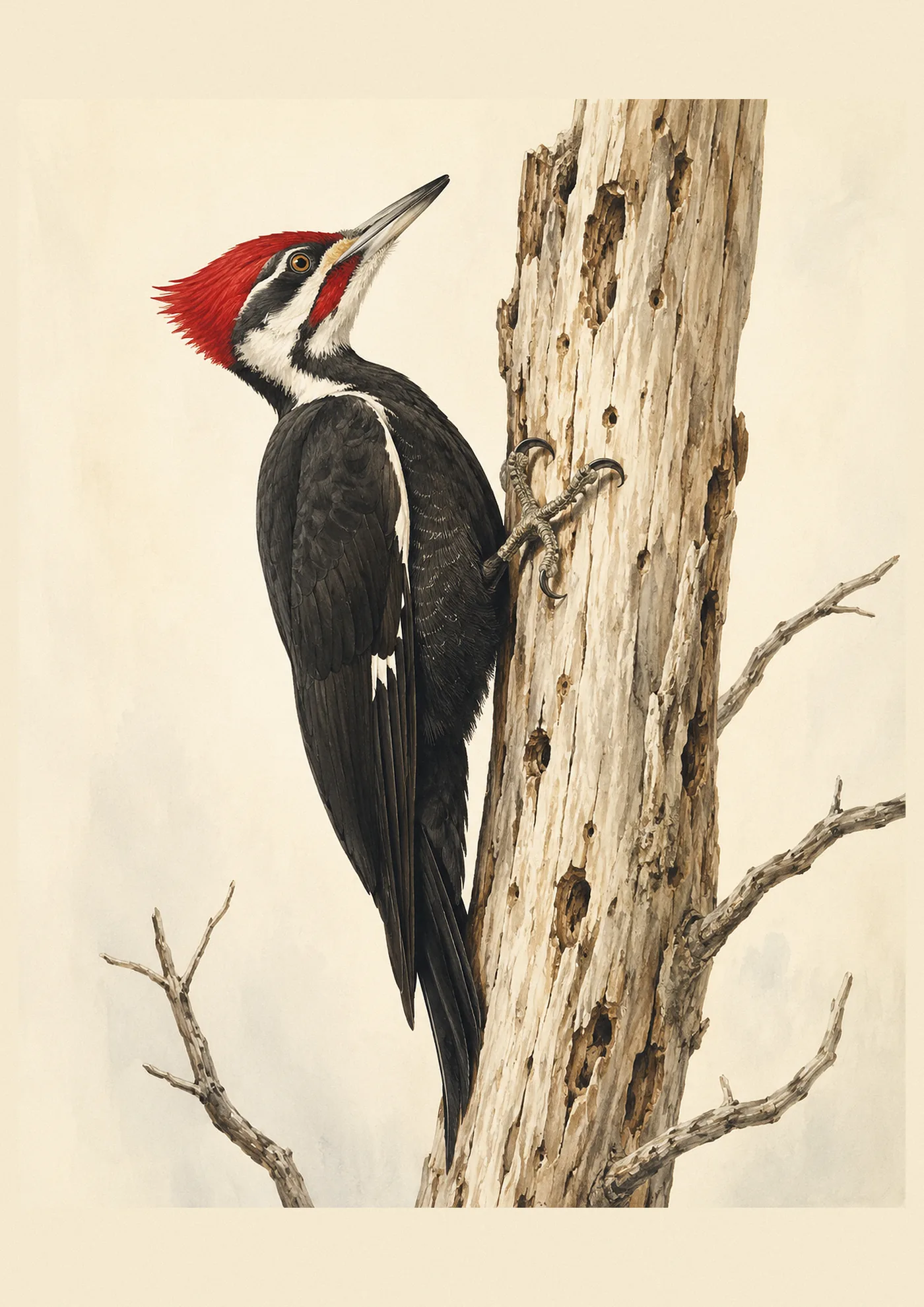
The Omaha associated the call of woodpeckers with healing. Woodpecker bills and scalps appear in documented regalia and ceremonial items across multiple woodland tribes. The red scalp of the Pileated Woodpecker - the crow-sized woodpecker with the blazing red crest - appears in documented Choctaw ceremonial items. The Pileated’s crest is not subtle: it is a streak of vivid red on an otherwise black-and-white bird. It would read, to any observer, as significant.
Lewis’s Woodpecker (Melanerpes lewis) was collected by Meriwether Lewis during the Lewis and Clark Expedition in 1805 and described by the ornithologist Alexander Wilson in 1811. It was one of the new species the expedition documented in the West - unusual for a woodpecker in its slow, erratic, flycatcher-like flight, and in its iridescent dark green plumage. Named for Lewis, it is the only woodpecker that catches insects on the wing rather than excavating for them.
The Acorn Woodpecker of California creates what naturalists call granary trees: dead snags or wooden structures into which the bird drills individual holes, one per acorn, filling each hole with a single cached nut. A single granary tree can hold thirty thousand acorns. The California oak ecosystem is partly structured around this behavior, which the Acorn Woodpecker shares across communal family groups that cooperate on the same granary for generations.
What the Drumming Actually Is
The symbolism sites that attribute woodpeckers with “communication” and “messages” are looking at the drumming and reaching for meaning. The drumming is real. Its function is worth understanding.
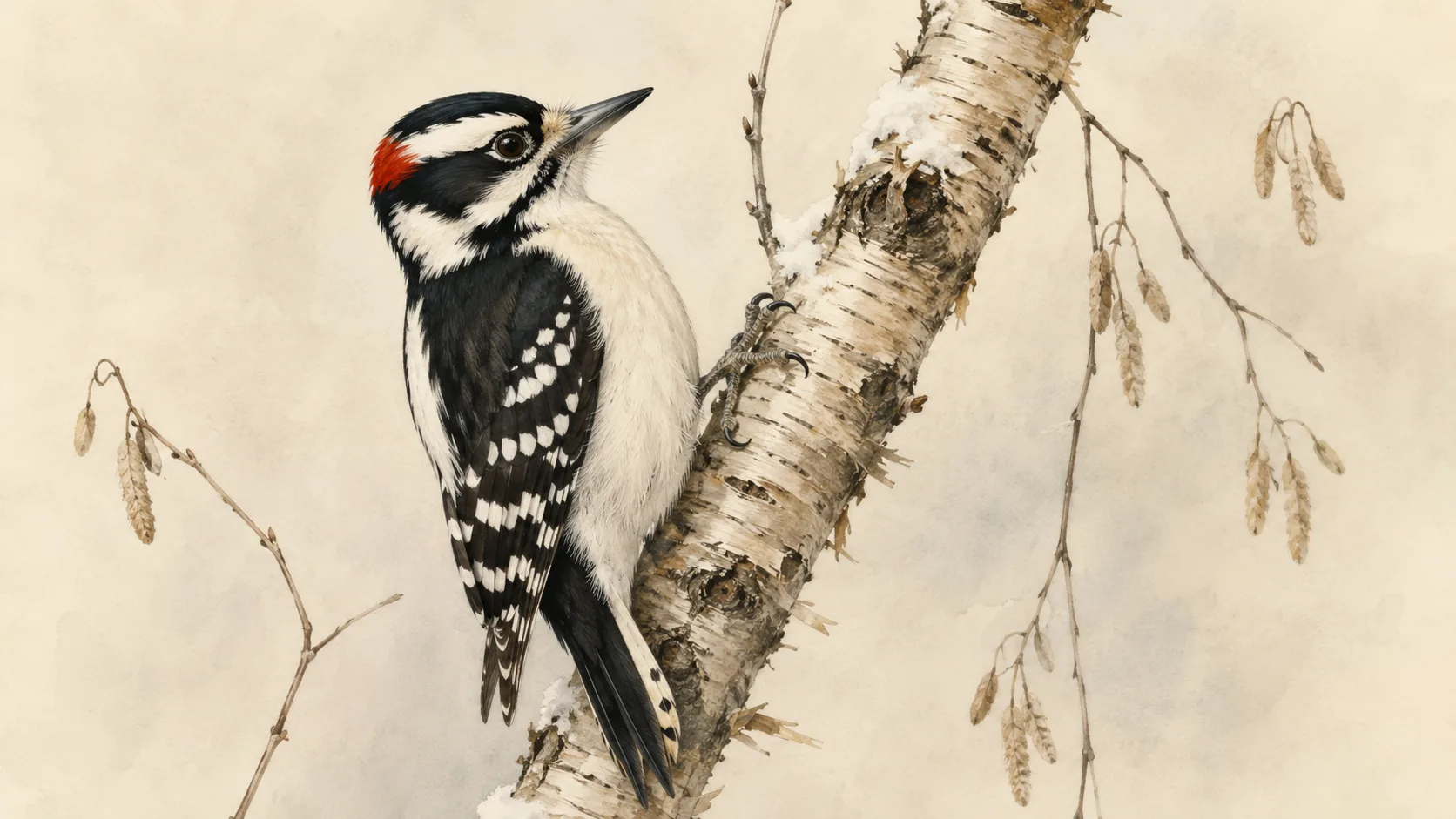
Woodpeckers drum on hard surfaces to establish territory and attract mates. The bill strikes ten to twenty times per second. A Pileated Woodpecker excavating a nest cavity can remove a foot of wood in two hours. The drilling into live trees for insects works through a different mechanism: the bill impacts the bark, the bird listens, and when the sound changes to indicate a hollow chamber or insect movement, it excavates at that precise point. This is echolocation by percussion, before scientists named it.
Some woodpeckers prefer resonant surfaces over wood. Metal flashing on roofs, aluminum gutters, propane tanks, dryer vents: these carry the drumming sound farther than any tree. The bird is not malfunctioning when it drums on your house. It is being rational. It has identified the loudest object in its territory and is using it. The bird at 5 a.m. on your flashing is a territorial male in spring, optimizing for broadcast range. The problem for you is not symbolic. It is acoustic.
The Persistence Reading: Where It Comes From
Modern symbolism content attributes persistence and determination to woodpeckers because observers watch a bird strike the same tree trunk repeatedly, hundreds of times, and interpret the behavior as tenacity in pursuit of a goal.
The behavior is real. The interpretation is anthropomorphic.
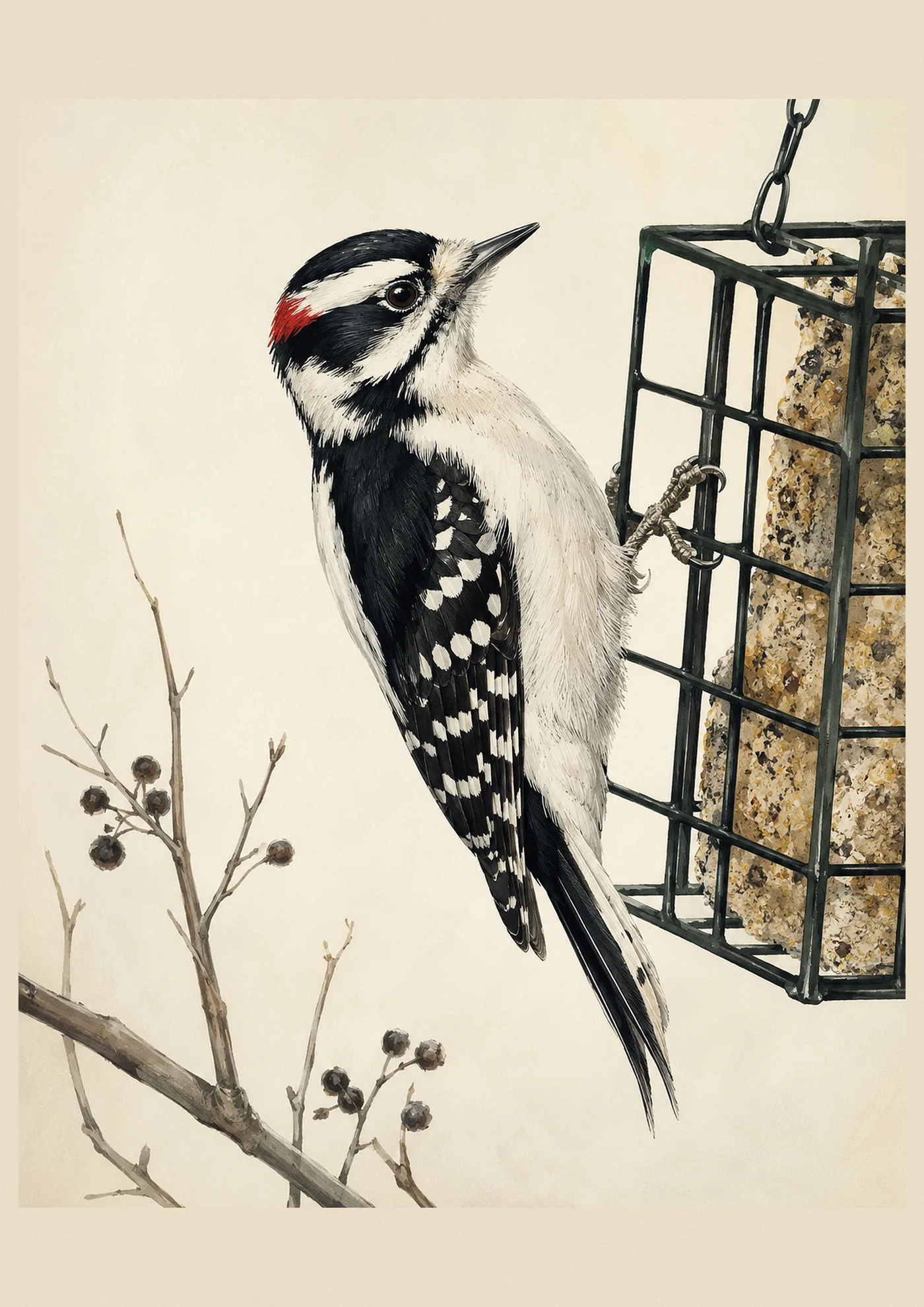
A woodpecker drilling into a dead snag for carpenter ant larvae is not demonstrating persistence in the sense of refusing to quit. It is following an effective foraging strategy for a food source that is reliably where the bird expects it. The anatomy evolved for it: the skull bones are thickened and spongy to absorb impact, the hyoid bone wraps around the skull and acts as a shock absorber, the brain is positioned to avoid rattling in the cranial cavity. A woodpecker’s bill can strike a surface at fifteen to twenty miles per hour, twenty times per second, without neurological damage. This is not determination. It is specialized hardware.
The “protection of the home” reading in symbolism sites probably derives from the human experience of woodpeckers returning repeatedly to a structure and the association of that return with territorial marking. The bird is marking territory. The home it is protecting is its own.
The Honest Accounting
What is documented: Picus as a Roman woodland deity and prophetic figure who becomes a woodpecker is in Ovid, Book 14. The woodpecker’s association with Mars and its role in Roman augury is documented in Plutarch and in the Latin etymology of the genus Picus. The Red-headed Woodpecker in Plains traditions and the Pileated Woodpecker in Choctaw ceremonial regalia are documented through ethnographic records. The Acorn Woodpecker’s granary behavior and its relationship to California oak ecosystems is documented by naturalists.
What is recent invention: the persistence reading, the determination reading, the protection-of-home reading, the general “good luck” frame that woodpeckers carry in spirit-animal content online. These are contemporary projections from observed behavior, not inherited traditions. They are also the readings that most people find when they search for woodpecker symbolism.
The documented tradition is stranger and harder to use as a comfort symbol. A prophetic king who refused a sorceress and was turned into a bird. An augury system in which the woodpecker’s appearance before a battle meant something that had to be read carefully. A bird sacred to the god of war not because it was violent but because it announced, in its drumming, that something consequential was about to begin.
The drumming at dawn on the aluminum flashing is, by Roman reckoning, an announcement.
It is not entirely wrong to hear it that way.