Field Guide
Yellow-throated Warbler
High in a longleaf pine in coastal Georgia, a warbler moves along a large horizontal limb not flitting and hovering in the warbler way but creeping, pressing close to the bark, working its way outward from the trunk with short deliberate steps. From below, the throat is a clean, burning yellow against gray upperparts and white underparts. It pauses, inserts its bill into a clump of hanging Spanish moss, extracts something, and moves on.
This is how the Yellow-throated Warbler forages - with patience and a technique borrowed from a different family entirely. It is one of the warblers that rewards looking up.
What It Looks Like
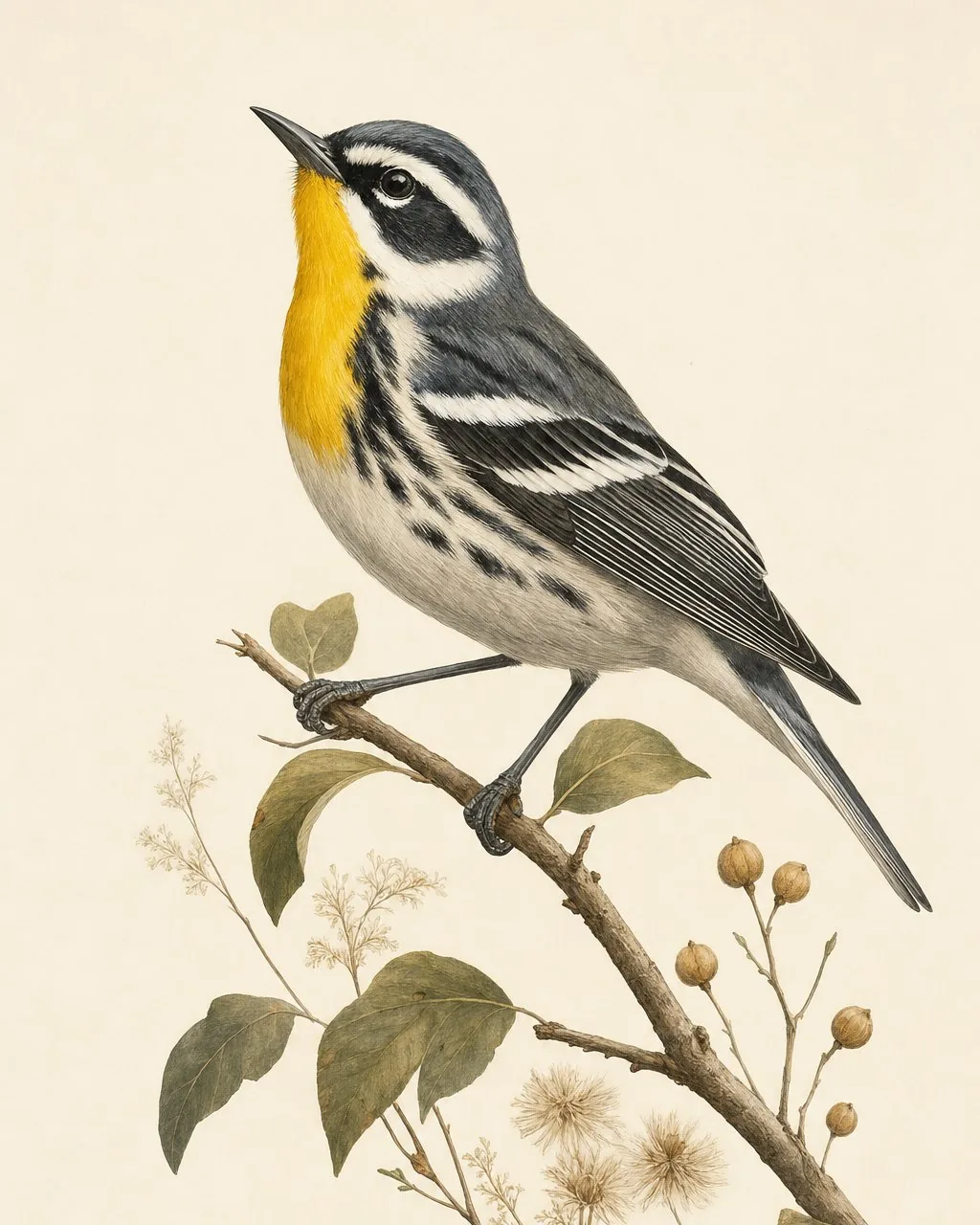
Clean and high-contrast. The upperparts are plain gray - no streaking, no green, just smooth blue-gray. The throat and upper breast are bright yellow, sharply bordered by black. The cheek and auriculars are also black. A broad white supercilium runs from the bill base back over the eye, and a white spot appears on the neck behind the auricular patch - a distinctive mark that helps separate this species from other warblers with yellow on the face.
The lower breast and belly are white, with black streaking on the flanks. The wing bars are white. The bill is notably long for a warbler - a tool suited to probing into bark crevices and moss clumps.
Males and females are similar in plumage, though females average slightly less black on the face. The species does not show dramatic seasonal plumage changes.
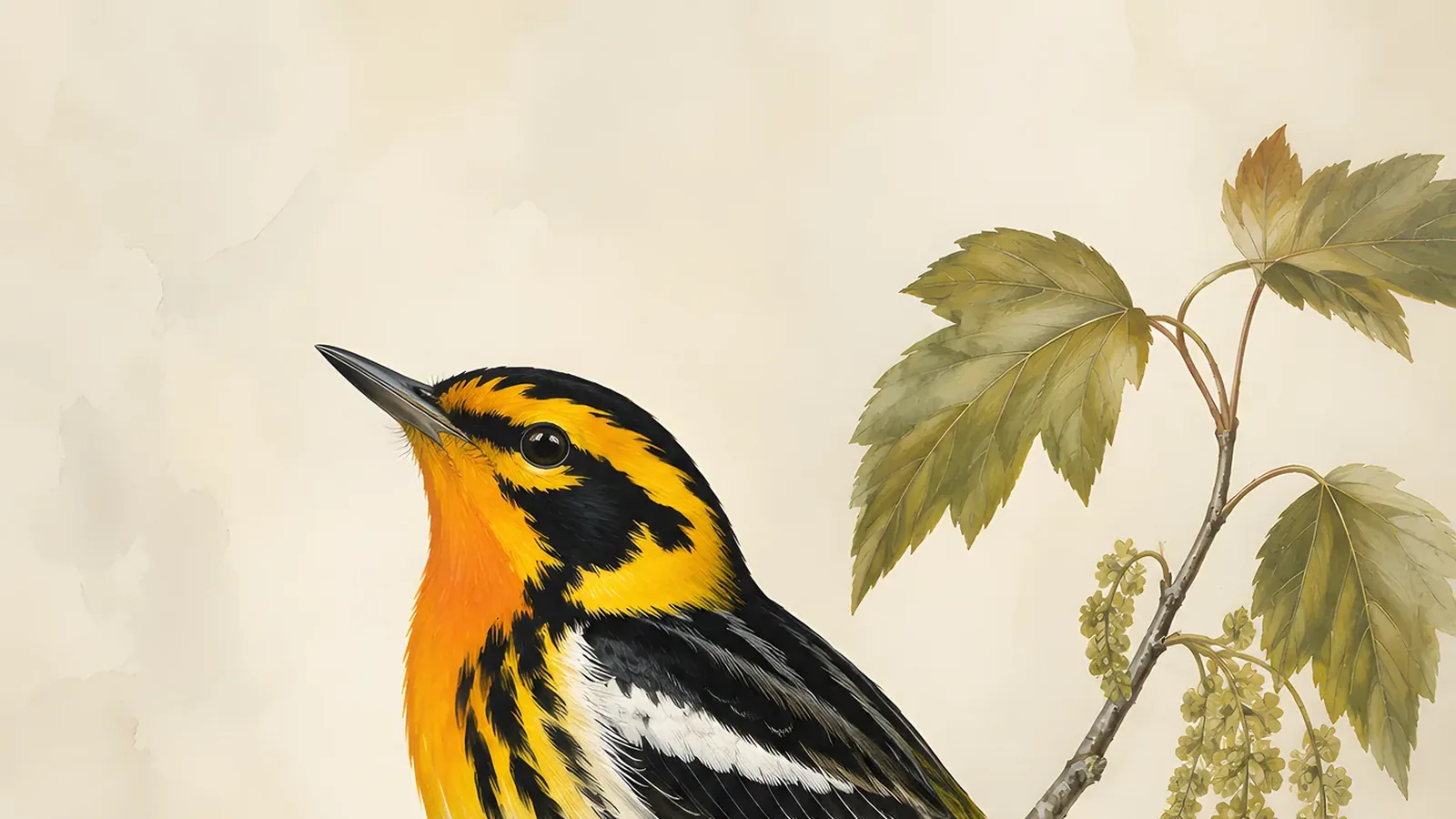
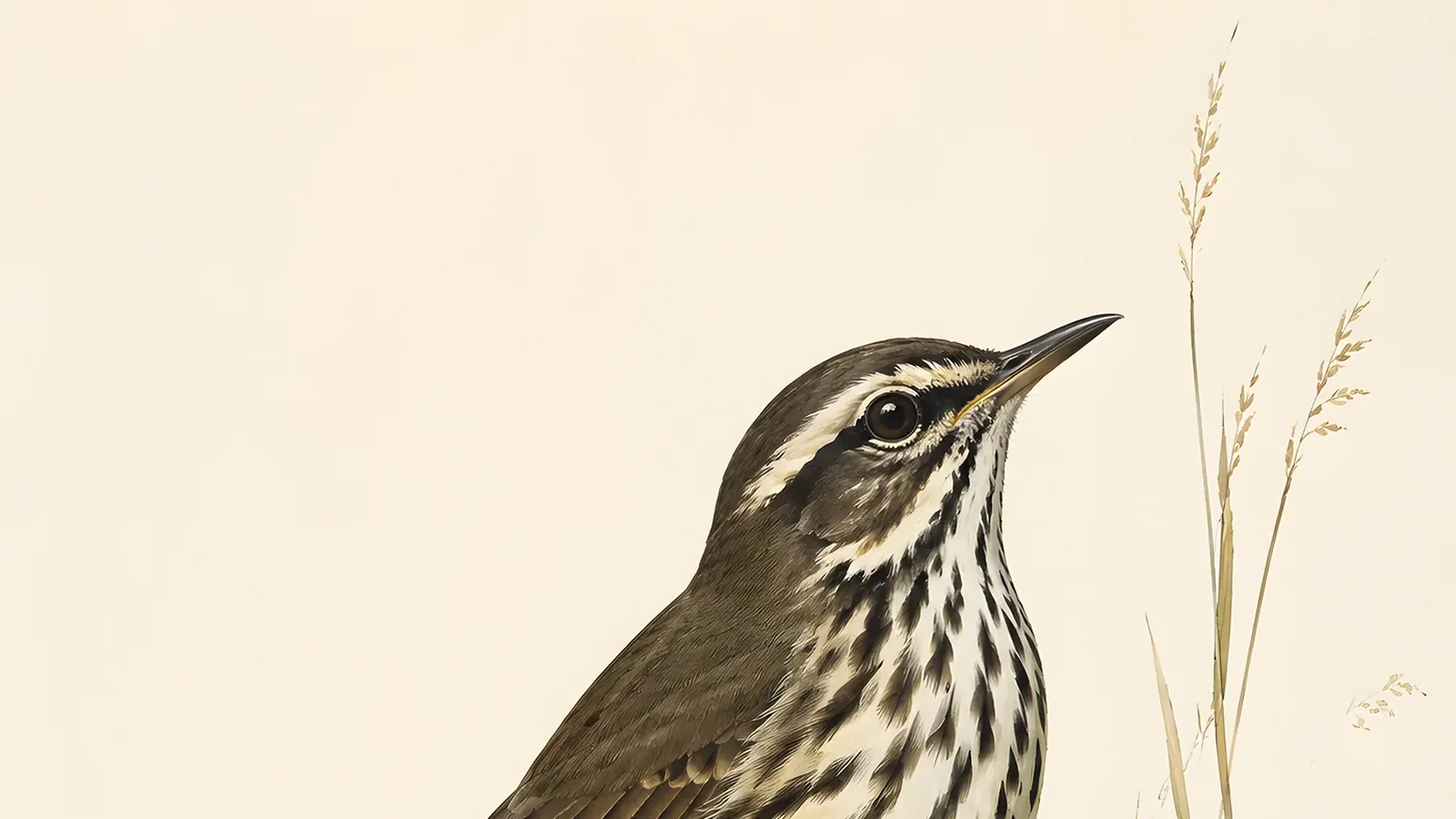
The Blackburnian Warbler has orange rather than yellow on the throat and a different face pattern. The Louisiana Waterthrush is brown above and shows the nuthatch-creeping foraging style on a different substrate - stream banks rather than tree limbs.
| Measurement | Range |
|---|---|
| Length | 13 - 14 cm |
| Weight | 9 - 12 g |
| Wingspan | 21 - 22 cm |
| Lifespan | 3 - 6 years |
Voice
The song is a descending series of clear whistled notes that slurs downward and ends with an uptick - often written as tee-ew tee-ew tee-ew titi-ew. It carries well through pine canopy and is one of the distinctive sounds of southeastern coastal forest in spring. The ending rise helps distinguish it from other warblers singing similar descending phrases.
The call is a sharp, high chip note, unremarkable among warbler chip calls.
Range and Habitat
The Yellow-throated Warbler is primarily a bird of the southeastern United States. The core breeding range runs from the Atlantic Coastal Plain through the Gulf states, from the Carolinas south through Florida and west through the Gulf Coast states. The species breeds north to southern Indiana, Ohio, and New Jersey in favorable habitat along the Atlantic slope.
Several distinct habitat types support the species through the range, and different subspecies have adapted to each. Along the Atlantic Coast and in the Gulf Coast plain, the bird is associated with longleaf and loblolly pine - particularly mature stands where the canopy provides wide horizontal limbs and Spanish moss accumulates. In the interior, especially in river systems of the mid-Atlantic and Midwest, the species switches to sycamore-dominated riparian corridors, foraging on the distinctive mottled bark and among the hanging seed balls.
Some populations in Florida are year-round residents. Others are migratory, wintering in the Caribbean, Central America, and Mexico.
Diet
Insects and other invertebrates gleaned from bark and foliage. The Yellow-throated Warbler is particularly adept at probing Spanish moss, a microhabitat that harbors numerous arthropods year-round in the southern coastal plain. It also works into pine bark crevices, into hanging seed clusters of sycamore, and along the underside of limbs where insects shelter.
The creeping foraging style - moving along limbs and trunks rather than flitting through leaf clusters - gives the species access to prey that more conventional warbler foragers would miss. It is the niche exploitation that explains why the species tends to use the largest-diameter trees available: big limbs provide more bark surface area, more crevices, and more structural complexity.
Breeding
Nesting occurs in the same tall trees where the species forages. In pine habitat, nests are typically placed high in longleaf or loblolly pine - sometimes in Spanish moss clumps themselves, or in a fork of a large branch. In sycamore habitat, nests are placed in the forks of large outer branches.
The nest is a compact cup of plant fibers, pine needles, and bark strips, often deeply embedded in Spanish moss material that camouflages the structure. The female lays 4 to 5 eggs, gray or greenish with dark spotting concentrated at the larger end. Incubation lasts approximately 12 to 14 days. Both parents feed the nestlings, which fledge at about 10 days old.
Pairs are typically monogamous within a season, and some site fidelity between years has been noted at well-studied locations.
A Warbler That Thinks Like a Nuthatch
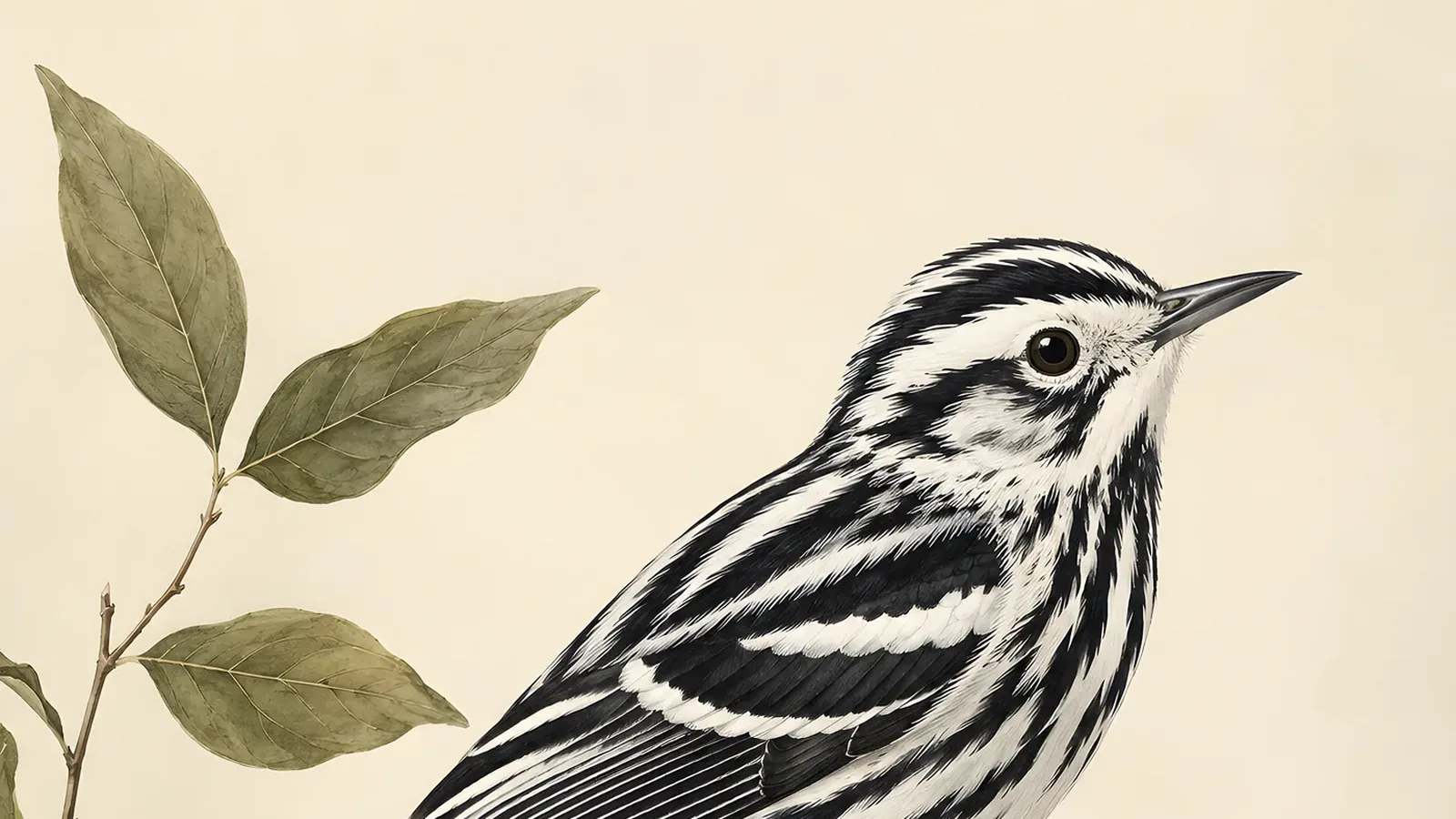
The functional overlap between the Yellow-throated Warbler and the Black-and-white Warbler - another species that creeps along bark - reveals something about how ecological roles are filled in a community. The Black-and-white Warbler works trunks and major branches with a nuthatch-like technique developed independently. The Yellow-throated Warbler takes the outer branches and large limbs in a slightly different way, using its longer bill to probe more deeply.
These are not identical niches. They are adjacent niches in the same large-tree microhabitat, and in mature pine or sycamore stands both species can coexist because they are working slightly different substrates. The warbler family’s diversity is built, in part, on exactly this kind of specialization - the same general body plan pushed into dozens of different solutions to the problem of finding insects in trees.
The bird moves out to the branch tip, works the underside briefly, and then drops off into the gap between the pines. The yellow throat disappears into the canopy light. Down here at ground level, the Spanish moss sways, and whatever the warbler left uneaten remains hidden in there, waiting for the bird to come back.