Field Guide
Blackburnian Warbler
High in a white spruce in northern Vermont, at the very tip of the tallest spire, a male Setophaga fusca opens his bill. The orange of his throat catches the morning light and for a second it reads as fire - as something that should not be sitting calmly at the top of a conifer. The song that follows is thin enough to be almost hypothetical, a rising spiral so high in frequency that anyone standing below who is past fifty has a real chance of not hearing it at all. Then the bird drops back into the needles and disappears. You were not meant to get a close look. That is the design of this bird.
The Blackburnian Warbler - Setophaga fusca, family Parulidae - is the only warbler in North America that carries a flaming orange throat. It is a canopy specialist of mature coniferous and mixed forest, a long-distance migrant that winters in the Andes, and it spends most of its life at heights that keep it safely out of easy view. The colour it carries down there, if you can get angle and light together, is the most concentrated orange in the eastern forest. Birders call it the fire-throat. Both words earn their place.
What he looks like
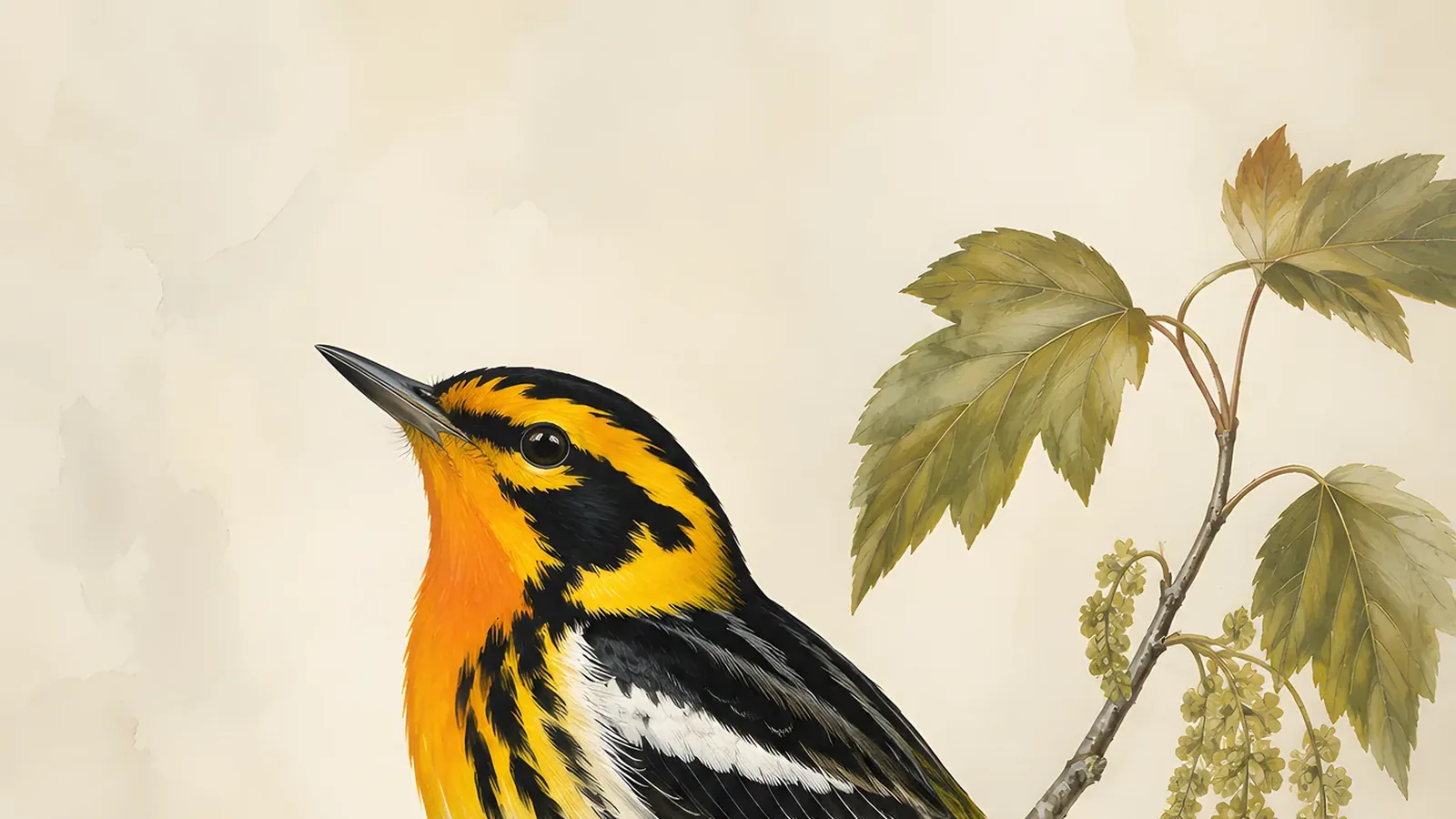
The breeding male is built around that throat. The chin, upper breast, forecrown stripe, and wide supercilium are all the same deep, saturated orange - not yellow-orange, not apricot, but the warm colour of a coal just before it goes white. Against it, the mask, crown, and back are jet black, the contrast deliberately harsh. The wings are black with two broad white bars that merge in good light into a single white panel. The lower breast fades through pale yellow to white, with black streaking down the flanks. The overall impression is of a bird wearing a painted emblem, a heraldic mark no other warbler in the country shares.
The female is the same pattern read in pencil rather than ink. Where the male is orange, she runs pale yellow-orange to yellow. Her back is dark olive rather than black, her streaking softer. The dark triangular ear patch is still present. The supercilium is still yellow. Both sexes share a characteristic large-headed structure with a thick neck that field guides describe as blocky for a warbler, and both show white in the outer tail feathers. At 11 to 13 centimetres long, 9 to 12 grams, with a wingspan of 20 to 23 centimetres, this is a small bird. Cornell Lab’s All About Birds records the oldest confirmed individual at eight years and two months, captured and re-released during banding in Minnesota.
Autumn and immature birds are frustrating. The male moults into a subdued version of his breeding dress, still orange where breeding plumage shows but washed and blurred. First-fall females approach a plain yellow-faced bird with streaked backs, close enough to other Setophaga species that the triangular ear patch and the hint of yellow in the supercilium become the field marks to find first.
The fire-throat in the canopy
The Blackburnian is a treetop bird, and this is not a casual preference - it is an ecological commitment. Males hold territories in the uppermost third of the canopy, gleaning insects from the tips of branches, hovering briefly to take prey from the underside of needles, working outward along limbs to their finest points where no heavier bird can follow. Cornell Lab notes that males forage consistently higher than females within the same stand of trees.
The classic account of why begins with Robert MacArthur’s 1958 study in Maine and Vermont spruce forest, published in Ecology (39:779-619, October 1958). MacArthur studied five closely related warbler species coexisting in the same stands and mapped where each foraged. The Blackburnian, he found, occupied the canopy tops alongside Cape May Warblers, separating itself from Bay-breasted, Black-throated Green, and Yellow-rumped Warblers that divided the middle and lower zones. This vertical partitioning was how five structurally similar species avoided direct competition in the same forest. The paper became foundational ecology. The Blackburnian’s position in it, the bird that goes highest, has held in every subsequent study of the guild.
The consequence for birders is real. Finding this species means finding the tops of old trees, then finding the patience to work the canopy crown with binoculars until something orange appears. The term warbler neck - that particular ache from craning upward in a spruce stand for twenty minutes - applies here more reliably than to almost any other species in the wood.
The bird requires mature coniferous and mixed forest. Spruce and fir dominate its breeding preference across the boreal portion of its range. Further south in the Appalachians, it shifts to hemlock, which provides the same deep shade and canopy structure. New Hampshire Audubon notes this geographic division precisely: “Blackburnian Warblers are strongly associated with spruce-fir forest in the northern part of their range… to the south their preference shifts to hemlock.” The key requirement throughout is old trees with emergent crowns. A Webb, Behrend, and Saisorn study of a New York forest from 1953 to 1962 found that Blackburnian populations decreased significantly when logging removed that structure. Even-aged managed stands that lack emergent trees do not hold this species the same way.
The song you may not hear
The Blackburnian’s song is one of the highest-pitched of any songbird in North America, and this is not a casual observation - it is a genuine functional limit. The Audubon Society describes it as “very thin and wiry, increasing in speed and rising to the limit of hearing.” The Animal Diversity Web at the University of Michigan records the frequency range as 4 to 12 kilohertz, occupying the upper register that begins to fade for human listeners in their forties and vanishes for many by sixty. The final note of the primary song climbs so sharply that it crosses into inaudibility for a significant portion of the birders standing below the bird.
| Measurement | Value |
|---|---|
| Length | 11 - 13 cm |
| Weight | 9 - 12 g |
| Wingspan | 20 - 23 cm |
| Confirmed max lifespan | 8 years, 2 months |
| Song frequency range | 4 - 12 kHz |
| Nest height | commonly 12 - 25 m, recorded to 26 m |
Males carry two distinct song types and will alternate between them during the breeding season. One version begins with a series of high introductory notes that drop briefly before climbing to the terminal peak. The other inverts this contour, starting lower and spiraling upward throughout. The call note is a thin, high tsip, used in daytime movement and detectable at the higher end of the range that older ears retain. Singing peaks in very early morning, from high stationary perches near the crown.
This is a bird that rewards a field recorder. Slowing a recording of the Blackburnian’s primary song reveals a structure that many ears receive, in real time, only as an indistinct upward thread. Playing it back at half speed makes the phrasing legible. Some birders who cannot hear the song at all can still pick out the thin tsip call, which the Wild Adirondacks guide describes as a reliable contact note throughout the season.
Range and the two forests
The breeding range extends from the boreal forest of central Saskatchewan east to the Maritimes, south through New England and the Great Lakes to the Appalachian Mountains, reaching as far south as Georgia in the higher elevations. Partners in Flight estimates a global breeding population of approximately 13 million individuals, with roughly 55 percent breeding in Canada’s boreal forest. The highest breeding densities fall in northeastern Minnesota, northern Wisconsin, central Ontario, and northern New York. In the Adirondacks and on the Tug Hill Plateau of New York, it is among the characteristic breeding warblers of mature spruce-fir stands.
Migration is transoceanic in ambition. The Blackburnian travels more than 3,000 kilometres to winter in the highlands of South America, from Costa Rica and Venezuela south through Colombia, Ecuador, and Peru to Bolivia. The core wintering ground is the Andean highlands, with birds recorded from sea level to 3,000 metres elevation but concentrated in montane forest at mid-elevation. Smithsonian Institution materials describing the species’ winter ecology note that it is “fairly common among the migrants in shade coffee plantations” across Central America and the northern Andes, and that it winters “mostly in the Andean highlands from Venezuela to Peru.”
The shade-coffee connection is ecologically important. Traditional Andean coffee cultivation - growing the crop beneath a canopy of native shade trees - maintains a multi-layered forest structure that holds insect prey and foraging space similar to what the birds use on the breeding grounds. Research in Colombia published in Agroforestry Systems has documented that Neotropical-Nearctic migrants, including the Blackburnian, use shaded plantations as functional overwinter habitat where native forest has been reduced. When shade trees are removed in favour of high-yield sun monocultures, the canopy structure the birds depend on goes with them. The same forces that pressured the cerulean warbler on its Andean wintering grounds apply here, on the same mountain slopes, to a different species arriving from a different part of the eastern continent.
The IUCN lists the Blackburnian Warbler as Least Concern. The North American Breeding Bird Survey records very slight increases in the overall population from 1966 to 2015, though Appalachian breeding populations have shown localized declines attributed in part to hemlock woolly adelgid damage to the hemlock stands the southern breeding birds require.
Diet
Through the breeding season, the Blackburnian is almost entirely insectivorous. The staples are caterpillars - including spruce budworm larvae, which can drive local population pulses in budworm outbreak years - supplemented with beetles, flies, ants, aphids, lacewings, spiders, and mayflies. Audubon’s field guide notes a willingness to take flying insects on short sallies from branch tips, and the Adirondacks ornithological record documents both gleaning and hovering as foraging techniques. During migration and on the winter grounds, fruit supplements the diet when insect availability drops.
The spruce budworm association deserves a note. Several co-occurring warblers - the Cape May in particular - increase dramatically during budworm irruptions, tracking the prey pulse. Blackburnian populations in Maine showed a different response, declining rather than increasing during budworm outbreaks. This counterintuitive pattern may reflect the disruption that budworm-damaged forest structure causes to the canopy architecture on which the Blackburnian depends: a forest in the grip of a severe budworm outbreak is losing the tall, dense canopy cover this bird treats as home.
Breeding
Males arrive on the breeding grounds a few days before females, typically reaching northern New England and New York in the first week of May. Pairs are seasonally monogamous. The female builds the nest alone, constructing a compact cup of twigs and bark strips bound with spider silk and lined with lichens, mosses, and dead pine needles. The nest site is almost always a conifer, with a strong preference for hemlock in the south and spruce in the north, and it is placed well away from the trunk on a horizontal branch high in the canopy. The Wild Adirondacks guide records nest heights “almost always in conifers” with confirmed placements to 26 metres. A C. Hart Merriam observation from 1885, cited in Smithsonian Institution materials, documented a nest at 84 feet containing a cowbird egg - described as the altitude record for Brown-headed Cowbird brood parasitism at the time.
Clutch size is three to five eggs, most commonly four, incubated by the female for 12 to 13 days. Both parents feed the nestlings, visiting every 10 to 20 minutes. The young fledge at approximately ten days and the family disperses before southward migration, which begins in early August in the northern part of the range. One brood per year is the rule.
The argument for the treetop
The Blackburnian Warbler is sometimes framed as merely decorative - the flashy one you chase for a life list and then move on from. That reading misses what the bird is actually doing. It is occupying an ecological position that no other warbler in North America holds: the extreme canopy of old coniferous forest, using a foraging niche that MacArthur identified in 1958 as the mechanism by which five competing species maintain stable coexistence. Remove the tall trees, and the partition collapses. The Blackburnian loses not just its perch but the vertical space that separates it from its competitors. It requires old forest not as preference but as architecture.
The Blackburnian Warbler is the fire in the top of the tree, and the only way to keep the fire is to keep the tree.
That is the practical content behind the colour. The flaming throat is not incidental - it is what happens when a species commits fully to a niche at the top of the world, where the light is best and the canopy, if you leave it alone long enough, is thick enough to hold everything in the guild below.