Field Guide
Black-and-white Warbler
April in Pennsylvania. The oaks are still bare, only the palest suggestion of bud-break on the higher branches. A small bird drops onto a shaggy-barked trunk twelve feet up and begins to move downward, headfirst, in short hitching steps. It pauses, probes a crevice, moves again. Its pattern is stark against the pale bark: hard black and clean white, humbug stripes from crown to tail. The forest around it is silent in the way that early spring is silent, with no insect hum in the canopy, no leaves to catch the wind. But the bird is already here, working, finding enough to eat.
This is Mniotilta varia - the Black-and-white Warbler. It does not need the leaves.
What it looks like
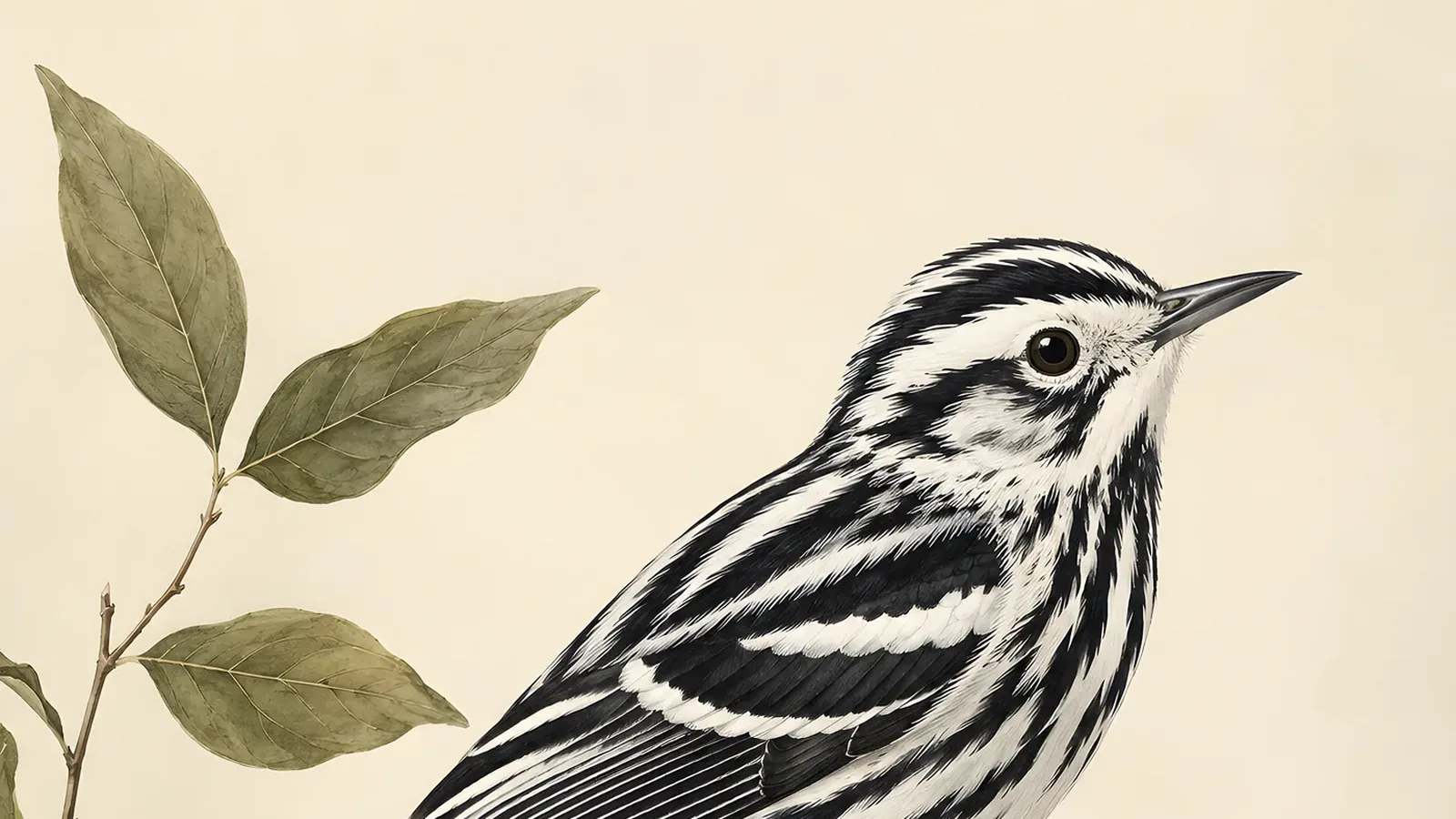
The pattern is unlike anything else in eastern North America. The male in breeding plumage is boldly divided into black and white, with a black crown bisected by a white central stripe, black cheeks and throat (the throat of the female is white), and dense black streaking along the flanks and breast that presses against white ground colour all the way to the undertail. The bill is slightly downcurved, longer and heavier than the bills of most warblers, built for probing bark rather than plucking insects from leaves. The legs are stout. The hind claw is notably elongated compared with other wood-warblers, an adaptation that lets the bird anchor itself to vertical and inverted surfaces without the prop of a stiff woodpecker tail.
Length runs 11 to 13 cm. Weight ranges 8 to 15 grams, depending on sex, season, and condition on arrival. Wingspan measures 18 to 22 cm. The oldest banded individual on record reached at least 11 years (Bird Banding Laboratory data, via Kricher 1995, The Birds of North America No. 158), though typical wild survival is closer to five or six years given the hazards of long-distance migration.
The female is paler overall, her streaking softer, her cheeks washed buff rather than solid black. Both sexes show the diagnostic head stripe and the creeper posture that separates this species from every other warbler at once.
| Measurement | Range |
|---|---|
| Length | 11 - 13 cm |
| Weight | 8 - 15 g |
| Wingspan | 18 - 22 cm |
| Max recorded age | 11 years (banding data) |
| IUCN status | Least Concern (declining) |
The bark-creeper
Mniotilta comes from Greek roots meaning roughly “moss-plucker,” a name Vieillot coined when he formalised the genus - referring to the bird’s habit of pulling plant material from bark surfaces. That etymology captures the method: this warbler is a bark-worker, not a foliage-gleaner, and it has the body plan to prove it.
It is the only North American wood-warbler that habitually creeps along trunks and large branches in the manner of a nuthatch or Brown Creeper, moving both upward and downward, around the trunk and along the underside of horizontal limbs, using its heavier feet and lengthened hind claw to grip where other warblers would slip. Kricher (1995) documented the morphological correlation between these structural features and the bark-foraging niche that no other parulid occupies with such consistency.
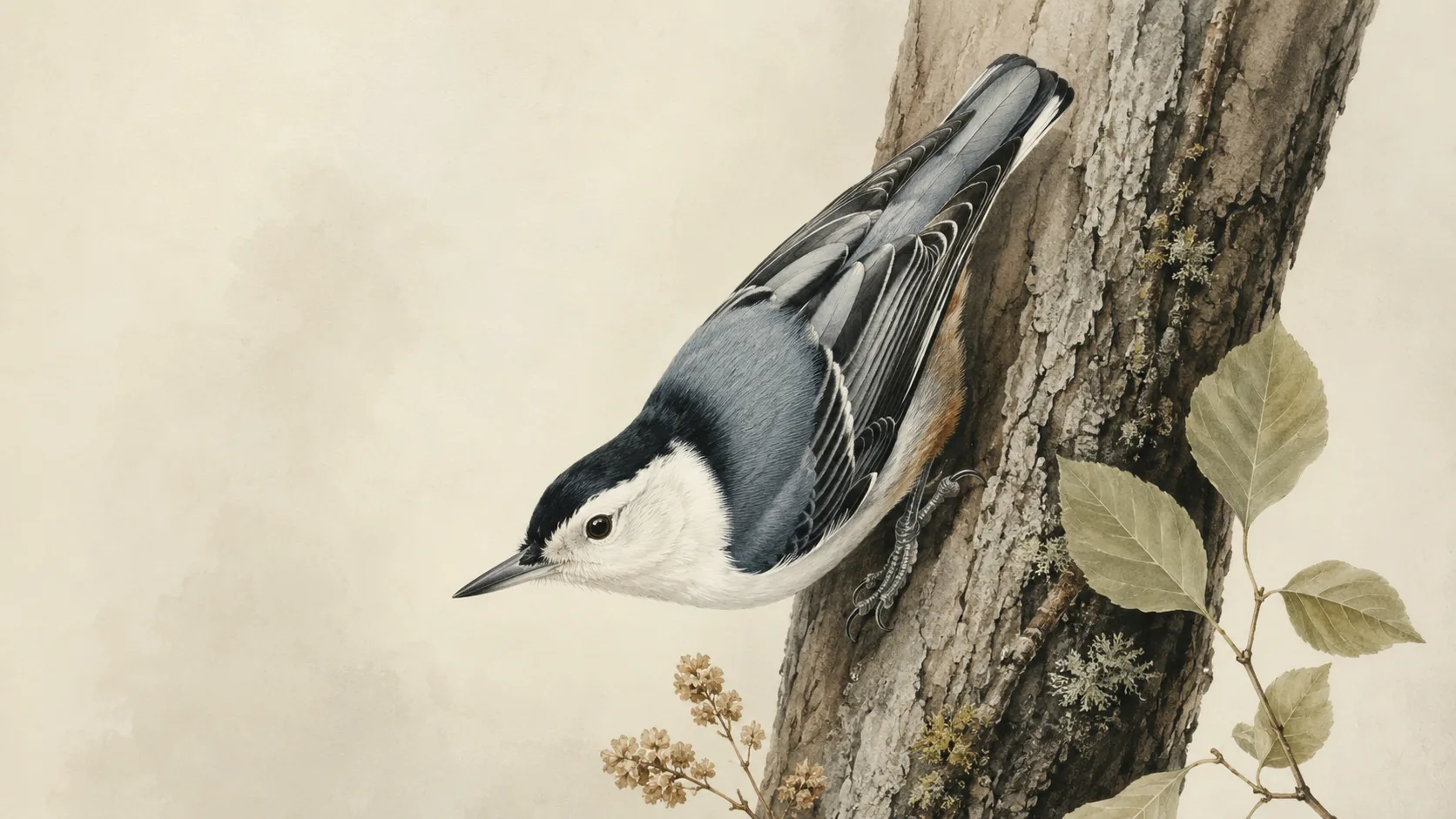
The white-breasted nuthatch does much the same thing through convergent adaptation, the two species having arrived at similar postures and feeding strategies from entirely different ancestral lines. The difference on the trunk is posture and persistence: the nuthatch is a resident that cycles a territory through winter, while the warbler is a long-distance migrant that must find the same bark resource profitable enough to build a breeding season around. Both prove that the bark of large trees is a productive microhabitat year-round, if you have the feet for it.
The diet is primarily insects and spiders taken from bark: caterpillars, beetles, bark borers, ants, flies, leafhoppers, and egg masses tucked into crevices. The bill’s slight downcurve lets it lever up loose bark and probe deep into furrows. According to the Cornell Lab of Ornithology’s All About Birds account, the species forages from the canopy level all the way to the root collar, and is regularly seen working low on large trunks and even exposed roots.
The Black-and-white Warbler has solved a problem most warblers never attempt: how to eat well before the forest leafs out.
What it sounds like
The song is thin and high, a repeating two-syllable phrase that runs continuously like a squeaky wheel - an apt comparison that birders have been making for over a century. The standard rendering is weesy weesy weesy weesy, seven or more repetitions at the same pitch, with almost no variation between phrases. It sits near the upper limit of comfortable human hearing, and on a still April morning it carries far through bare woods.
Females sing occasionally, a quieter version of the same phrase. Both sexes produce a dull tik call note in alarm, and a thin doubled call in flight. The primary song is one of the more distinctive in the spring chorus precisely because of its mechanical regularity.
Range and the early arrival
The Black-and-white Warbler breeds across a wide arc of eastern and central North America, from the boreal zone of Canada south through New England, the mid-Atlantic, Appalachia, and into the southern states. The Boreal Bird Initiative estimates that approximately 52 per cent of the North American population breeds within the boreal forest. Pennsylvania and Virginia represent the heart of the mid-Atlantic breeding range: mature mixed forest with large-diameter trees, often on rocky hillsides and ravines where the tree bark is rough and complex.
Winters are spent in the tropics - southern Florida, the Caribbean, Mexico, Central America, and as far south as the Peruvian Andes. The birds move through on a broad front and are among the first warblers to push north in spring, sometimes appearing on the Gulf Coast in early March, weeks ahead of warblers that depend on insect emergence in the canopy. The bark-foraging strategy makes this possible. Dormant insect forms - eggs, pupae, overwintering adults in crevices - are available before any leaf has uncurled, and the Black-and-white Warbler is adapted to exploit them. As Birds of the World (Cornell Lab of Ornithology) notes, the species “may be less dependent than other wood-warblers on leaves opening” precisely because it never needed the leaves to begin with.
The IUCN lists the species as Least Concern with an estimated population of around 18 million individuals (Audubon Field Guide, adapted from Kenn Kaufman’s Lives of North American Birds), though North American Breeding Bird Survey data show a downward trend since the 1960s, attributed to forest fragmentation and pesticide pressure on its insect prey base.
Breeding
Males arrive on the breeding grounds ahead of females, singing from the tops of large trees to establish territory before the understory has leafed enough to conceal a rival. Courtship is vigorous - prolonged chases through the canopy, the male displaying with spread wings and fanned tail.
Nesting is entirely the female’s work. She constructs a deep open cup on the ground, almost always at the base of a tree trunk or tucked beneath the edge of a fallen log, using dry leaves as the outer shell and lining the interior with finer grass, pine needles, and sometimes hair. The location is chosen to be invisible from above: the overhanging leaf litter conceals the cup entirely when the female approaches along the ground rather than dropping directly in.
Clutch size is most often five eggs, occasionally four, rarely six. The female incubates alone for 10 to 12 days. Both parents feed the nestlings, which fledge 8 to 12 days after hatching. The family group often persists together for another two to three weeks as the young birds learn to navigate and grip vertical surfaces - a skill this species needs earlier and more completely than most.
The nest’s ground position makes it vulnerable to snakes, raccoons, and Brown-headed Cowbird parasitism. First-year birds must then survive their first southbound migration with all its hazards: glass, cats, and habitat loss on the wintering grounds.
What remains is a bird shaped by a very specific solution to a very specific problem. The long claw, the stout leg, the probing bill, the spring arrival timed to bare bark rather than opening leaves - each feature traces back to a foraging niche that most birds leave empty. The Black-and-white Warbler has had it to itself for a long time, and it arrives each April to claim it again, working headfirst down the grey trunk before the forest has properly woken up.