Field Guide
Yellow Rail
At two in the morning, somewhere in a black sedge meadow in Minnesota, two small stones are tapping together in the dark. Tap-tap. Tap-tap-tap. Tap-tap. Tap-tap-tap. The rhythm is so mechanical, so unhurried, so precisely five-beat that it seems like a trick of the ear - some fence post vibrating, some loose timber. It is not. It is Coturnicops noveboracensis - the Yellow Rail - the bird ornithologists have spent a century almost entirely failing to observe.
The tap carries across the wet sedge perfectly, and yet the bird producing it remains invisible. Not hidden. Not merely shy. Genuinely unknown. Theodore Bookhout, who wrote the authoritative species account for Cornell Lab of Ornithology (Leston and Bookhout, 2020, Birds of the World), noted that basic aspects of Yellow Rail biology remain poorly documented - an extraordinary admission about a bird breeding on a continent with tens of thousands of active ornithologists.
What it looks like
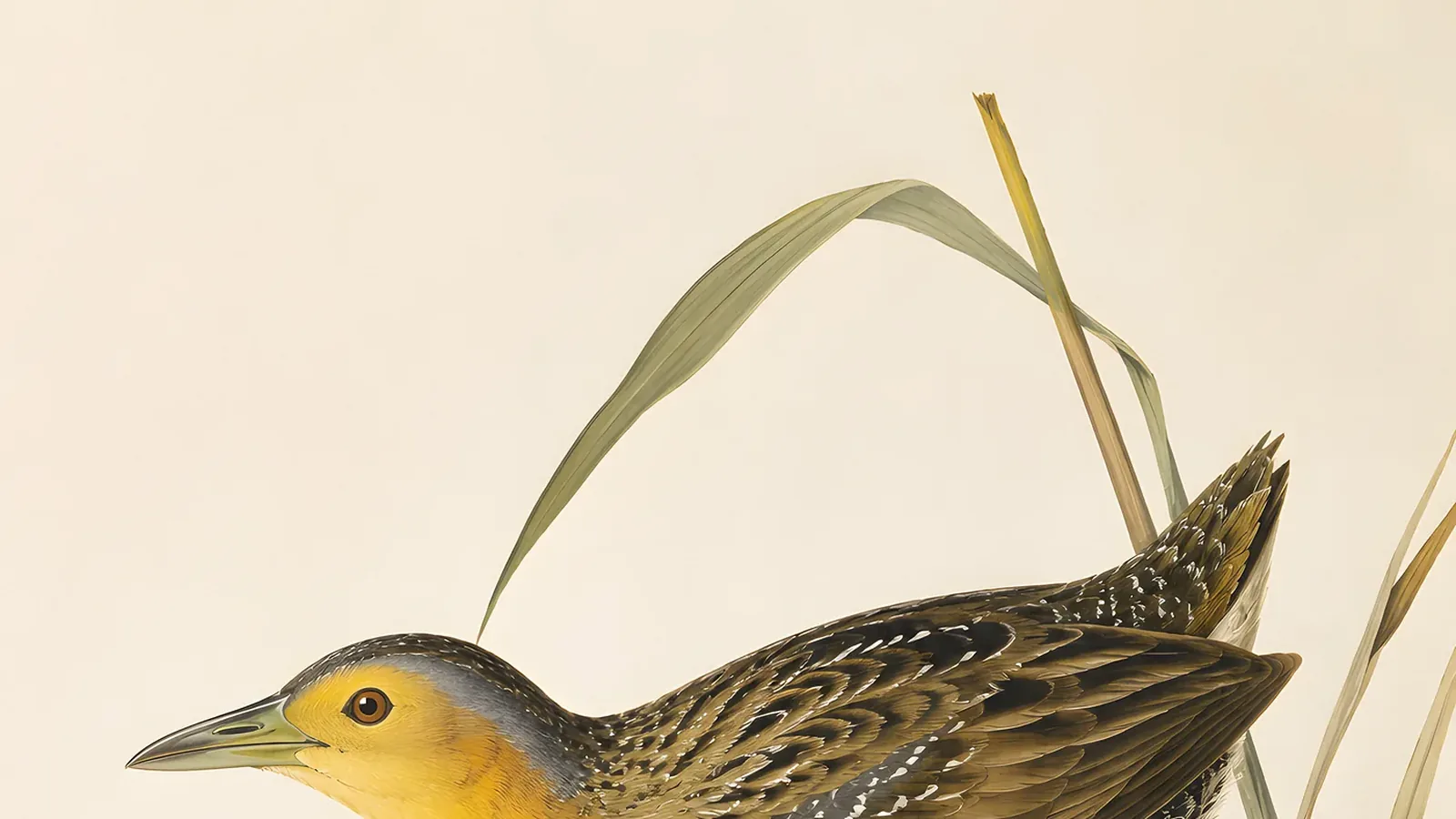
The Yellow Rail is a very small rail: 15 to 18 cm long, weighing 45 to 70 grams, with a wingspan of 30 to 33 cm. Think of a chubby sparrow with a laterally compressed body and a short, pale bill, and you are most of the way there.
The upperparts are tawny yellow-brown, heavily streaked with dark brown and black, and crossed by narrow white bars on the back and wings. The face and breast are warm buff - almost the colour of dried hay. The flanks are barred brown and white. The bill is short and yellowish-green, the legs are greenish-yellow, and the tail is stubby and often cocked.
One marking defines the species in the rare moments of flight. The inner secondaries - the trailing portion of the inner wing - form a bold white patch, visible even in the bird’s characteristically weak, fluttering exit. No other North American rail shows this exact pattern. On the ground it is invisible. In the air it announces, briefly and unmistakably, exactly who has just left.
| Measurement | Range |
|---|---|
| Length | 15-18 cm |
| Weight | 45-70 g |
| Wingspan | 30-33 cm |
| Eggs per clutch | 8-10 |
| Incubation | 16-18 days |
| Fledging | ~35 days |
Sexes are similar in plumage. Juveniles are darker than adults and lack the crisp white barring of breeding birds.
The sound of tapped stones
The Yellow Rail’s advertising call is one of the most distinctive sounds in North American ornithology and one of the most easily imitated. Two coins, two pebbles, two knuckles tapped together in the rhythm: tick-tick, tick-tick-tick, tick-tick, tick-tick-tick. The pattern is nearly invariable - two taps, then three, then two, then three - a code that, once learned, resolves any confusion about distant frogs, insects, or tapping wood.
Males call mostly after full darkness. They begin shortly after the sky goes fully black and continue, with brief pauses, until before dawn. The call carries well across open sedge meadow and can be heard at distances of several hundred metres on calm nights.
“The calling of the male Yellow Rail, given most frequently after complete darkness, is a unique metallic 5-note call - click-click, click-click-click - easily imitated by tapping two stones together.”
- Michigan Natural Features Inventory, species description for Coturnicops noveboracensis
Because males call nocturnally and because their habitat is nearly impenetrable, listening at night is the most reliable way to census a population. Martin, Koper, and Bazin (2014, Waterbirds 37:68-78) conducted 334 nocturnal surveys across 80 wetlands in Manitoba, finding that call-broadcast playback contributed relatively little to detection compared to repeated quiet visits - the birds were calling anyway, on their own schedule, in the dark.
The bird no one sees
The claim that any living North American bird is essentially unstudied sounds like hyperbole. For the Yellow Rail it is accurate.
The species almost never flushes. When a human walks through its territory, it runs. Rails as a group are built for this - narrow bodies threading vertical stems without disturbing them - but the Yellow Rail takes the family talent to an extreme. Researchers have used flushing chains dragged across marshes to force birds into the air, and even then the birds may simply run ahead rather than fly. When one does flush, the flight is brief, low, fluttering, and ends within twenty metres, where the bird drops back into the sedge and vanishes.
This means that most confirmed sightings in the ornithological record come from a handful of contexts: birds killed by cats or window strikes, individuals found during rice harvests in the Gulf Coast wintering grounds (the machinery disturbs them enough to force flight), and a small number seen at close range during planned nighttime searches using spotlights.
The result is a species for which the population size is genuinely uncertain. A 2023 COSEWIC (Committee on the Status of Endangered Wildlife in Canada) re-assessment of the Canadian population raised the estimated number of mature individuals to between 18,000 and 65,000 - a range so wide it reflects not a narrow confidence interval around a known number but a candid acknowledgement that no one is quite sure how many Yellow Rails there are.
Range and habitat
The Yellow Rail breeds in a chain of wet sedge meadows across central and eastern Canada, from the interior of British Columbia east through the prairie provinces to Quebec and the Maritime provinces, with smaller numbers breeding in Michigan, Wisconsin, North Dakota, and a few other northern US states. The core of the breeding range lies in northern Ontario and Quebec.
Breeding habitat is specific. The species requires shallow, shallowly flooded or saturated sedge meadows - particularly those dominated by fine sedges such as Carex lasiocarpa - with a thick mat of dead vegetation from previous seasons and water depths rarely exceeding ten to twelve centimetres. Austin and Buhl (2013, Waterbirds 36:199-213) found that optimal water depth at occupied sites averaged 9.9 centimetres, and that Yellow Rails strongly selected areas with deep litter and high ground cover but avoided sites with more than eight percent shrub cover - a precise structural requirement that limits the species to a particular successional stage of marsh vegetation.
Fire matters here. Austin and Buhl found that the probability of Yellow Rail presence was highest in areas burned two to five years prior (probability of 0.285), compared to only 0.028 for unburned sites more than ten years old. The species needs open sedge structure, not shrubby encroachment, and periodic disturbance maintains that structure.
Wintering habitat is different: coastal salt marshes of the Gulf Coast from Louisiana to Florida, and rice fields in the same region. The shift from interior freshwater sedge to coastal Spartina represents one of the longer ecological pivots of any North American rail - and it means the species is exposed to two distinct sets of habitat threats across its annual cycle.
Diet
Yellow Rails eat a wide variety of invertebrates: aquatic insects, spiders, small crustaceans, and probably earthworms. Small freshwater snails appear to be seasonally important during the breeding season - the birds forage by picking through wet litter and probing shallow water along the base of sedge stems. In fall and winter, seeds contribute substantially to the diet, particularly on the Gulf Coast wintering grounds where rice and grass seeds are available in quantity.
Foraging happens almost entirely on the ground, within the dense cover of the litter mat. The saltmarsh sparrow - another small bird threading through marsh vegetation and eating invertebrates from a wet substrate - faces analogous foraging constraints in its own habitat, though the two species rarely overlap in range or season.
Breeding
Males arrive on the breeding grounds in May and establish territories by calling, often from a single spot within the sedge for hours at a time. Nests are woven cups of grasses and sedges, placed on the ground or just above the water surface, often with a canopy of vegetation pulled together overhead for concealment.
The clutch is large: eight to ten eggs, creamy buff with a wreath of reddish-brown spots concentrated at the larger end. Incubation by the female alone lasts 16 to 18 days. The chicks are precocial - covered in glossy black down, capable of leaving the nest within two days of hatching - but require parental feeding for up to three weeks. Fledging occurs at around 35 days.
What happens after fledging is not well understood. Dispersal rates appear to be high, with low inter-annual return rates in the limited banding data available. Whether the same individuals return to the same breeding sites in consecutive years, and how territories are established in a habitat that changes from year to year with fire and water level, remain open questions in a species where almost everything remains an open question.
The argument for protecting Yellow Rail habitat is not simply that the species is declining - it has lost ground at the southern edge of its range as wetlands have been drained and converted to agriculture. The argument is subtler. Here is a bird that has lived alongside humans for all of recorded ornithological history and managed to remain largely unknown. The sedge meadow that keeps its secrets is a place that has resisted reduction, analysis, categorisation. There is something worth preserving in that resistance - not just the bird, but the quality of darkness from which those tapped-stone notes emerge, two and three, two and three, all night long.