Field Guide
Black-crowned Night-Heron
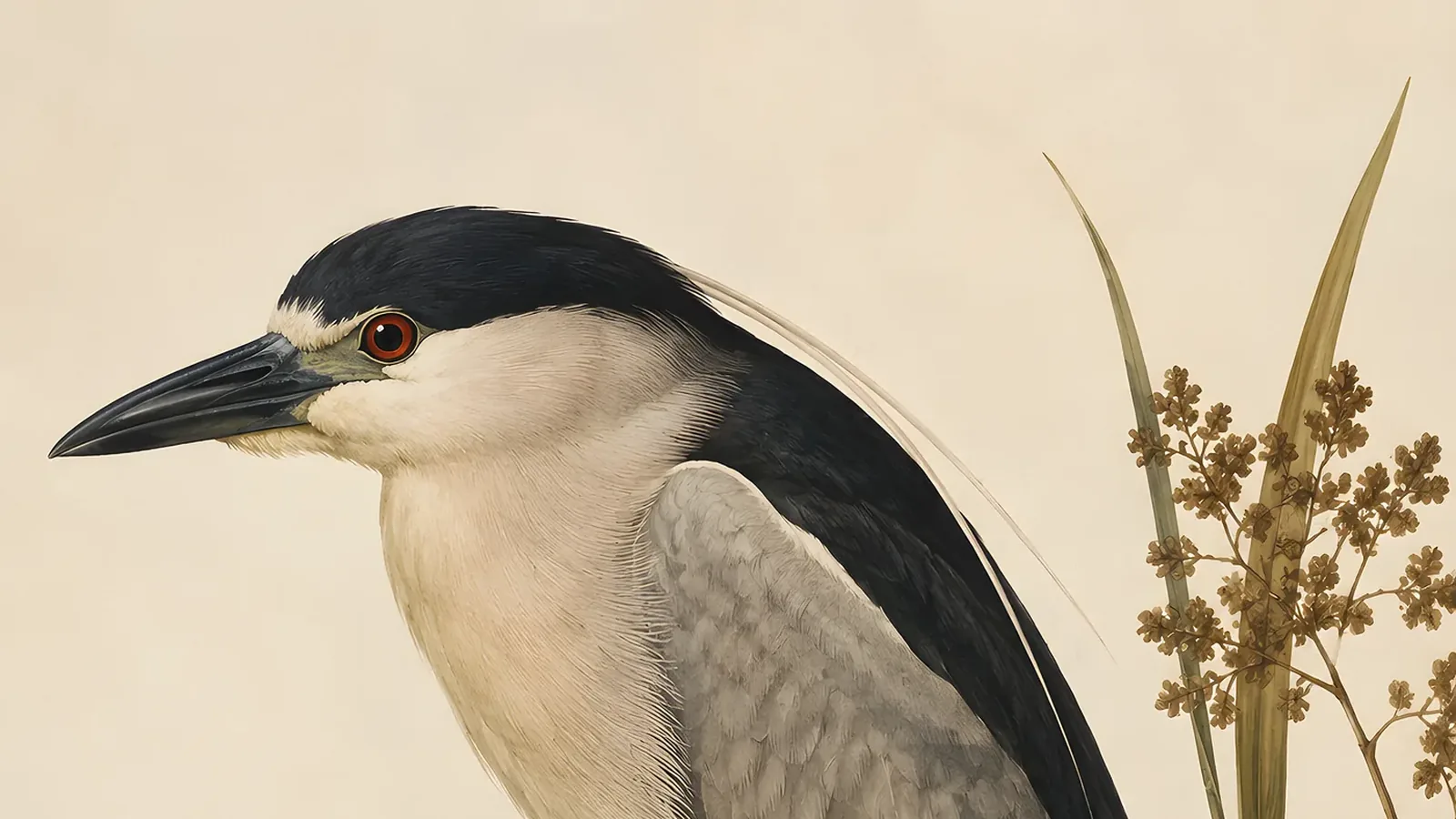
At the edge of a marsh at dusk, there is a heron that looks like it belongs to a different order of things. Nycticorax nycticorax, the Black-crowned Night-Heron. It sits hunched on a low branch above the water, neck sunk into its shoulders, body compact and somehow dense. Then the light catches its eye. Not yellow, not orange. Deep red, the colour of an ember.
This is the heron that took the night shift.
While the great blue and the great egret stake the shallows during daylight hours, the Black-crowned Night-Heron is mostly sleeping in a tree somewhere nearby, waiting for the column of light to tilt away. When it finally rises from its roost and drops to the water’s edge, the other herons are already gone. The marsh belongs to it.
That is not coincidence. It is a competitive strategy, written into the bird’s very genome.
What it looks like
The Black-crowned Night-Heron is built to look like no other heron. It is stocky and short-necked, with a large rounded head and a heavy black bill, the body proportions of something designed for stealth rather than elegance. At 58 to 66 centimetres long and with a wingspan of 114 to 119 centimetres, it is smaller than the great blue heron, but it occupies space differently - hunched and compressed rather than tall and spear-shaped.
The adult is a study in three colours. Crown and back are glossy black. Wings, rump, and tail are pale silver-gray. The underparts are white to very pale gray. The eye is brilliant red, deep and striking, the most distinctive feature at any range. The bill is black, the legs yellow-green in non-breeding condition and flushing to bright pink during the breeding season.
Two long white plumes extend from the back of the crown in breeding dress. They trail behind the head like thin white ribbons, and are raised and fanned during courtship displays. Outside the breeding season they are absent.
The juvenile is a different bird entirely, and is one of the most reliably misidentified herons in North America. It is brown, heavily streaked and spotted with large pale teardrops of buff and white on the wings and back, with a streaked buff-brown breast. It carries a yellow bill and orange-yellow eyes. Observers encountering their first juvenile Black-crowned Night-Heron often cannot place it in the same family as the sharply marked adults. It takes roughly three years and several partial-moult cycles before a young bird carries the clean black-and-gray plumage of an adult.
| Feature | Adult | Juvenile |
|---|---|---|
| Crown | Glossy black | Buff-brown streaked |
| Back | Glossy black | Brown with pale spots |
| Wings | Pale gray | Brown with teardrop spots |
| Eye colour | Deep red | Orange-yellow |
| Bill | Black | Yellow |
| Head plumes | Two white (breeding) | None |
The night shift
The Black-crowned Night-Heron is the most nocturnal of the regularly encountered North American herons, foraging primarily from dusk through the hours before dawn. The Smithsonian National Zoo describes it as “named for their habit of feeding between evening and early morning.” Where it shares a colony site with great blue herons, great egrets, and snowy egrets, the temporal separation is near complete. The day-feeders leave as the night-heron arrives.
Whether this niche was seized or conceded is a question ornithologists have considered carefully. Some evidence suggests the night shift is partly a response to competitive pressure from larger, more dominant species. But the genomic evidence points toward something more fundamental. In 2022, Luo and colleagues published a whole-genome analysis of N. nycticorax in BMC Genomics, identifying 21 positively selected genes related to vision, including genes controlling eye size and photoreceptor function. The night heron’s eyes are relatively large for a heron of its size, and the retina is rod-rich, favoring light sensitivity over colour resolution. The species also carries a tapetum lucidum - a reflective layer behind the retina found in many nocturnal mammals but rare among birds - which bounces available light back across the photoreceptors for a second pass (Luo et al., 2022, BMC Genomics 23:683).
The trade-off: olfactory receptor genes are reduced by roughly half compared to diurnal relatives. The bird bet on vision and won.
In Florida, where its range overlaps with virtually every other wading bird in the family, the temporal partition holds year-round. During breeding season, when energy demands are highest, it will forage opportunistically through daylight hours as well - taking larger prey by day than by night, when smaller fish and invertebrates dominate the catch.
What it sounds like
The night heron’s characteristic call is a deep, abrupt bark - variously transcribed as kwok, quawk, or wok - delivered in flight or from a perch, usually after dark. The Audubon Society field guide describes it as “loud, barking,” and it is the call most likely to alert a nocturnal walker that a heron has passed overhead. The wings are near-silent. The call is the announcement.
At the breeding colony, the repertoire expands. Birds approaching the nest give a rapid series of guttural croaks. Adults disturbed at the nest produce loud, harsh bill-snapping. Chicks call insistently for food with a higher, rasping note. A large colony in full breeding season, visited at night, produces a sustained din audible from some distance.
Range and habitat
Nycticorax nycticorax is among the most widely distributed herons in the world. The Smithsonian National Zoo calls it “the most widespread heron species in the world” - and the claim holds. It breeds on every continent except Australia and Antarctica, with four recognised subspecies covering North and South America, Europe, Asia, and Africa. Cornell’s All About Birds confirms that the oldest banded bird on record was at least 21 years and five months old when recovered in California in 2012, having been banded there in 1992.
In North America, breeding populations run from coastal British Columbia across southern Canada to Nova Scotia, south through most of the contiguous United States and into Mexico and Central America. Northern birds migrate in September and October. East Coast breeders typically winter along the Atlantic coast, in the Caribbean, and in Central America. Pacific breeders move down into Mexico.
Habitat is defined by water and cover. Freshwater marshes, tidal flats, slow rivers, swamps, mangroves, rice paddies, irrigation canals, and the overgrown margins of reservoirs all serve. The heron roosts colonially in dense stands of trees or large shrubs close to water, often in the same trees used for nesting. Outside the breeding season it may be encountered almost anywhere near water, including urban parks and retention ponds.
Diet
An opportunist by every measure. The primary prey is fish, but the Black-crowned Night-Heron will take leeches, earthworms, crayfish, mussels, insects, frogs, lizards, snakes, small rodents, the eggs and chicks of other colonial waterbirds, and carrion. In urban settings it has learned to work waterfronts, fish markets, and refuse tips.
The standard foraging posture is the stand-and-wait technique common to the heron family: the bird stands motionless at the water’s margin, neck tucked, waiting for prey to enter range, then strikes with a rapid extension of the neck and a pinch of the mandibles. It does not impale prey in the way larger herons sometimes do. A small fish is swallowed whole, headfirst.
Breeding
The Black-crowned Night-Heron nests colonially, often in mixed colonies with other herons and egrets. A colony may hold dozens to several hundred pairs. Nest sites are most often in dense trees or tall shrubs above or near water, built as a loosely woven platform of sticks and twigs 0.3 to 1 metre across. The same trees may be used for decades by successive generations.
Males arrive first and establish territories within the colony, performing display flights and raising their crown plumes and white head streamers to attract females. Once a pair forms, both birds contribute to nest construction. The female typically lays three to four pale green eggs. Both parents incubate in shifts for 21 to 26 days. Both feed the young, which leave the nest at around one month and fledge fully at approximately six weeks. First breeding occurs at age two.
The clutch, the incubation period, and the colonial nesting arrangement are closely comparable to those of the great egret and the snowy egret. What separates the night heron is the schedule by which all of this activity eventually unfolds, with foraging trips falling mostly after dark.
There is something quietly efficient about a bird that found a gap in the schedule of its competitors and settled into it so completely that its eyes rewired to match.
The Black-crowned Night-Heron is listed as Least Concern by the IUCN, with an estimated global population of three million individuals. Numbers declined between the 1960s and mid-1980s alongside DDT contamination and wetland loss - the bird bioaccumulates organochlorines through the fish it eats, and its eggshells thinned accordingly. Following the DDT ban, many North American populations recovered. Wetland drainage and water pollution remain the primary threats today.
It is not the most conspicuous bird in any marsh. It keeps odd hours, sits still in the shadows, and the juvenile looks like something else entirely. But find the colony roost at dusk and watch the birds drop one by one to the water as the light fails, each one landing with a short bark, and it becomes clear that the night heron has not simply ceded the daylight to its competitors. It has done something better. It made the night its own.