Field Guide
Red-winged Blackbird
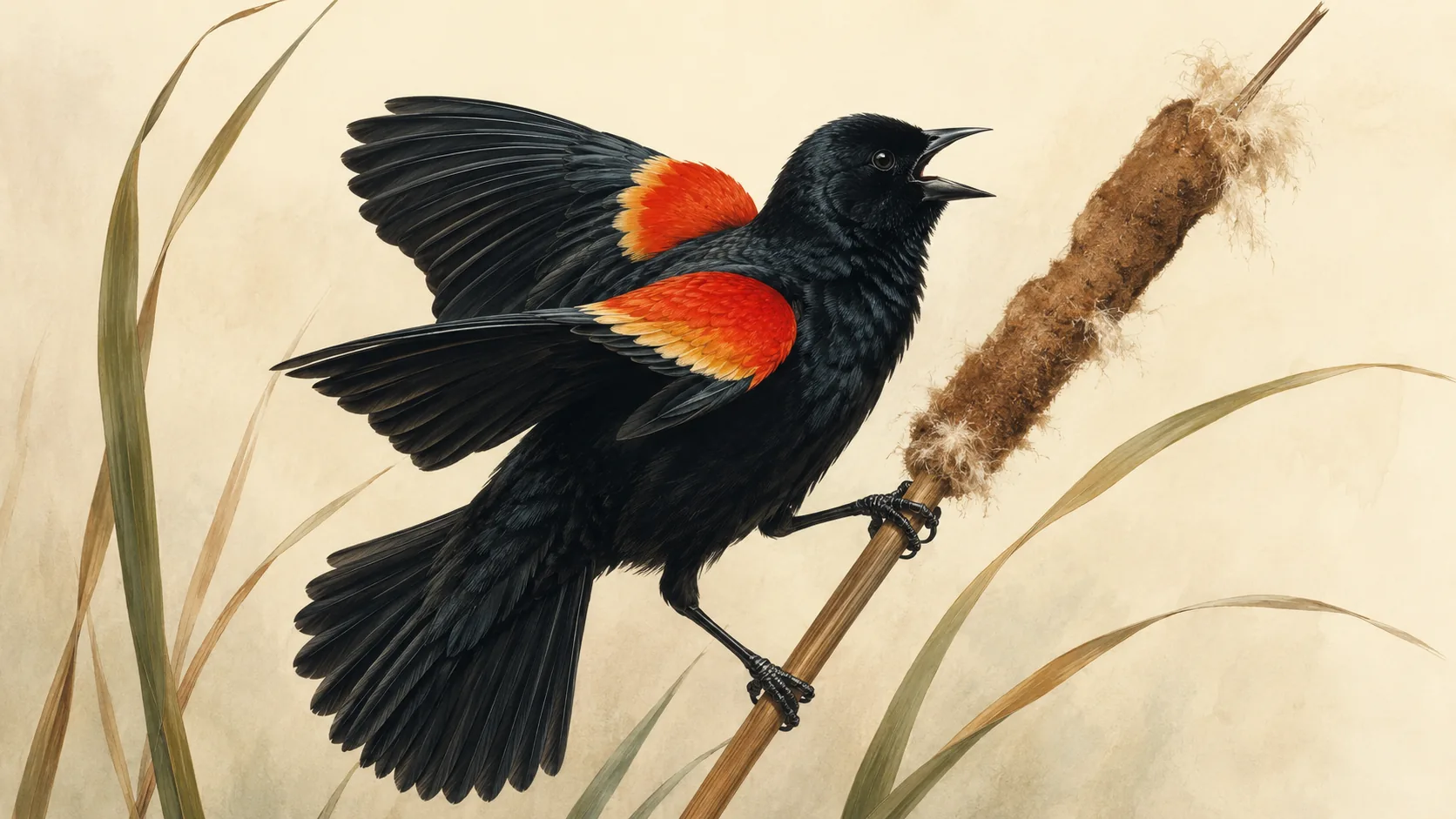
In March, before the frost is properly out of the ground, a sound starts up over the cattail marsh that means winter is finished. Conk-la-ree. It comes from a male Red-winged Blackbird gripping a swaying reed, glossy black, his red-and-yellow shoulders flared like a struck match. For much of North America this is the first true song of spring, and it arrives weeks before the leaves.
He is one of the most abundant birds on the continent, and the loudest claim he makes is colour. Cornell Lab researchers ran the experiment that proves it: blacken a territorial male’s scarlet epaulets, and he loses his patch of reeds to rivals within days. The red is not ornament. It is the document that holds the deed.
What he looks like
The breeding male is unmistakable. Glossy jet black from bill to tail, with a single bright red shoulder patch on each wing, bordered below by a band of buff-yellow. Birders call these patches the epaulets. He can flare them to a blaze in display or fold them almost completely out of sight when he wants to move through the marsh unnoticed, and the difference in the bird’s whole bearing is startling. Flared, he is a flag. Hidden, he is a shadow.
The female looks like a different species. Heavily streaked dark brown above and below, sparrow-like, with a pale eyebrow and often a faint wash of rust or pink about the face and throat. She is easy to overlook and easy to misidentify as a large, dark sparrow or a finch. The contrast between the sexes is one of the most extreme of any common North American songbird.
Both sexes are robin-sized. Cornell Lab gives the length at 17 to 23 centimetres and the weight from around 32 grams in a small female to as much as 77 grams in a large male, the male noticeably the bigger bird. The silhouette is a conical, sharply pointed bill on a medium-bodied blackbird, typically seen low over water or perched at the tip of a reed rather than high in a tree.
What he sounds like
The song is the marsh in audio. A harsh, liquid, gurgling phrase usually written as conk-la-ree or o-ka-leee, the last note a thin rising buzz that seems to hang in the cold air. He delivers it with his whole body: leaning forward, wings spread, tail fanned, epaulets thrown open. The song and the display are a single act. You rarely get one without the other.
The common call is a sharp, dry check, given in flight and from cover, and a high slurred whistle in alarm. Females sing too, a chattering scolding series, often in response to a displaying male or a rival female. Through the breeding season the chorus over a productive marsh can be continuous from before dawn, dozens of males each restating the same line over the same square of reeds.
Range and habitat
Agelaius phoeniceus is one of the most widespread land birds in North America. It breeds from Alaska and across Canada south through nearly all of the United States and into Mexico and Central America, and the Audubon field guide notes it is present year-round across much of that range. Northern birds are migratory, the males arriving first in spring to claim ground before the females return.
The breeding habitat is water and the edges of water: freshwater and brackish marshes thick with cattail and bulrush, wet meadows, brushy swamps, and the weedy margins of ditches, ponds and hayfields. Outside the nesting season the bird abandons the marsh for open agricultural country. Cornell Lab and Audubon both note that in winter Red-winged Blackbirds gather into enormous roosts, sometimes mixed with grackles, cowbirds and starlings, that can number in the millions and range across the farmland and feedlots of the southern states.
That abundance has not made the species immune to loss. Partners in Flight estimates the population at around 180 million, and the IUCN lists it as Least Concern, but Cornell Lab’s data record a substantial decline in the continental population since 1970, driven by wetland drainage, changes in farming and decades of organised control at winter roosts.
Diet
The Red-winged Blackbird is, across the year, mostly a seed eater. Audubon puts roughly three-quarters of the annual diet as seeds of grasses, weeds and waste grain, taken from the ground and from standing crops, which is what brings the winter flocks into conflict with farmers. In the breeding season the balance tips hard towards animal food. Beetles, caterpillars, grasshoppers, dragonflies, spiders, snails and other invertebrates dominate, and most of what the nestlings are fed is insect protein gleaned from the marsh vegetation and the water’s surface. Late in summer the bird adds berries and small fruit. It forages low, walking and probing rather than hammering, and will visit feeders at the marsh’s edge for cracked corn and sunflower.
Breeding and nesting
The mating system is the bird’s defining drama. The Red-winged Blackbird is one of the textbook examples of resource-defence polygyny: a strong male holds a territory of dense reeds and tolerates several females nesting within it, sometimes, Cornell Lab notes, as many as fifteen. The females do the choosing, and a male with a rich, well-defended patch of marsh attracts more of them. This is why the epaulet matters so much, and why blacking it out costs a male everything.
The female alone builds the nest, lashing it to several upright stems a metre or so above the water. She winds stringy plant material around the supports, weaves in a platform of coarse wet vegetation, plasters the inside with mud and lines the cup with fine grass. Cornell Lab records clutches of three to four eggs, occasionally two to six, pale blue-green and marked with dark scrawls concentrated at the broad end. She incubates alone for about 10 to 12 days. The young leave the nest 11 to 14 days after hatching, well before they can fly properly, and stay dependent on the parents for weeks afterwards. In the warmer parts of the range a female may raise more than one brood in a season.
The flash worth watching
The single behaviour worth standing still for is the song-spread display, because you are watching a colour signal do a real job in real time. A male, challenged by a rival at his boundary, will run the full sequence: he leans out over the reeds, opens his wings, fans his tail, throws both epaulets wide, and pours out the conk-la-ree at full volume. To a rival male, that flare of red is a measured threat. To a watching female, it is a résumé. To a person on the boardwalk with a flask of tea, it is one of the most legible pieces of animal communication in any North American wetland, the whole transaction visible in a second and a half.
What makes it land is the off switch. The same bird, threatened from above by a hawk or simply moving between perches, can fold the red away until it nearly vanishes and slip through the marsh as an anonymous black bird. He spends the breeding season toggling between flag and shadow, and which one he chooses tells you, more reliably than the song, exactly what he is trying to do.
Blacken a male Red-winged Blackbird’s scarlet epaulets and he loses his territory in days. The colour is not decoration. It is the deed to the marsh.
There is a reason this bird is so heavily studied. It is common enough to find, conspicuous enough to follow, and honest enough about its intentions that a single afternoon at a marsh edge can show you territory, courtship, threat and retreat, all spelled out in red.