Field Guide
Black-headed Grosbeak
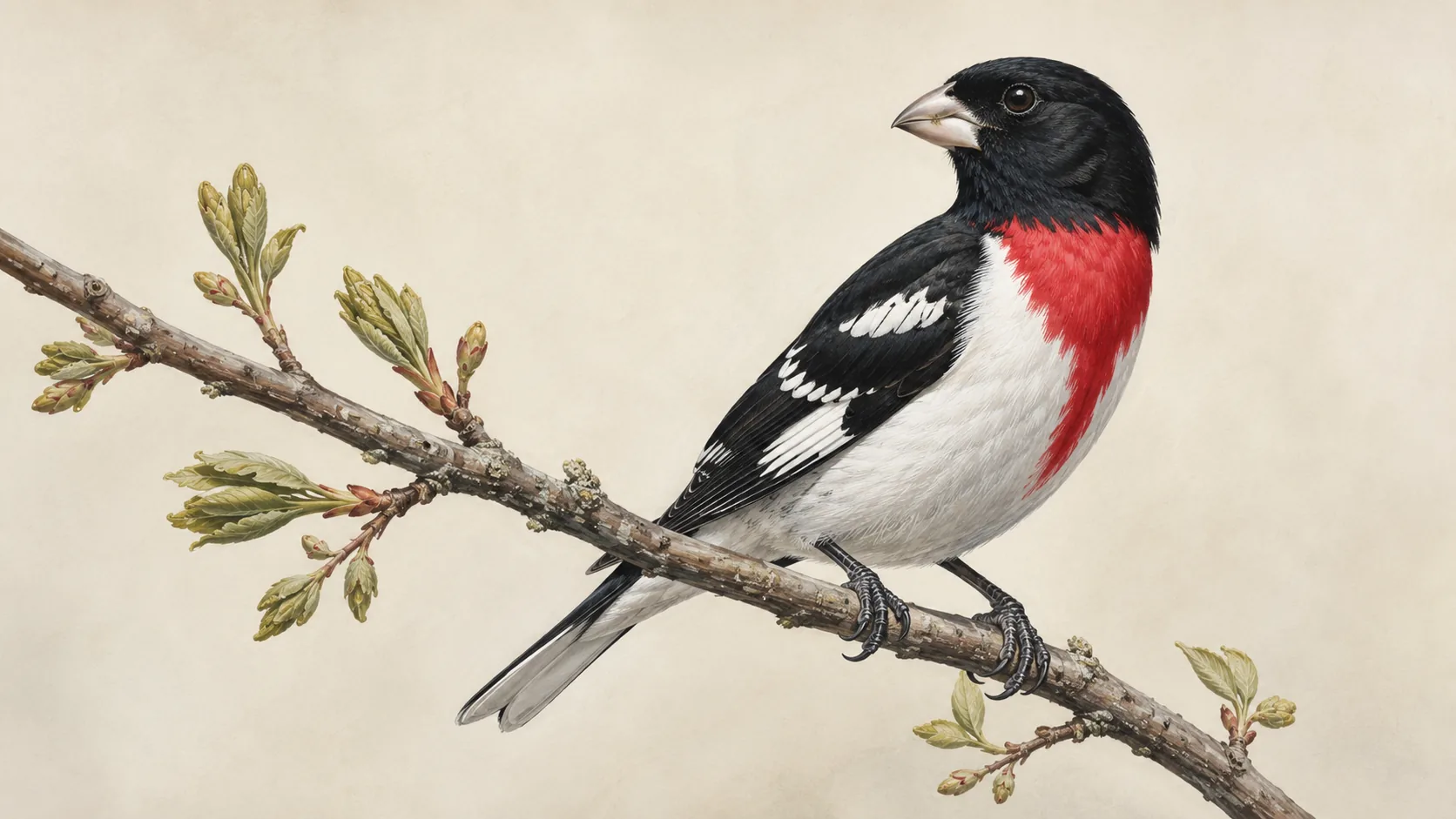
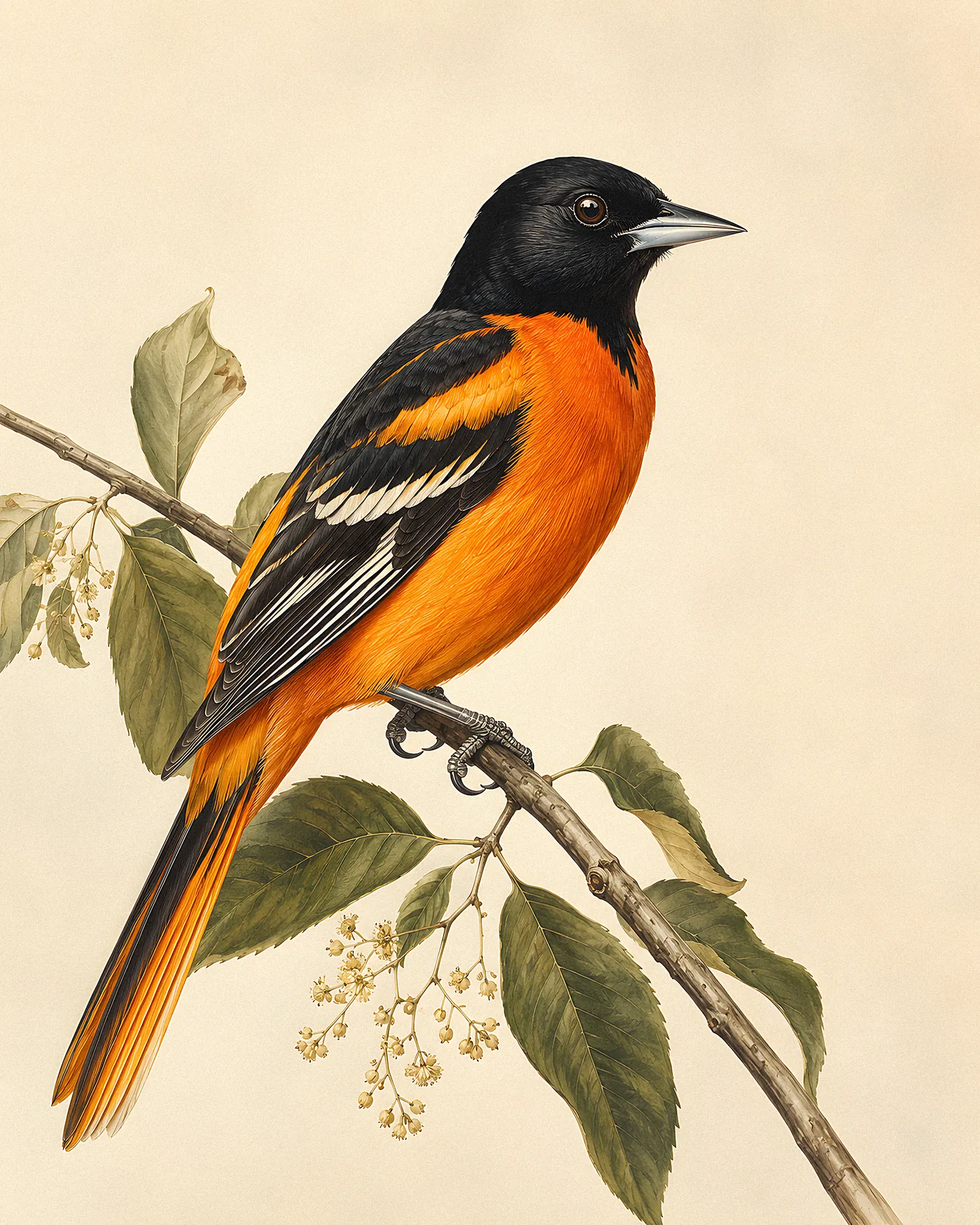
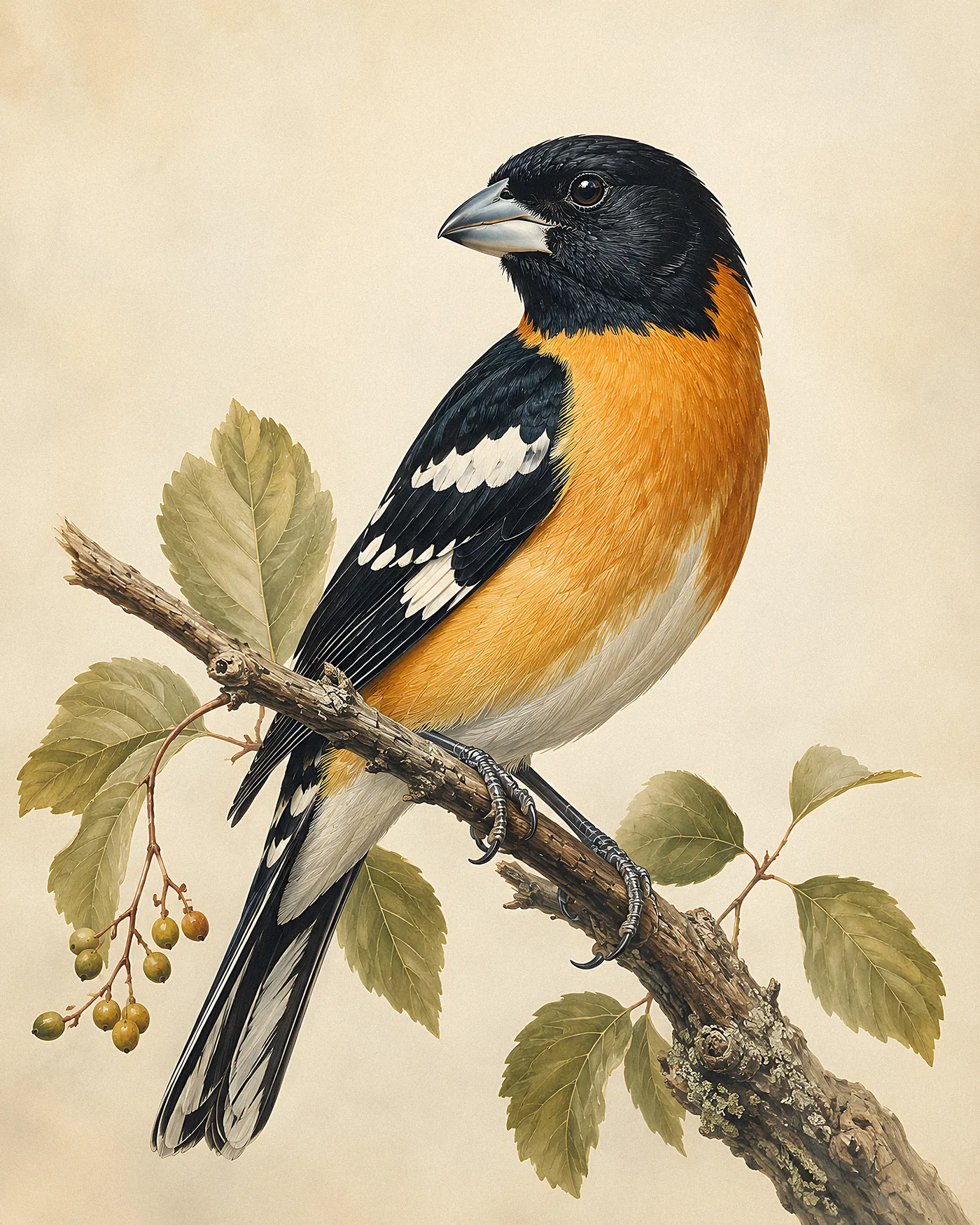
A male Black-headed Grosbeak arrives in a Colorado canyon in early May, dropping into a cottonwood by a stream with a song already running. He is the size of a small robin, his head and upper back jet-black, his breast and collar a deep burnt orange that the field guides call cinnamon and the eye reads as the colour of a clay roof. The bill is the giveaway: pale, blunt, conical, a seed-cracking tool the whole grosbeak family is built around. He is the western answer to the Rose-breasted Grosbeak, his closest relative, and where their ranges brush along the Great Plains the two sometimes pair and produce hybrids.
He sings from the open, which the Scarlet Tanager never does, and he sings a great deal. The Black-headed Grosbeak is not a bird of passage in the way the Rose-breasted is for an eastern feeder watcher. He arrives to breed, he holds a territory through the summer, and he is one of the more conspicuous and audible birds of the western woods while he is there.
What he looks like
The breeding male is a two-tone bird with a heavy bill. The head is solid black, the back black streaked with cinnamon, and the breast, collar and rump a rich orange-cinnamon. The wings are black with bold white patches and white-tipped coverts, and there is a flash of lemon-yellow in the wing linings, visible from below in flight. Cornell Lab puts the species at roughly 18 to 20 centimetres long, weighing 40 to 49 grams, with a wingspan around 30 to 32 centimetres, a hefty, big-headed songbird, bulkier than a House Finch and stockier than a robin.
The female is the more subtle bird, and the cause of the usual grosbeak confusion. She is warm brown above, buff below with fine dark streaking confined mostly to the sides, and she carries a bold face pattern: a broad pale eyebrow, a dark crown and a dark cheek. Like the male she has a yellowish wash under the wing. The shared field mark, as always with this family, is the massive pale bill. A useful Cornell Lab detail for the patient watcher: the male does not gain his full black-and-cinnamon breeding dress until he is two years old, so a streaky, half-coloured singing male in spring is a yearling, not a female.
What it sounds like
The song is a rich, rolling warble, and the standard comparison, repeated everywhere because it fits, is an American Robin that has had a glass of wine. Cornell Lab describes it as more fluent, faster, sweeter and more mellow than a robin’s, rising and falling through long musical passages, delivered from an exposed perch rather than hidden in the canopy.
The female sings too. Usually hers is a shorter version of the male’s song, but females have been recorded delivering a full, male-quality song, which has led to the suggestion that a sitting female may sing to fool her mate into thinking a rival has appeared, drawing him back to the nest. The common call is a sharp, penetrating eek or ik, often likened to the squeak of a shoe on a gym floor, the same family note the Rose-breasted Grosbeak gives.
Range and habitat
Pheucticus melanocephalus breeds across western North America, from the Pacific coast east to the middle of the Great Plains, and from southwestern Canada south through the mountains of Mexico. It favours mixed woodland with both large trees and a rich understory: cottonwood and aspen along floodplains and stream margins, broken pine forest, deciduous canyons and valleys, and well-treed gardens, orchards and suburbs. Water nearby is a recurring theme in the habitat descriptions.
It is a true migrant. Cornell Lab records the great majority of US and Canadian birds wintering in Mexico, spread across the central highlands. It is on those Mexican wintering grounds that the bird does its most surprising piece of natural history, which belongs under diet. Partners in Flight estimates a global breeding population of around 15 million and rates the species low on the continental concern scale, and the IUCN lists it as Least Concern.
Diet
The grosbeak is an omnivore with a crushing bill, and through the breeding season the balance tips towards animal food, roughly sixty percent by Cornell Lab’s account. The menu runs to beetles, caterpillars and other insects, plus spiders and snails, the heavy bill making short work of shells. The vegetable half is seeds, berries and fruit, and at a feeder the bird takes sunflower seed readily.
The headline item comes in winter. Where the grosbeaks gather in central Mexico, their range overlaps the great wintering colonies of monarch butterflies, and the grosbeaks eat the monarchs in large numbers. Monarchs are loaded with cardenolide toxins picked up from milkweed, which make them poisonous to most birds. The Black-headed Grosbeak is one of the very few that feeds on them in bulk without apparent harm, eating them on roughly an eight-day cycle that seems to let the toxins clear between feasts. It is one of the more remarkable predator-prey stories in North American ornithology, and this is one of its two main characters.
Breeding and nesting
The nest is an open cup of twigs, stems and rootlets, often loosely built and set in the fork of a shrub or small tree, frequently near water. Cornell Lab records a clutch of two to five pale blue-green eggs spotted with brown, with incubation lasting about 12 to 14 days.
Incubation is shared, which marks this bird out alongside its eastern cousin. Both sexes take turns on the eggs, and the pair have been recorded singing softly to each other at the changeover, one bird relieving the other on the nest. Only the female sits through the night. Both parents brood and feed the young, who leave the nest before they can fly well and are fed by the adults for some time after. Shared incubation, with the male taking real daytime shifts, is uncommon among songbirds, and it is a trait the Black-headed Grosbeak holds in common with the Rose-breasted across the Plains divide.
The bird that eats poison
Most western birders know the Black-headed Grosbeak as a voice: the wine-soaked robin singing from a cottonwood by a creek in June. That alone earns it a place. The orange-and-black male is handsome, the song is generous, and unlike the skulking tanagers he sings where you can find him.
But the bird’s real distinction is hidden in the winter, hundreds of miles south, in the fir forests of central Mexico where the monarchs hang in their millions. There the grosbeak does what almost nothing else can: it eats the poisoned butterfly, pacing itself against the toxin, and turns one of nature’s most famous chemical defences into a meal.
The bird that sings like a tipsy robin in a Colorado canyon is also one of the only creatures that can eat a monarch butterfly and live.
So the next handsome orange grosbeak singing from an exposed branch is worth more than the glance the colour and the song earn him. He is a bird with a second, stranger life in the south, one of the few animals that has solved a poison the monarch evolved precisely to make itself uneatable.