Field Guide
Black Rail
The kic-kic-kerr comes out of the dark grass at ten o’clock at night. No shape. No movement. Only sound - a short, staccato triple note rising then dropping, repeating from somewhere inside a wall of black needlerush that is impenetrable even at noon. A marsh biologist can stand two metres from this bird and never lay eyes on it. Most people who have recorded Laterallus jamaicensis have recorded a voice, nothing more.
This is the Black Rail: the smallest rail in North America, barely larger than a sparrow, and one of the most secretive birds on the continent.
What it looks like
Laterallus jamaicensis is a bird built for invisibility. Twelve to fifteen centimetres from bill-tip to tail - shorter than a field sparrow’s body plus tail feathers - and weighing between 29 and 35 grams, it is roughly the mass of a small persimmon. The wingspan runs 22 to 26 centimetres across, just enough to carry it in short, reluctant bursts when flushing is unavoidable.
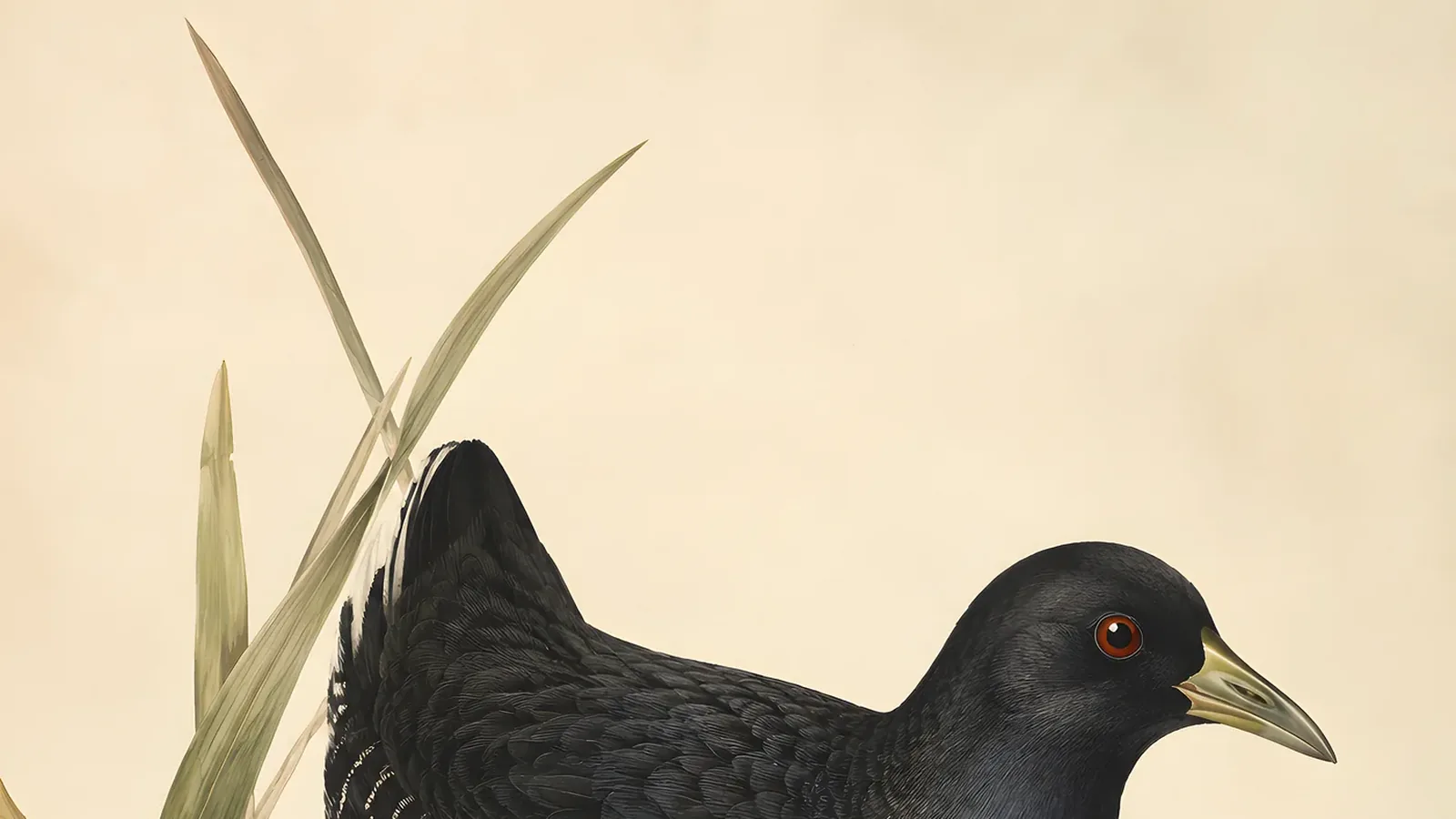
The colouration is precise camouflage for the marshes it inhabits. The crown, back, and underparts are deep slate-grey, nearly charcoal in poor light, fine white speckles scattered across the back and wings like droplets of foam on dark water. The nape - the collar of feathers at the back of the skull - breaks from the grey in a band of rich chestnut brown. The bill is short, dark, and compressed, suited to probing through grass roots rather than the long bills of wading herons. And the eye, if you are ever close enough to see it, is red. Crimson in adults, darker orange-brown in immatures. It does not make the bird easier to find.
The eastern subspecies (L. j. jamaicensis) and the California subspecies (L. j. coturniculus) share this basic plan with minor variation in size. The California bird averages slightly lighter. Neither subspecies has any field-mark likely to be seen before the bird runs. What makes it: the combination of very small, very dark, white-spotted, and refusing to stop moving under cover.
| Feature | Measurement |
|---|---|
| Length | 12 - 15 cm |
| Weight | 29 - 35 g |
| Wingspan | 22 - 26 cm |
| Lifespan (wild) | 5 - 9 years |
| Clutch size | 6 - 8 eggs (typical) |
| Incubation period | 17 - 20 days |
The voice in the dark
The call is the species. Described variously as kic-kic-kerr, kic-kee-doo, or ki-ki-kerr depending on the observer’s ear and phonetic conventions, it is a three-syllable staccato phrase with the last note typically lower in pitch and shorter. It is given primarily by territorial adult males. Audubon’s Field Guide describes the vocalization as “a piping ki-ki-doo, the last note lower in pitch,” and the Conserve Wildlife Foundation of New Jersey field guide documents that the call is “most frequent during early breeding season (late April through mid-May)” and peaks in the hours after sunset and before sunrise.
The bird is almost completely nocturnal in its vocal behaviour. Calling begins in earnest after dark and tapers before first light. Biologists conducting nighttime point-count surveys have documented that the window of greatest detectability runs from roughly one hour post-sunset through midnight. Approach a marsh at noon and walk through sedge all afternoon. You will not hear it and are extremely unlikely to see it. Come back at ten o’clock, stand still, and wait - and there it is, calling from grass that could be two metres or twenty metres away, impossible to locate precisely because the vegetation baffles all directional information.
Other calls include short kik and yip notes used for communication between individuals at close range, but these are not the sounds that bring rails to the attention of surveyors.
“The kic-kic-kerr call of the territorial male is the primary means by which this species is detected across its entire range, and the vast majority of documented occurrences in survey databases represent audio detections only.” - Eddleman, Flores, and Legare, Birds of the World (Cornell Lab of Ornithology, 2020)
The bird no one sees
The reason biologists treat the Black Rail as functionally invisible is not metaphor. The species runs through dense grass on foot - quickly, low, mouse-like - rather than flushing. Rails in general are reluctant fliers. The Black Rail has taken that tendency to an extreme. When pursued, it does not rise into the air. It compresses its laterally flattened body (rails are anatomically narrow, and the idiom “thin as a rail” derives from this family) and threads through the base of the vegetation at speed, changing direction unpredictably, and going completely silent.
In high tide events - when coastal marsh floods and birds must move to adjacent upland edges to escape the water - Black Rails become briefly more visible. But even then they are running across open ground rather than flushing into view. Survey protocols designed specifically for the species rely on broadcast playback of the kic-kic-kerr call to provoke a response call, which is the closest most researchers get to confirming presence.
The yellow rail (Coturnicops noveboracensis) presents a nearly parallel secretive-marsh-bird challenge, but it occupies slightly different habitat and has a distinctive clicking call. The Black Rail’s combination of size, plumage, and nocturnal vocal behaviour makes it arguably the more difficult of the two to document even where it occurs in known numbers.
Range and the vanishing marsh
The Black Rail breeds along the Atlantic Coast from Florida north to Connecticut, along the Gulf Coast into Texas, and has scattered inland populations at shallow freshwater and wet meadow sites in the Midwest. The California subspecies (L. j. coturniculus) is a permanent resident in the Central Valley and along the Colorado River. Eastern populations are migratory, withdrawing southward in winter to Florida, the Gulf Coast, Central America, and the Caribbean.
The eastern subspecies (L. j. jamaicensis) is in crisis. Bryan Watts and colleagues at the Center for Conservation Biology at the College of William and Mary have documented, through multi-year surveys, a greater-than-90-percent population decline in the Chesapeake Bay region since the 1990s, with an annual decline rate exceeding nine percent in the northern portion of the range. The Atlantic Coast breeding range has contracted southward by more than 450 kilometres, with the species now largely absent from states where it once bred regularly.
Two forces are driving this collapse. The first is historical wetland loss: the direct filling, ditching, and diking of tidal marshes through much of the twentieth century eliminated habitat outright. Between 1953 and 1973, nearly a quarter of all tidal marshes in New Jersey were destroyed or fundamentally altered (Beans and Niles, eds., Endangered and Threatened Wildlife of New Jersey, 2003). The second force is sea-level rise. Black Rails nest in the elevated portions of coastal marshes - the high marsh zone flooded only during extreme tides, where saltmeadow hay (Spartina patens), needlerush (Juncus spp.), and saltgrass (Distichlis spicata) grow in dense low stands. As mean sea level rises and the frequency of inundation events increases, this high-marsh zone shrinks or converts to lower marsh types the bird cannot use. The nesting sites are not just degraded. They are submerged.
On November 9, 2020, the U.S. Fish and Wildlife Service formally listed the eastern Black Rail as Threatened under the Endangered Species Act (Federal Register 85 FR 63764, Docket FWS-R4-ES-2018-0057) - the first federal protection the subspecies has received. The species-level IUCN Red List assessment is Near Threatened (NT). The divergence reflects the eastern subspecies’s acuteness of decline relative to the still-viable California and Central American populations.
Diet
Laterallus jamaicensis is a generalist feeder constrained to what is available at the marsh surface and root zone. The diet documented by Eddleman, Flores, and Legare (2020) includes aquatic beetles (particularly diving beetles), spiders, snails, isopods, small crustaceans, and seeds from bulrush (Scirpus spp.), sedges, and marsh grasses. The Conserve Wildlife Foundation of New Jersey species account notes weevils and grasshoppers as supplementary prey. Seeds become proportionally more important in the winter months when arthropod numbers fall.
The foraging style is ground-gleaning: the bird moves through the litter layer and root mat at the marsh surface, picking items from mud, debris, and low vegetation. It does not probe deeply or use the bill to excavate. The short, sturdy bill is adapted to this surface-picking method rather than the long-probing bills of snipe or the generalist chisel-bills of woodpeckers. Water depth at foraging sites rarely exceeds six centimetres - one more constraint on usable habitat.
Breeding
Breeding in the eastern subspecies runs from late April through August, the extended season allowing for replacement clutches if nesting fails. The nest is constructed from marsh grasses and sedges woven into a compact cup, typically with a canopy of living vegetation arching over it - the domed structure documented across the Rallidae family to reduce predator detection from above. Nest sites sit at or near the upper limit of the high-marsh zone, at elevations that avoid routine tidal flooding but that become vulnerable when sea level or storm surge pushes water above normal levels. Nest failure by flooding is one of the primary sources of reproductive loss documented by Hand and colleagues in their 2021 South Carolina breeding study published in Waterbirds (vol. 44).
Clutch size averages six to eight eggs, white to pale buff with fine brown speckling. Both sexes incubate, with the period running 17 to 20 days. Chicks are precocial and leave the nest within 24 hours of hatching, following the adults through the vegetation. The total number of breeding pairs along the Atlantic Coast is estimated at between 455 and 1,315 - a figure Bryan Watts documented in his 2016 status assessment for the Center for Conservation Biology, and a number that places the entire eastern subspecies within the scale of a modest-sized suburban neighborhood.
The eastern Black Rail’s situation compresses a familiar argument about habitat and urgency. When a bird is primarily detected by its voice, the absence of that voice at a survey point is not evidence of absence - it may be that the population is too sparse, or that conditions that night suppressed calling, or that the monitoring effort missed the right window. This ambiguity has historically made it harder to establish how badly the species was doing. The 25-year effort by the Center for Conservation Biology to document the decline - through standardized surveys, point-counts, and telemetry - produced the data that finally compelled federal listing in 2020.
The kic-kic-kerr is still audible on spring nights along the Texas and South Carolina coasts and in the best remaining tidal marshes of the Mid-Atlantic. What that voice means, and whether it will still be sounding from those same marshes in another twenty-five years, depends entirely on whether the high marsh zone has any ground left to stand on when the water keeps rising.