Field Guide
Black Skimmer
The light is failing over a Florida lagoon. The terns have settled. A long, low shape crosses the water - not hovering, not diving, but moving with an almost mechanical steadiness two centimetres above the surface, its red-and-black bill trailing a thin line in the glass. It does not slow when it hits a fish. The bill snaps shut by reflex, the head drops, and the bird banks away with something silver in its grip. It found that fish not by seeing it but by touching it. The whole passage took less than two seconds, and it will repeat the sequence several hundred times before the sky lightens again.
Rynchops niger is a bird built around a problem and a solution. The problem is finding fish at the water’s surface in low light, when the advantage goes to the animal that does not need to see. The solution is a bill unlike any other in the world - and a set of pupils unlike any other in North America.
What it looks like
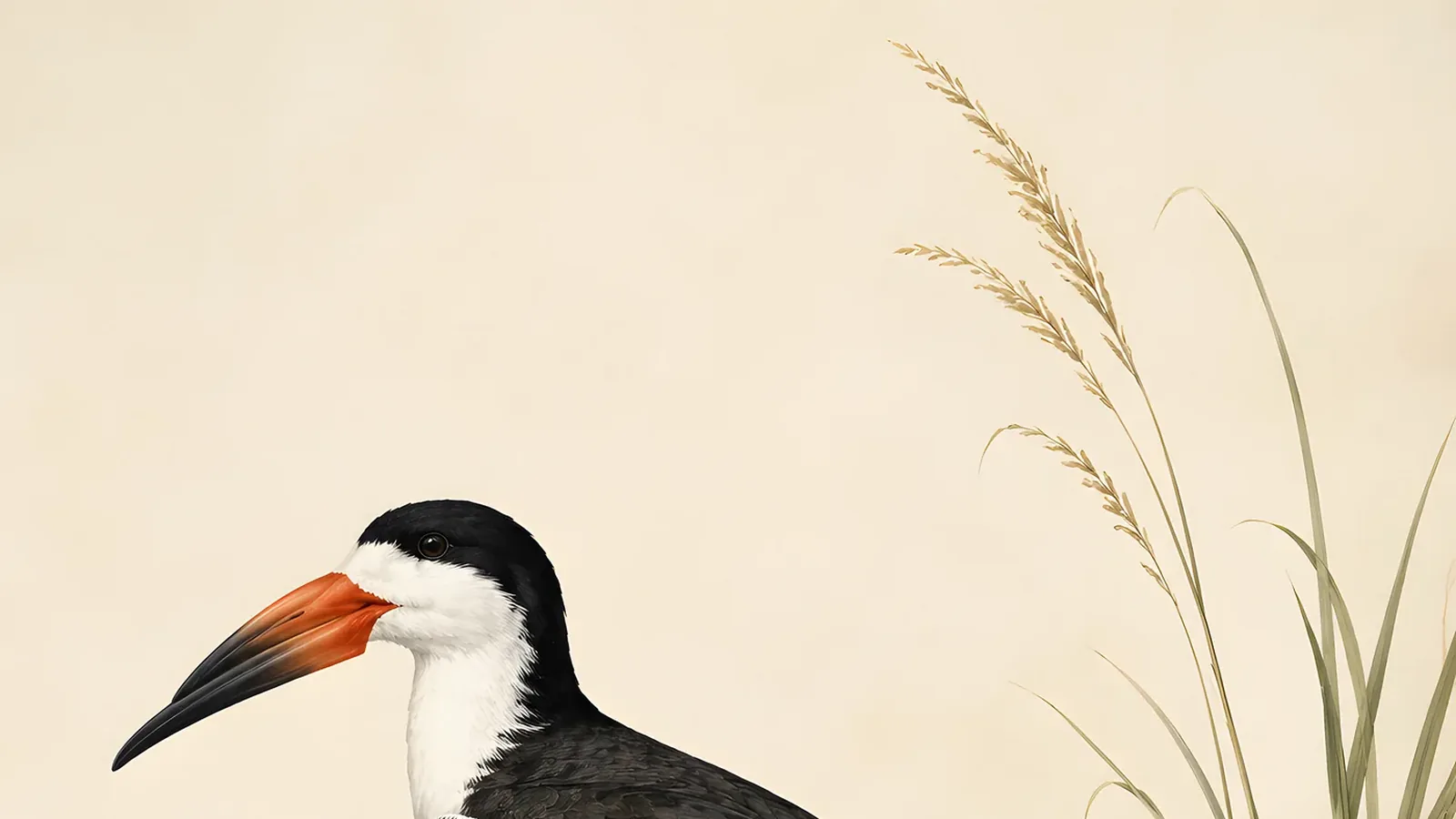
The Black Skimmer runs 40 to 50 centimetres in length with a wingspan of 107 to 127 centimetres - roughly the dimensions of a large tern, though the silhouette is entirely its own. Weight ranges from 212 to 447 grams (Cornell Lab of Ornithology, All About Birds), with males running noticeably heavier than females, a reversal of the usual shorebird pattern.
The upper parts are solid black from crown to tail. The forehead, undersides, and trailing edges of the secondaries are white. The bill is compressed laterally and coloured in two distinct zones - the basal two thirds bright red-orange, the terminal third black - as if the tip had been dipped in ink. The legs are short and red-orange to match. In flight, the long pointed wings give a shape that other birds in the family Laridae do not approach: thin, angular, built for sustained low-level passes rather than soaring or plunge-diving.
Juveniles and immatures carry mottled brown and buff on the back, with paler bill colouring and a less pronounced mandibular difference - the lower mandible’s extra length develops gradually with age.
| Measurement | Range |
|---|---|
| Length | 40 - 50 cm |
| Wingspan | 107 - 127 cm |
| Weight | 212 - 447 g |
| Lower mandible projection | 2 - 3 cm beyond upper |
| Maximum recorded lifespan | 20.2 years (wild) |
The bill that fishes by feel
Rynchops niger is the only bird in the world whose lower mandible is markedly longer than the upper. The lower bill projects two to three centimetres beyond the upper and is laterally compressed into a blade that cuts water with minimal resistance. At the moment of contact with a fish, the upper mandible drops by reflex - the result of a rapid head-flexion response documented by R. L. Zusi in his foundational morphological work on the genus (Zusi, 1962). The bird does not squeeze or grip. The bill claps shut by touch alone.
This is what ornithologists call tactile foraging - the same category of sensory strategy used by spoonbills sweeping through murky water - but applied at speed in open air above a moving surface. Because the trigger is mechanical rather than visual, it works equally well in full dark. The skimmer does not need to see the fish. It needs only to clip it.
The bill wears continuously. Lower mandibles grow faster than upper mandibles throughout the bird’s life, maintaining the gap. Researchers have noted that captive birds deprived of skimming surface show overgrowth of the lower mandible, which confirms that the contact itself - the friction against water - is what keeps the structural asymmetry calibrated.
The cat eye
The vertical-slit pupil of the Black Skimmer was first formally reported by Taczanowski in the Proceedings of the Zoological Society of London in 1874, and later documented in detail by Alexander Wetmore in the Proceedings of the Biological Society of Washington in 1919. Zusi and Bridges published comparative drawings of pupil shape under varying light intensities in the Journal of Field Ornithology in 1981, establishing that the contraction to a narrow slit occurs in bright conditions and the pupil opens fully in low light.
No other North American bird has this arrangement. The vertical slit is the pupil geometry of ambush predators and crepuscular foragers across many animal classes - cats, vipers, geckos - because it allows both very tight closure in sun and very wide aperture in darkness, a range of control not achievable with a round pupil. On a bird that feeds primarily at dawn, dusk, and through the night, and rests on open sand in full tropical sun between feeding bouts, that dual function is not incidental.
The eye itself is difficult to photograph. The dark brown iris sits within the black feathering of the head, and the nictitating membrane can cover the slit entirely, which is why most field observers do not register the pupil shape even when they are looking directly at the bird.
What it sounds like
The Black Skimmer is not a bird of elaborate song. The call is a flat, hoarse bark - a short syllable at roughly six kilohertz, lasting under half a second - variously rendered as yap or kak. At a colony, particularly when a predator approaches or when rival pairs dispute nest boundaries, the barking becomes collective and insistent. Away from the colony, foraging birds at night are largely silent. The voice is functional, not musical.
Robert Cushman Murphy, writing on the skimmers of South America, described foraging flocks as “aerial beagles hot on the scent of aerial rabbits” - which captures the purposefulness of their low passes without quite capturing how quiet those passes are.
Chicks call from the nest scrape when a parent returns, and adults will produce a softer contact call within the colony. Outside the breeding season, wintering flocks roosting on beaches in the hundreds are sometimes completely silent.
Range and the beach colony
The breeding range in the United States follows the Atlantic coast from Massachusetts to Florida, continues around the Gulf Coast to Texas, and has a separate and more recent presence in southern California - the Pacific population dates from the 1960s and now nests at the Salton Sea and San Diego. In winter, northern populations move south to the Gulf Coast and Florida. The species is present through Central America and throughout coastal South America.
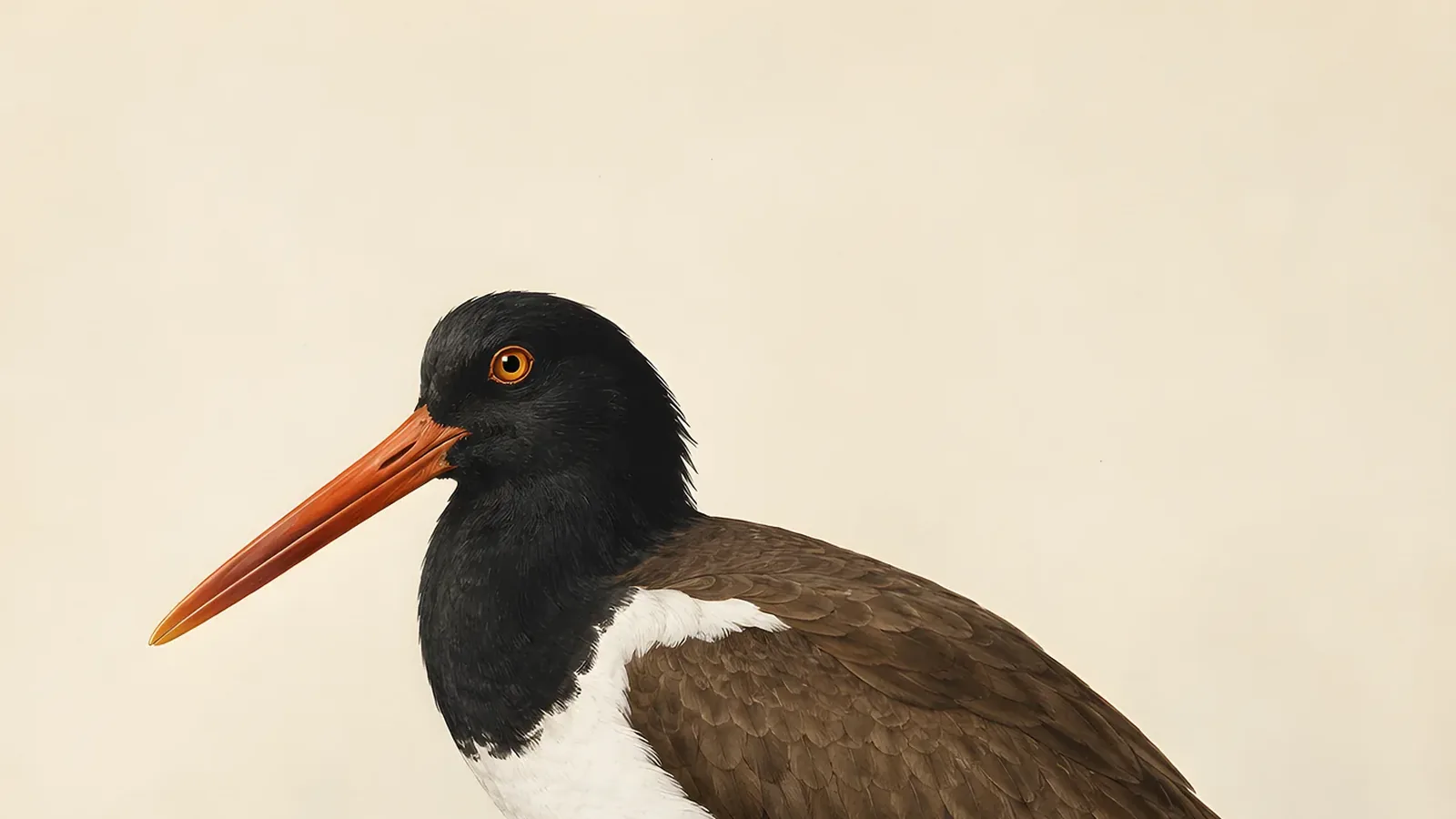
The American oystercatcher shares much of this coastal territory, but the two birds occupy distinctly different foraging niches - the oystercatcher works rocky substrate and shellfish by prying and hammering, while the skimmer requires open water calm enough for the bill to trace a clean line. They are often on the same beach without competing.
Black Skimmers nest colonially on open sand - barrier islands, sandbars, dredge-spoil flats, shell banks. They prefer sites that are exposed and close to water, and they regularly mix with colonies of Least Terns, Common Terns, and Laughing Gulls. The mixed colony serves a collective defence function - terns are more aggressive aerial defenders than skimmers, and nesting close to an active tern colony reduces predation pressure on skimmer eggs.
Nest density within a colony can be high, and individual pairs defend small territories around the scrape rather than the full colony perimeter. Both sexes incubate. The incubation shift at night often falls to the male.
Breeding
Breeding begins as early as mid-March in Texas and extends through August. The nest is a shallow scrape in open sand, unlined or lightly lined with shell fragments. Both sexes excavate by lying on the breast and rotating, a behaviour visible at active colonies when birds arrive and begin to reinforce the cup.
Clutch size runs three to five eggs, more commonly four. The eggs are cryptically marked - cream, tan, and pale grey with dark spots - and sit flush with the sand. Incubation lasts 21 to 26 days, shared by both adults. Chicks hatch with upper and lower mandibles of equal length. The asymmetry of the bill develops gradually as the young bird grows. This is not a minor anatomical detail: it means the chick physically cannot skim for food until the lower mandible has grown out sufficiently, so the parents provision it with whole fish - regurgitated at the nest - for the full 28 to 31 days before fledging.
The oldest individual on record was banded in California in 1990 and recovered in 2013, at a minimum age of 23 years and one month (Patuxent Wildlife Research Center banding data). Typical wild lifespan runs five to 20 years.
Populations declined by an estimated 87 percent between 1966 and 2015, primarily through beach development, vehicle disturbance at colonies, and storm overwash of low-lying nesting sites. IUCN lists the species as Least Concern globally, reflecting the still-substantial South American population, but the North American breeding colonies face genuine and ongoing pressure.
The Black Skimmer did not evolve in a world of beach umbrellas and off-road vehicles. It evolved on open sand that was reliably empty. The question the colonies now face is not whether the species can find food in the dark - that problem was solved millions of years ago, in the refinement of the bill and the slit pupil and the reflexive snap. The question is whether there is enough undisturbed sand left at the right time of year. Everything about the bird works. The habitat is what requires attention.