Field Guide
Black Rosy-Finch
A finch stands on grey talus at the edge of a Great Basin snowfield, 3,600 metres above sea level, where the air is thin enough to feel. It is nearly black - the darkest bird on the highest rock - working the slush line with quick, purposeful steps. Around it, the ground is littered with frozen crane flies and seeds blown up from the valleys below. The bird lifts one, tilts its head, moves on. In most seasons, no field naturalist watches. This is Leucosticte atrata, the Black Rosy-Finch, and it lives at the ceiling of the continent.
Of the three rosy-finches that breed in the American West - the gray-crowned rosy-finch with its silver cap and the brown-capped rosy-finch with its warmer plumage - the Black is the darkest, the most range-restricted, and the most climate-vulnerable. It occupies a band of alpine habitat in the northern Great Basin and central Rockies that is both narrow and finite. It cannot adapt by moving lower. It can only go higher, and there is not much higher left.
What it looks like
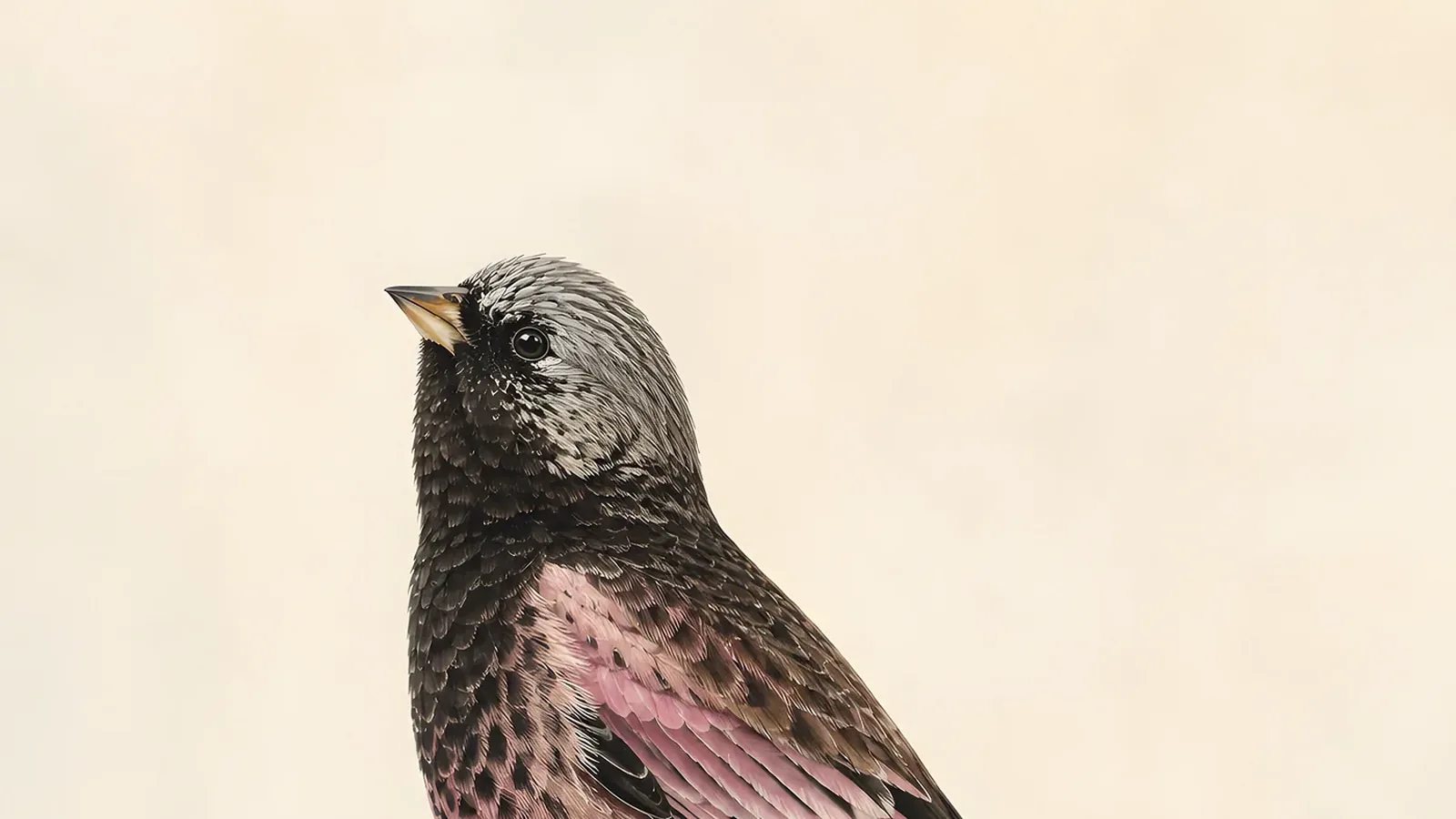
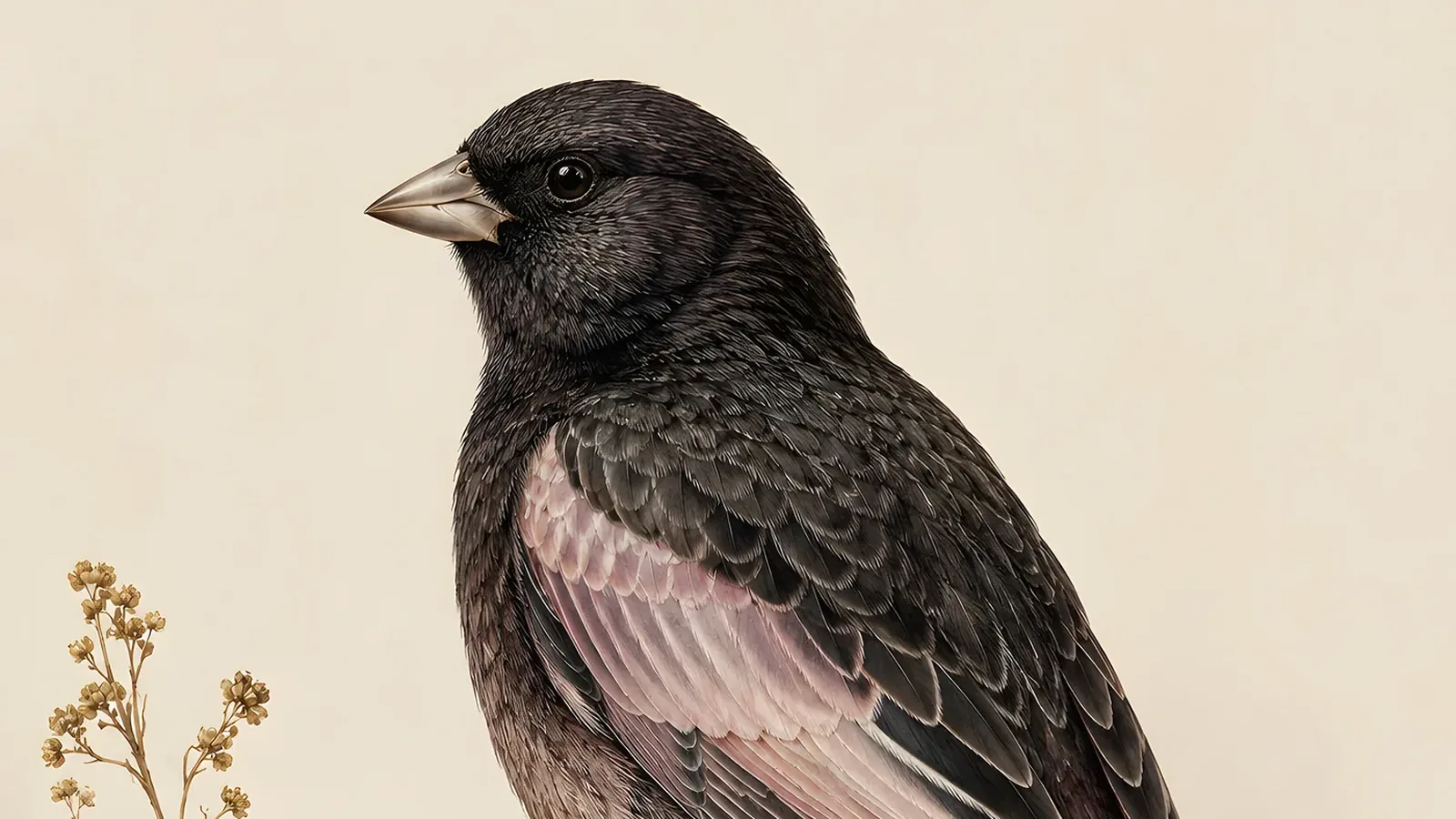
The adult male Leucosticte atrata is largely sooty black - a deep charcoal that reads as true black in flat light and reveals only the faintest brownish cast in direct sun. The back, breast, face, and forehead are all this uniform dark tone. A grey patch wraps the back of the head and nape: not a crown exactly, but a smudge of lighter colour that distinguishes the bird from a distance. The belly, rump, and wing coverts carry a rose-pink wash that gives the genus its common name. In flight, the pink lights up against the dark ground colour with startling contrast - a small, dark bird suddenly flickering with colour.
The bill is black in summer and turns yellow in winter, a seasonal shift shared across the rosy-finch group. Females follow the same pattern at reduced intensity: darker and browner than the male equivalent, with a narrower grey nape patch and a paler pink wash. In flocks, the two sexes are distinguishable but require attention. First-year birds are the dullest, with buffy wingbars and little obvious pink.
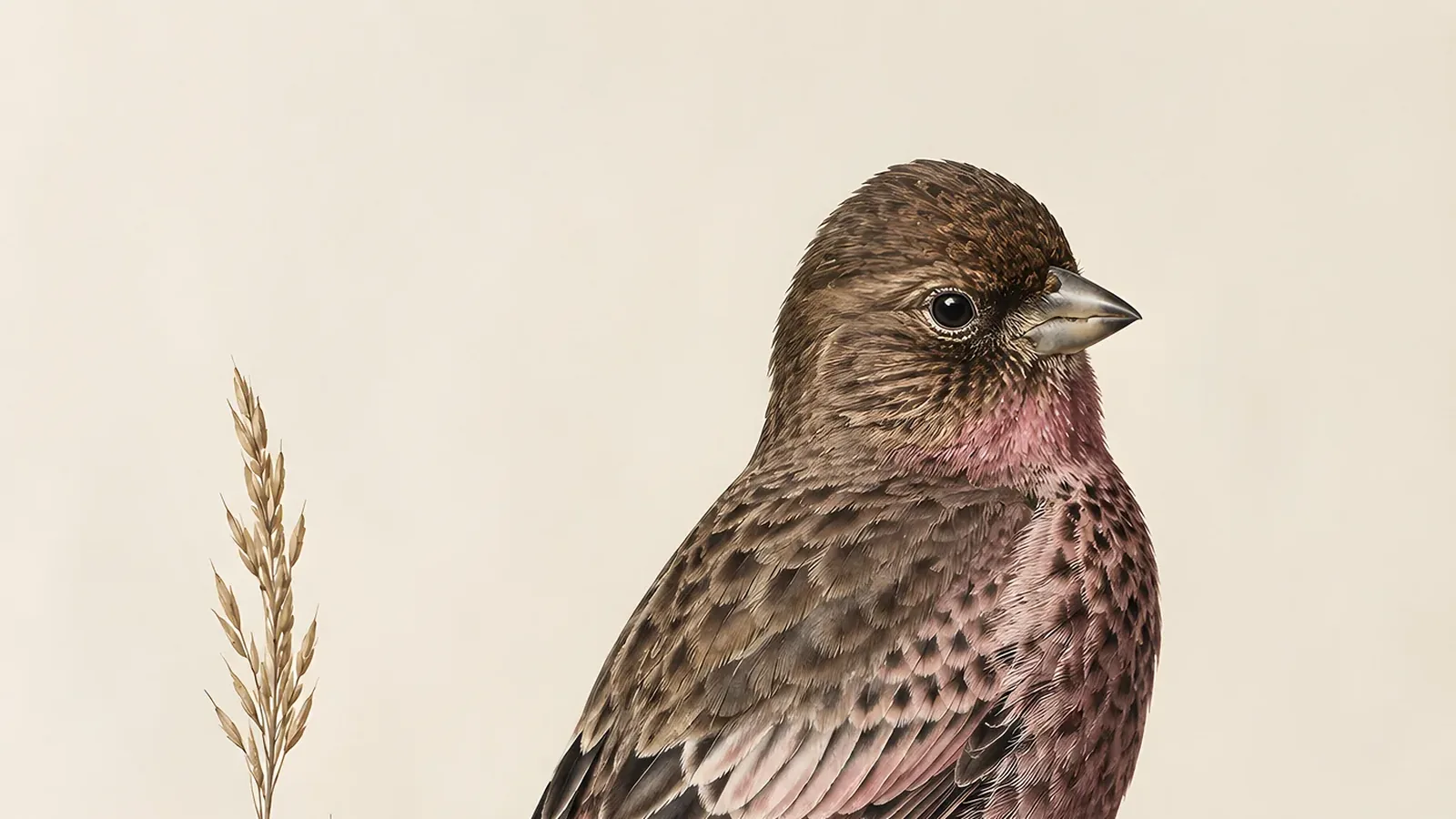
Compared to its closest relatives, the Black is unambiguous. The gray-crowned has a warm brown body with a clear silvery cap. The brown-capped is browner still, lacking the grey nape of both its siblings. The Black is simply darker than either - the species you identify by what is absent: colour, lightness, any softening of tone.
| Measurement | Range |
|---|---|
| Length | 15-18 cm |
| Weight | 22-40 g |
| Wingspan | 33-36 cm |
| Oldest recorded | 8 years, 7 months (Cornell Lab banding records) |
The highest rock
The Black Rosy-Finch breeds exclusively in alpine environments above treeline, on barren talus slopes, cliff faces, and permanent or near-permanent snowfields. The Biodiversity Research Institute (BRI), which has tracked birds in northwestern Wyoming, describes the species as breeding “exclusively in alpine environments where snowfields and alpine tundra facilitate foraging and cracks in cliffs provide nest sites.” It is one of the least-studied birds in North America. BRI researchers note that only an estimated five parties have ever documented finding a nest.
The breeding range runs from northeastern Nevada north through Idaho, Utah, Wyoming, and Montana, with a concentration in the mountain ranges of the northern Great Basin. The species is the most range-restricted member of its genus: it nests within a roughly defined corridor of high mountain country and does not spread beyond it. On the edges of that corridor, its presence is irregular and sometimes seasonal.
The nest itself is placed deep in a cliff crevice or beneath a boulder in talus - protected from direct weather, inaccessible to most predators. The female builds an open cup of grass, plant stems, and moss, lined with feathers or hair. Clutch size runs three to five eggs, typically four to five. The Audubon Field Guide records incubation at 12 to 14 days, carried out by the female alone. Both parents feed nestlings, which leave the nest approximately 20 days post-hatching. One brood per season is standard.
Like the other rosy-finches, the Black develops gular pouches - paired sacs opening from the floor of the mouth during the breeding season - that allow a foraging adult to carry substantially more food than the bill alone could hold. A parent that has worked a snowfield for insects can return to a cliff nest with a compressed payload, making the long foraging distance economical. No other North American finch shares this adaptation.
What it sounds like
The Black Rosy-Finch calls in a low “cheep” that carries across exposed alpine terrain and serves as both contact call and flight announcement. Flocks in movement give a repeated, soft chirping sequence. The Audubon Field Guide notes the call as “low cheep notes,” adequate for communication across open ground in wind but not built for the acoustic complexity that forest species require. The song is minimal - a few churring notes, rarely elaborate - suited to a bird that spends its vocal life on open rock rather than in dense vegetation competing for acoustic space.
In winter roosts, which may gather hundreds or thousands of birds in cliff faces and protected ledges at lower elevations, the combined calling of a large flock creates an audible murmur that is one of the species’ most accessible field experiences. A winter roost in a Utah canyon is often how birders first encounter the Black Rosy-Finch.
Diet at the snowline
The primary foraging strategy is ground and snow-surface gleaning: the bird walks steadily along the slush line where melting snow exposes stranded insects, or picks across bare tundra and fellfield for seeds. The Audubon Field Guide documents a summer diet of insects, buds, and leaves supplemented by seeds, with young fed predominantly on insects for the protein required to fuel rapid growth at altitude. In winter, the diet shifts heavily toward seeds - grass and weed seeds gathered in open valleys and adjacent slopes at lower elevation.
The dependence on snowfields as foraging substrate is functional, not incidental. Wind-blown insects - midges, crane flies, beetles carried aloft on thermals and then deposited on snow where cold immobilises them - represent a concentrated protein source available precisely where the bird already spends its time. Research from the Biodiversity Research Institute in Wyoming notes that foraging birds travel up to four kilometres from nest sites across snowfields and tundra. The snow is not an obstacle. It is the food source.
Range and the winter descent
In summer, the Black Rosy-Finch is a bird of the highest elevations accessible within its restricted range: mountain summits and ridge systems from northeastern Nevada through Idaho, Utah, Wyoming, and into southwestern Montana. In autumn, the birds descend to lower elevations in flocks, moving into high valleys, open mountain country, and sometimes the edges of towns with suitable feeding habitat. Winter range extends south into Colorado and northern New Mexico, though the species rarely reaches the latitudinal and elevational extremes of the more widespread gray-crowned.
Research from Utah State University, Tracy Aviary, and the Utah Division of Wildlife Research - a collaborative project using RFID-enabled feeders to track microchip-banded birds, led by PhD student Aimee Van Tatenhove - has begun to map these winter movements with precision. Data from nearly 12,000 feeder visits by tagged rosy-finches during winter 2019-2020 suggest that Utah serves as a winter convergence point for birds breeding in multiple Rocky Mountain states, including Montana. The project confirmed at least three consecutive years of individual site fidelity at winter feeding stations.
A 2019 analysis by the National Audubon Society projected that a global temperature rise of 2 degrees Celsius would eliminate 79 percent of the Black Rosy-Finch’s currently suitable habitat. The species holds an IUCN status of Endangered. Its mountaintop breeding grounds are, by definition, finite: pushed upward by warming, they contract against the summits, and there is no equivalent habitat waiting at higher elevation because there is no higher elevation.
Breeding
Breeding begins in late May and June, once snowpack has retreated sufficiently to expose tundra and talus, but before the snowfields that supply insect forage have melted entirely. The timing is narrow. A late year keeps the nest inaccessible under snow and compresses the foraging season. An early year may reduce the snow-stranded insect supply that nestlings depend on.
Male Black Rosy-Finches arrive at breeding grounds before females and establish loose territories around cliff sections with suitable nesting crevices. Courtship is not elaborate by finch standards - the male feeds the female during pair formation, a behaviour common across the rosy-finch group. Once eggs hatch, both sexes provision young, the gular pouch allowing efficient delivery of insects gathered across extensive snowfields.
The Black Rosy-Finch occupies the continental ceiling by design, not accident. It has arranged its anatomy, its timing, and its foraging strategy around snow. The irony is not subtle: the very feature that creates its food source is disappearing, degree by degree, beneath it.
The species is characterised by the Rosy-Finch Working Group - formalised in 2021 to coordinate research across the range - as among the least-known breeding birds on the continent. Conservation ecologist Janice Gardner of the Sageland Collaborative, working alongside teams from the Utah Cooperative Fish and Wildlife Research Unit and the Biodiversity Research Institute, has described significant gaps in basic demographic data: survival rates, territory fidelity, and breeding success across years of varying snowpack remain poorly quantified.
What is clear is the structural problem. The alpine specialist cannot retrain. It cannot shift its nesting preference to lower cliffs with less snow and broader insect diversity. Its entire life history - the gular pouch, the snow-surface foraging, the cliff-crevice nest placed close to permanent white - was assembled over evolutionary time around an alpine environment that is currently contracting. The Black Rosy-Finch lives at the top of the mountain. The mountain is running out.