Field Guide
Black-throated Blue Warbler
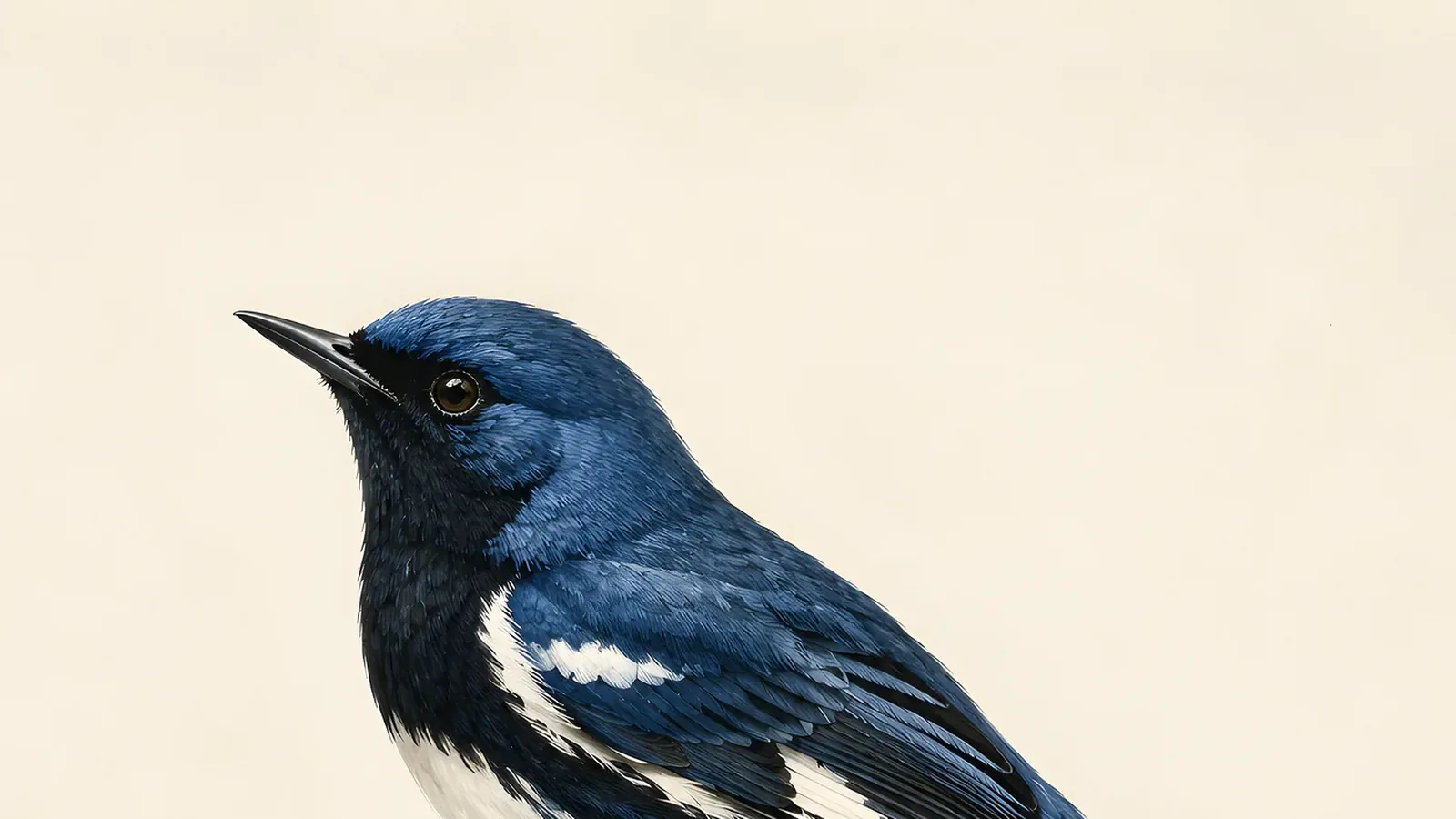
Deep in the shrub layer, where the hobblebush grows thick and the canopy closes out most of the sky, a small square of white catches the light. The rest of the bird sits still for a moment: midnight blue above, black from face to throat to flank, white belly. Then he tilts and the white square disappears and he is gone into the leaves. That square - bright as a folded handkerchief - is the one mark that follows Setophaga caerulescens, the Black-throated Blue Warbler, through every age and across every season. Everything else about this bird divides.
What they look like
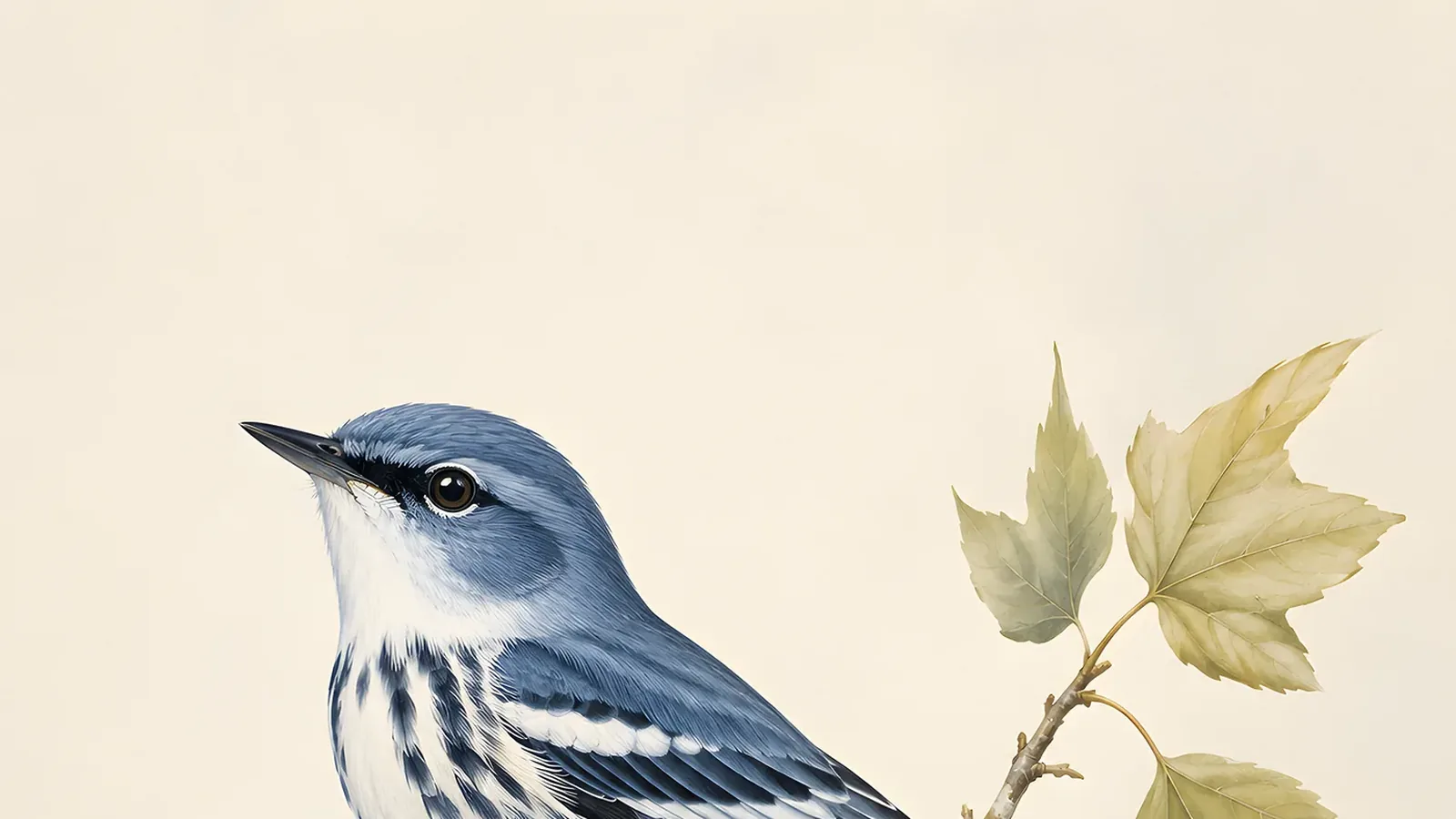
The male is one of the sharper plumage contrasts in North American birdwatching. His crown, back, wings, and tail run a deep midnight blue - not the electric turquoise of some warblers, but a subdued, slightly greenish blue that reads almost navy in shade and brightens only when light strikes him at the right angle. The face, throat, and flanks are jet black, and the belly beneath is clean white. He holds this dress year-round. There is no confusing breeding-versus-non-breeding plumage here, no autumn wash-out that muddles the field marks. What you see in May is what you see in August.
The female is something else entirely. She is olive-brown above and pale buff below, with a thin whitish eyebrow stripe and a faint dark cheek patch. Plain. Unassuming. Cryptic in exactly the way a bird nesting low in a shrub must be.
Both sexes share the one constant: a small white patch at the base of the primaries. On the male it is bold and rectangular. On the female it can be faint enough that a young bird, in her first autumn, seems almost to lack it. But it is there, and when you find it on that olive-brown bird, the question is settled.
| Measurement | Range |
|---|---|
| Length | 11-13 cm |
| Weight | 8.4-12.4 g |
| Wingspan | 19-20 cm |
| Oldest recorded | 9 years, 8 months |
Two birds, one species
When Alexander Wilson described the Black-throated Blue Warbler in 1810, he listed the male and female as two separate species. The drab olive bird he named the Pine Swamp Warbler. John James Audubon, working decades later, repeated the same mistake. It is not hard to understand why. Set a male and female side by side and the difference is not a matter of degree - it is a categorical break. The same family, same size, same nest, but a different world in the field glass.
The confusion held long enough to show up in multiple published accounts before enough breeding records accumulated to settle the matter. Even then, it took field observers watching birds at the nest to confirm what specimens alone could not prove. Today the dimorphism is famous precisely because it is so extreme, and birders use it as a teaching case in how strongly natural selection can push the two sexes of a single species in opposite directions.
“Both sexes possess a white square - or ‘pocket handkerchief’ - on their wings, a diagnostic field mark that persists across ages and sexes and distinguishes the species from all similar North American warblers.”
- Smithsonian’s National Zoo and Conservation Biology Institute
The white handkerchief
That white patch earns its name. When the wing is folded, it sits at the base of the primaries like a folded square of white cloth tucked in a breast pocket. It is small but crisp, and in the shade of a forest understory it catches available light in a way the rest of the wing does not.
The patch is your anchor. If you see a small warbler low in dense shrubs in the northeastern United States in summer - at knee height or shoulder height, working through the leaf litter and low branches - and you see white at the wing base, you have your bird. The male will be unmistakable a moment later. The female, lacking every other bright mark, still carries that square.
The cerulean warbler is sometimes raised as a comparison, but it works the canopy, not the understory, and lacks the black face. No other warbler combines the understory habit and the white primary patch in the way S. caerulescens does.
What he sounds like
The song is not a flashy one. It is slow, buzzy, unhurried - a series of three to seven rising notes, usually written as zee-zee-zee-zreeee, with the final note slurring upward in an almost drowsy lift. Audubon called the song “lazy.” The word fits. It moves at half the pace of a Yellow Warbler’s bright rattle, half the urgency of a Prairie Warbler’s climbing scale.
The laziness is deceptive. Males in New Hampshire forests have been recorded singing persistently through the breeding season, and at Hubbard Brook Experimental Forest - where continuous study of this species has run since 1969 - song output has been logged against territory quality and mate attraction. The call note is a flat, hard ctuk, useful when a bird is moving through dense cover and the song has stopped.
Females chirp but do not typically sing the primary song.
Range and the big-woods rule
Setophaga caerulescens breeds across the northeastern United States and southeastern Canada, from the Great Lakes east through New England and the Maritime provinces, and south along the Appalachian chain to northern Georgia and Alabama at higher elevations. In October it departs for the Greater Antilles - Cuba, Jamaica, Hispaniola, Puerto Rico - where it winters in forested habitats, shade-grown coffee plantations, and secondary woodland.
The breeding range on paper looks broad. On the ground the bird is selective. It wants large tracts of mature deciduous or mixed forest with a dense shrub understory. Hobblebush (Viburnum lantanoides), mountain laurel, rhododendron, and beech saplings are preferred nest shrubs. At Hubbard Brook, researchers found 51% of nests situated in hobblebush alone. The bird forages in the low and mid understory, rarely ascending to the canopy. It is, in the language of habitat ecology, a forest-interior specialist.
Holmes and colleagues (2005) documented that the species tends to avoid younger, second-growth forests with sparse understories, being primarily associated with mature northern hardwood stands where the shrub layer is well developed. The practical consequence is that fragmented woodlots, even sizeable ones, may not hold breeding populations. The bird favors the interior. Edge will not do.
New York’s Adirondacks, the high-elevation forests of Vermont and North Carolina, and the White Mountains of New Hampshire are strongholds. Populations have increased roughly 163% between 1970 and 2014 according to Breeding Bird Survey data, which makes this a species doing better than most Neotropical migrants - a fact worth pausing on when the news from other warblers is not so good.
Breeding
Nest construction falls to the female alone. She builds a cup of bark strips, plant fibers, and spider silk, set low in a shrub - typically between 30 cm and 1.5 m above the ground. The clutch runs two to five eggs, usually four, cream-colored with reddish-brown speckling concentrated at the broad end. She incubates for 12 to 13 days. Both parents feed the nestlings, which fledge at eight to ten days.
The species is capable of double-brooding, and at Hubbard Brook this has been studied in detail. Townsend, Sillett, Lany, Kaiser, Rodenhouse, Webster, and Holmes (2013, PLoS ONE) tracked 309 breeding females across 1986 to 2010 and found that 31% attempted second clutches in a given year. Crucially, pairs initiating their first nest earlier in warm springs were significantly more likely to attempt a second brood - and those pairs that did produce second broods averaged higher annual fecundity, roughly 3.7 offspring per pair-year. The implication is that a warming climate may, at least in the short term, benefit this species by extending the window in which double-brooding is possible.
Mate fidelity is moderate. Around 80% of returning birds pair with a previous mate when both return to the same area. Extra-pair paternity is documented at 34 to 43% of offspring, a rate typical of socially monogamous North American warblers.
At Hubbard Brook, 66% of 313 marked males and 46% of 186 marked females returned to within 150 metres of their previous breeding territory in subsequent years. This site fidelity, combined with the long-term monitoring that has run continuously for more than 50 years, makes Hubbard Brook the most detailed picture we have of any North American warbler’s demography. Research from the forest has documented how predator pressure - driven in part by chipmunk and squirrel populations that boom in mast years - shapes nest success from one season to the next.
The conservation picture is cautiously good. The IUCN lists S. caerulescens as Least Concern (LC), with an estimated 2.4 million mature individuals and a positive long-term trend. The threats that remain are habitat loss at both ends of the annual cycle - large undisturbed hardwood blocks on the breeding grounds, intact Caribbean forest on the wintering grounds - and the collision toll of glass-and-steel migration.
That white square will keep flashing in the understory as long as the big woods hold.