Field Guide
Wood Stork
Late November in the Everglades, and the pools left behind by the receding wet season are shrinking by the day. Mycteria americana - the Wood Stork - is working the shallows in a loose crowd of a dozen birds, each one moving with the unhurried deliberateness of something that has been doing this for a very long time. They are not watching the water. They cannot see what they are after, not in this tea-coloured soup. Instead, each bird wades forward with its long bill held slightly open and partly submerged, feeling for the moment when a fish blunders in.
When contact comes, the bill closes. Twenty-five milliseconds. One of the fastest reflexes ever recorded in a vertebrate.
This is the thesis of the Wood Stork: a large white wader whose entire life is governed by touch, timing, and the slow mathematics of falling water.
What it looks like
The Wood Stork is unmistakable in the water and startling in the air.
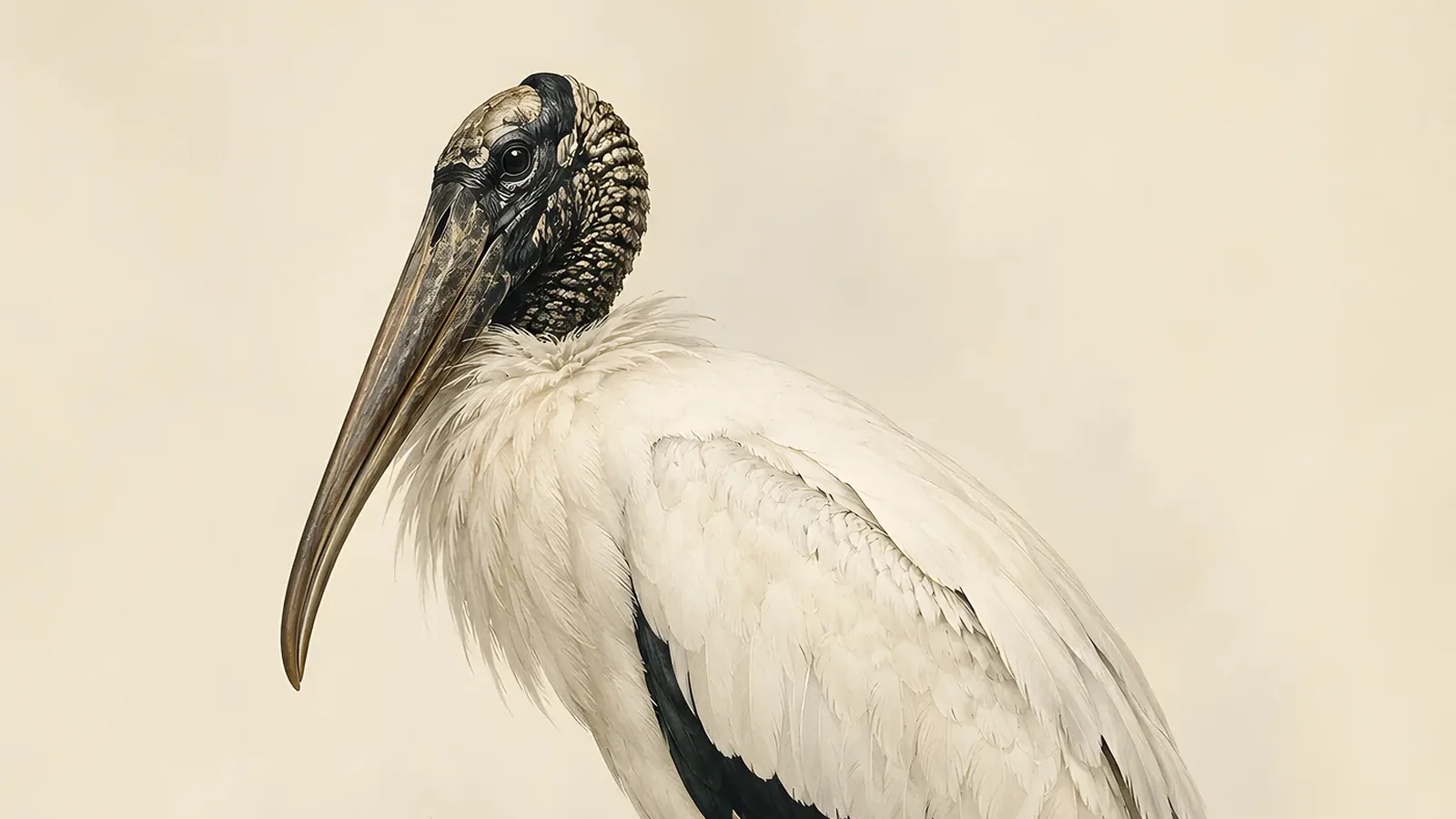
On the ground it stands 85 to 115 centimetres tall - taller than a Great Blue Heron from bill tip to toe in many encounters, though typically lighter, at 2.1 to 3.3 kilograms. The wingspan reaches 150 to 170 centimetres. It is a big bird. But the weight sits differently: the Wood Stork is narrowly built across the body, with the elongated neck and heavy decurved bill of the stork family, Ciconiidae.
The body feathers are white. The flight feathers and tail are black, with a green-purple iridescence in good light. The legs are dark, often flushed pinkish-red in breeding adults.
What stops you is the head. No feathers at all on the crown or neck - just bare, rough, dark grey skin, scaly and wrinkled as old bark. From a distance, at the wrong angle, it looks unfinished, as though some part of the bird never came in. This bare skin is, in fact, a heat-management adaptation, allowing the bird to shed body heat in the subtropical sun while still wearing a thick coat of white insulating body feathers.
The bill is thick, long, and downcurved at the tip - heavier and more distinctly decurved than the bill of the Roseate Spoonbill, which forages in much the same terrain.
In flight, the Wood Stork extends its neck fully and trails both legs behind, soaring on thermals with the calm authority of a bird that has no reason to hurry. Large colonies circle high over the nesting trees before descending.
Fishing by touch
Most wading birds hunt by sight. They stalk, pause, and strike at prey they can see, often in clear water or at the clear water’s edge.
The Wood Stork abandoned that strategy. It hunts by feel.
Kahl and Peacock (1963, Nature 199:505-506) described what they called the bill-snap reflex in detail. The stork wades forward with its bill open and submerged, sometimes sweeping side to side, sometimes standing still in the path of drifting prey. When a fish or other prey object makes physical contact with the bill’s sensitive interior surface - lined with mechanoreceptors - the mandibles close. The reflex arc is complete in approximately 25 milliseconds, making it one of the fastest reflexes documented in vertebrates.
The bird does not need to see the fish. It does not need clear water. It can hunt at night. It can hunt in water thick with suspended sediment. It works stirred-up mudflats, seasonally flooded pastures, and the dark-tannin swamps of the cypress swamps of Florida with equal indifference to visibility.
This is not a compromise. It is a specialisation. Most fish cannot detect and escape a 25-millisecond closure. The stork’s bill is fast enough to be accurate across a wide range of conditions and prey types, from small fish and frogs to crayfish and aquatic insects.
| Measurement | Range |
|---|---|
| Length | 85-115 cm |
| Weight | 2.1-3.3 kg |
| Wingspan | 150-170 cm |
| Bill-snap reflex | ~25 milliseconds |
| Clutch size | 2-5 eggs (typically 3-4) |
| Incubation | 28-32 days |
| Fledging | 55-65 days |
Range and habitat
Mycteria americana breeds across a range that extends from the southeastern United States south through Mexico, Central America, the Caribbean, and down into South America as far as Argentina and Peru. The species holds the distinction of being the only stork that nests regularly in North America.
The US breeding range is concentrated in Florida, Georgia, and South Carolina, with smaller colonies in North Carolina and occasional records west to Alabama and Mississippi. After breeding concludes in late spring and early summer, birds disperse widely - sometimes reaching the mid-Atlantic states and even further north as wanderers in summer and early autumn before returning south.
The habitat requirement is shallow water: freshwater marshes, cypress swamps, mangroves, seasonally flooded fields, and river margins where the water is no more than 25-30 centimetres deep and the prey density is high. The species is not loyal to one water type. It will forage in the Georgia coastal wetlands and across the interior swamps of northern Florida with equal facility. What it requires is concentration of prey, which leads directly to the central constraint on its life.
The water-level clock
The Wood Stork does not simply need water. It needs water falling.
Kushlan, Ogden, and Higer (1975, USGS Open-File Report 75-434) established the mechanism in the southern Everglades. During the Florida dry season, typically November through April, receding water levels concentrate prey fish in progressively smaller and shallower areas. A bird that needs to catch several hundred grams of fish per day cannot do so when prey is spread across a large wetland at low density. But as pans and sloughs contract, fish densities at the receding water’s edge spike to levels where the touch-hunting strategy becomes highly efficient. Prey concentrations were highest, Kushlan and colleagues found, in the thin layer of water at the drying edge, roughly 30 centimetres deep.
The Wood Stork’s breeding calendar is built around this dynamic. Nesting in Florida is timed to begin in November or December so that by the time chicks are growing and demanding the most food - late winter and early spring - the dry-season concentrations are at their peak. A colony of several hundred pairs, each feeding young, requires enormous daily prey intake. The falling water supplies it, but only if the timing is right.
This is the vulnerability. Artificially regulated water levels in the Everglades and other managed wetlands can decouple the wet-dry cycle from its historical pattern. If water stays high when it should be falling - held back by water control structures, disrupted by altered drainage - fish do not concentrate. Adults cannot gather enough food. Nesting fails. The USFWS has explicitly identified disruption of natural hydroperiods as the primary threat to the species’ recovery in Florida.
The Wood Stork is, in this sense, a living measure of Everglades health.
Breeding
Wood Storks nest colonially, typically in trees standing in or over water where terrestrial predators cannot easily access the structure. Cypress stands and mangroves are preferred in Florida. Nests are large stick platforms, often reused from year to year, with new material added each season until some reach a considerable mass.
Breeding colonies can range from a few dozen to several thousand pairs. Both parents incubate, with incubation lasting 28 to 32 days. Young remain in the nest for 55 to 65 days. Sexual maturity arrives at around four years.
The species is largely silent - adults produce hissing sounds and bill-clattering at the colony but are not vocal birds in the manner of herons and egrets. The sound of a large colony is the sound of the colony: wing beats, rustling, and the percussive snap of bills.
The recovery
The Wood Stork was listed under the US Endangered Species Act as Endangered in 1984. The US breeding population had fallen from an estimated 20,000 or more pairs in the 1930s to perhaps 5,000 pairs by the late 1970s, pushed down by drainage of Everglades habitat and the disruption of the natural hydroperiod. A bird whose breeding success depends on a specific hydrological cycle is acutely exposed when that cycle is manipulated.
Recovery took decades. Targeted habitat protection, Everglades restoration efforts, and the natural expansion of nesting colonies into South Carolina and Georgia - where the birds proved adaptable to non-Everglades wetlands - steadily rebuilt the population. By 2014, three-year averages for nesting pairs had exceeded 7,000, surpassing the 6,000-pair threshold set in the 1997 recovery plan, and the USFWS downlisted the species from Endangered to Threatened. In 2023, the Service proposed full delisting based on a count of more than 10,000 nesting pairs, with 12,720 pairs recorded in 2009 representing the highest count since the early 1960s.
The IUCN Red List currently rates Mycteria americana as Least Concern (LC) across its full global range, reflecting the stable or growing populations across Central and South America.
The recovery is real. It is also conditional. Nesting success in Florida still tracks the wet-dry cycle, and the Everglades restoration project remains unfinished. The stork cannot be fully secure until the water system it depends on is fully restored. But what the population numbers show is that a bird with a 25-millisecond reflex and four million years of evolutionary refinement has proved more resilient than its mid-century decline suggested.
The water table rose a little. The storks came back. Whether both things continue together is still an open question.