Field Guide
Roseate Spoonbill
There is no mistaking it. A flush of pink against the green of a southern marsh, and a bill like nothing else on the water. The Roseate Spoonbill is one of the strangest and most beautiful birds in the Americas.
How to know it
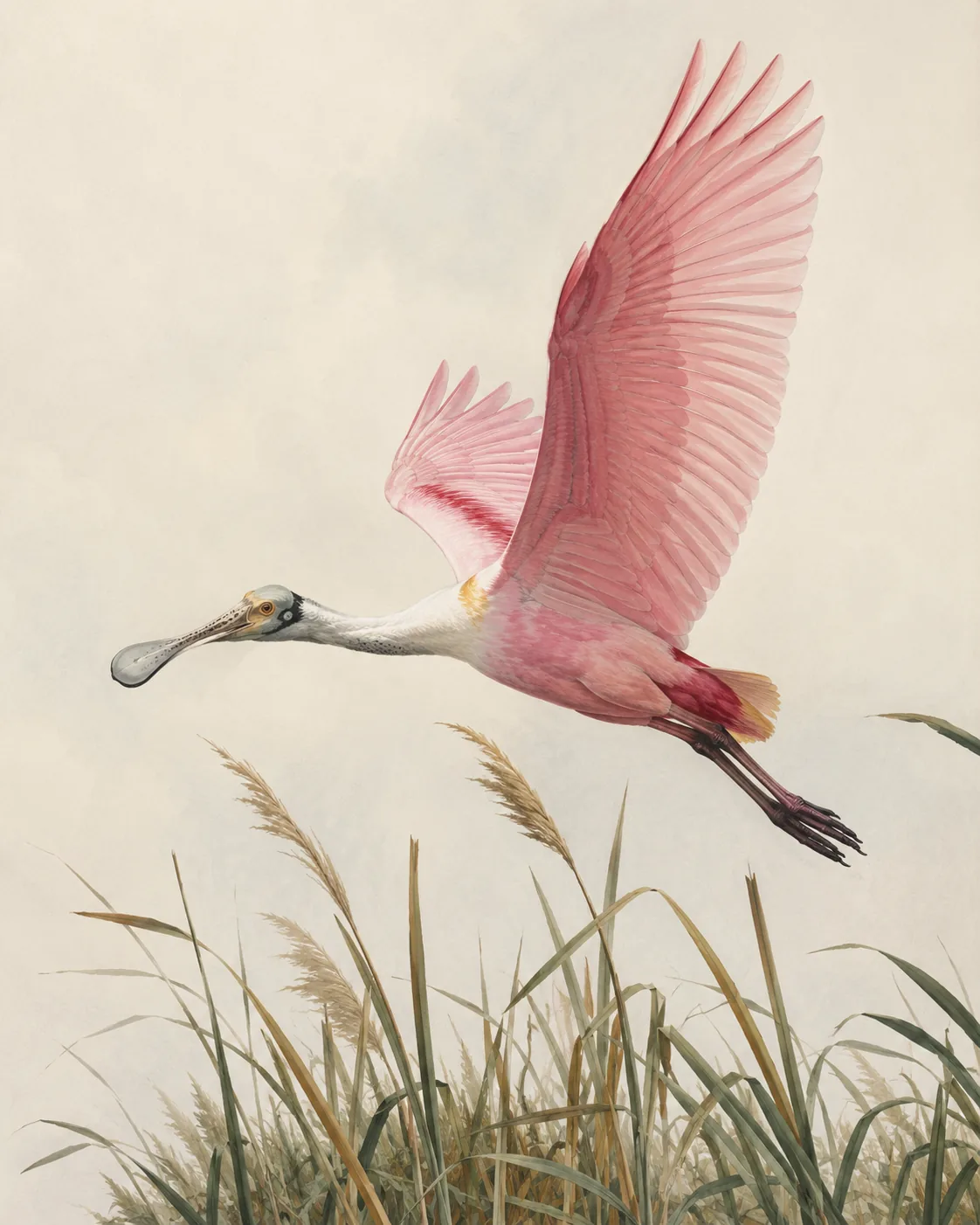
Look for the pink first. It is the only large pink wading bird across most of its range.
The body runs from pale blush to a deep carmine at the shoulder. The wings carry a scarlet patch. The legs are red.
Then look at the head. Adults wear a bare, greenish skin on a pale dome, no feathers at all.
The bill settles it. Long, grey, and flattened into a broad spoon at the tip. Nothing else here shares it.
A tall bird, standing over two and a half feet, with a wingspan that can reach more than four feet in flight.
The pink is not paint. It comes from the food. Crustaceans in the diet carry carotenoids, the same pigments that colour a flamingo, and the bird wears what it eats.
Range and habitat
A bird of warm, shallow, brackish water.
In the United States it holds the Gulf Coast and Florida, with breeding pushing into Texas and Louisiana. From there it spreads down through Central America, across the Caribbean, and deep into South America.
It wants wetlands. Mangroves, coastal lagoons, tidal flats, and the quiet margins of estuaries. Anywhere the water is shallow enough to wade and rich enough to feed.
Behaviour
Watch one feed and the bill makes sense.
The spoonbill walks slowly through shallow water with its bill held open and partly submerged. It swings the head side to side, sweeping that spoon through the mud. When it touches prey, small fish, shrimp, insects, the bill snaps shut.
It feeds by feel, not by sight, which lets it work murky water and low light.
They are social birds. They feed in loose groups and nest in colonies, often shoulder to shoulder with herons, egrets, and ibises in the trees above the water.
In flight the neck is held straight out, not tucked, with slow steady wingbeats. A line of them crossing a sunset is a sight you do not forget.
Voice
A quiet bird, for the most part. At the nest and in the colony it gives a low, rolling, grunting croak. Soft, guttural, easy to miss under the louder calls of its neighbours.