Field Guide
Long-tailed Tit
In a Sheffield woodland in early spring, a male Long-tailed Tit carries a single feather across 200 metres of bare oak canopy. He has done this more than 1,000 times already this season. He will do it another 500 times before the nest is finished. He does not know that a sparrowhawk will take the nest in three weeks. He carries the feather anyway.
This is the bird the British hedgerow has quietly been arranged around. Aegithalos caudatus - the long-tailed tit - is smaller than a wren but louder than a wood pigeon at close range, a resident of every county in Britain and Ireland except the highest Scottish peaks, and the subject of one of the most rigorous studies of cooperative bird behaviour ever conducted in the UK. The thesis here is a simple one: this is a bird whose family life is more interesting than its field marks, and whose field marks are already arresting.
Appearance
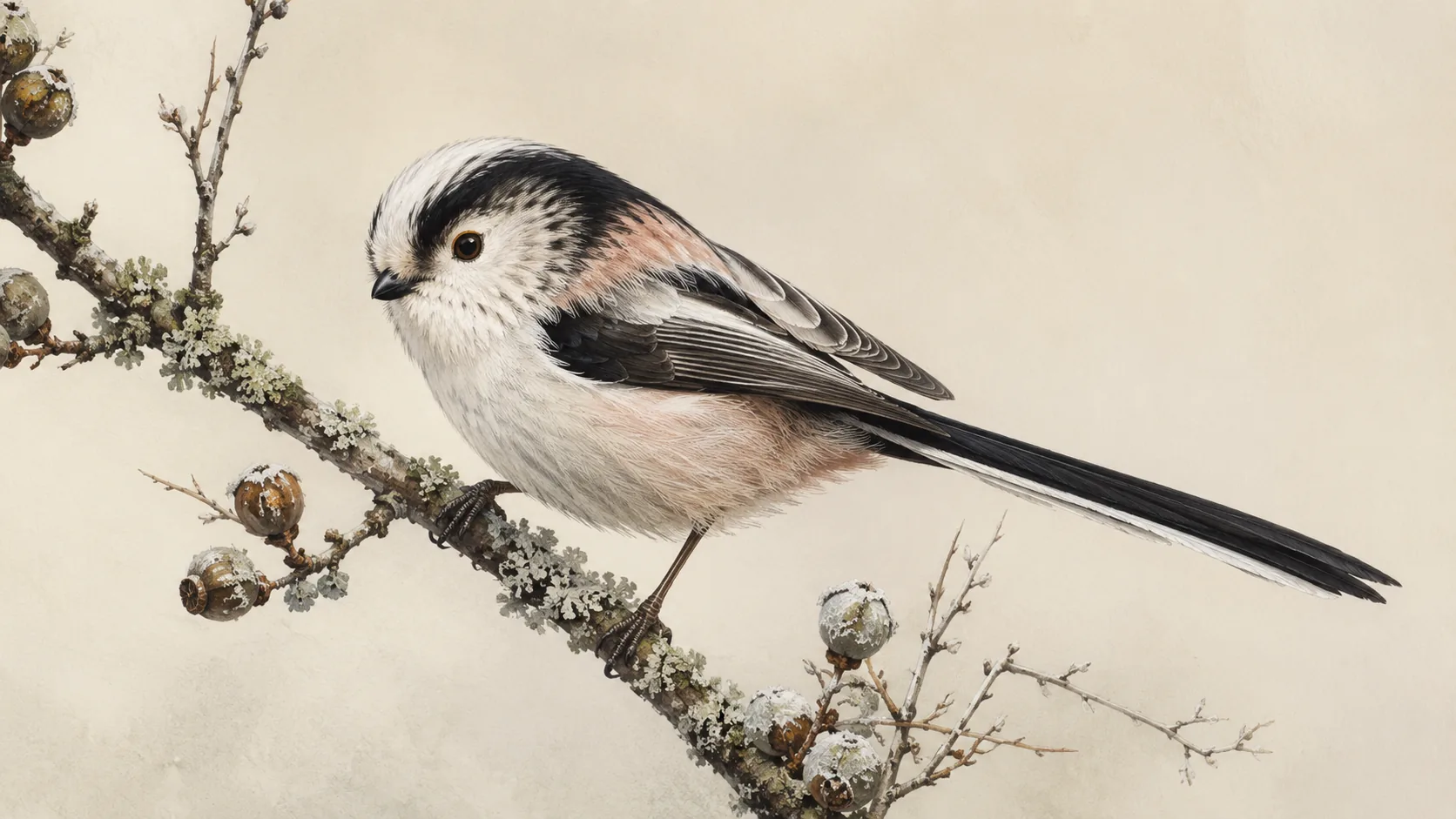
The long-tailed tit is 13 to 15 centimetres from bill to tail tip, and roughly half of that length is tail. The body itself - round, pink-washed, white-bellied, with a white head crossed by bold black eye-stripes - sits at the end of the tail like an afterthought. Weight runs seven to nine grams. In the hand it is the weight of a few coins. In the field it looks improbable.
Adults show blush pink on the breast, scapulars, and eye-ring; the wings and back carry pink and buff alongside deep black. The outermost tail feathers are edged white. Males and females look identical. Juveniles are duller, with browner tails and no pink flush, and are sometimes mistaken for a different species when they appear in late summer flocks.
The flight is distinctive: a series of rapid wing-beats followed by a brief undulating glide, then rapid wing-beats again. In woodland it looks like a small, frantic pendulum. The tail catches the eye well before the bird itself is identifiable.
Voice
The long-tailed tit is one of the most vocal small birds in the British landscape, and the easiest to locate by ear in leafy cover. The primary contact call is a rapid, high-pitched trisyllabic ripple - usually written as si-si-si or tsee-tsee-tsee - that flocks emit almost continuously as they move. A second call, a soft churring tupp, functions as a closer-range cohesion signal. These calls work together as a moving-flock tracking system: the louder ripple places the group in the landscape, the churred tupp keeps individuals in contact within the canopy.
The song itself is thin and not widely studied. The calls are the functional language of the species.
Range and habitat across the year
The British Trust for Ornithology’s bird atlas records the long-tailed tit present in 78 per cent of all 10-kilometre squares across Britain and Ireland during the breeding season, making it one of the most widely distributed resident passerines in these islands. Its range has expanded northward in recent decades, reaching areas of northern Scotland previously unoccupied.
Habitat in the breeding season centres on deciduous and mixed woodland with dense understorey: hawthorn hedges, bramble tangles, scrubby woodland edge, and overgrown gardens. The nest requires a sheltered fork - typically in gorse, blackthorn, or a low branch - and the surrounding landscape must supply both spiders’ webs (for the nest’s elastic outer shell) and a generous scatter of lichen (for camouflage). After nesting, in late summer, family groups merge into the large, roving winter flocks that are many birders’ first close encounter with the species. These flocks often travel with blue tits, great tits, treecreepers, and goldcrests in loose, mixed-species associations, working a given woodland section methodically before moving on.
Diet
The long-tailed tit feeds almost entirely on small invertebrates gleaned from bark and leaf surfaces: moth eggs, spiders, aphids, caterpillars, and small beetles. It forages acrobatically, hanging upside-down from the thinnest branch tips to reach food that heavier species cannot access. In winter, when invertebrate densities collapse, it supplements this diet at garden feeders - suet and peanuts are both taken - but it remains primarily insectivorous. Seed-eating, despite its close association in the field with seed-eating tits, is a minor component of the diet.
Breeding and the nest
The nest is one of the most architecturally ambitious structures built by any British bird. Both adults work from mid-February onward, weaving a domed oval from moss, lichen, and spider silk. The spider silk is load-bearing: it gives the nest its elasticity, allowing the structure to expand as the chicks grow. The outside is plastered with lichen for camouflage. The inside is lined with feathers - the BTO and multiple published accounts agree on an average between 1,500 and 2,000 individual feathers, each carried singly to the site from across the surrounding woodland. A completed nest is a small, dense, warm chamber no larger than a human fist.
Clutch size runs from six to 12 eggs. The chicks hatch in April, and both parents provision them intensively.
Nest predation is the defining pressure on the species. The BTO’s long-running research in the Rivelin Valley, Sheffield - which has tracked a population of roughly 100 breeding adults since 1994 - records predator-caused failure in approximately 72 per cent of all nests. Most of those failures happen before the chicks fledge.
The cooperative turn
What happens after a nest fails is where the long-tailed tit becomes genuinely extraordinary.
A male whose nest has been taken by a sparrowhawk or a jay does not simply wait out the rest of the season. If the failure occurs after late April - too late to start again - a proportion of failed breeders, predominantly males, locate a relative’s active nest and begin feeding those chicks as auxiliary helpers. They receive no direct parental credit. They raise no genetic copies of themselves. They expend energy that costs them measurably in survival probability.
In 2014, Ben Hatchwell, Philippa Gullett, and Mark Adams published a study in the Philosophical Transactions of the Royal Society B testing whether this behaviour satisfied Hamilton’s rule - the inequality that predicts altruism when indirect fitness gains outweigh direct costs. Their finding, built on the Sheffield population data, was that it does. Each helper increased offspring recruitment by roughly 6 per cent. The helpers were almost invariably related to the male parent at the nest they chose to assist - nephews and brothers, not random pairs - which meant the genetic return was real, if indirect. The cost, a statistically significant reduction in helper survival, was real too. The arithmetic came out in favour of helping.
Approximately half of all long-tailed tit broods in the Sheffield study had helpers. Becoming a helper also predicted higher survival the following year. The causal chain is not fully understood, but the pattern is consistent: the birds that redirect their effort into a relative’s nest do better, in aggregate, than those that do not.
Winter roosting
On cold nights, long-tailed tits roost communally. Extended family groups huddle together in a tight, horizontal row along a sheltered branch, each bird pressed against the next for warmth. The RSPB records clusters of up to 20 individuals using this behaviour. At the scale of the individual bird - nine grams, enormous surface-area-to-volume ratio, no fat reserves to speak of - a cold January night without the warmth of the group is a genuine survival problem. The roosting clusters are not decorative. They are how the species gets through winter.
What the nest means
The long-tailed tit is often mentioned as a garden bird, a feeder visitor, a cheering flash of pink and white in January. Those things are true. The deeper truth is that it is a bird whose entire social architecture - the cooperative breeding, the family-group winter ranges, the roosting clusters - is a set of solutions to a specific problem: how to survive at nine grams in a temperate climate with a nest that most predators find in three weeks.
The IUCN lists Aegithalos caudatus as Least Concern, with a large and stable Eurasian range. The UK population is Green listed. The bird is not at risk. What it is, instead, is a small argument for paying attention to small things: the single feather carried across the winter canopy, the failed breeder turning up at a nephew’s nest, the roosting row of 20 bodies pressed together against the January dark.
The long-tailed tit builds its nest from other birds’ feathers. When that nest fails, it finds another nest to tend. There is a logic in this that exceeds the bird.