Field Guide
White-tailed Ptarmigan
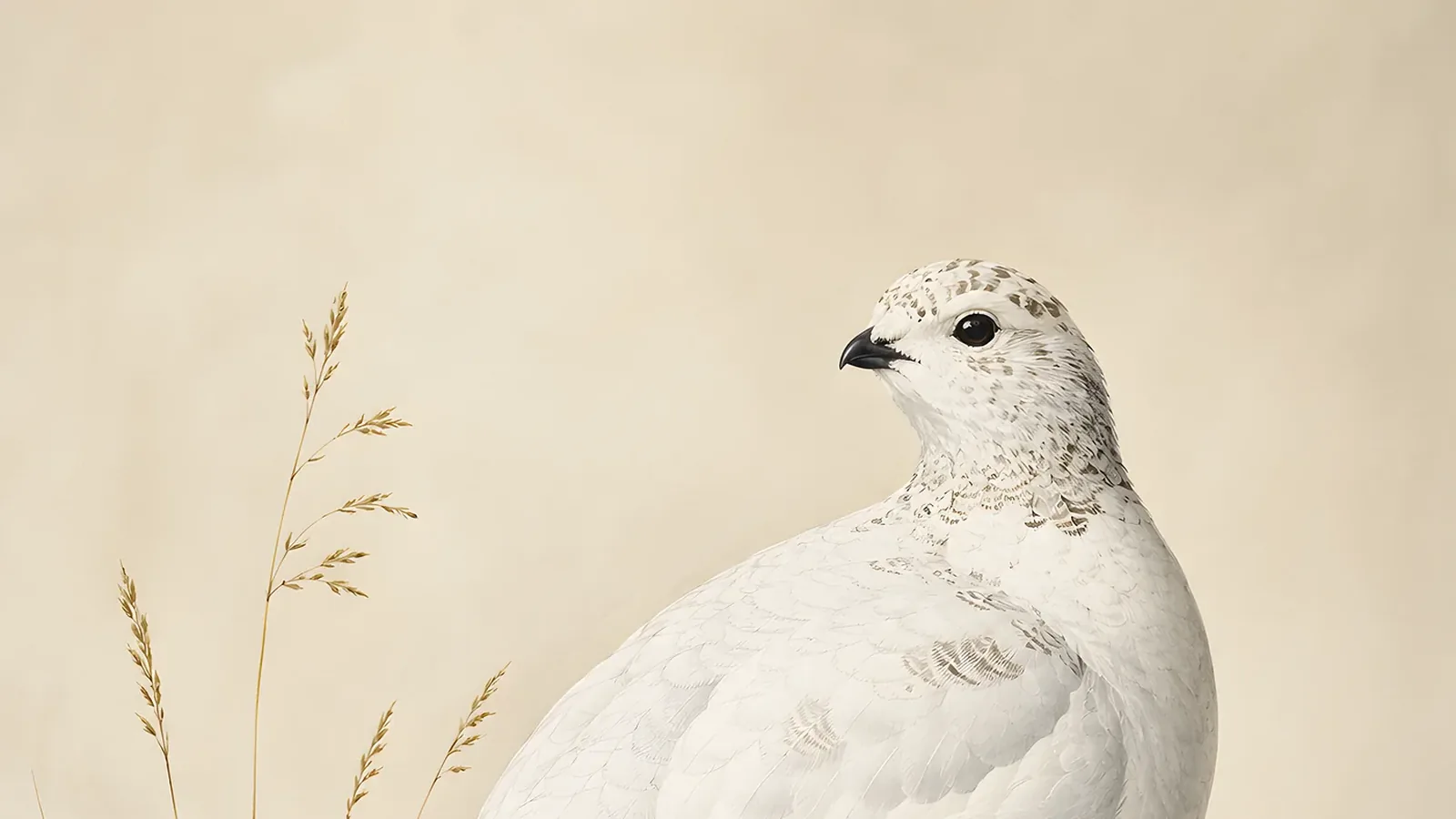
The snowfield looks empty. Wind has scoured the surface to a smooth crust, and the ridgeline above treeline in the Colorado high country offers nothing moving, nothing warm. Then one piece of snow tilts its head. Lagopus leucura - the White-tailed Ptarmigan - has been sitting four feet from you the whole time, a bird so thoroughly converted to winter that the gap between the animal and the element has ceased to exist.
This is the smallest grouse in North America. It is also the only ptarmigan that lives year-round in the lower 48 states. It does not migrate south when the alpine tundra locks under snow. It does not drop below treeline to shelter in the spruce. It stays, at elevation, in the cold, and it does so by becoming, in every meaningful sense, part of the snow itself.
The thesis of this bird is simple and unnerving: it has refined itself so perfectly to a single, high, cold place that there is no backup plan. As that place warms upward, the ptarmigan has nowhere warmer-proof to go.
What it looks like
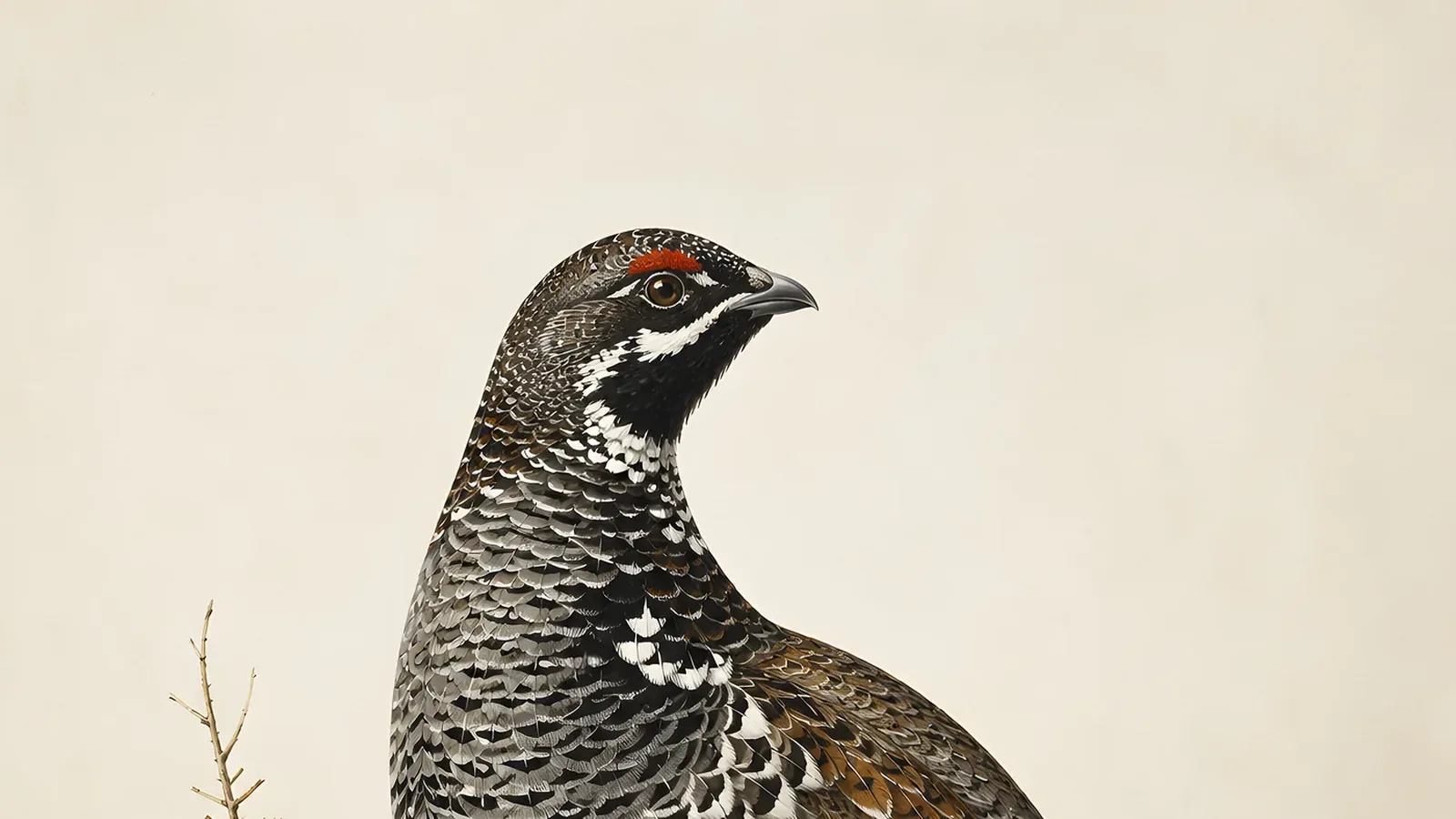
Lagopus leucura runs 30 to 34 centimetres in length, weighs between 345 and 425 grams, and spans 56 to 61 centimetres wing-tip to wing-tip. That puts it well below the spruce grouse in size - closer in mass to a large pigeon than to the blocky upland birds most people picture when they think of grouse. Males and females are close in size, with males only marginally larger.
The name points to the one feature that stays constant all year: white tail feathers. Every other ptarmigan species - Willow and Rock among them - has black rectrices that show through the winter plumage. Lagopus leucura has none. Every feather in that tail is white, summer or winter, and that fact alone identifies the bird when all other markings shift.
In summer, the bird is heavily mottled: brown, buff, and black across the back and flanks, with white showing on the wings and belly, and that clean white tail anchoring the rear. Males display a red eye comb above the eye, most vivid in the breeding season. Females are browner, more uniformly barred, built for invisibility on the nest.
| Measurement | Range |
|---|---|
| Body length | 30 - 34 cm |
| Weight | 345 - 425 g |
| Wingspan | 56 - 61 cm |
| Lifespan (wild) | 3 - 4 years (longevity record 15 years) |
Turning white
Between late September and November, Lagopus leucura moults completely. The mottled summer plumage falls out and is replaced by feathers so uniformly white that the bird, sitting still on a snowfield, is effectively invisible to human eyes and, presumably, to most of the hawks and owls hunting the ridge.
This transformation is triggered by photoperiod - shortening days initiate the change regardless of whether snow has arrived. The bird does not wait to see the weather. It trusts the calendar, which has been reliable across this species’ evolutionary history. The reverse moult - back to mottled brown - runs from late April through October, a process that spans eight months of the year and means the bird is almost always in some phase of feather replacement.
One thing does not change: that tail. Through every moult, across every season, the rectrices stay white. They are the one constant in a coat built for flux.
Built for snow
“Ptarmigan grow feathers on the bottoms of their feet that both insulate and increase surface area, acting like built-in snowshoes.”
- National Park Service, Rocky Mountain
The feet of Lagopus leucura are feathered to the toes. Dense plumage on the soles functions as insulation against snow and cold rock, and it increases the surface area of each foot by an estimated 40 percent - enough to let the bird walk across soft snow without postholing through. The name Lagopus means “hare-footed” in Greek, a reference to exactly this feature. The sharp-tailed grouse grows pectinations - rigid comb-like projections on the toes - as a winter adaptation, but the ptarmigan’s solution is more thorough: full feathering across the entire base of the foot.
When temperatures drop far enough, the bird does not simply roost in a tree or crouch against a rock. It digs. Snow burrows - sometimes shallow depressions, sometimes tunnels a foot deep - provide thermal insulation against wind and cold that the surface cannot offer. A snow burrow holds a temperature near zero Celsius even when outside air drops to minus 30. The bird enters at dusk, closes the tunnel behind it with a slight settling of snow, and spends the night in what is effectively a white sleeping bag made of frozen water.
What it eats
Winter diet is almost entirely willow. The alpine willows - Salix planifolia and Salix brachycarpa grow low and wind-swept above treeline, and their buds and twigs project above the snowpack just far enough to be reachable on foot. Lagopus leucura walks the snowfield during daylight hours, nipping these buds methodically, then retreats to a snow roost by dusk. Birch catkins, alder, and sedge supplement the diet when available, and the bird swallows grit from exposed rocky areas to grind this fibrous material in the gizzard.
Chicks eat differently. In the first three weeks after hatch, young ptarmigan rely heavily on insects - flies, beetles, spiders found in the low alpine vegetation - to fuel rapid growth. After that window closes, they shift to the adult plant-based diet and begin to resemble miniature versions of their parents by late summer.
Adults are not dietary generalists. They cannot fall back on seeds or grain. The mountain’s specific offerings - willows above the snow, willow buds where the shrubs poke through - are what this bird is built to eat, and what the bird requires those shrubs to continue providing.
Range and the warming tops
Lagopus leucura is the only member of its genus found south of Canada in the contiguous United States. Its range runs from south-central Alaska south through the Coast Ranges and Rocky Mountains, dropping as far as northern New Mexico in the highest peaks. In Washington, a distinct subspecies - Lagopus leucura rainierensis - occupies the volcanic summits of the Cascades. The Mount Rainier subspecies was listed as Threatened under the Endangered Species Act in August 2024, reflecting the isolation and small size of that population. A southern subspecies, L. l. altipetens, holds the Colorado and New Mexico populations.
The core threat is not hunting or direct human disturbance - though mining, all-terrain vehicles, and ski development all affect habitat. The core threat is elevation itself. Lagopus leucura is an alpine-obligate species. It cannot live below treeline. As temperatures rise, the zone of suitable alpine tundra shrinks upward. The mountains are finite. At some elevation they simply end, and there is no higher place to go.
Jackson, Gergel, and Martin (2015, PLOS One) modelling Vancouver Island White-tailed Ptarmigan found that suitable summer habitat could decline by 44 percent by the 2050s and 56 percent by the 2080s under lower emissions scenarios, with mean patch size shrinking by 52 to 79 percent. Remaining habitat concentrates toward single mountain summits - individual birds on individual peaks, cut off from adjacent populations by valleys too warm to cross.
Wann, Aldridge, and Braun (2016, PLOS One) tracked 45 years of breeding data from two Colorado populations and found that growing degree days at the study sites have warmed significantly, with mean hatch dates advancing roughly four days per decade at one site. The birds are tracking the warming - shifting breeding earlier - but whether that tracking can stay pace with the rate of change remains an open question.
Zimmerman and colleagues (2020, Heredity) found evidence of local adaptation across the species’ range, with populations diverging along gradients of elevation, snowmelt timing, and plant community composition. That local adaptation is a conservation complication: southern populations may lack the genetic variation to shift upward because they are already at the top, and they are adapted to exactly where they live - not to somewhere else.
Breeding
Breeding begins in late May or early June as snow begins to melt from the ridge tops. Males establish territories and court females with low runs, head movements, and strident cackling calls - higher and more clucking than the booming leks of larger grouse species. Voice overall is quiet relative to body size: the Audubon field guide describes it as “high-pitched creaking notes and soft low clucks.”
The nest is a scrape on the ground, placed near taller willow growth for cover, lined with feathers and plant material. The female lays four to eight pale, faintly spotted eggs and incubates alone for 22 to 26 days. Chicks are precocial - they leave the nest within hours of hatching and begin foraging almost immediately, with the female brooding them at night and during cold weather.
Fledging happens at ten to twelve days, a fast timeline necessary because the alpine summer is brief and the window before autumn snow narrows every year. Males take no role in incubation or brooding. Annual survival rates in Colorado populations run around 44 percent for females and 59 percent for males. Predation by raptors accounts for the majority of adult mortality (Wann et al., 2014, Population Ecology).
The species is nominally monogamous, with pairs remaining bonded for several months. Second clutches are occasionally attempted if the first fails.
The elegance of Lagopus leucura is inseparable from its danger. An animal that becomes snow is an animal staked entirely to the continuation of snow. The birds on Trail Ridge Road in Rocky Mountain National Park, the birds on the volcanic summits of the Cascades, the birds that have been working the same willow patches above the same ridgelines since before any written record - they are not adaptable generalists hedging their bets across a continent. They are specialists at the top of a mountain, in a warming world, with no mountain above them.
The ptarmigan does not know this. It still turns white in November. It still digs its snow burrow at dusk and waits through the cold with the patience of something that has always done exactly this. The question is not whether the bird is capable. The question is whether the snow will be there to turn into.