Field Guide
Spruce Grouse
A hen Canachites canadensis stands at the base of a black spruce in a Maine bog and watches you approach. She does not flush. She moves, with unhurried steps, four metres to one side, and resumes looking. At three metres she is still not alarmed. At two, she tilts her head. You could pick her up.
This is the Spruce Grouse - the bird biologists and old-time woodsmen called the “fool hen.” The name sounds like an insult. It is actually a description of a species that evolved without land predators fast enough to close the gap before a grouse could step out of the way. It has calibrated its threshold of alarm to a world without people with guns. The calibration was correct for a long time. It still is, across most of its range. The Spruce Grouse is not stupid. It is finely tuned to a different set of threats.
Its real strategy - the one that earns attention - is what it does in winter.
What it looks like
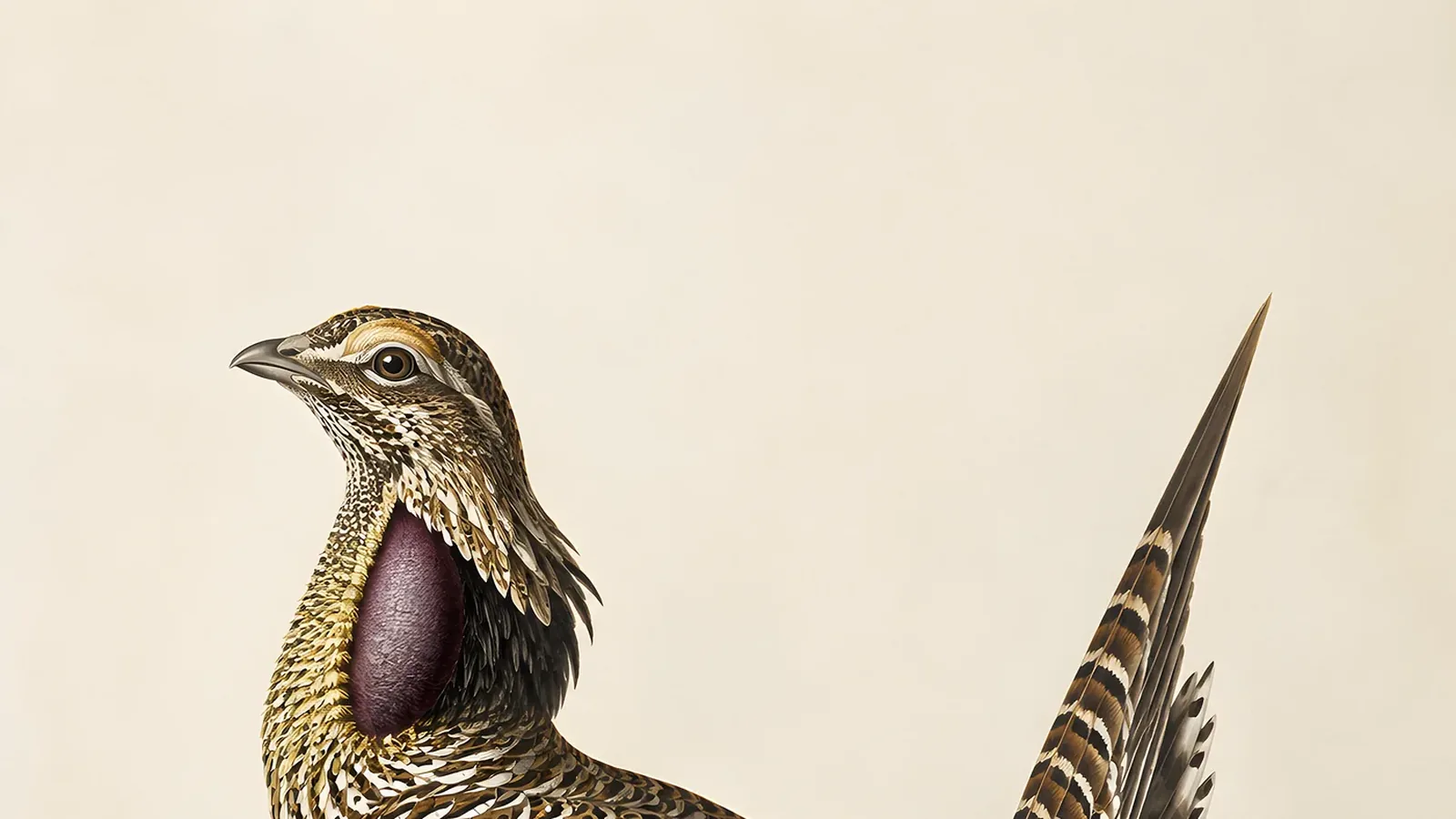
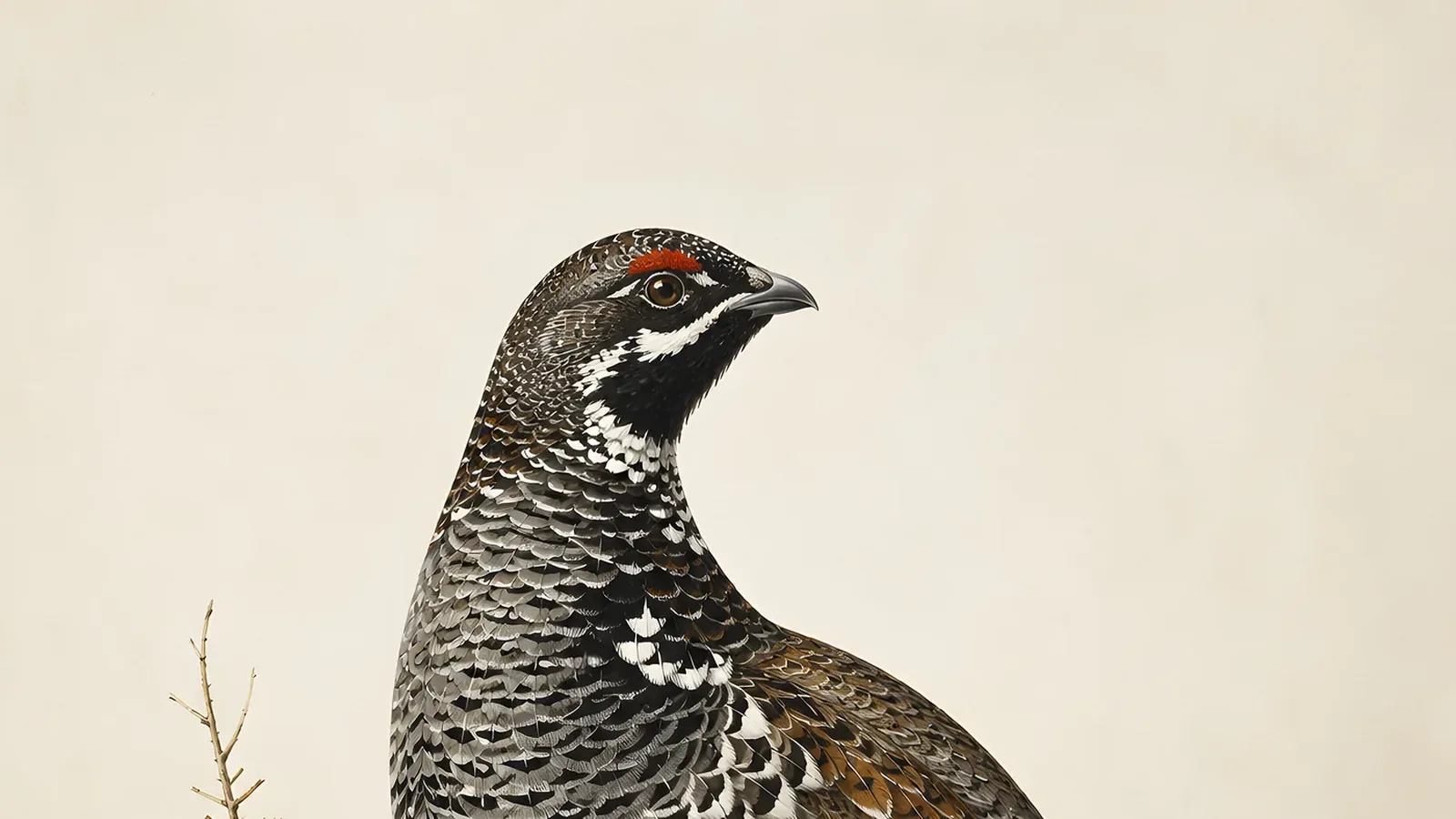
The male runs 38 to 45 centimetres long and weighs 550 to 650 grams. He is dressed for invisibility in a forest of dark trunks and grey-green needles. His throat and breast are black, each feather trimmed with a narrow white edge that gives the dark mass a scaled texture. His back and wings are a soft grey-brown barred and vermiculated in black and white. His tail is dark, often with a rust-coloured terminal band. Above each eye sits a small comb of bare red skin that flushes brighter during display. The cumulative effect is a bird that disappears against bark.
The hen is different in kind, not just degree. She is reddish-brown or grey-brown, heavily barred across the breast and flanks, with black-and-white patterning on the head and underparts that reads as dead fern fronds at any distance over a metre. Her tail is shorter and darker than the male’s. On a ground nest in spruce duff she is genuinely invisible.
Both sexes are compact and short-necked. The feet are partially feathered in winter - a practical adaptation for walking on snow crust - and the toes develop small projections, called pectinations, that function like snowshoes. The Spruce Grouse is built for a particular kind of cold.
| Measurement | Male | Female |
|---|---|---|
| Length | 40-45 cm | 38-42 cm |
| Weight | 550-650 g | 450-550 g |
| Wingspan | 55-63 cm | 55-60 cm |
| Eye comb | Prominent red | Absent |
| Tail | Dark with rust tip | Dark, barred |
A winter of needles
From November through March, the Spruce Grouse eats almost nothing but conifer needles - jack pine and black spruce in most of the boreal range, lodgepole pine in the west, white spruce and tamarack filling the gaps. The diet is, by conventional nutritional standards, wretched. Conifer needles are low in protein, high in terpenes and resin acids toxic to most birds, and extraordinarily difficult to digest. The Spruce Grouse has solved all three problems.
The solution begins in the gut. B. A. Pendergast and D. A. Boag, writing in The Auk in 1973, documented seasonal changes in the internal anatomy of Alberta Spruce Grouse that amount to a complete winter reconfiguration. The gizzard - the muscular stomach that grinds food - enlarges by roughly 75 percent from its summer size. The caeca, the paired blind-ended extensions of the large intestine where microbial fermentation occurs, grow by approximately 40 percent. The combined effect is a digestive engine built to run on spruce needles, dismantled and rebuilt each year.
A Spruce Grouse can carry up to 45 cubic centimetres of needles in its crop at the end of the day - about 10 percent of its body mass. It forages for a few hours each morning, loads the crop, then retreats to the cover of a dense spruce or the insulation of a snow roost for the remaining 20-plus hours of the winter day.
“In the snow-free summer, they forage on the ground, eating fresh greenery, insects, and berries. In winter, they live up in the trees, eating nothing but conifer needles.”
- BirdNote / Cornell Lab of Ornithology
The strategy is stark. Abandon the calorie-rich food entirely. Shift your anatomy to process the one thing available in unlimited quantity. Wait for spring.
The fool hen
The tameness that earned the bird its nickname has been observed and documented across the full range of Canachites canadensis. Hunters and naturalists working the boreal have noted for two centuries that Spruce Grouse can sometimes be knocked from branches with sticks. The Animal Diversity Web account from the University of Michigan notes that flushed birds may “move only several feet from their capturers before beginning to forage again.” The bird reacts normally to hawks and owls - it is not slow, and it is not unobservant. What it lacks is a learned aversion to large terrestrial mammals approaching on two legs.
This is a meaningful distinction. The boreal forest that Spruce Grouse have occupied for thousands of years had wolves, bears, foxes, and mink - all predators that trigger a strong evasive response. Large bipedal predators were absent, or nearly so, across much of the range until relatively recently. The Spruce Grouse simply has not updated its threat model. In Maine, where hunting is now closed for the species, this works fine. In areas where hunting pressure is heavier, the same trust is a liability.
The bird is also, outside of breeding season, a solitary animal. It does not flock. It holds a small territory - males defend 10 to 15 acres of spruce forest - and moves little over the course of the year. It is a stay-put bird in a stay-put forest. Its entire life is vertical: summer foraging at ground level on berries and insects, winter foraging in the mid-crown of conifers, overnight roosts burrowed into snow. It rarely appears on open ground.
What it sounds like
The Spruce Grouse is not a vocal bird by grouse standards. The male produces a low, rolling call - a series of short krrk krrk notes, described by the Audubon Field Guide (Kenn Kaufman, 1996) as “the lowest-pitched vocal sound of any North American bird.” It carries only a short distance through dense spruce cover, consistent with a bird holding a small, discrete territory in a forest that dampens sound.
The female’s vocabulary is simpler still - soft clucking notes used to warn chicks and, occasionally, as an alarm. She is mostly silent outside the breeding season. Compared to a sharp-tailed grouse performing its full spring display on a lek, the Spruce Grouse is a quiet bird in a quiet place.
The male does, however, display. During the breeding season he struts with red combs erect, fans his tail, and raises the scaled feathers of his breast. The Franklin’s subspecies (C. c. franklinii) of the Pacific Northwest adds a wing-clap display in which the male strikes his wingtips together over his back during a near-vertical flutter-flight - two sharp cracks audible up to 150 metres away. The Taiga subspecies (C. c. canadensis), which covers most of the range, uses the flutter-flight without the audible clap. Both are territorial advertisements. Both are dramatic by the understated standards of this species.
Range and habitat
The Spruce Grouse is a boreal specialist. It occupies a band of coniferous forest stretching from Alaska across all Canadian provinces to Newfoundland, dipping south into the northern tier of US states - the Upper Peninsula of Michigan, the Adirondacks of New York, the forests of Vermont, New Hampshire, and Maine, and the northern Rocky Mountains through Idaho and Montana. It is non-migratory. A bird banded in Alberta will likely die within a few kilometres of where it was caught.
Habitat requirements are narrow: dense conifer stands with low canopy access, preferably black spruce and jack pine in the east, lodgepole pine in the west. The ideal Michigan habitat, as the Michigan Natural Features Inventory describes it, is black spruce mixed with jack pine, scattered openings, and decaying logs - a specific structural description that could serve as a field identification tool for the habitat itself. The Spruce Grouse is not found in hardwood forests. It is not found in open country. It is found where the conifer canopy is thick enough that a bird standing inside it is invisible from above.
Populations at the southern edge of the range - New York, Vermont, Wisconsin, Michigan - are listed as Endangered, Threatened, or Species of Special Concern at the state level, reflecting the fragmentation and reduction of boreal habitat at its margins. The global IUCN Red List assessment is Least Concern (LC), reflecting the large, stable population across the intact Canadian boreal.
Breeding
Courtship begins in April. The male selects a display area within his territory - a low branch or a clear piece of ground - and performs his flutter-flight and tail-fanning until a female accepts him. Mating is promiscuous. The male takes no part in incubation or chick-rearing.
The female scrapes a shallow nest in spruce duff, lining it with dry needles and leaves, typically concealed under a low spruce branch or against a log. She lays four to eight eggs - averaging close to five in most populations - pale buff with sparse brown spotting. Incubation runs 21 to 25 days. The female alone broods.
Chicks are precocial - mobile within hours, foraging for arthropods almost immediately. In their first week they eat almost nothing but insects. By October they are clipping conifer needles like adults, and by November the annual transformation of their digestive anatomy has begun. They will be sexually mature by the following spring. A bird that reaches its first autumn in good condition may live five to seven years under normal circumstances. The oldest banded birds in long-term Alberta studies reached 13 years - unusual, but not impossible for a bird with few natural enemies fast enough to catch it.
The Spruce Grouse is the bird that found a different answer to the problem of winter. Not migration, not starvation, not cache-and-retrieve. It rebuilt its own digestion, climbed into the spruce, and ate what was there. The needle-eater. The fool hen that will not flush. It has been standing in the black-spruce bogs of the boreal for a very long time, watching people approach, calculating whether to take four steps to the left.
Usually, it decides four steps is enough.