Field Guide
Sharp-tailed Grouse
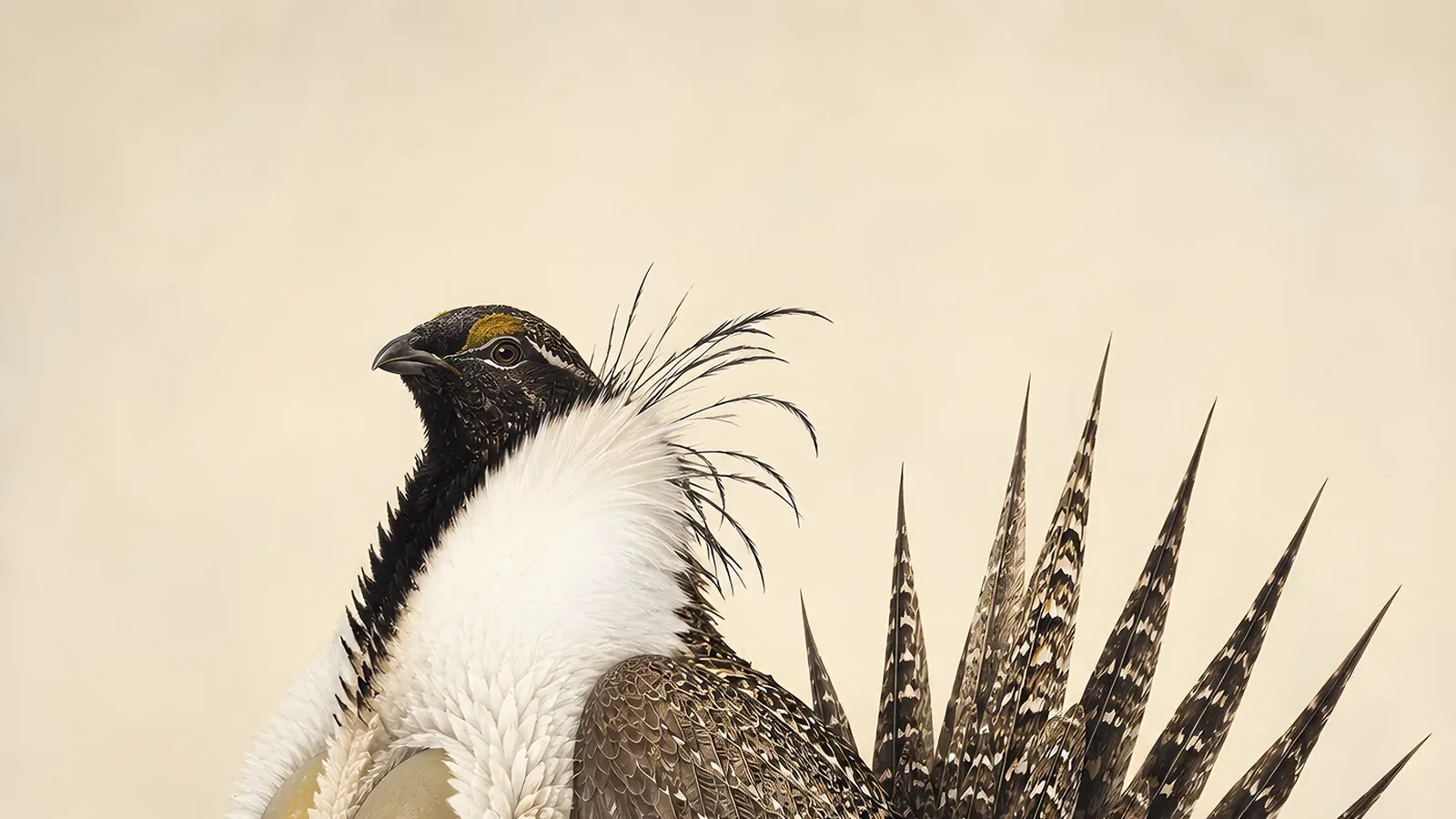
Before first light on an April morning in North Dakota, a dozen males are already on the dancing ground. They arrived in darkness. Each holds a small patch of grazed turf no bigger than a kitchen table, and when the sky turns from black to the colour of iron, they begin. Wings out, stiff and cupped downward. Tail cocked straight up, the two long central feathers pointing at the sky. Head dropped low and pressed forward. Feet hammering the ground at close to 20 beats per second, the whole body driven forward in a short arc before the bird spins, resettle, and starts again. The violet air sacs at the sides of the neck inflate and deflate. The yellow combs above the eyes flush bright. The rattling of stiff tail feathers carries across the open grass.
Tympanuchus phasianellus - the Sharp-tailed Grouse - has been performing this dance on the same patches of ground, year after year, longer than anyone alive has been watching.
What it looks like
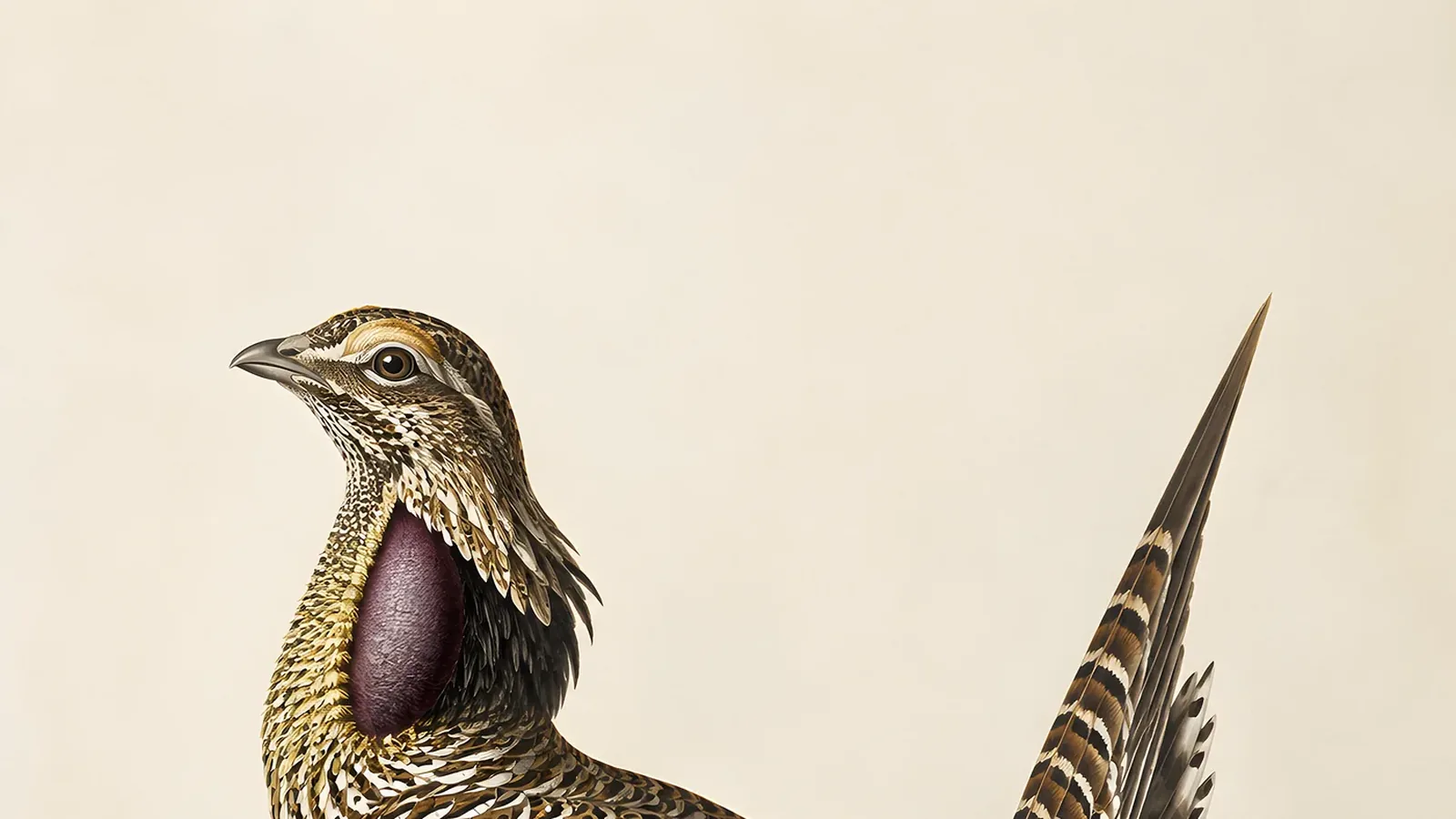
The Sharp-tailed Grouse is a compact, short-necked bird, 41 to 47 centimetres long and weighing between 596 and 1,031 grams. The male is larger than the female and the difference is visible in the field. Plumage on both sexes is brown and buff, heavily patterned with dark brown chevrons, white spots, and pale shaft-streaks that create a cryptic broken pattern on the back, breast, and flanks. The belly is white. The tail is the field mark: two central feathers project past the rest as a short, stiff point - not a fan, not a square, but a spike. No other prairie grouse has this shape.
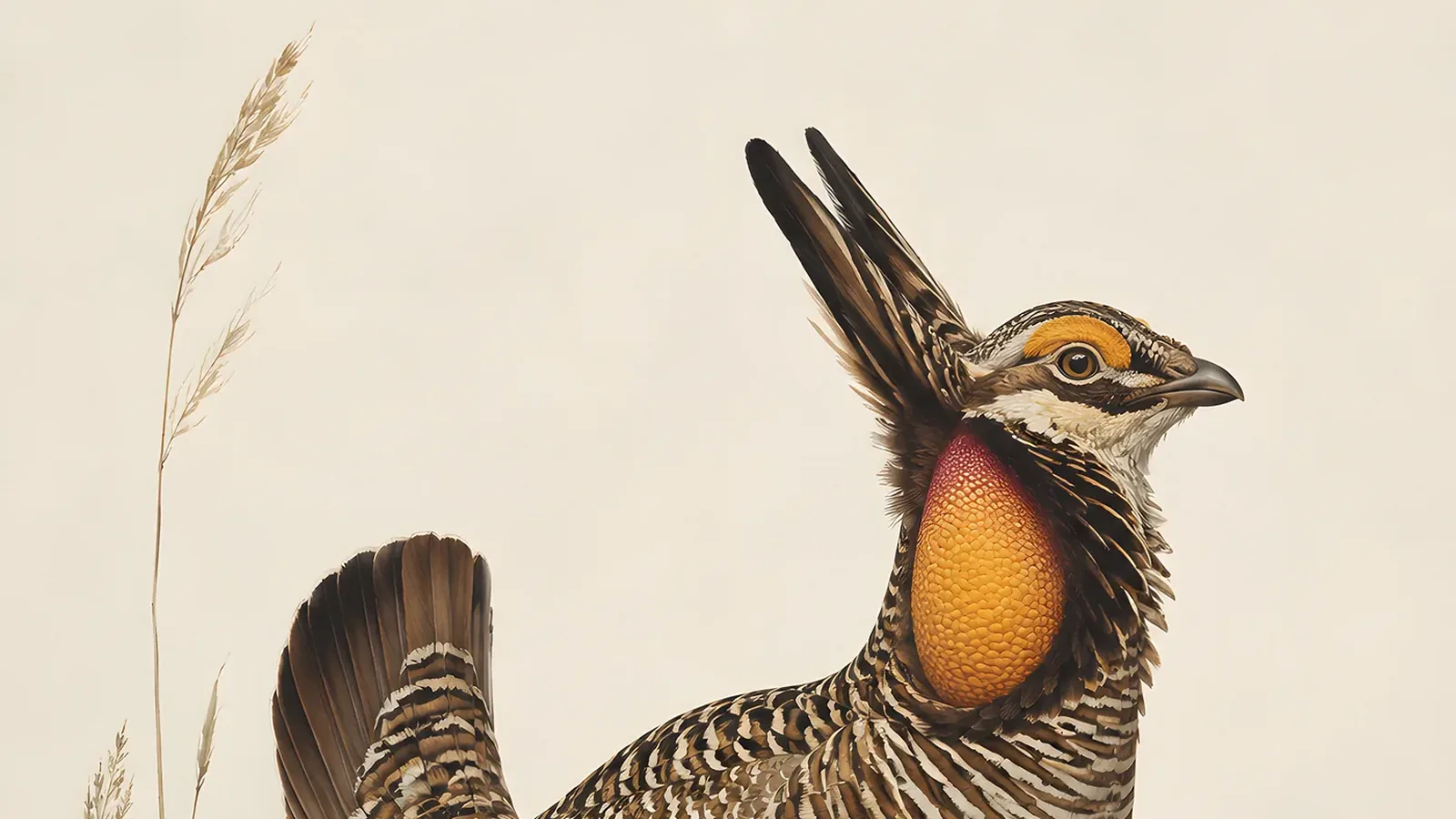
The male carries the display equipment. The yellow comb above each eye is a fold of bare skin that thickens and brightens during the breeding season. The violet neck patches are pouches of bare skin over the esophagus. When inflated during lek display they swell into rounded purple discs that stand out sharply against the brown of the breast. The greater prairie chicken has orange-yellow neck sacs. The Sharp-tailed’s purple is unambiguous once you know to look for it.
In flight the bird shows white outer tail feathers and a distinctive flickering wingbeat - rapid, shallow, interspersed with short glides.
| Feature | Sharp-tailed Grouse | Greater Prairie-Chicken |
|---|---|---|
| Tail shape | Short spike (two long central feathers) | Short, rounded, square |
| Neck sac colour | Purple-violet | Orange-yellow |
| Range (northern limit) | Alaska and Yukon | Southern Manitoba |
| Winter diet | Buds from shrubs and trees | Grain, forbs |
| Habitat tolerance | Grassland, shrubland, open forest | Tallgrass and mixed-grass prairie |
The dance
The lek is not a random gathering. It is a fixed site - often the same half-hectare of short turf, a hilltop or a grazed knoll - used year after year, sometimes for decades. Males return to the same territory within the lek each spring, and the hierarchy holds: older, dominant males hold central territories, where females prefer to mate. Peripheral males display with equal intensity and far less success. Connelly, Gratson, and Reese, writing in The Birds of North America (1998), recorded that the majority of matings at any given lek are concentrated among the two or three males at the centre.
The foot-stamping rate - documented at approximately 20 beats per second - is among the fastest sustained limb movements recorded in any bird during courtship display. The sound is an audible rapid pattering, more like a drumroll than individual footfalls.
Display begins just before dawn and continues until mid-morning. A second, shorter session occurs near dusk. Females move through the lek, observing, and eventually crouch to solicit a central male. Copulation is brief. The female leaves immediately to nest. The male returns to his display.
Males do not fight as much as they posture. Confrontations between neighbouring territory-holders involve a brief rush at the boundary, wings spread, tail raised, and combs flared - then both birds stop at the line and begin displaying again. The lek functions as theatre as much as combat.
What it sounds like
The courtship coo is a soft, low double note, around 300 to 340 hertz, audible for a moderate distance but not carrying the way a prairie-chicken’s booming does. The cooing is aimed at females moving through the lek. Connelly et al. (1998) identified six distinct vocalizations: a low coo (male-to-female), a crackle (threat), a cork (female acceptance signal), a chilk (distraction call), a gobble (territorial), and a whine used between males at close range. The overall impression at a lek is not the resonant booming of a prairie-chicken but a complex, quieter mix of rattles, coos, and rapid drumming.
In late summer and autumn, the birds call softly in flocks - a clucking contact note that keeps scattered birds in touch across grass and brush.
Range and habitat
The Sharp-tailed Grouse occupies more of North America than any of its prairie-grouse relatives. Its range runs from central Alaska east to western Ontario and Quebec, south through the northern Great Plains into Wyoming, Nebraska, and Kansas, with a separate population in the Great Lakes region. Six subspecies are recognised, each tied to a distinct geography. The Columbian subspecies (T. p. columbianus) holds the furthest west, in British Columbia and the mountain states. It is the most restricted and the most closely watched by conservation agencies.
Habitat use shifts dramatically through the year. In spring and summer, the birds are birds of open ground - native grasslands, shrub-steppe, agricultural grasslands, and the burned or grazed edges of boreal forest. They follow the lek to the nest: females build within two kilometres of the dancing ground, almost always in a patch of moderate grass cover with overhead concealment. After the chicks fledge, family groups move to areas rich in forbs and insects.
Winter changes everything. The Sharp-tailed Grouse moves to stands of shrubs and trees - aspen, willow, birch, rose, and buffaloberry - and feeds almost entirely on buds and catkins. This capacity to switch from a grass-and-seed diet to a woody-browse diet is the key adaptation that lets this species survive at latitudes and in conditions where the Greater Prairie-Chicken cannot persist. Where the two species overlap in the northern Great Plains, the Prairie-Chicken needs tall, continuous grassland, while the Sharp-tailed Grouse can persist in the mosaic of brush, grove, and grassland that cattle ranching and partial settlement have created across much of the region.
Diet
The diet follows the calendar with a reliability that a phenologist could chart. Summer and early autumn mean forbs, seeds, grasshoppers, beetles, and berries - especially chokecherry, buffalo berry, and rose hips. Insects are critical for growing chicks. A brood moved to insect-poor ground in July will suffer. Grain waste in agricultural fields extends the autumn diet for birds near crops. Corn, wheat, and sunflower seeds from harvested fields are heavily used where available.
Once snow covers the ground, the birds shift almost entirely to shrub and tree buds. Aspen, willow, birch, and hawthorn catkins and buds provide the bulk of the winter calories. Birds feeding in aspen groves spend extended periods in the canopy, clipping buds methodically. The comb-like projections - pectinations - that extend from their toes provide grip on icy branches and act as snowshoes when walking on crusted snow.
Breeding and why it persists
Females begin nesting in May. The nest is a shallow scrape, roughly 17 by 20 centimetres and seven centimetres deep, lined with grass, feathers, and available plant material. The average clutch is 12 eggs, olive-buff to pale brown with faint brown speckling. Incubation runs 23 to 25 days and is performed by the female alone. The male plays no role in incubation or chick-rearing, remaining on the lek while the female incubates and broods.
Chicks are precocial. They leave the nest within hours of hatching and can fly weakly within two weeks. The first 12 weeks of life carry the highest mortality. Chicks depend on the hen for warmth and for guidance to insect-rich areas. Survival through the first summer determines year-class strength more than any other factor. Maximum documented lifespan in the wild is 7.5 years, established by Connelly et al. (1998). Most birds that survive their first winter live two to four years.
The species is listed as Least Concern on the IUCN Red List (BirdLife International, 2012), and its overall numbers - while reduced from historical peaks in parts of the southern range - remain substantially higher than those of the Greater Prairie-Chicken across the continent. The reason is not that the Sharp-tailed Grouse is less sensitive to habitat loss. It is that the habitat it needs is less specific. Where the Prairie-Chicken requires the interior of intact tallgrass prairie, the Sharp-tailed Grouse will use a working cattle ranch with aspen bluffs, brushy draws, and enough open ground for a lek. Much of the northern Great Plains still provides exactly that. The bird has outlasted the pure grassland because it was never fully dependent on it.
What the lek asks of the landscape is simple: a patch of short, open ground, visible from a distance, returned to year after year. Destroy that patch, or fragment the surrounding habitat until no birds can reach it, and the lek fails. Keep the ground and the connection, and the birds keep dancing. They have been at it since before there were field guides to record them, and they give every indication of intending to continue.