Field Guide
Varied Thrush
You hear it before you see it. You will almost certainly never see it at all.
A note comes out of the Douglas fir - long, buzzy, held for two or three seconds at a single pitch, then stopping cleanly. The fog absorbs it. Ten seconds of silence. Then a different note, pitched lower, or higher, or off to the left now, impossible to triangulate. The forest does not offer explanations. You stand in the wet understory of an Oregon coast-range hillside, moss on every surface, the light coming from everywhere and nowhere, and the notes keep arriving: unconnected, unhurried, each one complete in itself and seemingly unaware of the others. This is the Varied Thrush. This is what it does.
The sound is not a song in any conventional sense. There is no melody, no development, no repetition. There is only the phrase, the silence, and then another phrase at a pitch chosen, apparently, at random from the registers the bird commands. People hearing it for the first time in winter neighborhoods on the Pacific slope regularly describe it as electronic - a transformer humming, a cell tower glitching, something that does not belong to the natural world. That mistake is itself a piece of data. The Varied Thrush sounds like nothing you have learned to expect from a bird.
What it looks like
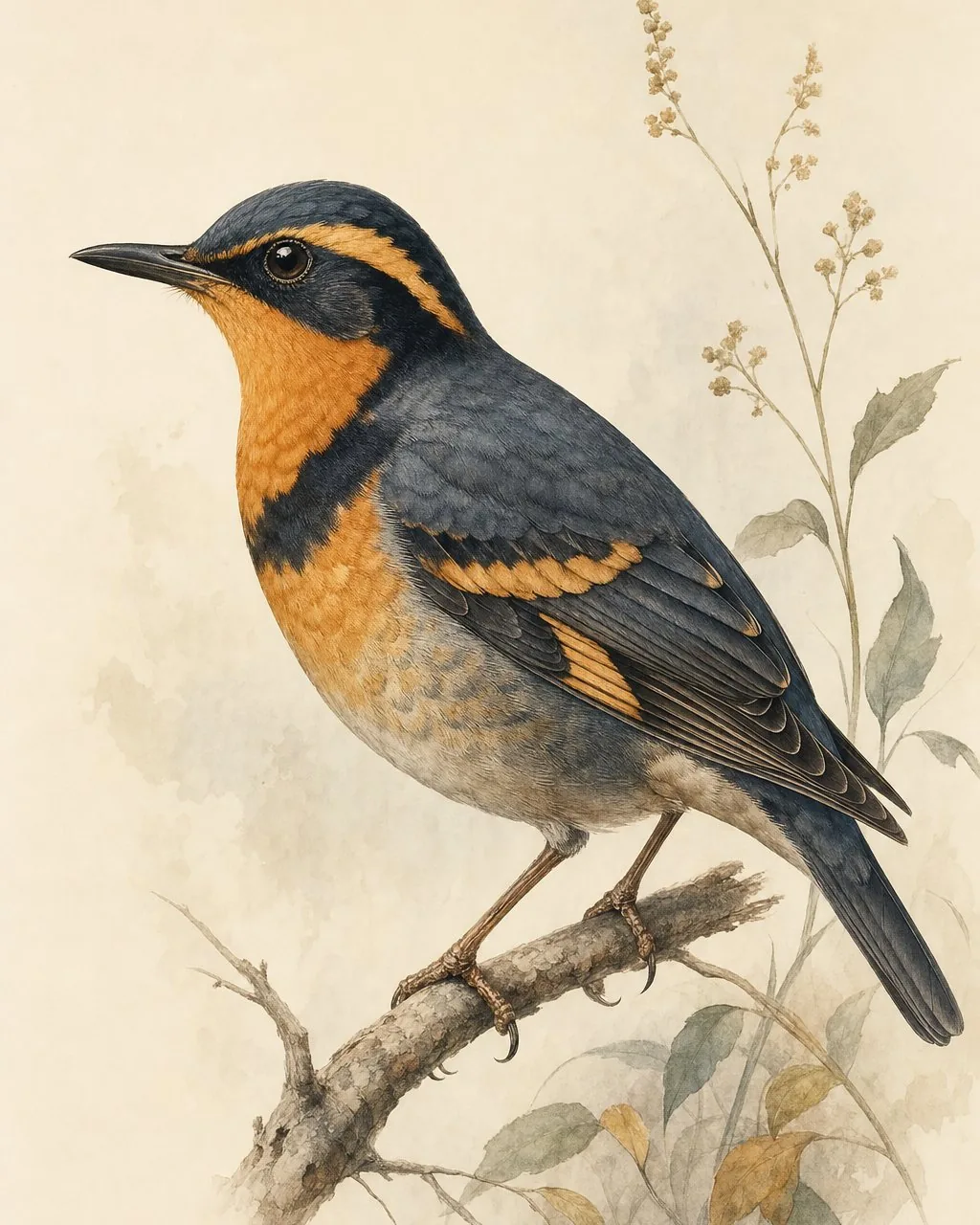
The Varied Thrush is a robin-sized bird - 23 to 26 centimeters long, weighing between 65 and 100 grams, with a wingspan of 33 to 37 centimeters. The family resemblance to the American Robin is clear enough that the two are sometimes confused at a glance. But hold the image still and the differences accumulate.
The breast is orange, yes. But it is cut across by a wide dark breast band - slate-blue in males, gray-brown in females - that runs cleanly from side to side at mid-chest. The robin’s orange sweeps uninterrupted from chin to belly. The Varied Thrush’s is stopped, divided, interrupted by that band as if the painter changed plans halfway down. Above the breast, the face carries a black mask in males: a broad, solid bar across the lores and ear coverts. The crown and back are slate-blue, cold and clean. The undertail coverts are white.
Then the wing. Orange bars cross the wing coverts, and orange edgings mark the flight feathers in a pattern that looks less like field marks and more like deliberate decoration. An orange supercilium runs above the eye, a precise stripe from bill to nape. The overall effect - slate-blue above, orange and black below, orange accents on the wing and face - is a bird that looks like it was assembled by someone who had been told what a robin looked like but had never actually seen one.
Females are duller throughout. The mask becomes a soft gray-brown smudge rather than a clean black field. The breast band fades. The orange is warm but subdued. First-year birds of both sexes begin life resembling females and acquire the male’s sharp definition through their first winter molt.
| Feature | Adult male | Adult female |
|---|---|---|
| Crown and back | Slate-blue | Gray-brown |
| Face mask | Black | Gray-brown, diffuse |
| Breast band | Slate-blue, solid | Gray-brown, faint |
| Breast color | Bright orange | Duller orange-buff |
| Wing bars | Orange, two distinct bars | Orange, less vivid |
| Supercilium | Orange, bold | Orange, muted |
| Flanks | Gray | Brown-gray |
The hermit thrush is the only common West Coast thrush likely to be confused with the Varied Thrush from behind - both are medium-sized and mostly dark-backed in forest light. From the front there is no confusion. The hermit thrush is spotted below, not banded, and lacks orange entirely.
The voice
This is the heart of the account, so it deserves room.
The Varied Thrush’s call note is a soft, brief pip. It is the song that requires attention and keeps it. The song is a single sustained whistle, delivered in one long exhalation, without ornament, without change of pitch within the phrase, without vibrato. Depending on the individual and the moment, it can be slightly buzzy or more purely flute-like, but it is always held on one pitch and always single. Duration runs from roughly two to three seconds. Then nothing. The silence lasts five to fifteen seconds, sometimes longer. Then the next note, at a completely different pitch, with no audible relationship to the one before.
No pattern emerges because there is no pattern. Field ornithologists who have spent seasons in the range listening for structure have not found reliable sequencing rules in the pitch choices. Each phrase appears to be independent. The bird is not building toward something. It is not developing a theme. It is not even repeating itself in the way that most songbirds use repetition to establish territory - the repetition is there, in the sense that the bird sings the same type of phrase for hours, but not in any particular pitch or sequence.
The sound carries through dense forest the way few bird sounds do. Audubon warblers and chickadees make a racket nearby and you barely notice them. One Varied Thrush note at four hundred meters stops you mid-step. The physics of this are real: a sustained single-frequency tone in the two-to-four kilohertz range travels cleanly through wet conifer forest, losing relatively little energy to the bark and needle interference that breaks up more complex, broadband songs. The bird’s voice is acoustically adapted to its habitat in the same way a foghorn is adapted to water.
Singing males perch high in conifers, typically near or at the top, largely invisible. The song apparently emerges from empty sky. You can spend twenty minutes looking directly at the tree the sound is coming from and never pick the bird out of the canopy. It is a large thrush. It weighs close to a hundred grams. It simply does not move while singing, and the forest canopy is not flat.
There is something about a single long note held in fog-wet air, followed by silence, that operates on a person differently than a melody does. A melody gives you something to follow. A resolved tune provides the satisfaction of completion. The Varied Thrush note completes nothing, implies nothing, resolves nothing. It arrives. It ends. The silence that follows is not an absence - it is what the note opens. You wait for the next one. You always wait for the next one.
Range and habitat
The Varied Thrush is a bird of old-growth and mature conifer forest on the Pacific slope of North America. Its summer range runs from the coast ranges and Cascades of northern California north through Oregon, Washington, British Columbia, and into southeastern Alaska, with outlying populations in the interior mountains. The heart of its year-round range is the wet coast-range forest: Douglas fir, Sitka spruce, western hemlock, Pacific silver fir. Forests that rarely dry out, where moss grows on the branches, where the light in June is still dim at noon under a full canopy.
The bird does not require old-growth exclusively, but it prefers it. Mature forest with a complex canopy structure, dense understory, and a wet floor provides the combination of high singing perches and ground-foraging opportunities the species uses. Clearcut and young plantation forest hold far lower densities. The Varied Thrush is, in that way, an indicator of the old forest’s continuing existence.
In winter, birds move to lower elevations but largely remain within the Pacific coastal zone. They come down into suburban gardens and parks, into riparian corridors, into neighborhoods where berry-bearing shrubs grow. This is when most people see one, or rather, when most people hear one singing from a neighbor’s Douglas fir in January fog and stand puzzled in the street.
The winter irruption years are a different phenomenon. In some autumns, perhaps tied to food availability in the breeding range, Varied Thrushes move far east of their normal distribution - well past the Cascades, past the Rockies, into the Great Plains and beyond. In an irruption winter, individual Varied Thrushes have been recorded in most eastern states and Canadian provinces. They appear at feeders stocked for cardinals and juncos: a single bird, alone, far from any other of its kind, feeding quietly on the ground or picking at fallen berries, its orange and slate-blue plumage entirely out of register with every bird sharing the feeder. The eastern birder who finds one has, for a few days or weeks, the Pacific rainforest in their backyard.
Diet
The Varied Thrush is a ground forager through most of the year. It works the forest floor, flipping leaf litter with the bill, running short distances after exposed invertebrates, stopping to listen in the manner of all thrushes. Diet in the breeding season concentrates on invertebrates: earthworms, beetles, caterpillars, ants, spiders, and similar forest-floor prey. In fall and winter, fruit and berries become the primary food: madrone berries, toyon, mistletoe berries, holly, fallen crabapple. The bird swallows fruit whole and is an effective seed disperser for the native plants of the Pacific coastal zone.
At winter feeders, Varied Thrushes will take berries, suet, and occasionally scatter-foraging on the ground for any seeds that have fallen. They rarely come to hanging feeders. The ground is where the food is.
Breeding
Breeding biology is less thoroughly documented than for many thrushes, partly because the Varied Thrush nests in terrain that resists study - dense, wet, steep Pacific coast-range hillsides where access is difficult and visibility is low. What is known establishes a standard thrush pattern with particular details.
The nest is a bulky open cup, typically placed in a conifer 10 to 15 feet off the ground, sometimes higher. The female builds it from twigs, grasses, moss, and mud, with a finer inner lining. She lays two to five eggs - a pale blue-green with fine brown speckling - and incubates them for about two weeks. Both parents feed the nestlings, which fledge at around two weeks of age. Pairs may attempt two broods in years when the season starts early.
Territorial males sing persistently from high perches throughout the breeding season, producing that sequence of independent notes hour after hour through the long Pacific coast-range days of May and June. The relationship between the song and territory defense is inferred rather than closely studied. Other males seem to respond to playback. But the mechanics of what the phrase says, and what its pitch and timing communicate, remain genuinely unresolved.
The irruption bird
A Varied Thrush at an eastern feeder in December is a minor local event. Someone posts a photograph online. The county bird group convenes to see it. It stays for days or weeks, then departs or disappears - returning west, presumably, or not surviving the winter.
There is something quietly affecting about these birds. The Varied Thrush is not a rare species. In a good coastal-range forest in winter it is almost background noise - that repeating tone from the trees, as constant in January Oregon as birdsong gets. But the individual bird at a Connecticut feeder is as far from its context as a bird can be. The Pacific rainforest, the fog, the Douglas fir, the long silence between notes - all of that is months and thousands of kilometers away. The bird forages on the same seeds and fallen berries it would take at home. It does not appear distressed. It simply is, in the wrong place, which is not its frame of reference, only ours.
Whether these irruption birds ever make it back is largely unknown. Most are not banded. The ones that disappear in February or March could be dead, or they could have started moving west. The continent does not keep those records.
Alone in a wet forest
There is a specific quality to standing in a mature Oregon coast-range forest in January, or a hemlock draw on the Washington coast in April, when a Varied Thrush begins to sing.
It is not beauty in any easy sense. The notes are not pretty the way a warbler’s notes are pretty. They do not cascade or develop or resolve. They ask nothing of you in the way that a melody asks you to follow it to the end. Each note simply presents itself, fully formed, complete in itself, unrelated to what came before or after, and then the forest takes it.
What the note does is open the silence. After twenty seconds of it you are no longer listening to ambient forest noise. You are listening to the gap between one phrase and the next, and the gap is attentive, weighted, something you are inside rather than observing. The fog sits in the branches. The needles drip. You realize you have stopped moving and are not going to start again until the next note comes, and when it comes, from forty meters to the left now, pitched differently, it does not resolve what the previous one started. It simply starts again.
No other bird in the Pacific Northwest does quite this to a person. The hermit thrush at dusk is more conventionally beautiful, more developed, more satisfying in the musical sense. The Varied Thrush is not trying for satisfaction. It is trying for something else, and the something else is harder to name than beauty, and probably older.
The Varied Thrush’s single sustained note in fog-thick forest is not a melody and not a communication in any sense we can decipher. It is a fact about the world, repeated at intervals, in a slightly different key each time. Standing in the understory waiting for the next one, you understand that some facts cannot be improved by context.