Field Guide
Northern Hawk Owl
At the very tip of a lone black spruce, in the middle of an afternoon, a bird the size of a pigeon sits with a long tapering tail angled downward and its head working in short, precise arcs. Nothing about it says owl. The posture is alert, almost aggressive. The silhouette - pointed wings held close, narrow body, tail - belongs to a Merlin or a small falcon. Then it launches. The flight is fast and direct, low over the snow, and it pulls up into an arc that resolves into a strike. It has killed a vole it detected from somewhere across the clearing, by sight alone, in full daylight.
Surnia ulula, the Northern Hawk Owl. The only owl in a genus entirely its own, and one of the strangest animals in the boreal forest.
What it looks like
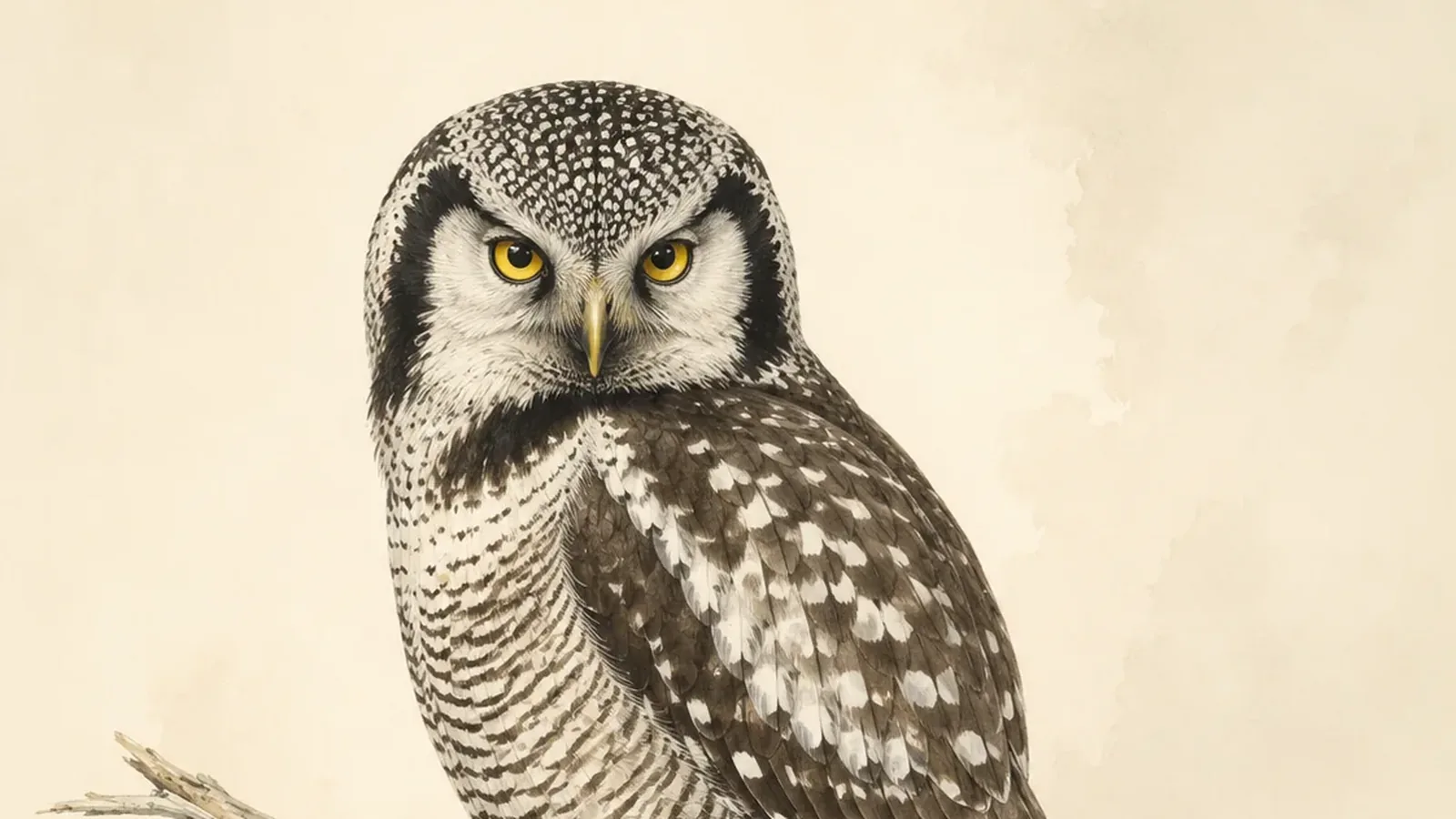
The Northern Hawk Owl is a medium-sized owl that barely reads as an owl at all. Length runs 36 to 45 centimetres, weight from roughly 270 grams in smaller males to about 440 grams in large females, and wingspan 74 to 84 centimetres (Audubon Society Field Guide). The bill is short and yellow. The eyes are yellow. The tail - this is the feature that stops you - is long for any owl, and narrow, and it is held at a downward angle when the bird is perched, exactly the way an Accipiter holds its tail.
The face disc is present but underdeveloped, a pale oval framed by a bold black border that runs from the cheek down to the sides of the breast, producing a wide black collar that, from the front, looks like a dark ruff. The back is dark chocolate brown, densely spotted with white. The underparts are white or pale buff, crossed by close horizontal brown barring from breast to belly. There are no ear tufts.
In flight the impression is of something between a kestrel and a Cooper’s Hawk. The wingbeats are rapid and shallow, interspersed with brief glides on angled wings, and the bird moves through open forest with the speed and low-level intent of an Accipiter. The posture at rest - perched bolt upright at a spruce tip, tail bobbing occasionally - is a raptor posture, not the hunched, sleepy silhouette of a roosting owl.
| Measurement | Range |
|---|---|
| Length | 36-45 cm |
| Weight | 270-440 g |
| Wingspan | 74-84 cm |
| Clutch size | 5-13 eggs |
| Incubation | 25-30 days |
Males and females carry identical plumage. The female is typically larger - useful information only when a pair stands together.
The owl that hunts like a hawk
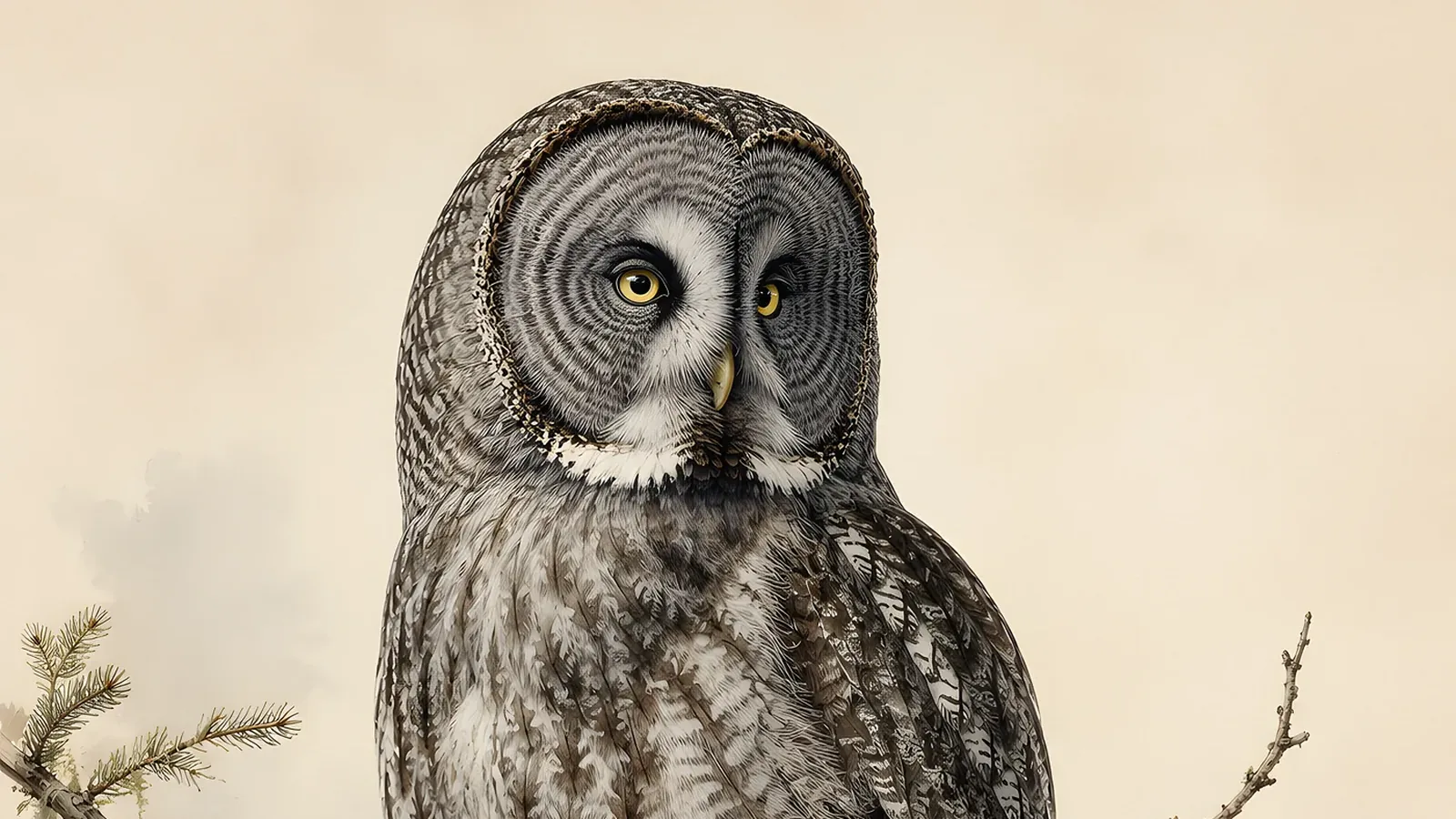
Most owls are built around the ear. The barn owl’s facial disc is a parabolic sound collector. The great gray owl can locate a vole under 45 centimetres of snow by sound alone and needs no visual contact at all. The Northern Hawk Owl went a different direction.
It relies on vision. Its hearing is average by owl standards, its facial disc too small to function as a directional amplifier. What it has instead is exceptional daylight acuity. The Handbook of Birds of the World (del Hoyo et al., 1999, Vol. 5) gives the visual detection range as up to 800 metres for a moving vole - roughly half a mile. A bird perched 15 metres up on a spruce tip therefore commands a hunting circle nearly two kilometres across. It watches, it waits, and when it sees movement it launches.
The hunting method follows directly from this. A Northern Hawk Owl does not quarter low over grass like a Short-eared Owl, hoping to flush something. It sits high and still and looks hard. When it goes, it goes fast - a straight low-level sprint, then a short climbing arc, then the plunge. It will also hover briefly in the kestrel style before dropping. It can penetrate snow to take prey it heard from the surface, but the trigger is more often visual than acoustic.
This is an owl that gave up the dark. It hunts in open boreal clearings at noon. The ear is secondary. The eye does the work.
That shift has consequences for the body plan. The Northern Hawk Owl has longer, pointed wings relative to its size than most owls, better suited to direct sustained flight than the rounded wings that give most owls their silent manoeuvrability in close timber. It is fast. It is conspicuous. And unlike almost every other member of Strigidae, it does not particularly need the night. Audubon’s field guide notes it as “the most diurnal of all owls,” and that is not an overstatement.
Daylight and sight
The boreal forest in summer has no night, and in winter the days are short but the light that exists is bright. An owl built around hearing and darkness would lose much of the year. Surnia ulula solved the problem by becoming, essentially, a raptor in owl’s clothing.
The Alaska Department of Fish and Game records it hunting from dawn to dusk throughout the year, and in the continuous daylight of an Alaskan June, hunting at midnight is the same as hunting at noon. The species does not maintain the secretive roosting habits of most owls. It perches openly at conspicuous heights - the dead top of a spruce at the forest edge is the favourite station - where it can be seen from a long distance and where it can see a long distance. It bobs its tail when alert. It is, in short, easy to find, which is an unusual thing for an owl to be.
This visibility makes it a favourite among birders willing to drive north into open spruce and birch country in Alaska or northern Canada in winter. An owl this conspicuous, hunting in daylight, from the tops of the tallest trees at the edge of a clearing, can be watched for long minutes at a time - something that a nocturnal forest owl rarely allows.
What it sounds like
The voice is surprising. On the breeding grounds, the male produces a prolonged rolling trill - a fast, purring ullululululul that can run for 14 seconds or longer. Cornell Lab’s All About Birds describes the advertising call as resembling the whistle of an American Kestrel, and there is something in that comparison: a fast, carrying, sharp repetition, not the deep resonant hoot of a large owl. The call rolls out across open forest and carries well across clearings.
The female’s calls are shriller and shorter. Both sexes produce a harsh chattering ke-ke-ke-ke when alarmed near the nest - again, more reminiscent of a falcon than an owl. Young birds produce food-begging calls through midsummer.
Away from the breeding grounds the species is largely silent. A wintering Northern Hawk Owl seen in Minnesota or Maine in January will often go hours without uttering a sound.
Range and irruptions
The breeding range is circumpolar boreal forest: Alaska and Canada from the Yukon east through the taiga to Labrador and Newfoundland, and across Eurasia from Scandinavia through Siberia to Kamchatka. Within that vast arc it favours open or semi-open habitat - forest edges, regenerating burns, muskeg bogs, larch and spruce with clearings. The dark closed-canopy spruce-fir forest holds nothing for it. It needs sightlines.
The species is not a true migrant. It does not reliably move south in winter on a predictable schedule. It is nomadic, shifting its range in response to food supply. Voles and lemmings follow a boom-and-bust cycle, and the owl follows the voles. In years when northern prey populations crash, hawks owls move.
A 2022 study by Dale and Sonerud in Oecologia examined irruption dynamics in Fennoscandia across four decades and found that Northern Hawk Owls moved south when rodent populations in northern breeding areas were below median, and that 84 to 90 per cent of recorded irruption birds appeared in exactly those low-rodent years - the push side of a push-pull dynamic. The same study found that upon arrival in lower latitudes, the owls were selective: in years when wood mouse populations were elevated in farmland areas, the owls moved out of boreal forest and took farmland habitat. They tracked food at fine spatial scales, not just making broad south-ward movements.
The practical consequence for North American birders is that this owl is a rare but real winter visitor south of the Canadian border, most often appearing in the Great Lakes region, the upper Midwest, and the northern tier of New England. An irruption winter brings scattered individuals to fence posts and hayfield edges, sitting conspicuously in the open in the manner of small falcons, drawing observers from hours away. The great gray owl and the snowy owl share this irruptive pattern, driven by the same vole-and-lemming arithmetic. What makes the Northern Hawk Owl different is how it behaves when it arrives: upright, conspicuous, hunting at noon.
Breeding
The breeding season begins early, sometimes as early as March in interior Alaska, which places egg-laying ahead of snowmelt. The species nests in natural tree cavities - hollow tops of broken snags, abandoned woodpecker holes, occasionally the old platform nest of a hawk or crow - and makes no attempt to add lining beyond whatever debris is already present.
Clutch size is variable and tracks prey abundance with unusual directness. In a vole-poor year the pair may lay three eggs or skip breeding entirely. In a high-vole year the clutch can reach 13 eggs. Audubon’s field records note that exceptional years have produced clutches even larger. The female incubates alone for 25 to 30 days while the male hunts and delivers food to the nest. Eggs hatch asynchronously, producing chicks of staggered sizes.
Young birds fledge at roughly three to five weeks but remain dependent on adults for food for another several weeks. NPS researchers working in Denali have recorded the transition to full independence at two and a half to three months. One bird can breed in its first year. In a good year, with a high rodent supply and a large clutch, a single pair can produce enough young to populate a wide area. That reproductive flexibility is what makes the boom-and-bust strategy viable.
The IUCN lists Surnia ulula as Least Concern, with an estimated population between 100,000 and 499,999 mature individuals and a stable trend. The boreal forest is under pressure from climate and industrial forestry, and both reduce the open burned-over areas the owl depends on. But the global population is large, the range is vast, and for now the arithmetic still works.
What the Northern Hawk Owl has done, over the long course of its evolution, is bet on a different set of assets than any other owl in the family chose. It bet on vision over hearing, on daylight over dark, on the open boreal clearing over the closed forest. It became, in the structure of its body and the logic of its life, more raptor than owl. That it still nests in cavities, still feeds its young in the owl manner, still carries the compact rounded head and the yellow eyes of the family - these things remind you it is an owl dressed as something else. The disguise is very good. On a spruce tip, in full January light, with the tail angled down and the head moving in short arcs over the snow, only the face gives it away.