Field Guide
Swallow-tailed Kite
Over the swamp forests of Florida, a raptor is cutting arcs no other North American hawk can manage. Elanoides forficatus - the Swallow-tailed Kite - tilts its deeply forked tail nearly ninety degrees, redirects without a wingbeat, and plucks a dragonfly from the air. It does not land to eat. It works the prey with its feet while still airborne, tears it apart, and swallows the pieces in flight. The whole transaction takes seconds. The bird never breaks from its long glide.
That is the argument this species makes with its existence: life can be conducted almost entirely above the ground. No North American raptor has taken that argument further.
What it looks like
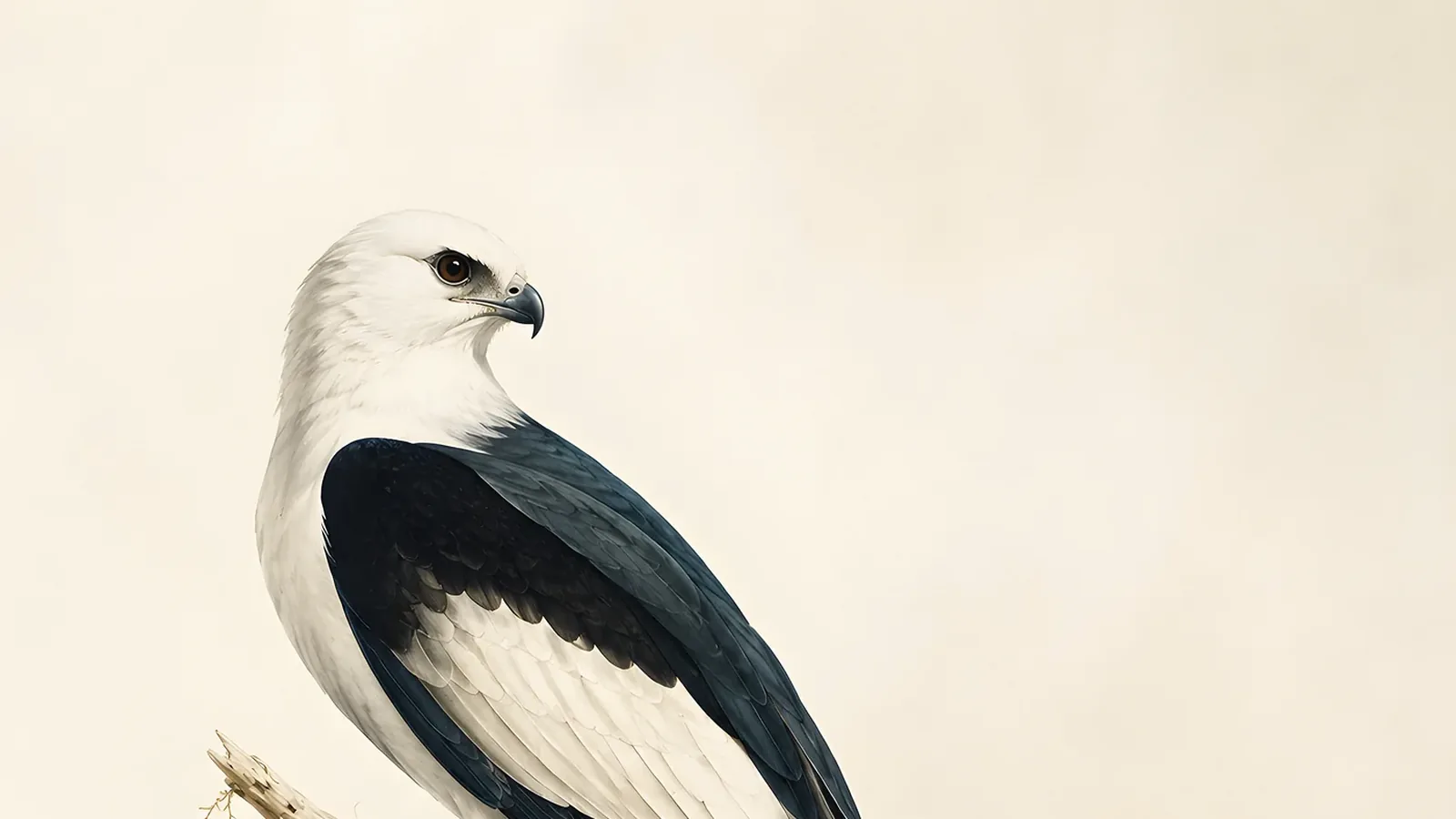
Elanoides forficatus is 50 to 65 centimetres from bill to tail tip, with a wingspan of 114 to 136 centimetres and a body weight that ranges from 310 to around 600 grams - light for a bird that size, which is part of the design. The plumage is one of the sharpest two-tone patterns in North American ornithology: pure white head, neck, and underparts against a back, wings, and deeply forked tail of blue-black. The contrast is exact. There is no streaking, no blurring of the boundary. From below, the white body and wing-linings glow against the dark flight feathers. From above, the black back catches the sun with a slight iridescent sheen.
The tail is the diagnostic feature. It forks for 27 to 37 centimetres - the longest paired streamers on any North American raptor - and the bird uses it constantly as a rudder, angling each lobe independently as it banks and turns. In strong wind the tail closes to a narrow point. In a tight turn it fans open and cranks hard over. Audubon himself described the flight as “exceeding in elegance and grace” anything else he had observed. The field evidence supports him.
Males and females share the same plumage. Juveniles show faint brownish edging to the wing feathers and a slightly shorter tail fork, but the black-and-white pattern is present from fledging.
Everything on the wing
The Swallow-tailed Kite is built for aerial life in a way that goes beyond flight performance. It hunts in the air. It eats in the air. It drinks by skimming the water’s surface at speed, scooping water into its open bill the way a swallow does - the behavior that lends it half its common name. It bathes the same way, making repeated low passes over still water, dipping the breast and spraying up a wake.
Prey is largely taken from vegetation rather than from open air: the kite sweeps low over tree canopy and plucks lizards, tree frogs, small snakes, nestling birds, and large insects directly from branches and leaves without pausing. Meyer (2004, Journal of Raptor Research) documented 1,092 prey items brought to nests in Florida: 56 per cent frogs, 30 per cent birds, and 11 per cent reptiles - a diet that shifts considerably with season and location. Insects dominate when the birds are newly arrived in spring and when foraging in their South American wintering range, where termites, caterpillars, and large flying beetles make up the bulk of prey.
What the kite almost never does is perch to hunt. Coulson (unpublished banding data, 2009) noted that birds on Louisiana breeding grounds would perch only briefly in the early morning, before thermals formed, and spent the balance of daylight hours airborne. The legs are short and relatively weak - this is not an accipiter built to pursue prey through dense cover. It is an aerial predator that solves the problem of perch-hunting by eliminating the perch.
On the wing it bathes, drinks, eats, and courts. The Swallow-tailed Kite lands to sleep and to incubate its eggs, and for little else.
A second aerial behavior worth noting is communal roosting. Through late July and August, before southward migration begins, hundreds of Swallow-tailed Kites concentrate at pre-migration staging roosts in the longleaf pine and cypress country of the Southeast. American Bird Conservancy reports roosts exceeding 1,000 birds at single sites in the Florida Panhandle. For a raptor - a group not noted for gregariousness - this density is extraordinary. The communal assembly appears to serve as a gathering point before the crossing of the Gulf.
What it sounds like
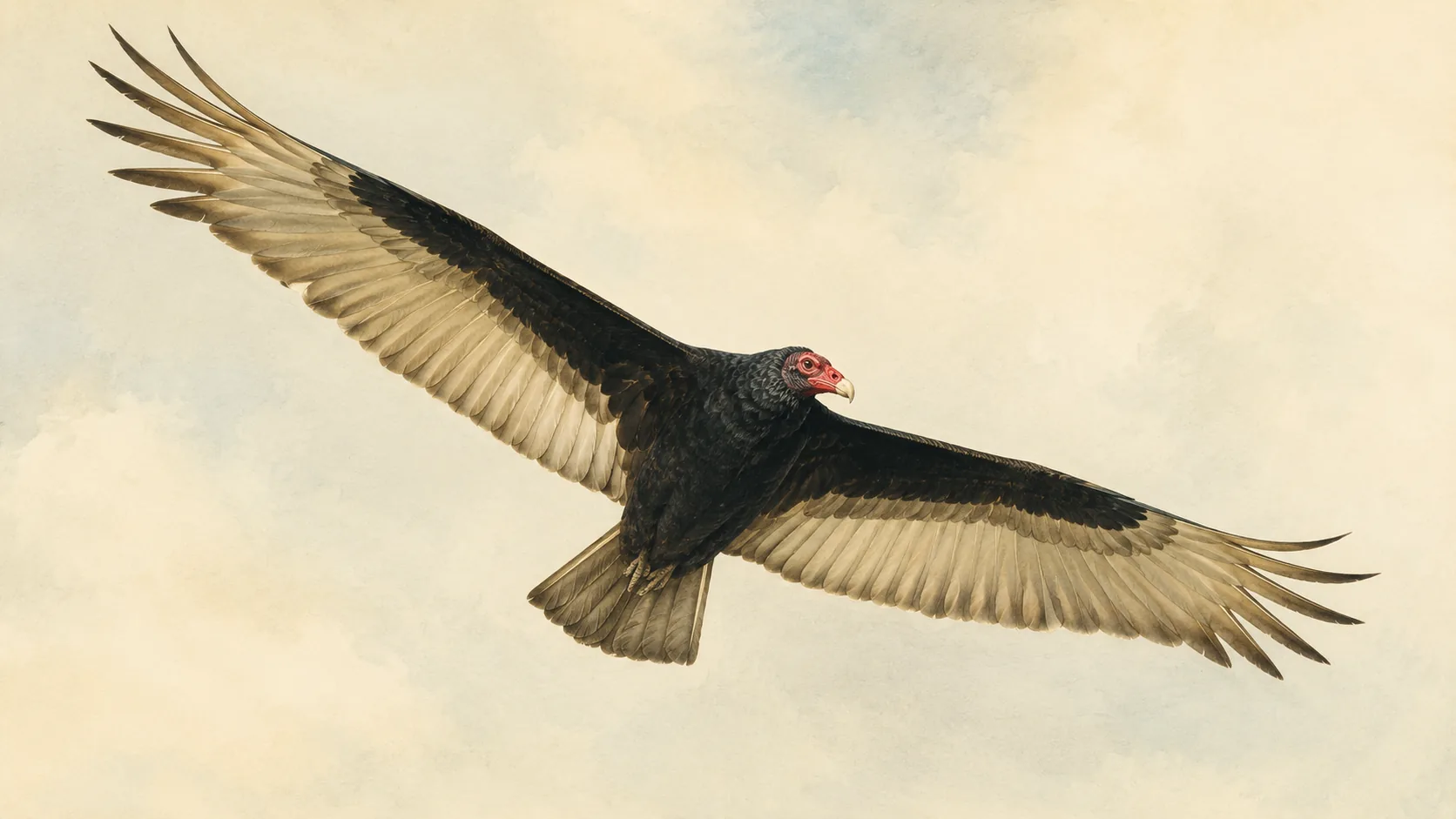
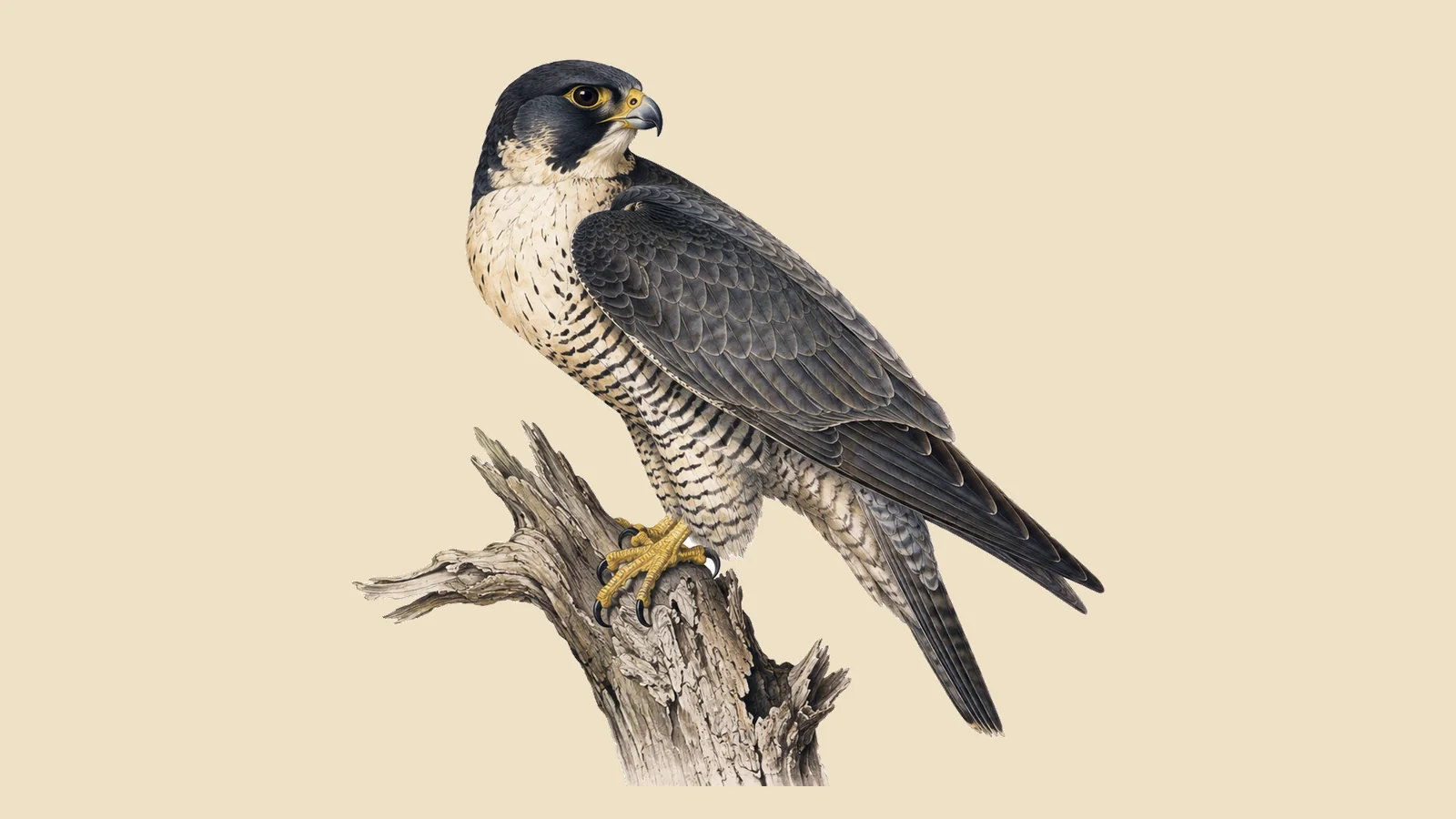
The Swallow-tailed Kite is not a loud bird. The call most often heard on the breeding grounds is a rapid, high-pitched klee-klee-klee, shrill and emphatic, rising slightly on the final note. Pairs exchange thin whistles near the nest. Neither call carries the authority of the turkey vulture’s hiss or the scream of a Peregrine - the kite communicates quickly and softly, often while still moving at speed through the canopy edge.
Range and the ground it lost
The Swallow-tailed Kite once nested in 21 American states. Records from the 1800s place breeding pairs along the Mississippi River drainage as far north as Minnesota and Wisconsin. By 1940, that range had collapsed to seven states along the southeastern coastal plain - Florida, Georgia, South Carolina, North Carolina, Louisiana, Mississippi, and Texas. The contraction was steep: four decades erased most of what had taken millennia to establish.
| Period | Breeding states | Approximate cause |
|---|---|---|
| Pre-1880 | 21 states (MN to FL) | Intact bottomland forest |
| 1880-1940 | Rapid contraction | Logging, swamp drainage, shooting |
| 1940 onward | 7 southeastern states | Permanent range reduction |
| 2000s-present | Modest re-expansion into east TX, LA | Managed forest recovery |
The causes were logging of tall bottomland timber - the trees the kite requires for nesting and roosting - combined with widespread persecution and the drainage of the river-bottom swamps it depended on. The birds were not adapted to hide. Their white-and-black plumage made them easy targets, and their aerial, semi-colonial habits made the impact of shooting cumulative. By the time active killing mostly stopped, the habitat that supported the northern populations was largely gone.
Today the U.S. breeding population is estimated at 7,500 individuals, concentrated in Florida, with smaller numbers in the other six states. The IUCN lists the species as Least Concern (LC) globally because the South American population - where the birds spend seven months of the year - remains large. American Bird Conservancy puts the global total at approximately 260,000 birds. But Least Concern status understates what happened in North America: a range that covered the American interior now fits inside the southeastern coastal strip. The recovery has been slow, limited by the pace at which tall humid forest grows back.
Diet
The prey list is long and reflects the kite’s opportunism: dragonflies, cicadas, wasps, caterpillars, tree frogs, anoles, vine snakes, geckos, nestling songbirds, bird eggs. In South America the birds take considerable fruit, an unusual behavior for a raptor that has no equivalent in their North American season. Gerhardt (2004, Journal of Raptor Research) documented 1,496 prey items at Guatemala nests: 62 per cent insects, 18 per cent nestling birds, and 10 per cent reptiles and amphibians - a different balance from the Florida data, reflecting both latitude and prey availability.
The young are fed differently than the adults eat. Adults hunt insects for themselves in flight. Chicks at the nest receive frogs, lizards, and nestling birds that require more energy to acquire. Both parents provision the nest, and the effort scales sharply in the final weeks before fledging when the young are near full size and consuming at near-adult rates.
Breeding and migration
Swallow-tailed Kites arrive in South Carolina and Florida from late February onward, among the earliest returning raptors in the eastern United States. Nests go up in the crowns of the tallest available trees - emergent longleaf pines, bald cypresses, cottonwoods standing 18 to 40 metres high. The nest is a shallow cup of sticks and Spanish moss, small for a bird this size, woven in the high canopy where the pair has long sight lines in every direction.
Clutch size is typically two eggs, incubated by both parents for 28 to 31 days. Young fledge in 36 to 42 days, and family groups remain loosely associated for some weeks after the chicks leave the nest. The banding record established by Coulson (unpublished data) - a male banded as a nestling in Louisiana on June 2, 2002 and recaptured as a breeding adult on June 25, 2009 - confirms the species lives at least seven years and returns faithfully to within a few kilometres of the natal site.
Migration south begins in late July. The path is one of the longest in North American ornithology: birds funnel south through Florida, cross more than 800 kilometres of open Gulf of Mexico to the Yucatan Peninsula, continue through Central America, thread through a high pass in the Andes, and reach the wintering grounds in Mato Grosso do Sul, Brazil, a round trip of roughly 16,000 kilometres. Ken Meyer, founder of the Avian Research and Conservation Institute, has been satellite-tracking individual kites since 1988. Gina Kent of the same institution had tagged 210 birds as of the most recent reported data. The tracking work has shown that the birds can sustain four or more days of continuous flight over open water, timing their Gulf crossing with favourable tailwinds. They are not winging it. The decision-making is precise.
The Swallow-tailed Kite’s story, then, has two ends. One end is the bird itself - the most aerial raptor on the continent, a creature of extraordinary precision that has solved the problems of hunting, drinking, bathing, and navigating a 10,000-mile migration with a body that weighs less than a can of soup. The other end is the map: 21 states reduced to seven, a range hollowing out while the bird itself remained unchanged. The kite did not fail. The landscape failed it. That distinction matters if you are thinking about what it would take to get the Mississippi Valley birds back.