Field Guide
Pine Siskin
The Pine Siskin is the bird that fools everyone.
It travels in restless flocks. It looks like nothing. And then it opens a wing, and there it is: a bar of yellow you did not expect.
How to know it
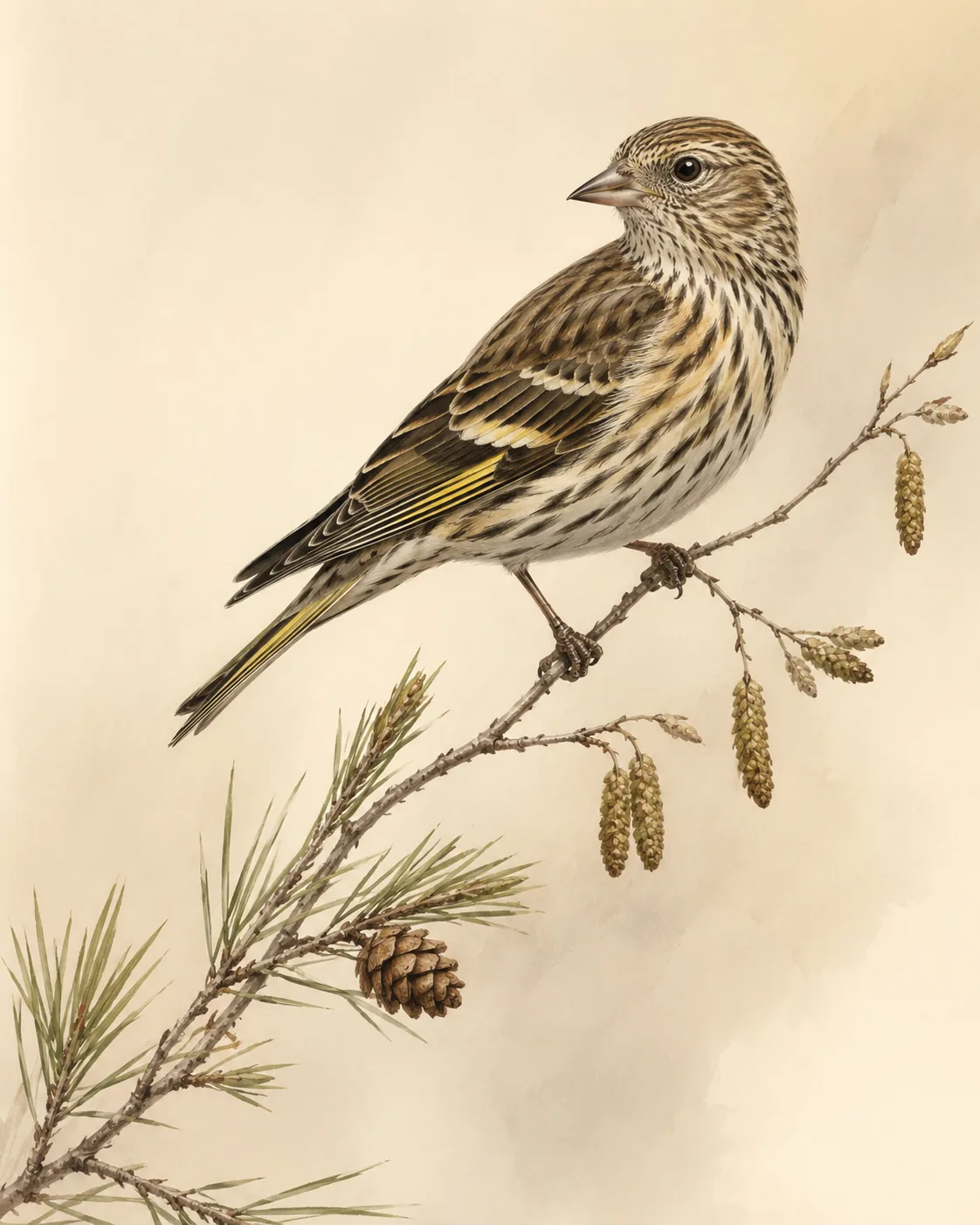
Look first for the streaks. The whole body is finely streaked in brown over cream, top to bottom, a busy pattern that sets it apart from the cleaner finches around it.
Then the bill. Thin, sharp, and pointed, more like a warbler’s than a finch’s. That fine bill is the surest tell.
The yellow is the prize. A wash of it edges the wing and the base of the tail. Often it hides when the bird is at rest. In flight, or when a wing lifts, it flashes.
This is a small bird. Slim, about the size of a goldfinch, and often mixed in among them.
Range and habitat
A bird of North America, from the spruce and pine forests of Canada south through the western mountains, and down into Mexico’s highlands.
In summer it keeps to conifers. In winter it wanders.
The Pine Siskin is famous for its movements. Some years it stays north. Other years, when the cone crop fails, vast numbers push south in what birders call an irruption. A winter with no siskins can be followed by a winter full of them.
That unpredictability is part of its charm. You do not summon a siskin. It arrives.
Behaviour
Sociable, and rarely alone.
Siskins feed in tight, chattering flocks, working over seed heads, alders, and thistle with quick, acrobatic movements. They hang upside down. They cling to the smallest stems.
At feeders they favour nyjer and small seeds, and they are bold for their size, holding their ground against larger birds.
They are hardy. A siskin can pack on body fat and ramp up its metabolism to survive nights far below freezing, which lets the flock winter further north than most small finches dare.
Voice
The call gives it away before the eye does.
Listen for a rising, buzzy zreeee, a wheezy note that climbs and stretches at the end. No other finch makes quite that sound.
Mixed in are twitters and trills, a constant light chatter as the flock feeds and moves. A tree full of siskins is a tree that murmurs.
Once you learn that rising buzz, you will hear them passing overhead long before you see the yellow.