Field Guide
Piping Plover
There is a nest on the sand in front of you. Four eggs, each the pale tan of the beach itself, each freckled with small dark spots that could be grains of shell or crab fragment. The nest is a scrape no deeper than a thumb-press, ringed with a few white pebble chips the adult placed there itself. You would not see it if someone had not driven a wooden stake into the sand nearby and strung orange twine from post to post. The fence is the only reason you stopped.
Charadrius melodus - the Piping Plover - has evolved a nest so perfectly camouflaged that the main threat to its eggs in the twenty-first century is not a fox or a crow but a barefoot family that never saw what they were about to walk on.
What it looks like
A small, round-bodied shorebird, roughly 15 to 19 centimetres long and weighing between 42 and 64 grams. It fits in a cupped palm. The wingspan runs 35 to 41 centimetres.
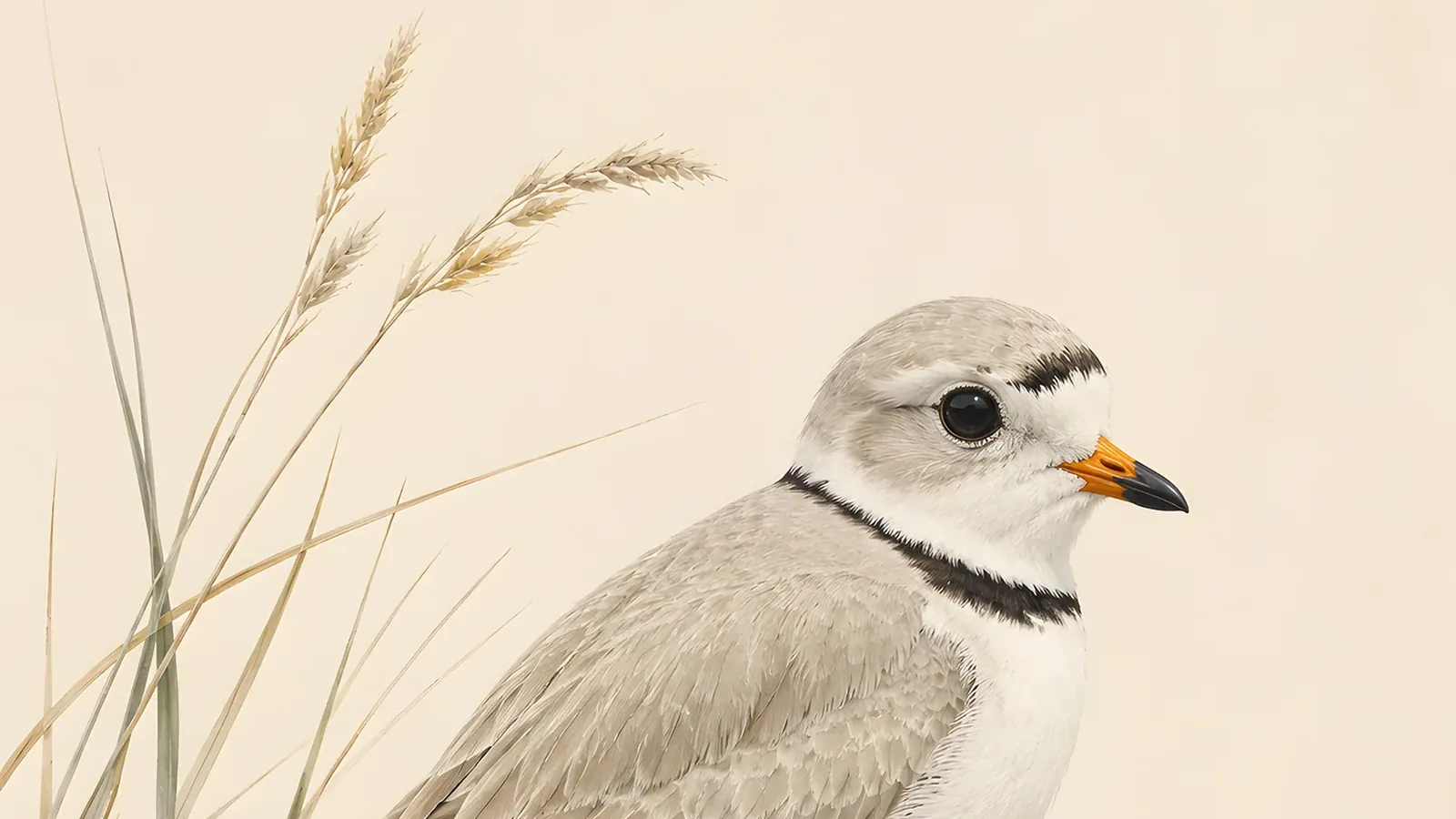
The plumage in breeding season is built for the open beach. The back and crown are the pale grayish brown of dry sand above the tide line - not the dark wet sand where herons hunt, but the soft upper beach where the sand holds heat and nothing grows. The underparts are white. The bill is short and stubby, orange with a black tip. The legs are the same orange, vivid against the pale body.
The field marks that settle identification are two black bands. One crosses the forehead between the eyes, a narrow stripe like a headband. The other encircles the upper breast, a partial or complete dark collar. In males the collar is bolder. In females it fades toward tan and may be incomplete. Both bands vanish after breeding season, leaving a bird that looks almost featureless on a winter beach - pale back, white front, gone.
The orange-and-black bill turns mostly black in non-breeding plumage. The orange legs pale toward yellow. By August, this bird is a ghost.
The invisible nest
The nest scrape holds four eggs. Four is the standard, laid one every other day over roughly eight days. Both parents share the 27-day incubation.
The eggs are roughly 32 millimetres long. They are pale buff with fine dark speckling distributed evenly across the shell. Laid on dry sand above the tide line, surrounded by shell fragments and pebble chips the adult has arranged around the scrape rim, they are functionally invisible. Shorebird egg camouflage of this type relies on both colour matching and disruptive patterning - the speckles break up the egg’s outline so that at any distance beyond a few metres the object simply does not register as an object (Troscianko et al., 2016, Ecology and Evolution).
The chicks match the eggs. They emerge covered in pale buff down with dark streaking, and they walk within hours of hatching. A piping plover chick standing still on dry sand is a problem in visual detection that most predators - and nearly all beachgoers - fail to solve. This is the design. Standing still is the first response, not running. The bird becomes the beach.
When something large approaches and the adult is close, the strategy shifts. The parent performs what ornithologists call an injury-feigning display - the broken-wing act. It drops one wing and drags it along the sand, listing to one side, calling in distress, moving steadily away from the eggs or chicks. The display is convincing enough that it works on dogs, foxes, humans, and researchers who have watched it dozens of times and still feel the pull to follow. Once the plover has led the threat far enough down the beach, it simply flies away (Ristau, 1991, Cognitive Ethology).
The system - cryptic eggs, cryptic chicks, distraction display - is hundreds of thousands of years old. What it was not designed for is summer on the barrier beaches of New Jersey.
What it sounds like
The name comes from the voice. A clear, plaintive, whistled “peep-lo” or “peep-peep-lo,” carrying across open sand. The “peep-lo” call - designated A12 in the scientific literature on plover vocalizations - functions as a contact call between mates and as a soft alarm. The second syllable drops in pitch, giving it a falling, questioning quality.
When something threatens the nest, the alarm sharpens to a rapid “pip-pip-pip.” The courtship display includes constant aerial peeping as the male flies over the female and swoops to the ground. Away from the breeding beach you are most likely to hear the soft single “peep” - audible only because the bird is small and the beach is quiet.
| Measurement | Range |
|---|---|
| Length | 15-19 cm |
| Weight | 42-64 g |
| Wingspan | 35-41 cm |
| Typical lifespan | 5-7 years |
| Maximum recorded lifespan | 16 years (“Gabby,” Great Lakes) |
Range and the three populations
The species breeds across three distinct populations with separate legal standing and separate conservation challenges.
The Atlantic Coast population (C. m. melodus) nests on barrier beaches and sandy spits from southern Newfoundland south to the Carolinas. In winter it moves to Gulf Coast beaches, the southern Atlantic states, and the Caribbean. It is listed as Threatened under the U.S. Endangered Species Act (listed December 11, 1985). By 2001 this population numbered roughly 2,920 adults, a 78 percent increase from 1991 - evidence that beach management can work when it is sustained (USFWS Atlantic Coast Recovery Plan).
The Northern Great Plains population (C. m. circumcinctus) nests on the alkali flats and sandy river bars of the interior - the Missouri River, the Prairie Potholes, the Canadian prairies south into the Dakotas and Montana. This is a bird of a different landscape entirely. It is also listed as Threatened, with roughly 2,953 adults counted in 2001. Climate-driven water-level changes in Prairie Pothole habitat represent a growing threat to this population’s nesting substrate.
The Great Lakes population is the smallest and most precarious. It is listed as Endangered under the Endangered Species Act. In 1990 the entire population had fallen to 13 breeding pairs on the Great Lakes shores. By 2024 that number had recovered to 81 pairs - the third consecutive record breeding season - with 124 wild fledglings (Great Lakes Audubon, 2024). The recovery goal is 150 nesting pairs sustained for five consecutive years, a threshold that has not yet been met.
Globally, the IUCN Red List categorises the Piping Plover as Near Threatened (NT). The total population was estimated at 7,600 to 8,400 individuals in 2020. The species qualifies as Near Threatened because its recovery is entirely dependent on active management - the IUCN notes that “positive trends would reverse if conservation action were to stop.”
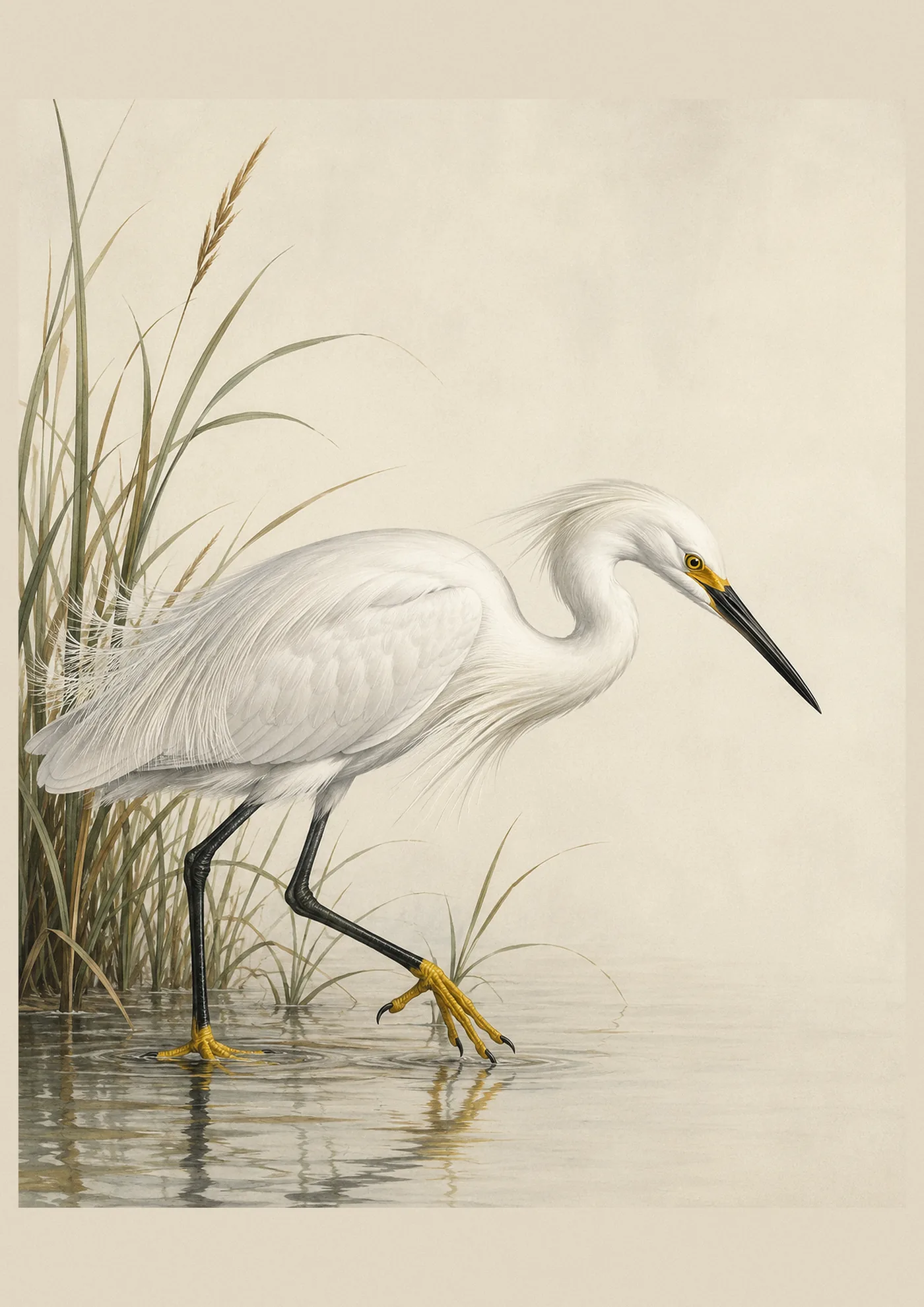
Winter range includes beaches along the Gulf of Mexico from Texas to Florida, the southern Atlantic coast, and coastal areas of the Caribbean. A snowy egret might share those winter flats, but it is a large, white, conspicuous bird - the opposite of everything the plover is.
Diet
The piping plover feeds by sight, moving in short runs across the upper beach and intertidal zone, pausing, tilting its head, then striking. The diet is beach-dwelling invertebrates: marine worms, small crustaceans, insects, fly larvae, beetles, mollusks. The short bill reaches into the top layer of substrate but not deep - this is a surface and near-surface forager.
Foraging happens at the wrack line, around the water’s edge, and on exposed intertidal flats. Chicks begin feeding independently within hours of hatching but cannot fly for roughly 30 days. This is the most dangerous period: mobile enough to wander, cryptic enough to be invisible to adults and humans alike, unable to escape anything that notices them.
Breeding and the beach
Males arrive on the breeding beach in late March and early April to claim territories, which they advertise with aerial displays - a looping, butterfly-like courtship flight with constant calling - and by digging multiple scrape sites for the female to evaluate. She selects one. The pair decorates it together with small white shell fragments placed around the rim.
The eggs are incubated for 27 to 28 days by both parents. If a nest is lost to predation or flooding, the pair will re-nest, sometimes two or three times in a season, though the clutch size typically drops. The chicks fledge at roughly 30 days old.
The breeding beach is where the conflict concentrates. The same open, high, dry sand the plover requires above the tide line is the same sand that beach-goers spread towels on from Memorial Day to Labor Day. This is not a coincidence of calendars. It is a structural collision. The plover arrives, stakes territory, lays eggs, and hatches chicks during the precise window when human beach use peaks.
The management response - orange twine, wooden stakes, signs, rangers on foot - is sometimes called “symbolic fencing,” though it is more than symbolic when it works. Nest exclosures (small wire cages placed over the nest to block mammalian predators) raised hatching rates from 25 percent at unprotected nests to 92 percent at protected nests in studies conducted in the late 1980s (reviewed in USFWS recovery planning documentation). Seasonal closures of nesting sections of public beaches have produced measurable increases in fledgling production on the Atlantic coast.
The argument for all of this is not sentimental. The piping plover is a species that would survive perfectly well on any summer beach in Massachusetts, New Jersey, or the Great Lakes if humans were absent for eight weeks in the right season. That is all it needs. The barrier beaches exist. The nesting habitat exists. The birds exist. What requires negotiation is the eight weeks.
Every fence post is a bet that the eight weeks are worth it. The slow, documented climb of all three populations since the 1985 listing suggests the bet pays out. “Gabby,” a female Great Lakes plover banded in the 1990s, was still breeding at 16 years old, having fledged 35 chicks in her lifetime. She is evidence that the system, when it functions, produces more than a number on a recovery chart. It produces a bird that has been on the same beach for 16 years and will, if this summer goes well, be there again next spring.
That is the argument. Not in principle. In practice, in orange twine and counted fledglings and an old bird coming back.