Field Guide
Pinyon Jay
A flock arrives like a moving piece of sky. Three hundred birds, maybe more, sweeping out of the pinyon pines in a loose mass and settling in the next ridge’s trees with a sound like a crowd at a distance. Each bird carries a seed in its throat pouch. Together, they are planting a forest.
The Pinyon Jay is the reason pinyon pines grow where they grow. That is not a loose claim. It is the conclusion decades of ecology have pushed us toward.
What it looks like
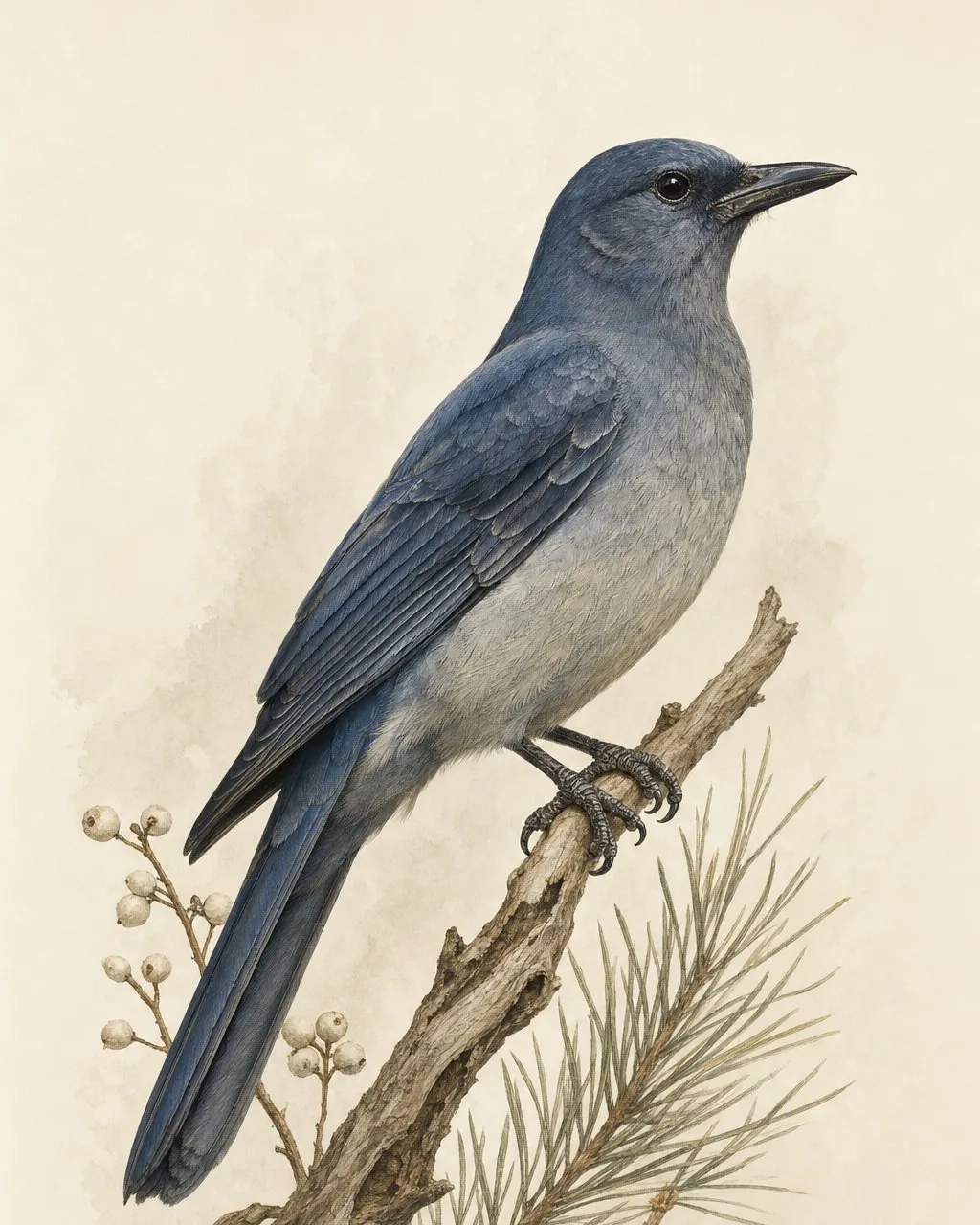
All blue - but not the brilliant, iridescent blue of a Steller’s Jay or the bold pattern of a Blue Jay. The Pinyon Jay is a quieter blue, the colour of worn denim or a winter sky at mid-morning. The blue runs from cap to tail without interruption. Throat streaking in adults is faint, the bill is long and pointed, straight rather than hooked. No crest. From a distance it reads as uniformly blue-grey, almost flat.
The bill is worth a second look. Long, thin, and sharp for a corvid - adapted not for cracking but for probing: pushing into the green cones of pinyon pines and extracting the seeds before the cones open and drop them.
The eyes are dark. The legs are black. Sexes look alike. Juveniles are grayer with a shorter bill.
| Measurement | Range |
|---|---|
| Length | 27-29 cm |
| Weight | 100-120 g |
| Wingspan | 44-46 cm |
| Lifespan | 10-16 years |
Voice
A nasal, rising call that carries well across open country. Kaay, sometimes doubled. The flock maintains contact with a rolling chorus of these notes, an almost continuous low conversation that you hear before you see the birds. Alarm calls are harsher. There is no song in the songbird sense - the voice is purely social, functional, always in communication with others.
“The clamour of a pinyon flock in full flight is one of those sounds that is somehow both cacophonous and musical - the noise of a community with a purpose.” - field notes, New Mexico, October
Range and habitat
The Pinyon Jay’s range maps almost exactly onto the pinyon-juniper woodland belt of the interior West - the mid-elevation zone from Oregon and Idaho south through Nevada, Utah, Colorado, Arizona and New Mexico, with scattered populations into Baja California. Wyoming has breeding populations in the foothills. Montana holds the northern fringe.
Within that zone, the bird does not spread evenly. It concentrates where pinyon pine cone crops are heavy, shifting its range year to year in response to seed availability. A flock absent from a valley for three years may return when the pines produce.
This nomadism is the bird’s survival strategy. It follows the food rather than defending a fixed territory.
Diet
Pinyon seeds are the center of the Pinyon Jay’s year, but the bird eats broadly. Insects, other seeds, berries, carrion, and small invertebrates all appear in the diet. Breeding birds feed chicks on protein - insects gathered from the understory.
But pinyon seeds drive everything. A single bird can carry up to 56 seeds at once in its expandable throat pouch. A flock of three hundred birds can move roughly 17,000 seeds in a single foraging bout. Many of those seeds are cached in the ground at depths that favour germination. Many are never recovered.
The seeds the birds forget - or die before retrieving - become the next generation of pinyon pines.
Breeding
Pinyon Jays breed in winter and early spring, timing their nesting to the availability of cached seeds rather than to the warmth of the season. This is unusual among birds, and it requires the caches to be substantial enough to fuel the energetic costs of breeding before insects emerge.
Colonies nest communally, with several pairs to dozens occupying the same loose grove. The pair bond is strong and often multi-year. The female builds the nest, a deep cup of twigs and grass placed in a pinyon or juniper, but the male attends closely and brings food while she incubates. Two to five eggs, pale blue-green with brown spots.
Young birds remain with the colony after fledging and are tolerated by breeding adults - an unusual arrangement in corvids that seems tied to the complex social bonds that hold the flock together.
The mutualism that makes a forest
The relationship between the Pinyon Jay and the pinyon pine is a textbook case of mutual dependence, and it deserves to be read carefully.
Pinyon pine seeds are large, nutritious, and - unlike the winged seeds of many conifers - completely incapable of wind dispersal. They fall straight down. Without an animal to move them, pinyon pines cannot colonise new ground, cannot retreat upslope as temperatures warm, cannot recover from fire or drought by seeding into adjacent areas.
The Pinyon Jay is almost certainly the primary dispersal vector for most of the pinyon pine range. The bird caches seeds at depths and in substrates that favour germination. It has the memory to relocate cached food, but retrieves less than it stores. The surplus germinates.
But the tree has also shaped the bird. The pinyon’s cone crop is mast-like - enormous in good years, near zero in poor ones. To exploit this unpredictable, patchily distributed resource, the jay evolved extreme sociality: large flocks that can sweep wide areas efficiently, communal information about where cones are heavy, and a nomadism that frees the bird from commitment to any single patch.
The jay made the forest. The forest made the jay.
Now both are in trouble. Pinyon-juniper woodland is dying across the West. Beetle outbreaks amplified by warming drought are killing pines at landscape scale. The 2011-2012 drought killed tens of millions of pinyon pines in the Southwest alone. When the trees die, the seed crop collapses. When the crop collapses, the flocks cannot sustain themselves. Breeding fails. Young birds do not replace adults lost to age and predation.
Breeding Bird Survey data show the Pinyon Jay has lost roughly 85% of its population since 1970. That number - slow in coming, alarming in its scale - is why the species carries Vulnerable on the IUCN Red List.
Conservation efforts focused on pinyon-juniper habitat are complicated by the fact that some land managers have historically viewed this woodland as invasive scrub encroaching on grasslands, and have removed it by mechanical treatment or prescribed fire. Those efforts may now be running counter to both the jay and the pines it depends on.
Closing
There is something worth sitting with in the Pinyon Jay’s story. A bird that builds the ecosystem it depends on. A forest that exists because a corvid forgot where it put the seeds. When we lose the jay, we lose the mechanism that moves the pines. We lose the pines. Something downstream of that shifts too - the Clark’s Nutcracker loses a food source, the black bear loses mast, the small mammal community restructures.
The flock sweeping over the ridge carries more than seeds. It carries the capacity of the landscape to persist.