Symbolism
What the snowy owl means
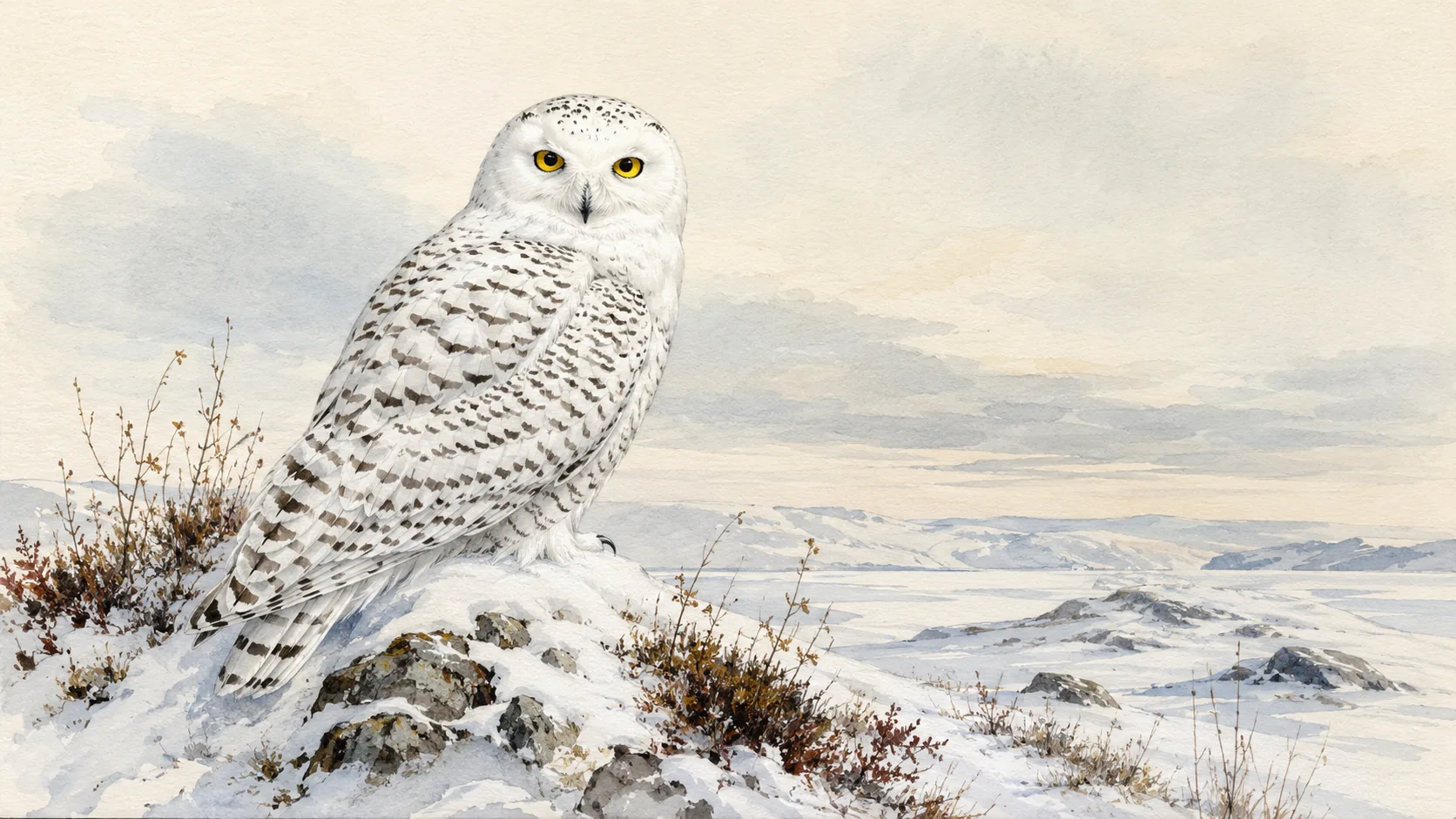
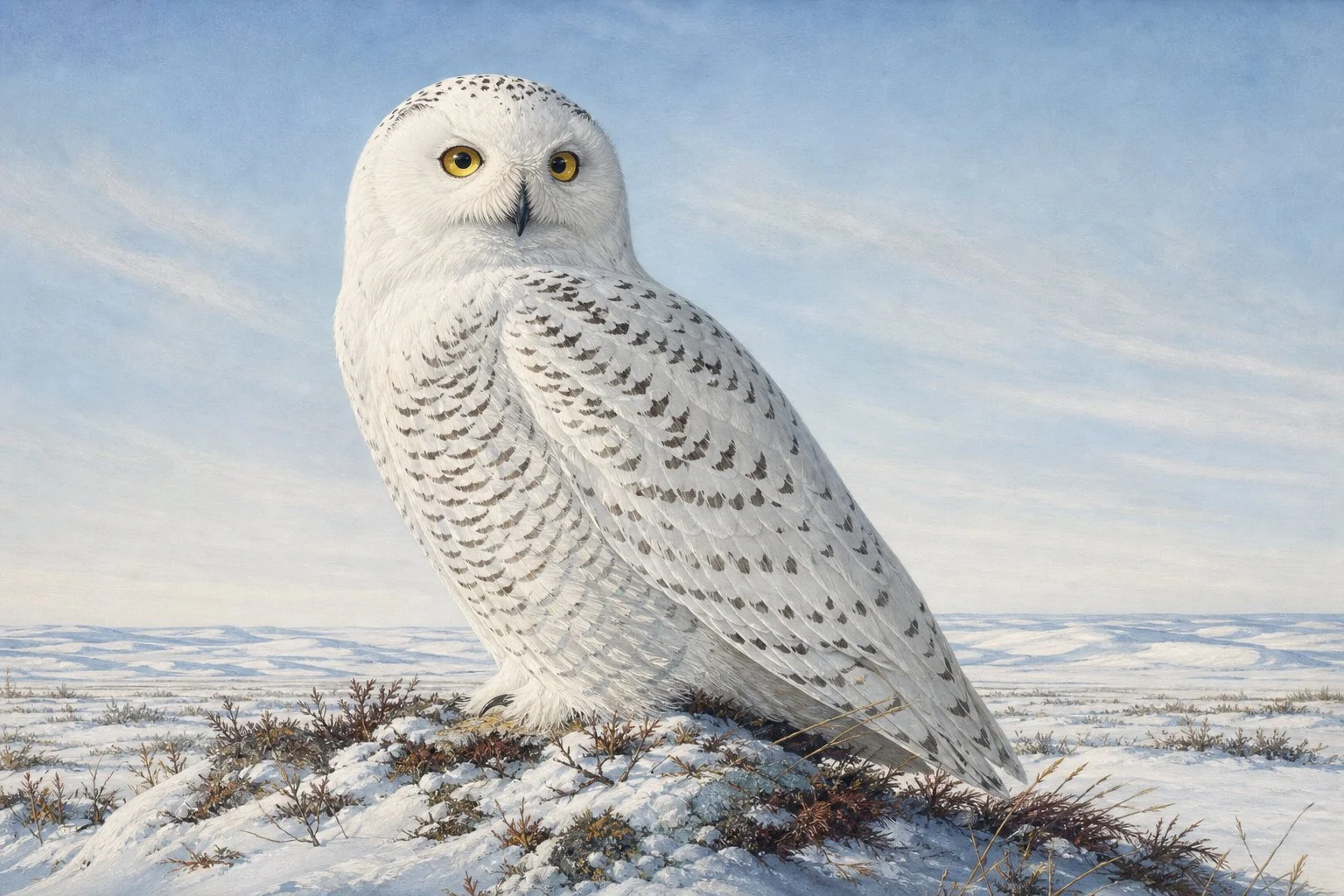
The snowy owl hunts by day.
This is the fact that makes almost everything written about snowy owl symbolism slightly wrong. Virtually all owl mythology across every culture derives from the same source: nocturnal behavior. The owl as creature of darkness, mystery, hidden knowledge, the dead. That symbolic architecture rests on a bird that hunts when humans cannot see, that calls from the dark, that appears suddenly and silently when the light fails.
The snowy owl does not do this. At its Arctic breeding grounds, night does not exist for months. The snowy owl evolved as a daylight hunter across open tundra, visible from enormous distances, completely exposed. It is, behaviorally, the owl least suited to being an owl symbol.
Which makes it the most interesting one.
What the Inuit actually documented
The only traditions that developed in sustained, direct contact with living snowy owls are the Inuit traditions of the Canadian Arctic. The Inuktitut name is ukpik. The snowy owl and the raven are the only two birds that overwinter in the High Arctic, a fact that gives both animals outsized spiritual weight in communities where every remaining creature in a winter landscape matters.
In Inuit shamanism, the owl guides the dead. Angakkuit - shamans - sought the snowy owl’s guidance during spirit journeys. The owl collects the spirits of the deceased before sunrise and shepherds them onward. This is documented, not speculative. It also makes ecological sense: in an environment with almost no wildlife from October to March, an owl you can actually watch moving across tundra becomes a psychopomp by logic of scarcity.
The snowy owl also signals spring. As breeding birds return to tundra from their southern winter dispersal, Inuit communities read the owl’s return as seasonal transition. Messenger in both directions - leading the dead out, leading the living into a new season.
The foundational Inuit narrative involving snowy owls is the Owl and Raven story, which explains how the raven got its black feathers. Owl and Raven are making each other new clothes. Raven makes Owl a beautiful patterned dress. Owl makes Raven a white dress. Raven demands change after change, wearing Owl’s patience down, until Owl pours lamp oil over Raven in frustration - permanently blackening its feathers. The National Film Board of Canada adapted this into a 1973 animated film by Co Hoedeman, using seal-fur puppets designed by Inuk artist Germaine Arnaktauyok. You can watch it at nfb.ca today. That is the level of documentation available: a verifiable film with a named Inuit artist, not a vague reference to oral tradition.
Kenojuak Ashevak (1927-2013), the most celebrated Inuit visual artist, made the snowy owl one of her signature subjects. Her 1960 print “The Enchanted Owl” became iconic enough to appear on a Canada Post stamp in 1970 commemorating the centennial of the Northwest Territories. The snowy owl enters mainstream Canadian visual culture not through government decree but through one artist’s sustained attention to a bird she knew.
The Ookpik: when a survival object became a nation’s mascot
In the early 1960s, Jeannie Snowball - then 64 years old, working at the Fort Chimo cooperative in what is now Kuujjuaq, northern Quebec - made a small sealskin owl doll. Her granddaughter’s account of the origin: Snowball had been caught in a blizzard, near starvation, when a snowy owl landed close enough to capture. She killed and ate it. The doll was a tribute to the owl that saved her life.
In November 1963, the Canadian federal trade department found the Ookpik in an Inuit art catalogue and selected it as Canada’s mascot for the Philadelphia Trade Fair. Demand immediately outpaced supply. The federal Department of Northern Affairs trademarked the Ookpik under the Trade Marks Act of 1964. An Ookpik Advisory Committee oversaw licensing - books, comics, a cartoon strip running in 50 newspapers for two years, the Ookpik Waltz, balloons, mass-produced dolls. By 1968, market saturation had collapsed the brand.
The snowy owl moved in one decade from survival animal to commemorative craft to national mascot to commercial relic. At each stage, the distance from Jeannie Snowball increased. The Canadian government, not the Inuit creator, held the trademark and made the licensing decisions. Academic analysis of the Ookpik - including work presented at Simon Fraser University’s IPinCH symposium in 2013 - frames it as an early attempt at generating Inuit income that became a case study in who controls Indigenous symbolism once governments get interested.
Algonquian nations and the owl’s power
The Ojibwe and Anishinaabe nations have some of the most documented owl traditions in North America. Gookooko’oo - the Anishinaabe owl - appears on Midewiwin Grand Medicine Society scrolls, placing it within one of the most sacred ceremonial traditions of the Great Lakes region. Scholar Wendy Makoons Geniusz argues in Algonquian and Iroquoian Linguistics that Western observers consistently misread this: they say the Anishinaabe owl symbolizes death. Geniusz’s correction is that the owl’s connection to death and darkness reflects extraordinary power, not malevolence. The owl mediates between life and death, light and dark, natural and supernatural. That mediation requires power. The owl has it.
Some Cree sources describe the snowy owl’s seasonal arrival as a positive signal - winter becoming spring - which is consistent with the Inuit spring-messenger reading and consistent with the biology. A snowy owl arriving from the north is not arriving from death; it is returning from it.
There are claims on symbolism websites that Cree traditions describe snowy owls as transformed warriors fighting from the afterlife. These claims circulate without specific primary sources. They are plausible given the documented Algonquian framework around owl power and warrior spirits, but they do not have the documentary grounding that the Inuit or Ojibwe material has. Note the difference, and treat it accordingly.
What the Norse actually documented: almost nothing
The popular claim that Odin had a pet owl alongside his ravens is not in the Poetic Edda or the Prose Edda. It is not in any Eddic text. The goddess name “Katyogel,” which circulates on Norse mythology blogs as a snowy owl deity, does not appear in any primary source. Norse mythology’s dominant birds are the raven - Odin’s Huginn and Muninn - and the eagle at the top of Yggdrasil.
This is genuinely strange, because the snowy owl breeds across Scandinavia. The Norse knew this bird. One interpretation from available records: ancient Northmen did not think owls deserved the attention they paid to other animals like wolves and ravens. Archaeological owl images found on some Scandinavian boats and weapons are considered protective symbols, but their specific meaning is contested and the species depicted cannot be identified.
The most specific documented Scandinavian belief comes from the Sami people, indigenous to northern Scandinavia: owls are good luck. That is the entire documented tradition. No distinction between snowy owls and other species in available sources.
Romania documents a different specific belief: the souls of repentant sinners fly to heaven as snowy owls. The whiteness reads as spiritual cleansing; the owl-form as passage between worlds. A tradition from the Ural Mountains describes snowy owls as punished for deception, forced to remain while other birds migrate - the only tradition that reads the bird’s Arctic residency as a negative fate.
The irruption misreading
In the winter of 2013-2014, the largest snowy owl influx since the 1920s swept across North America. Pennsylvania typically sees around ten snowy owls per winter. In 2013-14, the state recorded 400. Owls appeared in Florida and Bermuda. The media covered it as a mysterious event - Arctic visitors, possible omens, displaced birds seeking help at the edge of their range.
Project SNOWstorm, formed that winter and now a running research program, established what had actually happened. The summer of 2013 had seen a lemming boom in northern Quebec. Boom summers produce large clutches - up to 11 eggs instead of the usual 3-5 - flooding the population with young birds that then disperse south in autumn. The irrupting owls were not starving. They were fat and healthy, the product of exceptional nesting success.
As Project SNOWstorm put it directly: “It’s not hunger that usually produces these mega-flights, but an absurd abundance of food during the summer breeding season.”
The symbolism the public attached to that irruption - mysterious messenger, omen, harbinger, creature in distress crossing into human space - was built on a biological misunderstanding. The owl was not crossing into human space in desperation. It was a healthy juvenile following food gradients southward and ending up somewhere it had never been before.
Hedwig: saint and ghost
J.K. Rowling chose a snowy owl for Harry Potter deliberately. She described it as “the most beautiful owl of the lot: the Snowy Owl, which also goes by the name of Ghost Owl.” She named the owl after Saint Hedwig of Andechs (1174-1243), the medieval Duchess of Silesia and patron saint of orphans - a name she had found in a book of medieval saints years earlier and never forgotten.
The snowy owl named after a medieval saint and also called Ghost Owl. Sanctity and haunting at once, in one name.
Hedwig’s role across the series - loyal companion, messenger, emotional anchor, and ultimately sacrificial death in Deathly Hallows - gave the snowy owl a new layer of symbolism with no precedent in any traditional culture: loyalty, sacrifice, coming of age, loss. Rowling acknowledged that Hedwig’s vocalizations in the books should be understood as magical enhancement, because snowy owls are essentially mute outside breeding season and do not form the kind of bonds with humans that Hedwig demonstrates. The fictional owl is, biologically, a different animal.
The real-world consequences were real in some markets. The North Wales Owl Sanctuary reported abandoned captive-bred owls increasing sharply after the films. In India, Environment Minister Jairam Ramesh explicitly cited Harry Potter as driving demand in illegal owl trade. A 2017 PLOS One study examined UK legal wildlife trade data and found no statistically significant increase in legal owl ownership correlating with HP’s peak years - the crisis narrative, in the UK at least, was not supported by the data. The situation in India and Indonesia is documented separately and differently.
The purity paradox
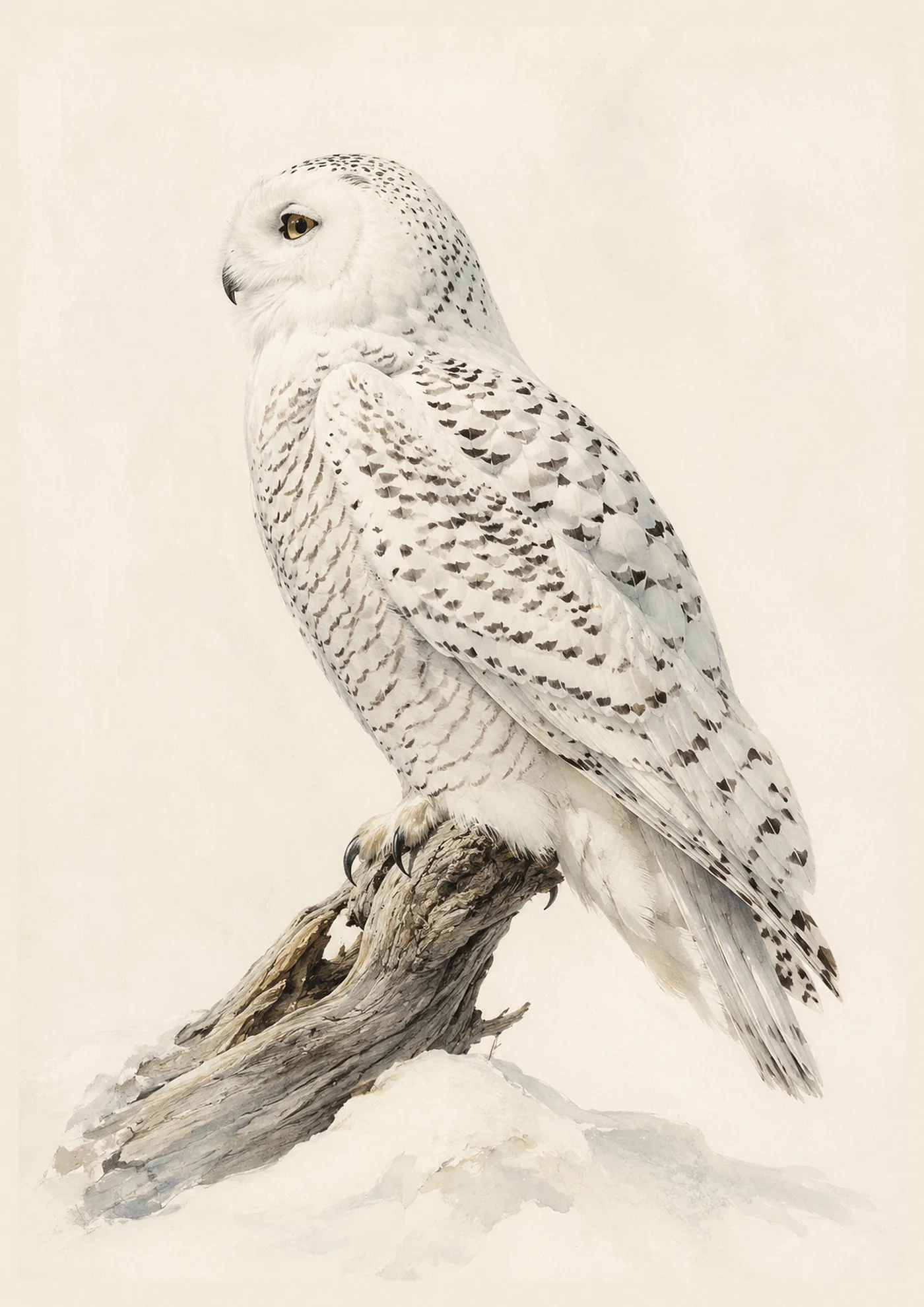
Male snowy owls are nearly pure white, especially with age. The white coloration almost certainly evolved for winter hunting camouflage - a white predator against snow. Female snowy owls retain extensive dark brown barring on wings, back, and tail. Most snowy owls, most of the time, are not the pure white birds of cultural imagination. The cultural archetype is built on one sex, one age class, one season.
The whiteness read as purity (Western tradition, the Romanian redemptive soul) evolved as a killing adaptation. The beautiful white bird is a precision predator that consumes more than 1,600 lemmings per year and has spent millions of years refining exactly how to do that in the most hostile environment on the continent. The whiteness is for hunting, not for peace. The Romanian belief captures something more honest than the purity reading: repentant sinners earn their white wings. Whiteness as outcome of something hard, not evidence of innocence.
Regional extinction, 2025
In December 2025, BirdLife Sweden declared the snowy owl regionally extinct. No confirmed breeding in Sweden since 2015. In the 1970s, hundreds of pairs nested in Swedish mountains during favorable years.
BirdLife Sweden’s statement: “The Snowy Owl’s disappearance from Sweden is more than a loss of a species. It’s a warning about how quickly Arctic ecosystems are changing.”
The mechanism is climate-driven lemming collapse. Warmer winters produce rain-on-snow events that seal the subnivean tunnels - the under-snow networks - that lemmings depend on for survival and reproduction. No tunnels, no lemmings. No lemmings, no owls. The IUCN uplisted the snowy owl to Vulnerable in December 2017. Denver Holt’s breeding counts at Utqiagvik, Alaska, recorded 54 nests in 1995 and 7 nests in 2018, three of which failed.
The symbolism of “lost wilderness” is no longer metaphorical when applied to the snowy owl in Sweden. In the country where the bird once bred every favorable year, it is now a memory. The newest layer of meaning attached to the snowy owl is not messenger, not omen, not Ghost Owl, not Hedwig. It is indicator species. Canary in the Arctic coalmine. The bird that tells you what you are losing before you are ready to know it.
That is the only symbolism here that does not require any interpretation at all.